Paper II — Q6
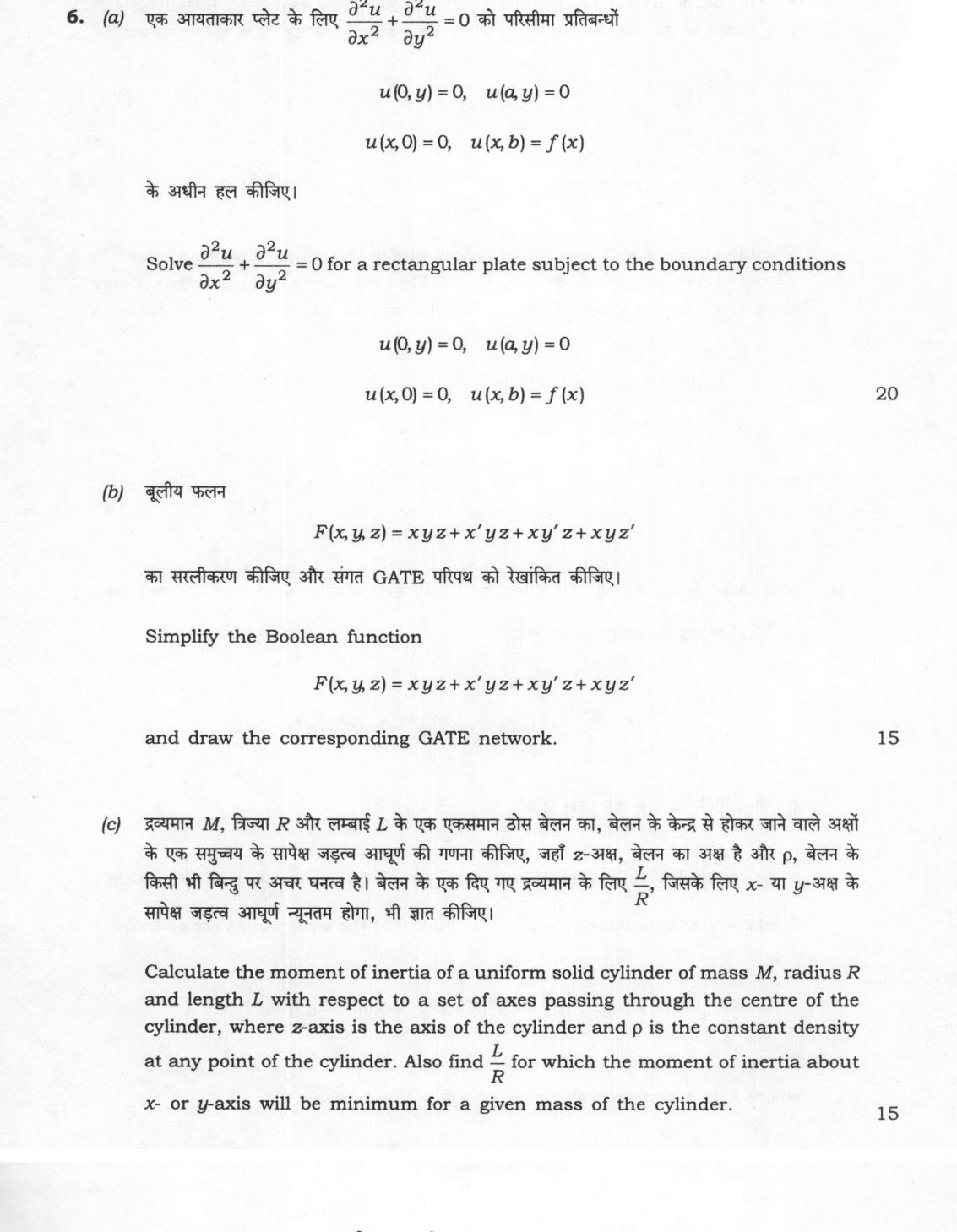
(a) Solve (∂² u)/(∂ x²) + (∂² u)/(∂ y²) = 0 for a rectangular plate subject to the boundary conditions u(0,y) = 0, u(a,y) =…
Solve (∂² u)/(∂ x²) + (∂² u)/(∂ y²) = 0 for a rectangular plate subject to the boundary conditions u(0,y) = 0, u(a,y) = 0 u(x,0) = 0, u(x,b) = f(x) 20 marks
Simplify the Boolean function F(x,y,z) = xyz + x'yz + xy'z + xyz' and draw the corresponding GATE network. 15 marks
Calculate the moment of inertia of a uniform solid cylinder of mass M, radius R and length L with respect to a set of axes passing through the centre of the cylinder, where z-axis is the axis of the cylinder and ρ is the constant density at any point of the cylinder. Also find L/R for which the moment of inertia about x- or y-axis will be minimum for a given mass of the cylinder. 15 marks
हिंदी में प्रश्न पढ़ें
एक आयताकार प्लेट के लिए (∂² u)/(∂ x²) + (∂² u)/(∂ y²) = 0 को परिसीमा प्रतिबंधों u(0,y) = 0, u(a,y) = 0 u(x,0) = 0, u(x,b) = f(x) के अधीन हल कीजिए। (20 अंक)
बूलिय फलन F(x,y,z) = xyz + x'yz + xy'z + xyz' का सरलीकरण कीजिए और संगत GATE परिपथ को रेखांकित कीजिए। (15 अंक)
द्रव्यमान M, त्रिज्या R और लंबाई L के एक एकसमान ठोस बेलन का, बेलन के केंद्र से होकर जाने वाले अक्षों के एक समुच्चय के सापेक्ष जड़त्व आघूर्ण की गणना कीजिए, जहाँ z-अक्ष, बेलन का अक्ष है और ρ, बेलन के किसी भी बिंदु पर अचर घनत्व है। बेलन के एक दिए गए द्रव्यमान के लिए L/R, जिसके लिए x- या y-अक्ष के सापेक्ष जड़त्व आघूर्ण न्यूनतम होगा, भी ज्ञात कीजिए। (15 अंक)
Model answer
Written by UPSC Answer Check against this question's marking rubric, to the expected length. UPSC does not publish answers for Mains — this is one way to score well, not an official key.
(a) Let u(x,y)=X(x)Y(y). Substituting into ∂²u/∂x² + ∂²u/∂y² = 0 gives
X″/X = -Y″/Y = -k².
Thus X″ + k²X = 0. The boundary conditions u(0,y)=0 and u(a,y)=0 give X(0)=X(a)=0. Therefore the non-trivial solutions are
Xₙ(x)=sin(nπx/a), k=nπ/a, n=1,2,3,...
For Y, Y″ - (nπ/a)²Y = 0. Since u(x,0)=0, we have Y(0)=0, so
Yₙ(y)=sinh(nπy/a).
Hence
u(x,y)=Σ_n=1^∞ Aₙ sin(nπx/a) sinh(nπy/a).
Using u(x,b)=f(x),
f(x)=Σ_n=1^∞ Aₙ sin(nπx/a) sinh(nπb/a).
This is a Fourier sine series. Therefore
Aₙ sinh(nπb/a) = (2/a)∫_0^a f(x) sin(nπx/a) dx,
so
Aₙ = [2/(a sinh(nπb/a))]∫_0^a f(x) sin(nπx/a) dx.
Final answer:
u(x,y)=Σ_n=1^∞ Aₙ sin(nπx/a) sinh(nπy/a),
where
Aₙ = [2/(a sinh(nπb/a))]∫_0^a f(x) sin(nπx/a) dx.
This holds for a piecewise smooth f(x) satisfying f(0)=f(a)=0, the necessary compatibility from the side boundaries.
(b) Use Boolean algebra. The given function is
F = xyz + x'yz + xy'z + xyz'.
Now
xy + yz + zx = xy(z+z') + yz(x+x') + zx(y+y') = xyz + xyz' + xyz + x'yz + xyz + xy'z = xyz + xyz' + x'yz + xy'z = F.
Thus
Final answer:
F = xy + yz + zx.
This is the majority function of x, y, z.
Gate network: use three 2-input AND gates to obtain xy, yz and zx. Feed these three outputs into a 3-input OR gate. The output of the OR gate is F.
Text diagram:
x ──┐ y ──┴── AND1 ── xy ──┐ y ──┐ │ z ──┴── AND2 ── yz ── OR ── F z ──┐ │ x ──┴── AND3 ── zx ──┘
(c) Let the cylinder have uniform density ρ. Its volume is
V = πR²L,
so
M = ρπR²L.
Take the z-axis along the cylinder axis and the x- and y-axes perpendicular to it through the centre. Use cylindrical coordinates (r,θ,z), with dV = r dr dθ dz.
For the z-axis, the perpendicular distance from the axis is r. Therefore
I_z = ∫ ρ r² dV = ρ ∫_-L/2^L/2 dz ∫_0^2π dθ ∫_0^R r² · r dr = ρ L · 2π · R⁴/4 = (1/2)ρπR⁴L = (1/2)MR².
For the x-axis, the squared distance from the x-axis is y²+z² = r² sin²θ + z². Hence
I_x = ρ∫(r² sin²θ + z²) dV.
The cross-sectional part is
ρ∫ r² sin²θ dV = ρL∫_0^2π sin²θ dθ ∫_0^R r³ dr = ρL · π · R⁴/4 = MR²/4.
The longitudinal part is
ρ∫ z² dV = ρ · 2π ∫_0^R r dr ∫_-L/2^L/2 z² dz = ρ · 2π · R²/2 · L³/12 = ML²/12.
Therefore
I_x = MR²/4 + ML²/12.
By symmetry, I_y = I_x.
Final answers:
I_z = (1/2)MR²,
I_x = I_y = MR²/4 + ML²/12.
All moments are in kg m² if M is in kg and R, L are in m.
For fixed mass M and fixed density ρ, the volume πR²L is constant, so R²L is constant. Let C = R²L. Then
I_x = M C/(4L) + M L²/12.
Differentiate with respect to L:
dI_x/dL = -M C/(4L²) + M L/6.
For minimum, dI_x/dL = 0, so
L/6 = C/(4L²)
⇒ 4L³ = 6C
⇒ L³ = (3/2)C.
The second derivative is
d²I_x/dL² = M C/(2L³) + M/6 > 0,
so this stationary point gives a minimum. But C = R²L, hence
L³ = (3/2)R²L
⇒ L² = (3/2)R²
⇒ L/R = √(3/2).
Final answer:
L/R = √(3/2).
At this ratio, the moment of inertia about the x- or y-axis is minimum for a given mass.
What "Solve" is asking you to do
Choose the method, then carry it through to a final answer. Identifying what kind of problem this is and why that method applies is the first thing marked; a correct figure arrived at invisibly earns almost nothing.
Structure that answers it
Given data and what is required → method chosen, with the reason it applies → set-up (equation, circuit, free body, trial balance) → working, step by step → answer with units and any condition of validity
Where marks are lost
Doing the middle steps mentally and writing only the result. In mathematics papers, a further loss comes from giving a decimal where the exact value in surds or fractions was wanted, or from skipping the justification a part explicitly asks for.
How this answer will be evaluated
Approach
(a) derive: given > assumptions > stepwise derivation > result > check | (b) derive: given > assumptions > stepwise derivation > result > check | (c) calculate: given > formula > substitution > result with units > interpretation Full marks: Complete derivations with all steps, correct results, and clear diagrams.
Key points expected
- State separation of variables method
- Solve X''/X = -Y''/Y = -λ²
- Apply u(0,y)=0 and u(a,y)=0 to find λ
- Expand f(x) in Fourier sine series
- Apply Boolean algebra laws to simplify F
- Identify redundant terms
- Draw gate network for simplified F
- Label inputs and output clearly
Evaluation rubric
Each sub-part is marked on its own, against the marks and word limit printed on the paper.
- (a) General solution of Laplace's equation for a rectangular plate with given BCs. 20 marks
derive— given → assumptions → stepwise derivation → result → check
Must cover
- State separation of variables method
- Solve X''/X = -Y''/Y = -λ²
- Apply u(0,y)=0 and u(a,y)=0 to find λ
- Expand f(x) in Fourier sine series
Loses marks
- Missing eigenvalue determination
- Incorrect Fourier coefficients
Earns more
- Explicit form of eigenfunctions
- General series solution for u(x,y)
- Verification of boundary conditions
Extra mark
- Sketch of first mode shape
- (b) Simplified Boolean expression and corresponding gate network diagram. 15 marks
derive— given → assumptions → stepwise derivation → result → check
Must cover
- Apply Boolean algebra laws to simplify F
- Identify redundant terms
- Draw gate network for simplified F
- Label inputs and output clearly
Loses marks
- Incorrect gate symbols
- Missing input/output labels
Earns more
- K-map verification of simplification
- Alternative simplification path noted
Extra mark
- Truth table for verification
- (c) Moments of inertia I_z, I_x, I_y and optimal L/R for minimum I_x. 15 marks
calculate— given → formula → substitution → result with units → interpretation
Must cover
- Set up volume integral for I_z
- Calculate I_z = (1/2)MR²
- Calculate I_x = I_y = (1/12)M(3R²+L²)
- Minimize I_x to find L/R
Loses marks
- Missing integration limits
- Incorrect minimization derivative
Earns more
- Use of perpendicular axis theorem
- Explicit integration steps shown
- Differentiation for minimization
Extra mark
- Physical interpretation of result
Practice this exact question
Write your answer and it is marked point by point against the model answer above — what you covered, what you missed, what you got wrong.
Evaluate my answer →More from Mathematics 2025 Paper II
- Q3 (a) Evaluate the integral ∮_C e^z/(z²(z+1)³) dz, C : |z| = 2. (15 marks) (b) Show that th…
- Q4 (a) Examine whether the mapping φ: Z[x] → Z defined by φ(f(x)) = f(0), for f(x) ∈ Z[x], i…
- Q5 (a) Find the solution of the equation (D² + DD' - 2D'²)z = ysin x, where D ≡ (∂)/(∂ x) an…
- Q6 (a) Solve (∂² u)/(∂ x²) + (∂² u)/(∂ y²) = 0 for a rectangular plate subject to the bounda…
- Q7 (a) Find the complete integral of z(p²-q²) = x-y; p≡∂z/∂x, q≡∂z/∂y. (15 marks) (b) Find t…
- Q8 (a) Find the characteristics of the partial differential equation p² + q² = 2; p ≡ ∂z/∂x,…