Paper II — Q8
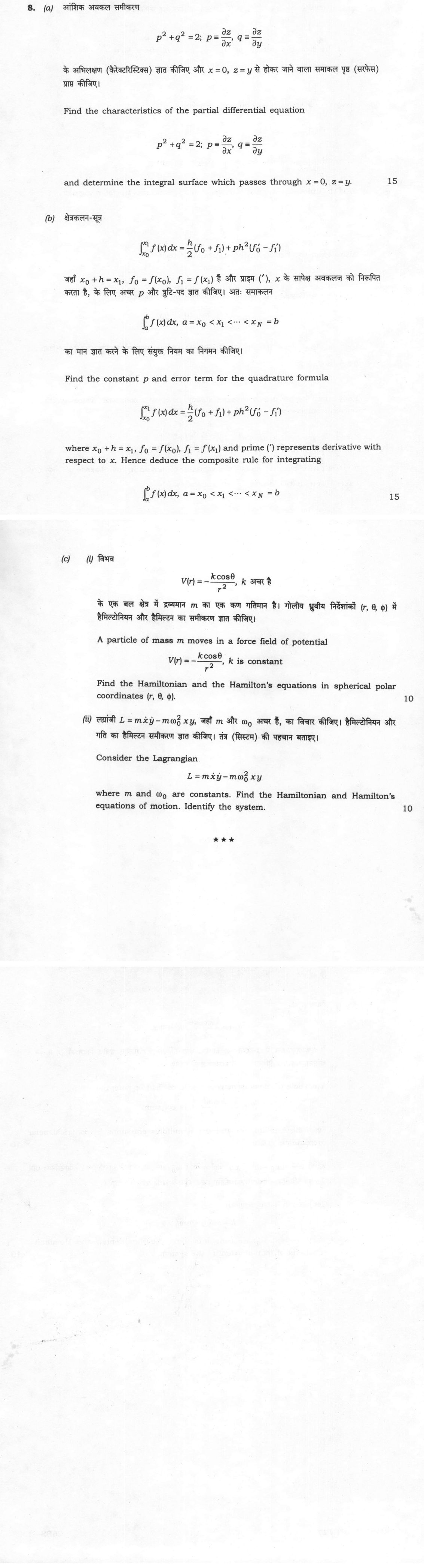
(a) Find the characteristics of the partial differential equation p² + q² = 2; p ≡ ∂z/∂x, q ≡ ∂z/∂y and determine the integral…
Find the characteristics of the partial differential equation p² + q² = 2; p ≡ ∂z/∂x, q ≡ ∂z/∂y and determine the integral surface which passes through x = 0, z = y. 15 marks
Find the constant p and error term for the quadrature formula ∫ₓ₀^x₁ f(x)dx = (h/2)(f₀ + f₁) + ph²(f'₀ - f'₁) where x₀ + h = x₁, f₀ = f(x₀), f₁ = f(x₁) and prime (') represents derivative with respect to x. Hence deduce the composite rule for integrating ∫ₐ^b f(x)dx, a = x₀ < x₁ < ... < x_N = b 15 marks
A particle of mass m moves in a force field of potential V(r) = -k cosθ/r², k is constant Find the Hamiltonian and the Hamilton's equations in spherical polar coordinates (r, θ, φ). 10 marks
Consider the Lagrangian L = mẋẏ - mω₀²xy where m and ω₀ are constants. Find the Hamiltonian and Hamilton's equations of motion. Identify the system. 10 marks
हिंदी में प्रश्न पढ़ें
आंशिक अवकल समीकरण p² + q² = 2; p ≡ ∂z/∂x, q ≡ ∂z/∂y के अभिलक्षण (कैरेक्टरिस्टिक्स) ज्ञात कीजिए और x = 0, z = y से होकर जाने वाला समाकल पृष्ठ (सरफेस) प्राप्त कीजिए। (15 अंक)
क्षेत्रकलन-सूत्र ∫ₓ₀^x₁ f(x)dx = (h/2)(f₀ + f₁) + ph²(f'₀ - f'₁) जहाँ x₀ + h = x₁, f₀ = f(x₀), f₁ = f(x₁) है और प्राइम ('), x के सापेक्ष अवकलज को निर्दिष्ट करता है, के लिए अचर p और त्रुटि-पद ज्ञात कीजिए। अतः समाकलन ∫ₐ^b f(x)dx, a = x₀ < x₁ < ... < x_N = b का मान ज्ञात करने के लिए संयुक्त नियम का निगमन कीजिए। (15 अंक)
विभव V(r) = -k cosθ/r², k अचर है के एक बल क्षेत्र में द्रव्यमान m का एक कण गतिमान है। गोलीय ध्रुवीय निर्देशांकों (r, θ, φ) में हैमिल्टोनियन और हैमिल्टन का समीकरण ज्ञात कीजिए। (10 अंक)
लैग्रांजी L = mẋẏ - mω₀²xy, जहाँ m और ω₀ अचर हैं, का विचार कीजिए। हैमिल्टोनियन और गति का हैमिल्टन समीकरण ज्ञात कीजिए। तंत्र (सिस्टम) की पहचान बताइए। (10 अंक)
Model answer
Written by UPSC Answer Check against this question's marking rubric, to the expected length. UPSC does not publish answers for Mains — this is one way to score well, not an official key.
(a) For F(x,y,z,p,q)=p²+q²−2=0, the characteristic equations are dx/F_p = dy/F_q = dz/(pF_p+qF_q) = −dp/(F_x+pF_z) = −dq/(F_y+qF_z). Here F_p=2p, F_q=2q, F_x=F_y=F_z=0. Hence dx/(2p)=dy/(2q)=dz/(2(p²+q²)), and dp=0, dq=0. So p=a, q=b with a²+b²=2. Taking s as parameter, dx/ds=2a, dy/ds=2b, dz/ds=2(a²+b²)=4. The initial curve is x=0, z=y. Parametrize it by y=t, z=t. The strip condition dz=p dx+q dy gives, on x=0, dz=q dy. Since dz=dy, q=1. Then a²+1=2 ⇒ a=±1. Thus two branches arise.
For p=1, q=1: dx/ds=2, dy/ds=2, dz/ds=4. From (0,t,t), x=2s, y=t+2s, z=t+4s, so z=x+y. For p=−1, q=1: x=−2s, y=t+2s, z=t+4s, so z=y−x. Therefore the Cauchy problem has two integral surfaces: z=x+y and z=y−x; if the branch p>0 is selected, then z=x+y.
(b) Put x=x₀+th. Then ∫_x₀^x₁ f(x)dx = h∫₀¹ f(x₀+ht)dt. Using Taylor expansion, I = h f₀ + h²/2 f₀′ + h³/6 f₀″ + h⁴/24 f₀‴ + h⁵/120 f₀⁗ + … The given formula is Q = h/2(f₀+f₁)+p h²(f₀′−f₁′). Expanding f₁ and f₁′ about x₀, Q = h f₀ + h²/2 f₀′ + (1/4−p)h³ f₀″ + (1/12−p/2)h⁴ f₀‴ + (1/48−p/6)h⁵ f₀⁗ + … Matching the h³ coefficient with I gives 1/4−p=1/6 ⇒ p=1/12. Then the h⁴ terms also match. The h⁵ coefficient in Q is 1/144, while in I it is 1/120. Therefore I−Q = (1/120−1/144)h⁵ f₀⁗ + … = h⁵/720 f₀⁗ + … By the extended mean-value theorem, if f∈C⁴, the error term is h⁵/720 f⁽⁴⁾(ξ), x₀<ξ<x₁. Thus ∫_x₀^x₁ f dx = (h/2)(f₀+f₁)+(h²/12)(f₀′−f₁′) + h⁵/720 f⁽⁴⁾(ξ). For the composite rule, with h=(b−a)/N and nodes x_i, ∫_a^b f dx = h/2[f₀+f_N+2Σ_i=1^N−1f_i] + h²/12(f₀′−f_N′) + (b−a)h⁴/720 f⁽⁴⁾(ξ), where ξ∈(a,b).
(c)(i) In spherical polar coordinates, T = (m/2)(ṙ²+r²θ̇²+r²sin²θ φ̇²), V = −k cosθ/r². The momenta are p_r = mṙ, p_θ = m r²θ̇, p_φ = m r²sin²θ φ̇. Hence the Hamiltonian is H = p_r²/(2m)+p_θ²/(2m r²)+p_φ²/(2m r²sin²θ) − k cosθ/r². Hamilton’s equations are ṙ = ∂H/∂p_r = p_r/m, θ̇ = ∂H/∂p_θ = p_θ/(m r²), φ̇ = ∂H/∂p_φ = p_φ/(m r²sin²θ), p_r_dot = −∂H/∂r = p_θ²/(m r³)+p_φ²/(m r³sin²θ) − 2k cosθ/r³, p_θ_dot = −∂H/∂θ = p_φ² cosθ/(m r²sin³θ) − k sinθ/r², p_φ_dot = −∂H/∂φ = 0. Thus p_φ is constant. Validity requires r>0, 0<θ<π, and sinθ≠0 where p_φ is expressed.
(c)(ii) For L=mẋẏ−mω₀²xy, p_x = ∂L/∂ẋ = mẏ, p_y = ∂L/∂ẏ = mẋ. Thus ẋ=p_y/m, ẏ=p_x/m. The Hamiltonian is H = p_xẋ+p_yẏ−L = p_x p_y/m + mω₀²xy. Hamilton’s equations are ẋ = ∂H/∂p_x = p_y/m, ẏ = ∂H/∂p_y = p_x/m, p_x_dot = −∂H/∂x = −mω₀²y, p_y_dot = −∂H/∂y = −mω₀²x. Differentiating again, ẍ = −ω₀²x, ÿ = −ω₀²y. So the system describes two uncoupled simple harmonic oscillators of angular frequency ω₀ along x and y, written in a nonstandard cross-momentum Lagrangian form.
What "Solve" is asking you to do
Choose the method, then carry it through to a final answer. Identifying what kind of problem this is and why that method applies is the first thing marked; a correct figure arrived at invisibly earns almost nothing.
Structure that answers it
Given data and what is required → method chosen, with the reason it applies → set-up (equation, circuit, free body, trial balance) → working, step by step → answer with units and any condition of validity
Where marks are lost
Doing the middle steps mentally and writing only the result. In mathematics papers, a further loss comes from giving a decimal where the exact value in surds or fractions was wanted, or from skipping the justification a part explicitly asks for.
How this answer will be evaluated
Approach
(a) derive: given > assumptions > stepwise derivation > result > check | (b) derive: given > assumptions > stepwise derivation > result > check | (c(i)) derive: given > assumptions > stepwise derivation > result > check | (c(ii)) derive: given > assumptions > stepwise derivation > result > check Full marks: Rigorous derivation with all intermediate steps, correct identification of constants, and clear physical interpretation.
Key points expected
- State Charpit's auxiliary equations for F = p² + q² - 2
- Derive the characteristic curves (dx/dp = dy/dq = dz/(2p+2q))
- Integrate to find the general solution involving an arbitrary function
- Apply boundary condition x=0, z=y to determine the specific surface
- Expand f(x) in Taylor series about x₀ to determine p
- Calculate the error term (remainder) of the quadrature formula
- Sum the formula over N sub-intervals to form the composite rule
- State the final composite rule with the error term
Evaluation rubric
Each sub-part is marked on its own, against the marks and word limit printed on the paper.
- (a) Characteristics of the PDE and the specific integral surface satisfying the boundary condition. 15 marks
derive— given → assumptions → stepwise derivation → result → check
Must cover
- State Charpit's auxiliary equations for F = p² + q² - 2
- Derive the characteristic curves (dx/dp = dy/dq = dz/(2p+2q))
- Integrate to find the general solution involving an arbitrary function
- Apply boundary condition x=0, z=y to determine the specific surface
Loses marks
- Skipping the integration of the auxiliary equations
- Failing to apply the boundary condition x=0, z=y
Earns more
- Explicitly identifies p and q as partial derivatives
- Verifies the final surface satisfies the original PDE
Extra mark
- Alternative method using Lagrange's auxiliary equations
- (b) Determination of constant p, the error term, and the composite integration rule. 15 marks
derive— given → assumptions → stepwise derivation → result → check
Must cover
- Expand f(x) in Taylor series about x₀ to determine p
- Calculate the error term (remainder) of the quadrature formula
- Sum the formula over N sub-intervals to form the composite rule
- State the final composite rule with the error term
Loses marks
- Guessing the value of p without Taylor expansion
- Failing to sum the error terms for the composite rule
Earns more
- Uses Taylor's theorem with Lagrange remainder explicitly
- Shows the summation of the error terms clearly
Extra mark
- Comparison with standard Simpson's or Trapezoidal rule
- (c(i)) Hamiltonian and Hamilton's equations for a particle in the given potential field. 10 marks
derive— given → assumptions → stepwise derivation → result → check
Must cover
- Write the kinetic energy in spherical polar coordinates
- Construct the Hamiltonian H = T + V(r, θ)
- Derive the canonical momenta p_r, p_θ, p_φ
- Write the three Hamilton's equations of motion
Loses marks
- Using Cartesian coordinates instead of spherical
- Omitting the potential term in the Hamiltonian
Earns more
- Explicitly states the potential V(r) = -k cosθ/r² in the Hamiltonian
- Identifies the conserved quantity (angular momentum) if applicable
Extra mark
- Mention of the physical interpretation of the potential
- (c(ii)) Hamiltonian, equations of motion, and identification of the system from the Lagrangian. 10 marks
derive— given → assumptions → stepwise derivation → result → check
Must cover
- Calculate canonical momenta p_x and p_y from L
- Perform Legendre transformation to find the Hamiltonian
- Write Hamilton's equations for x, y, p_x, p_y
- Identify the physical system (e.g., coupled oscillators)
Loses marks
- Incorrect Legendre transformation (sign error)
- Failing to identify the system as requested
Earns more
- Solving the equations to show the nature of motion (e.g., hyperbolic)
- Checking if the Hamiltonian is time-dependent
Extra mark
- Matrix form of the equations of motion
Practice this exact question
Write your answer and it is marked point by point against the model answer above — what you covered, what you missed, what you got wrong.
Evaluate my answer →More from Mathematics 2025 Paper II
- Q5 (a) Find the solution of the equation (D² + DD' - 2D'²)z = ysin x, where D ≡ (∂)/(∂ x) an…
- Q6 (a) Solve (∂² u)/(∂ x²) + (∂² u)/(∂ y²) = 0 for a rectangular plate subject to the bounda…
- Q7 (a) Find the complete integral of z(p²-q²) = x-y; p≡∂z/∂x, q≡∂z/∂y. (15 marks) (b) Find t…
- Q8 (a) Find the characteristics of the partial differential equation p² + q² = 2; p ≡ ∂z/∂x,…