Paper II — Q5
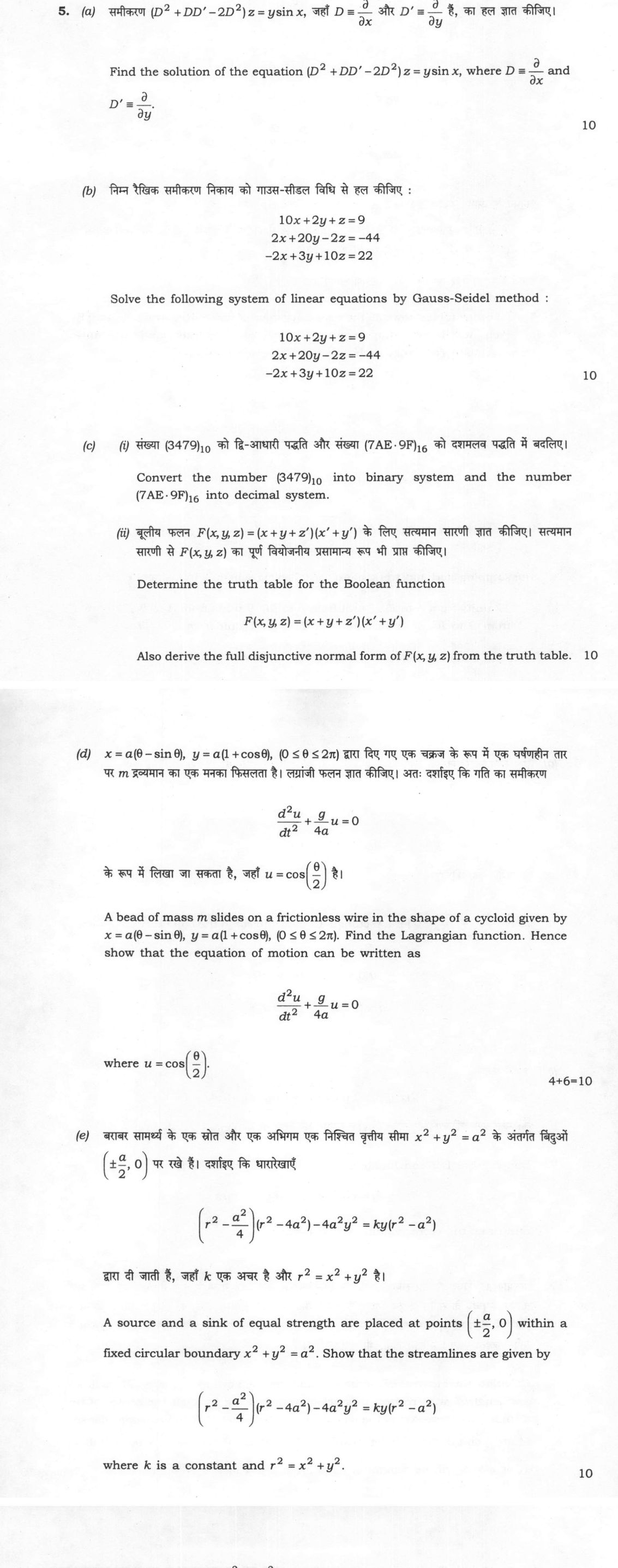
(a) Find the solution of the equation (D² + DD' - 2D'²)z = ysin x, where D ≡ (∂)/(∂ x) and D' ≡ (∂)/(∂ y). (10 marks) (b) Solve…
Find the solution of the equation (D² + DD' - 2D'²)z = ysin x, where D ≡ (∂)/(∂ x) and D' ≡ (∂)/(∂ y). 10 marks
Solve the following system of linear equations by Gauss-Seidel method : 10x + 2y + z= 9 2x + 20y - 2z= -44 -2x + 3y + 10z= 22 10 marks
Convert the number (3479)₁₀ into binary system and the number (7AE · 9F)₁₆ into decimal system.
Determine the truth table for the Boolean function F(x, y, z) = (x + y + z')(x' + y') Also derive the full disjunctive normal form of F(x, y, z) from the truth table. 10 marks
A bead of mass m slides on a frictionless wire in the shape of a cycloid given by x = a(θ - sinθ), y = a(1 + cosθ), (0 ≤ θ ≤ 2π). Find the Lagrangian function. Hence show that the equation of motion can be written as (d^2u)/(dt²) + g/4au = 0 where u = cos((θ)/2). (4+6=10 marks)
A source and a sink of equal strength are placed at points (pma/2, 0) within a fixed circular boundary x² + y² = a². Show that the streamlines are given by (r² - (a²)/4)(r² - 4a²) - 4a^2y² = ky(r² - a²) where k is a constant and r² = x² + y². 10 marks
हिंदी में प्रश्न पढ़ें
समीकरण (D² + DD' - 2D'²)z = ysin x, जहाँ D ≡ (∂)/(∂ x) और D' ≡ (∂)/(∂ y) है, का हल ज्ञात कीजिए। (10 अंक)
निम्न रैखिक समीकरण निकाय को गाउस-सीडल विधि से हल कीजिए : 10x + 2y + z= 9 2x + 20y - 2z= -44 -2x + 3y + 10z= 22 (10 अंक)
संख्या (3479)₁₀ को द्वि-आधारी पद्धति और संख्या (7AE · 9F)₁₆ को दशमलव पद्धति में बदलिए।
बूलियन फलन F(x, y, z) = (x + y + z')(x' + y') के लिए सत्यमान सारणी ज्ञात कीजिए। सत्यमान सारणी से F(x, y, z) का पूर्ण वियोजनीय प्रसामान्य रूप भी प्राप्त कीजिए। (10 अंक)
x = a(θ - sinθ), y = a(1 + cosθ), (0 ≤ θ ≤ 2π) द्वारा दिए गए एक चक्रज के रूप में एक घर्षणहीन तार पर m द्रव्यमान का एक मनका फिसलता है। लैग्रांजी फलन ज्ञात कीजिए। अतः दर्शाइए कि गति का समीकरण (d^2u)/(dt²) + g/4au = 0 के रूप में लिखा जा सकता है, जहाँ u = cos((θ)/2) है। (4+6=10 अंक)
बराबर सामर्थ्य के एक स्रोत और एक अभिगम एक निश्चित वृत्तीय सीमा x² + y² = a² के अंतर्गत बिंदुओं (pma/2, 0) पर रखे हैं। दर्शाइए कि धारारेखाएँ (r² - (a²)/4)(r² - 4a²) - 4a^2y² = ky(r² - a²) द्वारा दी जाती हैं, जहाँ k एक अचर है और r² = x² + y² है। (10 अंक)
Model answer
Written by UPSC Answer Check against this question's marking rubric, to the expected length. UPSC does not publish answers for Mains — this is one way to score well, not an official key.
(a) Let D = ∂/∂x and D' = ∂/∂y. The operator factors as D² + DD' - 2D'² = (D - D')(D + 2D') = (D + 2D')(D - D').
Complementary function:
- (D - D')z = 0 gives z = f(x + y), since dx/1 = dy/(-1), so x + y = constant.
- (D + 2D')z = 0 gives z = g(y - 2x), since dx/1 = dy/2, so y - 2x = constant.
Hence C.F. = f(x + y) + g(y - 2x).
For P.I., take z_p = -y sin x - cos x. Then z_px = -y cos x + sin x, z_py = -sin x, z_pxx = y sin x + cos x, z_pxy = -cos x, z_pyy = 0.
Therefore D²z_p + DD'z_p - 2D'²z_p = (y sin x + cos x) + (-cos x) - 0 = y sin x.
Thus the complete solution is z = f(x + y) + g(y - 2x) - y sin x - cos x, where f and g are arbitrary twice differentiable functions.
(b) The system is 10x + 2y + z = 9 2x + 20y - 2z = -44 -2x + 3y + 10z = 22.
For Gauss-Seidel, rearrange as x = (9 - 2y - z)/10 y = (-22 - x + z)/10 z = (22 + 2x - 3y)/10.
The coefficient matrix is strictly diagonally dominant, so Gauss-Seidel converges. Start with x₀ = y₀ = z₀ = 0.
Iteration 1: x₁ = (9 - 0 - 0)/10 = 0.9 y₁ = (-22 - 0.9 + 0)/10 = -2.29 z₁ = (22 + 1.8 + 6.87)/10 = 3.067.
Iteration 2: x₂ = 1.0513 y₂ = -1.99843 z₂ = 3.009789.
Iteration 3: x₃ = 0.998707 y₃ = -1.998892 z₃ = 2.999409.
Iteration 4: x₄ = 0.999837 y₄ = -2.000043 z₄ = 2.999980.
Iteration 5: x₅ = 1.000011 y₅ = -2.000003 z₅ = 3.000003.
Hence the solution is x = 1, y = -2, z = 3.
(c)(i) Convert (3479)₁₀ to binary by repeated division by 2: 3479 → remainders 1, 1, 1, 0, 1, 0, 0, 1, 1, 0, 1, 1 from least to most significant. Therefore (3479)₁₀ = (110110010111)₂.
Convert (7AE·9F)₁₆ to decimal: 7 × 16² + A × 16 + E + 9/16 + F/16² = 7 × 256 + 10 × 16 + 14 + 9/16 + 15/256 = 1792 + 160 + 14 + 159/256 = 1966 + 159/256.
Thus (7AE·9F)₁₆ = 1966.62109375.
(c)(ii) For F(x,y,z) = (x + y + z')(x' + y'), the truth table is:
- (0,0,0) → 1
- (0,0,1) → 0
- (0,1,0) → 1
- (0,1,1) → 1
- (1,0,0) → 1
- (1,0,1) → 1
- (1,1,0) → 0
- (1,1,1) → 0
The minterms where F = 1 are m₀, m₂, m₃, m₄, m₅. Hence the full disjunctive normal form is F = x'y'z' + x'yz' + x'yz + xy'z' + xy'z. Equivalently, F = Σm(0,2,3,4,5). It simplifies to F = x'y + xy' + x'z'.
(d) The cycloid is x = a(θ - sinθ), y = a(1 + cosθ).
Then dx/dt = a(1 - cosθ) dθ/dt, dy/dt = -a sinθ dθ/dt.
Kinetic energy: T = 1/2 m[(dx/dt)² + (dy/dt)²] = 1/2 m a²[(1 - cosθ)² + sin²θ](dθ/dt)² = 1/2 m a²[2 - 2 cosθ](dθ/dt)² = 2ma² sin²(θ/2)(dθ/dt)².
Potential energy, taking y upward: V = mgy = mga(1 + cosθ) = 2mga cos²(θ/2).
Hence the Lagrangian is L = 2ma² sin²(θ/2)(dθ/dt)² - 2mga cos²(θ/2).
Put u = cos(θ/2). Then sin²(θ/2) = 1 - u² and dθ/dt = -2(du/dt)/√(1 - u²), so (dθ/dt)² = 4(du/dt)²/(1 - u²).
Thus T = 8ma²(du/dt)², V = 2mga u², so L = 8ma²(du/dt)² - 2mga u².
Lagrange’s equation: d/dt(∂L/∂u̇) - ∂L/∂u = 0.
Here ∂L/∂u̇ = 16ma² du/dt, ∂L/∂u = -4mga u.
Therefore 16ma² d²u/dt² + 4mga u = 0, which gives d²u/dt² + g/(4a) u = 0. This is valid in the interior of the motion, where u ≠ ±1.
(e) Let z = x + iy and c = a/2. Take a source at z = c and an equal sink at z = -c. In free space, W₀(z) = m log((z - c)/(z + c)).
By the Milne-Thomson circle theorem, for the circular boundary |z| = a, W(z) = W₀(z) + overline{W₀(a²/z̄)}.
Using overline{log(a²/z̄ - c)} = log(a²/z - c), this simplifies to W(z) = m log[((z - c)(a² - cz))/((z + c)(a² + cz))].
Let U = (z - c)(a² - cz), V = (z + c)(a² + cz). Then the stream function is ψ = Im W = arg U - arg V.
For a fixed streamline, ψ = constant. Hence Im(U V̄) = tan ψ Re(U V̄).
With c = a/2, direct expansion gives Re(U V̄) = -(a²/4)[(r² - a²/4)(r² - 4a²) - 4a²y²], Im(U V̄) = -(5a³/4)y(r² - a²), where r² = x² + y².
Substituting into Im(U V̄) = tan ψ Re(U V̄), -(5a³/4)y(r² - a²) = tan ψ [-(a²/4){(r² - a²/4)(r² - 4a²) - 4a²y²}].
Simplifying, (r² - a²/4)(r² - 4a²) - 4a²y² = (5a cot ψ) y(r² - a²).
Let k = 5a cot ψ. Therefore the streamlines are (r² - a²/4)(r² - 4a²) - 4a²y² = ky(r² - a²), where k is a constant. The boundary and the x-axis occur as limiting streamlines.
What "Solve" is asking you to do
Choose the method, then carry it through to a final answer. Identifying what kind of problem this is and why that method applies is the first thing marked; a correct figure arrived at invisibly earns almost nothing.
Structure that answers it
Given data and what is required → method chosen, with the reason it applies → set-up (equation, circuit, free body, trial balance) → working, step by step → answer with units and any condition of validity
Where marks are lost
Doing the middle steps mentally and writing only the result. In mathematics papers, a further loss comes from giving a decimal where the exact value in surds or fractions was wanted, or from skipping the justification a part explicitly asks for.
How this answer will be evaluated
Approach
Framework: Standard Mathematical Problem-Solving (Derivation & Calculation). (a) calculate: Given > Assumptions > Stepwise derivation > Result and check | (b) calculate: Given > Formula > Substitution > Result | (c) calculate: Given > Formula > Substitution > Result | (d) explain: Definition/context > Points in order > Small example > Short close | (e) explain: Definition/context > Points in order > Small example > Short close Full marks: Complete derivations with all steps, correct final results, and clear notation.
Key points expected
- Factorization of PDE operator
- Gauss-Seidel iteration steps
- Base conversion algorithms
- Boolean truth table and DNF
- Lagrangian mechanics derivation
- Complex potential and image system
Evaluation rubric
Each sub-part is marked on its own, against the marks and word limit printed on the paper.
- (a) Complete solution (CF + PI) for the linear PDE with variable coefficients. 10 marks
calculate— Given → Assumptions → Stepwise derivation → Result and check
Must cover
- Factorize operator as (D+2D')(D-D')
- Compute Complementary Function (CF)
- Compute Particular Integral (PI) via inverse operators
- Final solution z = CF + PI
Loses marks
- Missing CF or PI
- Incorrect factorization of operator
Earns more
- Correct handling of 1/(D-D') operator
- Integration steps for PI shown clearly
Extra mark
- Verification of solution by substitution
- (b) Iterative solution of linear system using Gauss-Seidel method. 10 marks
calculate— Given → Formula → Substitution → Result
Must cover
- Rearrange equations for x, y, z
- State initial guess (e.g., 0,0,0)
- Show at least 2-3 iterations
- Final approximate values for x, y, z
Loses marks
- Using Jacobi method instead
- Arithmetic errors in iterations
Earns more
- Convergence check or stopping criterion
- Tabular format for iterations
Extra mark
- Comparison with exact solution
- (c) Base conversion and Boolean logic truth table/DNF derivation. 10 marks
calculate— Given → Formula → Substitution → Result
Must cover
- Decimal to Binary conversion steps
- Hex to Decimal conversion steps
- Complete truth table for F(x,y,z)
- Derivation of Disjunctive Normal Form (DNF)
Loses marks
- Incorrect base conversion
- Missing rows in truth table
Earns more
- Simplification of Boolean expression
- Correct identification of minterms
Extra mark
- K-map verification of DNF
- (d) Lagrangian formulation and derivation of equation of motion for cycloid. 10 marks
explain— Definition/context → Points in order → Small example → Short close
Must cover
- Kinetic and Potential energy expressions
- Lagrangian L = T - V
- Application of Euler-Lagrange equation
- Substitution u = cos(θ/2) to get final ODE
Loses marks
- Incorrect energy expressions
- Skipping Euler-Lagrange step
Earns more
- Clear definition of coordinates
- Step-by-step differentiation
Extra mark
- Physical interpretation of the result
- (e) Derivation of streamline equation for source-sink pair in circle. 10 marks
explain— Definition/context → Points in order → Small example → Short close
Must cover
- Complex potential for source/sink
- Image system for circular boundary
- Stream function ψ expression
- Algebraic manipulation to given form
Loses marks
- Incorrect image system
- Algebraic errors in stream function
Earns more
- Clear definition of complex potential
- Correct application of image theorem
Extra mark
- Sketch of streamlines
Practice this exact question
Write your answer and it is marked point by point against the model answer above — what you covered, what you missed, what you got wrong.
Evaluate my answer →More from Mathematics 2025 Paper II
- Q2 (a) Define Cauchy sequence and prove that every convergent sequence of real numbers is a…
- Q3 (a) Evaluate the integral ∮_C e^z/(z²(z+1)³) dz, C : |z| = 2. (15 marks) (b) Show that th…
- Q4 (a) Examine whether the mapping φ: Z[x] → Z defined by φ(f(x)) = f(0), for f(x) ∈ Z[x], i…
- Q5 (a) Find the solution of the equation (D² + DD' - 2D'²)z = ysin x, where D ≡ (∂)/(∂ x) an…
- Q6 (a) Solve (∂² u)/(∂ x²) + (∂² u)/(∂ y²) = 0 for a rectangular plate subject to the bounda…
- Q7 (a) Find the complete integral of z(p²-q²) = x-y; p≡∂z/∂x, q≡∂z/∂y. (15 marks) (b) Find t…
- Q8 (a) Find the characteristics of the partial differential equation p² + q² = 2; p ≡ ∂z/∂x,…