Paper II — Q4
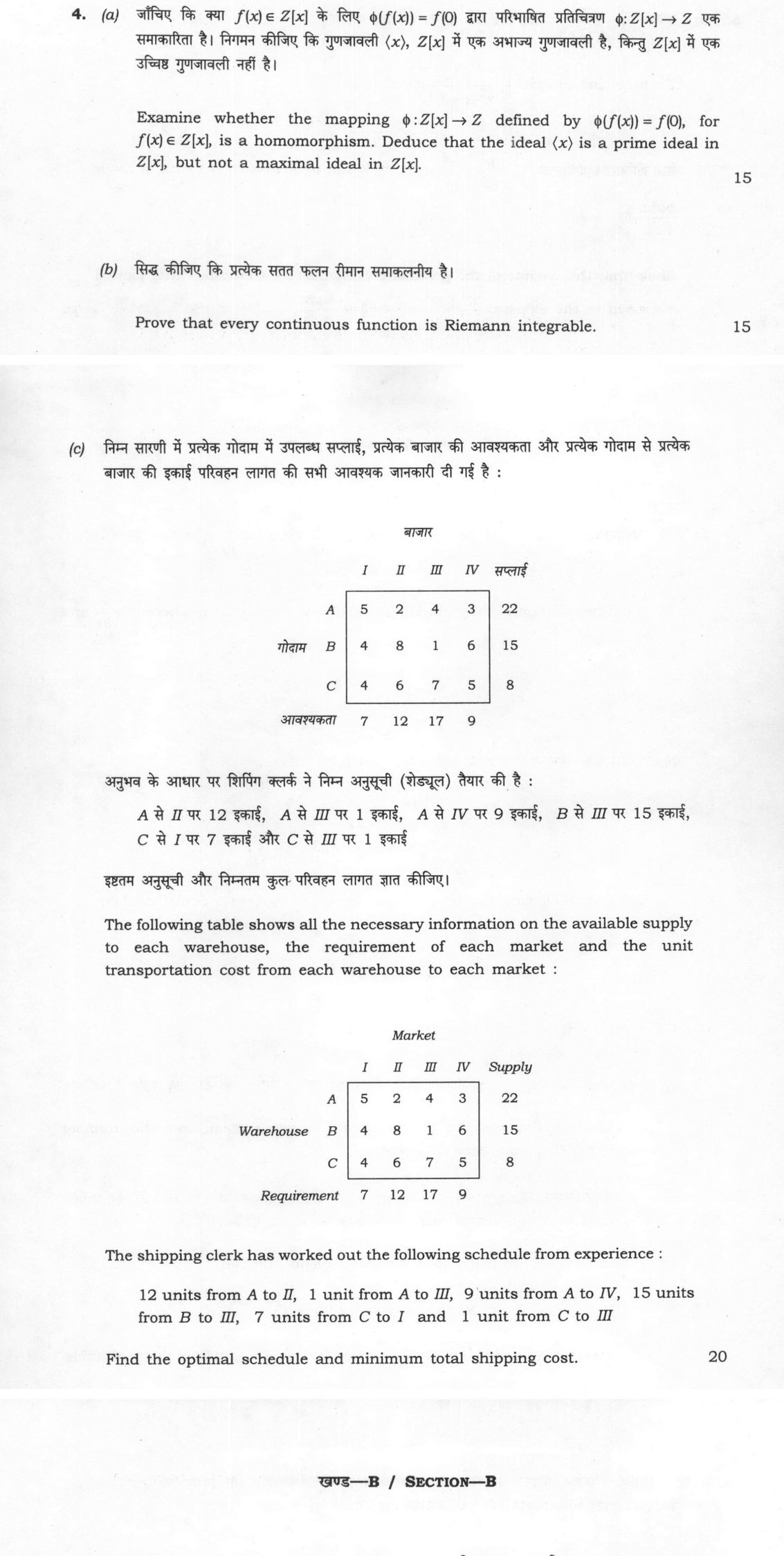
(a) Examine whether the mapping φ: Z[x] → Z defined by φ(f(x)) = f(0), for f(x) ∈ Z[x], is a homomorphism. Deduce that the ideal…
Examine whether the mapping φ: Z[x] → Z defined by φ(f(x)) = f(0), for f(x) ∈ Z[x], is a homomorphism. Deduce that the ideal ⟨x⟩ is a prime ideal in Z[x], but not a maximal ideal in Z[x]. 15 marks
Prove that every continuous function is Riemann integrable. 15 marks
The following table shows all the necessary information on the available supply to each warehouse, the requirement of each market and the unit transportation cost from each warehouse to each market :
Market
I II III IV Supply
A 5 2 4 3 22
Warehouse B 4 8 1 6 15
C 4 6 7 5 8
Requirement 7 12 17 9
The shipping clerk has worked out the following schedule from experience :
12 units from A to II, 1 unit from A to III, 9 units from A to IV, 15 units from B to III, 7 units from C to I and 1 unit from C to III
Find the optimal schedule and minimum total shipping cost. 20 marks
हिंदी में प्रश्न पढ़ें
जाँचिए कि क्या f(x) ∈ Z[x] के लिए φ(f(x)) = f(0) द्वारा परिभाषित प्रतिचित्रण φ: Z[x] → Z एक समाकारिता है। निगमन कीजिए कि गुणजावली ⟨x⟩, Z[x] में एक अभाज्य गुणजावली है, किन्तु Z[x] में एक उच्चिष्ठ गुणजावली नहीं है। (15 अंक)
सिद्ध कीजिए कि प्रत्येक सतत फलन रीमान समाकलनीय है। (15 अंक)
निम्न सारणी में प्रत्येक गोदाम में उपलब्ध सप्लाई, प्रत्येक बाजार की आवश्यकता और प्रत्येक गोदाम से प्रत्येक बाजार की इकाई परिवहन लागत की सभी आवश्यक जानकारी दी गई है :
बाजार
I II III IV सप्लाई
A 5 2 4 3 22
गोदाम B 4 8 1 6 15
C 4 6 7 5 8
आवश्यकता 7 12 17 9
अनुभव के आधार पर शिपिंग क्लर्क ने निम्न अनुसूची (शेड्यूल) तैयार की है :
A से II पर 12 इकाई, A से III पर 1 इकाई, A से IV पर 9 इकाई, B से III पर 15 इकाई,
C से I पर 7 इकाई और C से III पर 1 इकाई
इष्टतम अनुसूची और निम्नतम कुल परिवहन लागत ज्ञात कीजिए। (20 अंक)
Model answer
Written by UPSC Answer Check against this question's marking rubric, to the expected length. UPSC does not publish answers for Mains — this is one way to score well, not an official key.
(a) A map φ: Z[x] → Z is a ring homomorphism if it preserves addition and multiplication. For f,g ∈ Z[x], φ(f+g) = (f+g)(0) = f(0)+g(0) = φ(f)+φ(g), φ(fg) = (fg)(0) = f(0)g(0) = φ(f)φ(g). Also φ(1)=1. Hence φ is a ring homomorphism.
Now f(x)=a₀+a₁x+⋯ ∈ Z[x] has φ(f)=a₀. Thus f ∈ ker φ ⇔ a₀=0 ⇔ f(x)=x(a₁+a₂x+⋯). Therefore ker φ = ⟨x⟩. The map is onto, since every n ∈ Z is φ(n) with n viewed as a constant polynomial. By the first isomorphism theorem, Z[x]/⟨x⟩ ≅ Z. Since Z is an integral domain, Z[x]/⟨x⟩ is an integral domain, so ⟨x⟩ is a prime ideal. Since Z is not a field, the quotient is not a field, so ⟨x⟩ is not maximal. Therefore ⟨x⟩ is prime but not maximal in Z[x].
(b) The statement needs its usual domain: every continuous function on a closed bounded interval [a,b] is Riemann integrable on [a,b]. Without this restriction the statement is not true in general. Let f be continuous on [a,b]. By the Heine-Cantor theorem, f is uniformly continuous on [a,b]. Given ε>0, choose δ>0 such that |x−y|<δ ⇒ |f(x)−f(y)| < ε/(b−a), assuming b>a.
Choose a partition P: a=x₀<x₁<⋯<xₙ=b with mesh max Δxᵢ<δ. On each subinterval [xᵢ₋₁,xᵢ], f attains maximum Mᵢ and minimum mᵢ. For any two points in this subinterval, their distance is less than δ, so Mᵢ−mᵢ < ε/(b−a). Therefore U(P,f)−L(P,f) = Σ (Mᵢ−mᵢ)Δxᵢ < ε/(b−a) Σ Δxᵢ = ε. Thus for every ε>0 there is a partition with U(P,f)−L(P,f)<ε. By Riemann’s criterion, f is Riemann integrable on [a,b]. If b=a, the integral is 0. Hence every continuous function on a closed bounded interval is Riemann integrable.
(c) Costs c(row, column): A=(5,2,4,3), B=(4,8,1,6), C=(4,6,7,5) for markets I, II, III, IV. Supplies: A=22, B=15, C=8; requirements: I=7, II=12, III=17, IV=9.
Initial schedule: A→II=12; A→III=1; A→IV=9; B→III=15; C→I=7; C→III=1. Check feasibility: A uses 12+1+9=22; B uses 15; C uses 7+1=8. Requirements: I: 7; II: 12; III: 1+15+1=17; IV: 9. Feasible.
Initial cost = 12×2 + 1×4 + 9×3 + 15×1 + 7×4 + 1×7 = 24+4+27+15+28+7 = 105 cost units.
Use the MODI method. For basic cells A-II, A-III, A-IV, B-III, C-I, C-III, set u(A)=0. Then v(II)=2, v(III)=4, v(IV)=3, u(B)=−3, u(C)=3, v(I)=1. Reduced costs c−u−v for nonbasic cells: A-I=4, B-I=6, B-II=9, B-IV=6, C-II=1, C-IV=−1. The negative value occurs at C-IV, so C-IV enters. The loop is: C-IV +, C-III −, A-III +, A-IV −. The minimum of the negative cells is min(1,9)=1. Pivot by 1.
New schedule: A→II=12; A→III=2; A→IV=8; B→III=15; C→I=7; C→IV=1.
New cost = 12×2 + 2×4 + 8×3 + 15×1 + 7×4 + 1×5 = 24+8+24+15+28+5 = 104 cost units.
Check optimality. Basic cells now are A-II, A-III, A-IV, B-III, C-I, C-IV. Set u(A)=0. Then v(II)=2, v(III)=4, v(IV)=3, u(B)=−3, u(C)=2, v(I)=2. Reduced costs: A-I=3, B-I=5, B-II=9, B-IV=6, C-II=2, C-III=1. All are nonnegative, so the schedule is optimal.
Optimal schedule: A→II=12, A→III=2, A→IV=8, B→III=15, C→I=7, C→IV=1. Minimum total shipping cost = 104 cost units.
What "Prove" is asking you to do
Establish that the statement holds for every case it claims, not for one representative case. The argument must be closed: each line follows from a definition, a hypothesis, or a named theorem you are entitled to use.
Structure that answers it
Given and to prove, restated → theorem or construction to be used, named → the argument line by line → conclusion stated as proved
Where marks are lost
Testing one example, which illustrates but proves nothing. On an if and only if claim, proving one direction and stopping forfeits that half outright, and degenerate cases — zero, the empty set, the equality case — have to be disposed of rather than assumed away.
How this answer will be evaluated
Approach
(a) examine: intro > how/why with reasoning > evidence > conclusion | (b) justify: claim > 3-4 reasons > evidence > conclusion | (c) calculate: given > formula > substitution > result with units > interpretation Full marks: Rigorous proofs with all steps; correct optimal schedule and cost.
Key points expected
- Verify φ(f+g) = φ(f) + φ(g) and φ(fg) = φ(f)φ(g)
- Identify kernel of φ as the ideal <x>
- Prove Z[x]/<x> ≅ Z to establish <x> is prime
- Show Z[x]/<x> is not a field to prove <x> not maximal
- State uniform continuity of f on [a, b]
- Construct partition P with mesh size δ
- Show oscillation ω_i < ε for all subintervals
- Demonstrate U(P, f) - L(P, f) < ε
Evaluation rubric
Each sub-part is marked on its own, against the marks and word limit printed on the paper.
- (a) Verify homomorphism properties and deduce ideal classification. 15 marks
examine— intro → how/why with reasoning → evidence → conclusion
Must cover
- Verify φ(f+g) = φ(f) + φ(g) and φ(fg) = φ(f)φ(g)
- Identify kernel of φ as the ideal <x>
- Prove Z[x]/<x> ≅ Z to establish <x> is prime
- Show Z[x]/<x> is not a field to prove <x> not maximal
Loses marks
- Confusing prime ideal with maximal ideal
- Failing to check multiplicative property of φ
Earns more
- Explicitly states First Isomorphism Theorem
- Uses specific counter-example for non-maximality
Extra mark
- Mentions Z[x] is a UFD
- (b) Prove Riemann integrability of continuous functions on a closed interval. 15 marks
justify— claim → 3-4 reasons → evidence → conclusion
Must cover
- State uniform continuity of f on [a, b]
- Construct partition P with mesh size δ
- Show oscillation ω_i < ε for all subintervals
- Demonstrate U(P, f) - L(P, f) < ε
Loses marks
- Assuming continuity implies boundedness without proof
- Skipping the uniform continuity step
Earns more
- Explicitly defines Upper and Lower sums
- Uses the Riemann criterion for integrability
Extra mark
- Mention of Lebesgue's criterion
- (c) Find optimal transportation schedule and minimum total cost. 20 marks
calculate— given → formula → substitution → result with units → interpretation
Must cover
- Verify feasibility of the given initial schedule
- Calculate opportunity costs (u_i + v_j - c_ij) for all cells
- Identify entering variable with maximum positive opportunity cost
- Perform stepping-stone loop to find new optimal schedule
Loses marks
- Incorrect calculation of opportunity costs
- Failing to check for optimality condition
Earns more
- Correctly identifies the loop for the first iteration
- Calculates the final minimum cost explicitly
Extra mark
- Notes if the solution is degenerate
Practice this exact question
Write your answer and it is marked point by point against the model answer above — what you covered, what you missed, what you got wrong.
Evaluate my answer →More from Mathematics 2025 Paper II
- Q1 (a) Let H and K be two subgroups of a group G such that o(H) > √o(G) and o(K) > √o(G). Sh…
- Q2 (a) Define Cauchy sequence and prove that every convergent sequence of real numbers is a…
- Q3 (a) Evaluate the integral ∮_C e^z/(z²(z+1)³) dz, C : |z| = 2. (15 marks) (b) Show that th…
- Q4 (a) Examine whether the mapping φ: Z[x] → Z defined by φ(f(x)) = f(0), for f(x) ∈ Z[x], i…
- Q5 (a) Find the solution of the equation (D² + DD' - 2D'²)z = ysin x, where D ≡ (∂)/(∂ x) an…
- Q6 (a) Solve (∂² u)/(∂ x²) + (∂² u)/(∂ y²) = 0 for a rectangular plate subject to the bounda…
- Q7 (a) Find the complete integral of z(p²-q²) = x-y; p≡∂z/∂x, q≡∂z/∂y. (15 marks) (b) Find t…