Paper II — Q3
(a) Evaluate the integral ∮_C e^z/(z²(z+1)³) dz, C : |z| = 2. (15 marks) (b) Show that the volume of the greatest rectangular…
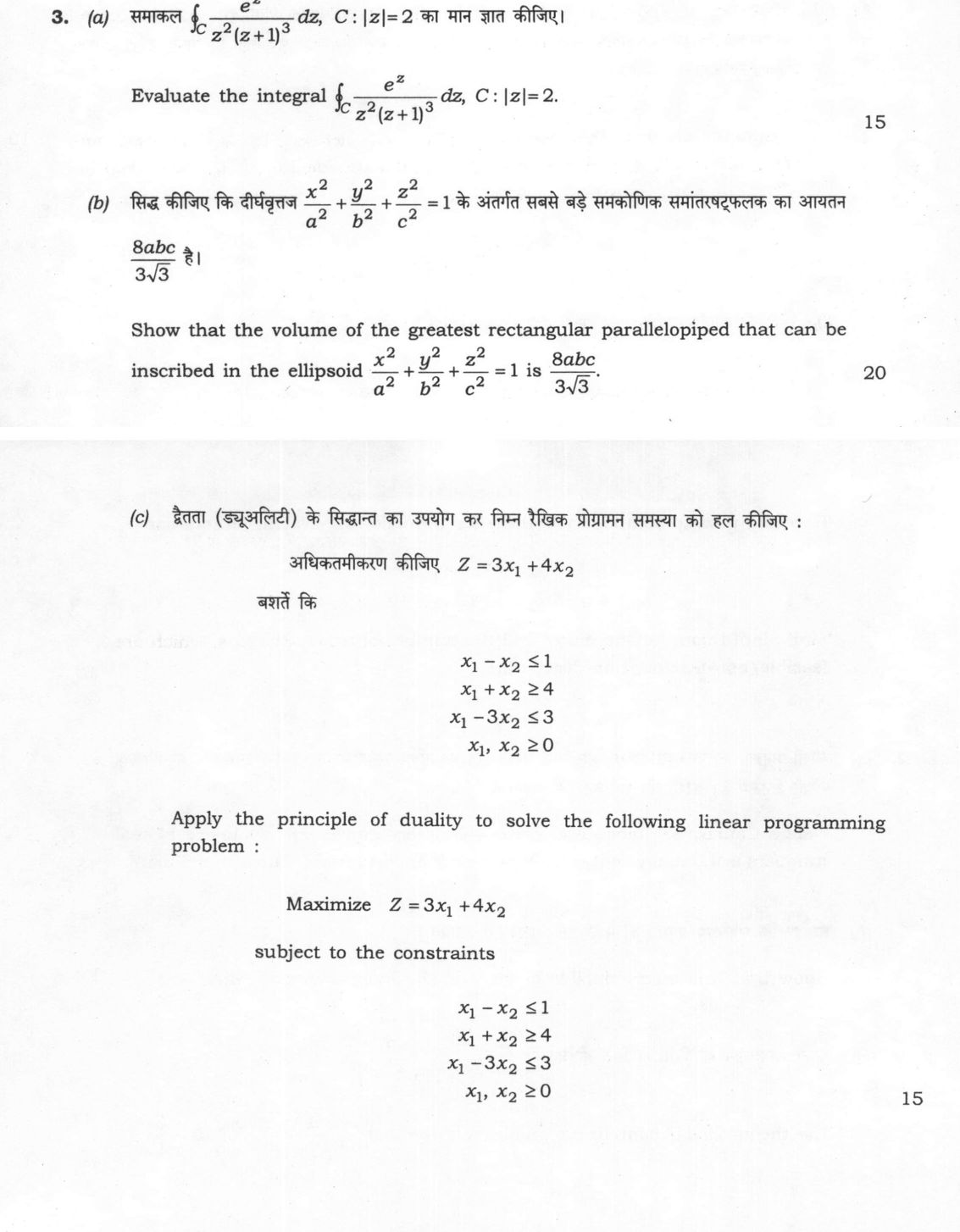
Evaluate the integral ∮_C e^z/(z²(z+1)³) dz, C : |z| = 2. 15 marks
Show that the volume of the greatest rectangular parallelopiped that can be inscribed in the ellipsoid (x²/a²) + (y²/b²) + (z²/c²) = 1 is 8abc/(3√3). 20 marks
Apply the principle of duality to solve the following linear programming problem :
Maximize Z = 3x₁ + 4x₂
subject to the constraints
x₁ - x₂ ≤ 1 x₁ + x₂ ≥ 4 x₁ - 3x₂ ≤ 3 x₁, x₂ ≥ 0 15 marks
हिंदी में प्रश्न पढ़ें
समाकल ∮_C e^z/(z²(z+1)³) dz, C : |z| = 2 का मान ज्ञात कीजिए। (15 अंक)
सिद्ध कीजिए कि दीर्घवृत्ताख (x²/a²) + (y²/b²) + (z²/c²) = 1 के अंतर्गत सबसे बड़े समकोणिक समांतरपृष्ठक का आयतन 8abc/(3√3) है। (20 अंक)
द्वैतता (ड्युअलिटी) के सिद्धांत का उपयोग कर निम्न रैखिक प्रोग्रामन समस्या को हल कीजिए :
अधिकतमीकरण कीजिए Z = 3x₁ + 4x₂
बशर्ते कि
x₁ - x₂ ≤ 1 x₁ + x₂ ≥ 4 x₁ - 3x₂ ≤ 3 x₁, x₂ ≥ 0 (15 अंक)
Model answer
Written by UPSC Answer Check against this question's marking rubric, to the expected length. UPSC does not publish answers for Mains — this is one way to score well, not an official key.
(a) By Cauchy’s residue theorem, since z = 0 and z = -1 lie inside |z| = 2,
∮ e^z/(z²(z+1)³) dz = 2πi [Res(f,0) + Res(f,-1)].
At z = 0, the pole is of order 2. Using the residue formula,
Res(f,0) = lim z→0 d/dz [z² f(z)] = d/dz [e^z(z+1)⁻³] at z = 0 = e^z(z-2)/(z+1)⁴ at z = 0 = -2.
At z = -1, the pole is of order 3. Hence
Res(f,-1) = 1/2! d²/dz² [(z+1)³ f(z)] at z = -1 = 1/2 d²/dz² [e^z z⁻²] at z = -1.
Let h(z) = e^z z⁻². Then h′(z) = e^z(z⁻² - 2z⁻³), h″(z) = e^z(z⁻² - 4z⁻³ + 6z⁻⁴).
At z = -1, h″(-1) = e⁻¹(1 + 4 + 6) = 11/e. So Res(f,-1) = 11/(2e).
Thus the sum of residues is -2 + 11/(2e).
Therefore ∮ f(z) dz = 2πi(-2 + 11/(2e)) = πi(11/e - 4).
Final answer (a): πi(11/e - 4).
(b) Let the rectangular parallelepiped be symmetric about the origin and have edges parallel to the coordinate axes. Let a vertex in the first octant be (x,y,z), where x,y,z ≥ 0. Then its volume is V = 8xyz, and the vertex lies on the ellipsoid
x²/a² + y²/b² + z²/c² = 1.
Put u = x²/a², v = y²/b², w = z²/c². Then u,v,w ≥ 0 and u + v + w = 1. Also
V² = 64a²b²c² u v w.
So we must maximize u v w subject to u + v + w = 1. By AM-GM,
(u + v + w)/3 ≥ (u v w)^(1/3).
Since u + v + w = 1,
u v w ≤ (1/3)³ = 1/27.
Equality occurs when u = v = w = 1/3. Hence
x = a/√3, y = b/√3, z = c/√3.
Therefore
Vmax = 8(a/√3)(b/√3)(c/√3) = 8abc/(3√3).
For completeness, Lagrange multipliers confirm the same: maximizing ln V subject to x²/a² + y²/b² + z²/c² = 1 gives
x²/a² = y²/b² = z²/c² = 1/3.
Final answer (b): 8abc/(3√3).
(c) First write the primal in standard max form:
Maximize Z = 3x₁ + 4x₂
subject to x₁ - x₂ ≤ 1, -x₁ - x₂ ≤ -4, x₁ - 3x₂ ≤ 3, x₁, x₂ ≥ 0.
Let the dual variables be y₁, y₂, y₃ ≥ 0. By the principle of duality, the dual is:
Minimize W = y₁ - 4y₂ + 3y₃
subject to y₁ - y₂ + y₃ ≥ 3, -y₁ - y₂ - 3y₃ ≥ 4, y₁, y₂, y₃ ≥ 0.
But the second dual constraint is impossible because the left side is ≤ 0 for all y₁, y₂, y₃ ≥ 0, while the right side is 4 > 0. Hence the dual is infeasible.
The primal is feasible; for example, (x₁,x₂) = (2,2) satisfies all constraints. By the duality theorem, if the primal is feasible and the dual is infeasible, then the primal is unbounded.
Indeed, take x₁ = t + 1, x₂ = t, with t ≥ 3/2. Then all primal constraints hold, and
Z = 3(t+1) + 4t = 7t + 3 → ∞ as t → ∞.
Thus the given LPP has no finite maximum.
Final answer (c): Z is unbounded above; no finite optimal solution exists.
What "Solve" is asking you to do
Choose the method, then carry it through to a final answer. Identifying what kind of problem this is and why that method applies is the first thing marked; a correct figure arrived at invisibly earns almost nothing.
Structure that answers it
Given data and what is required → method chosen, with the reason it applies → set-up (equation, circuit, free body, trial balance) → working, step by step → answer with units and any condition of validity
Where marks are lost
Doing the middle steps mentally and writing only the result. In mathematics papers, a further loss comes from giving a decimal where the exact value in surds or fractions was wanted, or from skipping the justification a part explicitly asks for.
How this answer will be evaluated
Approach
(a) calculate: given > formula > substitution > result with units > interpretation | (b) justify: claim > 3-4 reasons > evidence > conclusion | (c) calculate: given > formula > substitution > result with units > interpretation Full marks: Flawless application of theorems with complete working and verification.
Key points expected
- Identify singularities z=0 and z=-1 inside C
- Apply Cauchy's Integral Formula or Residue Theorem
- Compute residue at z=0 (pole of order 2)
- Compute residue at z=-1 (pole of order 3)
- Formulate volume function V = 8xyz
- Apply Lagrange multipliers for constraint
- Solve system to find x=a/√3, y=b/√3, z=c/√3
- Substitute to derive final volume 8abc/(3√3)
Evaluation rubric
Each sub-part is marked on its own, against the marks and word limit printed on the paper.
- (a) Value of the contour integral using complex analysis. 15 marks
calculate— given → formula → substitution → result with units → interpretation
Must cover
- Identify singularities z=0 and z=-1 inside C
- Apply Cauchy's Integral Formula or Residue Theorem
- Compute residue at z=0 (pole of order 2)
- Compute residue at z=-1 (pole of order 3)
Loses marks
- Missing residue at one of the poles
- Incorrect order of poles identified
- Arithmetic error in derivative calculation
Earns more
- Correct expansion of e^z for residue calculation
- Explicit statement of Cauchy's formula used
- Verification of singularity locations relative to |z|=2
Extra mark
- Alternative method using partial fractions
- (b) Proof that max volume is 8abc/(3√3). 20 marks
justify— claim → 3-4 reasons → evidence → conclusion
Must cover
- Formulate volume function V = 8xyz
- Apply Lagrange multipliers for constraint
- Solve system to find x=a/√3, y=b/√3, z=c/√3
- Substitute to derive final volume 8abc/(3√3)
Loses marks
- Incorrect setup of Lagrange equations
- Algebraic errors in solving for x, y, z
- Failure to maximize (finding a minimum or saddle)
Earns more
- Clear definition of the objective function
- Step-by-step algebraic simplification
- Verification that the critical point is a maximum
Extra mark
- Geometric interpretation of the result
- (c) Solution of LP problem using duality principle. 15 marks
calculate— given → formula → substitution → result with units → interpretation
Must cover
- Formulate the dual problem correctly
- Solve the dual problem (e.g., via simplex)
- Use duality theorem to find primal solution
- State the optimal value of Z
Loses marks
- Incorrect dual formulation (sign errors)
- Failure to solve the dual completely
- Ignoring non-negativity constraints
Earns more
- Correct handling of mixed constraints (≤ and ≥)
- Clear mapping of dual variables to primal constraints
- Verification of complementary slackness
Extra mark
- Graphical verification of the solution
Practice this exact question
Write your answer and it is marked point by point against the model answer above — what you covered, what you missed, what you got wrong.
Evaluate my answer →More from Mathematics 2025 Paper II
- Q1 (a) Let H and K be two subgroups of a group G such that o(H) > √o(G) and o(K) > √o(G). Sh…
- Q2 (a) Define Cauchy sequence and prove that every convergent sequence of real numbers is a…
- Q3 (a) Evaluate the integral ∮_C e^z/(z²(z+1)³) dz, C : |z| = 2. (15 marks) (b) Show that th…
- Q4 (a) Examine whether the mapping φ: Z[x] → Z defined by φ(f(x)) = f(0), for f(x) ∈ Z[x], i…
- Q5 (a) Find the solution of the equation (D² + DD' - 2D'²)z = ysin x, where D ≡ (∂)/(∂ x) an…
- Q6 (a) Solve (∂² u)/(∂ x²) + (∂² u)/(∂ y²) = 0 for a rectangular plate subject to the bounda…