Paper II — Q2
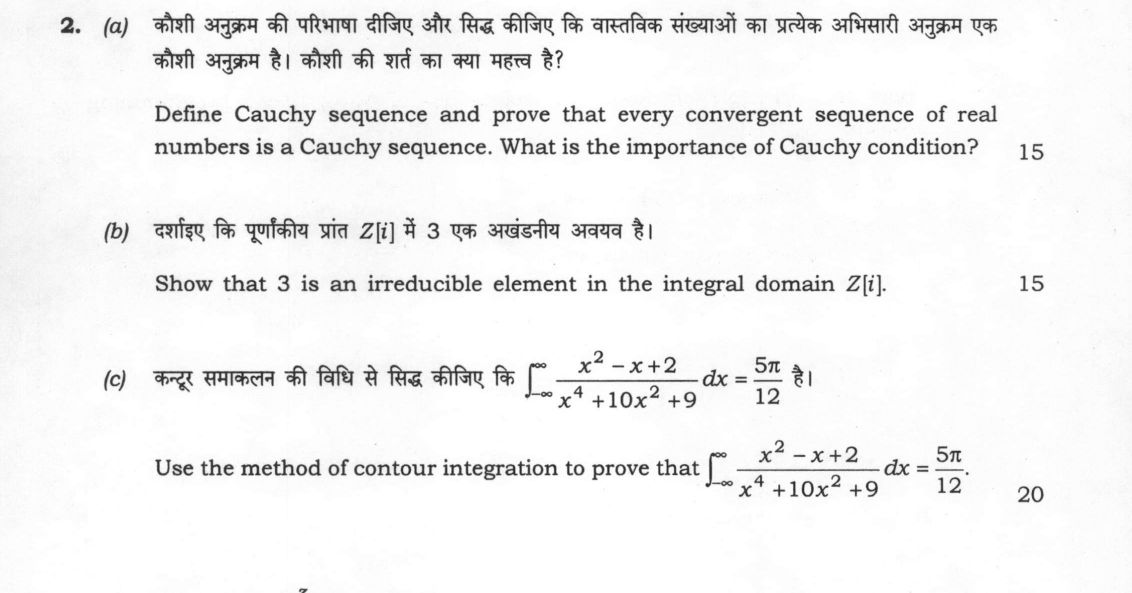
(a) Define Cauchy sequence and prove that every convergent sequence of real numbers is a Cauchy sequence. What is the importance…
Define Cauchy sequence and prove that every convergent sequence of real numbers is a Cauchy sequence. What is the importance of Cauchy condition? 15 marks
Show that 3 is an irreducible element in the integral domain Z[i]. 15 marks
Use the method of contour integration to prove that ∫₋∞^∞ (x² - x + 2)/(x⁴ + 10x² + 9) dx = 5π/12. 20 marks
हिंदी में प्रश्न पढ़ें
कोशी अनुक्रम की परिभाषा दीजिए और सिद्ध कीजिए कि वास्तविक संख्याओं का प्रत्येक अभिसारी अनुक्रम एक कोशी अनुक्रम है। कोशी की शर्त का क्या महत्व है? (15 अंक)
दर्शाइए कि पूर्णांकीय प्रांत Z[i] में 3 एक अविभाज्य अवयव है। (15 अंक)
कंटूर समाकलन की विधि से सिद्ध कीजिए कि ∫₋∞^∞ (x² - x + 2)/(x⁴ + 10x² + 9) dx = 5π/12 है। (20 अंक)
Model answer
Written by UPSC Answer Check against this question's marking rubric, to the expected length. UPSC does not publish answers for Mains — this is one way to score well, not an official key.
(a) A sequence (aₙ) of real numbers is called a Cauchy sequence if for every ε > 0 there exists N ∈ ℕ such that |aₘ − aₙ| < ε for all m, n ≥ N.
Let (aₙ) be convergent with limit L. Given ε > 0, since aₙ → L, there exists N ∈ ℕ such that |aₙ − L| < ε/2 for all n ≥ N. Then for all m, n ≥ N, by the triangle inequality,
|aₘ − aₙ| = |(aₘ − L) + (L − aₙ)| ≤ |aₘ − L| + |L − aₙ| < ε/2 + ε/2 = ε.
Hence (aₙ) is Cauchy. This proves that every convergent sequence of real numbers is Cauchy.
The Cauchy condition is important because in ℝ it is not only necessary but also sufficient for convergence: every Cauchy sequence of real numbers converges. Thus it tests convergence without knowing the limit in advance. It is equivalent to completeness of ℝ. In incomplete spaces, Cauchy sequences need not converge; for example, a sequence of rationals approximating √2 is Cauchy in ℚ but has no limit in ℚ. The condition also underlies convergence of series, contraction mapping arguments, and uniform convergence.
(b) In an integral domain R, a nonzero nonunit element a is irreducible if whenever a = bc, one of b or c is a unit.
In Z[i], define the norm N(a + bi) = a² + b². The units of Z[i] are exactly ±1 and ±i, all having norm 1. Also N(3) = 9 ≠ 1, so 3 is not zero and not a unit.
Suppose, if possible, that 3 = αβ for some α, β ∈ Z[i]. Using multiplicativity of the norm,
9 = N(3) = N(αβ) = N(α)N(β).
If neither α nor β is a unit, then N(α) > 1 and N(β) > 1. Since both are positive integers whose product is 9, the only possibility is N(α) = N(β) = 3. But if α = a + bi, then a² + b² = 3, which has no integer solution because integer squares are 0, 1, 4, … and no sum of two such squares equals 3.
Therefore one of α, β must be a unit. Hence 3 is an irreducible element in Z[i].
(c) Use the residue theorem. Let
f(z) = (z² − z + 2)/(z⁴ + 10z² + 9).
Factor the denominator:
z⁴ + 10z² + 9 = (z² + 1)(z² + 9) = (z − i)(z + i)(z − 3i)(z + 3i).
The poles in the upper half-plane are the simple poles z = i and z = 3i. Take the contour consisting of the real interval [−R, R] and the upper semicircle C(R): z = R e^(iθ), 0 ≤ θ ≤ π, with R > 3.
For a simple pole z₀ of P(z)/Q(z), the residue is P(z₀)/Q′(z₀). Here
P(z) = z² − z + 2, Q(z) = z⁴ + 10z² + 9,
so
Q′(z) = 4z³ + 20z.
At z = i:
P(i) = i² − i + 2 = −1 − i + 2 = 1 − i,
Q′(i) = 4i³ + 20i = −4i + 20i = 16i.
Thus
Res(f, i) = (1 − i)/(16i) = −(1 + i)/16.
At z = 3i:
P(3i) = (3i)² − 3i + 2 = −9 − 3i + 2 = −7 − 3i,
Q′(3i) = 4(3i)³ + 20(3i) = −108i + 60i = −48i.
Thus
Res(f, 3i) = (−7 − 3i)/(−48i) = (3 − 7i)/48.
Therefore the sum of residues in the upper half-plane is
−(1 + i)/16 + (3 − 7i)/48 = (−3 − 3i)/48 + (3 − 7i)/48 = −10i/48 = −5i/24.
By the residue theorem,
∫₋R^R f(x) dx + ∫_C(R) f(z) dz = 2πi(−5i/24) = 5π/12.
On C(R), for large R,
|f(z)| ≤ (R² + R + 2)/(R⁴ − 10R² − 9),
and the length of C(R) is πR, so
|∫_C(R) f(z) dz| ≤ πR(R² + R + 2)/(R⁴ − 10R² − 9) → 0
as R → ∞. Hence the semicircle contribution vanishes in the limit.
Therefore
∫₋∞^∞ (x² − x + 2)/(x⁴ + 10x² + 9) dx = 5π/12.
What "Prove" is asking you to do
Establish that the statement holds for every case it claims, not for one representative case. The argument must be closed: each line follows from a definition, a hypothesis, or a named theorem you are entitled to use.
Structure that answers it
Given and to prove, restated → theorem or construction to be used, named → the argument line by line → conclusion stated as proved
Where marks are lost
Testing one example, which illustrates but proves nothing. On an if and only if claim, proving one direction and stopping forfeits that half outright, and degenerate cases — zero, the empty set, the equality case — have to be disposed of rather than assumed away.
How this answer will be evaluated
Approach
(a) define: precise definition > the distinguishing feature > one example | (b) justify: claim > 3-4 reasons > evidence > conclusion | (c) derive: given > assumptions > stepwise derivation > result > check Full marks: Complete, rigorous, and well-justified answers with all steps and theorems clearly stated.
Key points expected
- Precise definition using epsilon and N
- Proof that convergent sequence is Cauchy
- Explanation of Cauchy condition importance
- Justification of every step in proof
- Definition of irreducible element
- Proof that 3 cannot be factored in Z[i]
- Use of norm function N(a+bi) = a^2 + b^2
- Selection of appropriate contour
Evaluation rubric
Each sub-part is marked on its own, against the marks and word limit printed on the paper.
- (a) Definition of Cauchy sequence, proof of convergence implication, and importance. 15 marks
define— precise definition → the distinguishing feature → one example
Must cover
- Precise definition using epsilon and N
- Proof that convergent sequence is Cauchy
- Explanation of Cauchy condition importance
- Justification of every step in proof
Loses marks
- Answer without working
- Skipping intermediate steps in proof
- Vague definition of Cauchy sequence
Earns more
- Mention of completeness of real numbers
- Clear logical flow of the proof
- Explicit statement of theorems used
Extra mark
- Alternative proof method noted briefly
- (b) Proof that 3 is irreducible in the integral domain Z[i]. 15 marks
justify— claim → 3-4 reasons → evidence → conclusion
Must cover
- Definition of irreducible element
- Proof that 3 cannot be factored in Z[i]
- Use of norm function N(a+bi) = a^2 + b^2
- Justification of every step in proof
Loses marks
- Answer without working
- Skipping intermediate steps in proof
- Incorrect use of norm function
Earns more
- Clear explanation of integral domain Z[i]
- Explicit statement of theorems used
- Verification of the result
Extra mark
- Alternative proof method noted briefly
- (c) Contour integration proof of the given integral. 20 marks
derive— given → assumptions → stepwise derivation → result → check
Must cover
- Selection of appropriate contour
- Identification of poles and residues
- Application of residue theorem
- Stepwise derivation of the integral value
Loses marks
- Answer without working
- Skipping intermediate steps in derivation
- Incorrect identification of poles or residues
Earns more
- Neat figure of the contour
- Clear explanation of each step
- Verification of the result
Extra mark
- Alternative method noted briefly
Practice this exact question
Write your answer and it is marked point by point against the model answer above — what you covered, what you missed, what you got wrong.
Evaluate my answer →More from Mathematics 2025 Paper II
- Q1 (a) Let H and K be two subgroups of a group G such that o(H) > √o(G) and o(K) > √o(G). Sh…
- Q2 (a) Define Cauchy sequence and prove that every convergent sequence of real numbers is a…
- Q3 (a) Evaluate the integral ∮_C e^z/(z²(z+1)³) dz, C : |z| = 2. (15 marks) (b) Show that th…
- Q4 (a) Examine whether the mapping φ: Z[x] → Z defined by φ(f(x)) = f(0), for f(x) ∈ Z[x], i…
- Q5 (a) Find the solution of the equation (D² + DD' - 2D'²)z = ysin x, where D ≡ (∂)/(∂ x) an…