Paper I — Q1
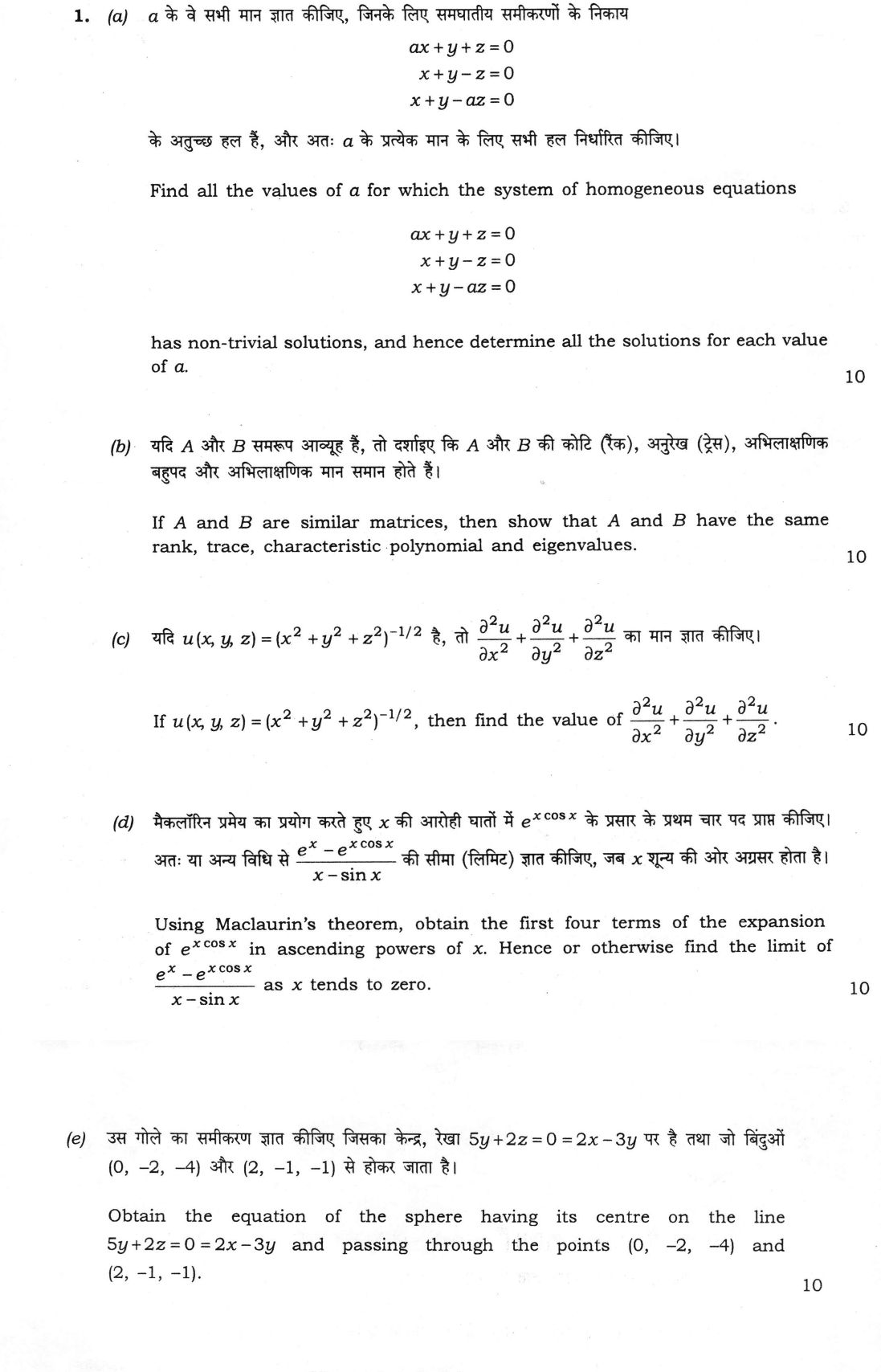
(a) Find all the values of a for which the system of homogeneous equations ax + y + z = 0 x + y - z = 0 x + y - az = 0 has…
Find all the values of a for which the system of homogeneous equations
ax + y + z = 0 x + y - z = 0 x + y - az = 0
has non-trivial solutions, and hence determine all the solutions for each value of a. 10 marks
If A and B are similar matrices, then show that A and B have the same rank, trace, characteristic polynomial and eigenvalues. 10 marks
If u(x, y, z) = (x² + y² + z²)^-1/2 , then find the value of ∂^2u/∂x² + ∂^2u/∂y² + ∂^2u/∂z² . 10 marks
Using Maclaurin’s theorem, obtain the first four terms of the expansion of e^x cos x in ascending powers of x. Hence or otherwise find the limit of (e^x - e^x cos x)/(x - sin x) as x tends to zero. 10 marks
Obtain the equation of the sphere having its centre on the line 5y + 2z = 0 = 2x – 3y and passing through the points (0, –2, –4) and (2, –1, –1). 10 marks
हिंदी में प्रश्न पढ़ें
a के वे सभी मान ज्ञात कीजिए, जिनके लिए समघातीय समीकरणों के निकाय
ax + y + z = 0 x + y - z = 0 x + y - az = 0
के अतुच्छ हल हैं, और अत: a के प्रत्येक मान के लिए सभी हल निर्धारित कीजिए। (10 अंक)
यदि A और B समरूप आव्यूह हैं, तो दर्शाइए कि A और B की कोटि (रैंक), अनुरेख (ट्रेस), अभिलाक्षणिक बहुपद और अभिलाक्षणिक मान समान होते हैं। (10 अंक)
यदि u(x, y, z) = (x² + y² + z²)^-1/2 है, तो ∂^2u/∂x² + ∂^2u/∂y² + ∂^2u/∂z² का मान ज्ञात कीजिए। (10 अंक)
मैक्लॉरिन प्रमेय का प्रयोग करते हुए x की आरोही घातों में e^x cos x के प्रसार के प्रथम चार पद प्राप्त कीजिए। अत: या अन्य विधि से (e^x - e^x cos x)/(x - sin x) की सीमा (लिमिट) ज्ञात कीजिए, जब x शून्य की ओर अग्रसर होता है। (10 अंक)
उस गोले का समीकरण ज्ञात कीजिए जिसका केन्द्र, रेखा 5y + 2z = 0 = 2x – 3y पर है तथा जो बिंदुओं (0, –2, –4) और (2, –1, –1) से होकर जाता है। (10 अंक)
Model answer
Drafted with AI by UPSC Answer Check against this question's marking rubric, to the expected length. UPSC does not publish answers for Mains — this is one way to score well, not an official key. How we build rubrics and answers.
(a) Values of a and the solutions A homogeneous system has a non-trivial solution if and only if the determinant of its coefficient matrix is zero. Coefficient matrix A = [a 1 1; 1 1 −1; 1 1 −a]. det A = a(1·(−a) − (−1)·1) − 1(1·(−a) − (−1)·1) + 1(1·1 − 1·1) = a(1 − a) − (1 − a) + 0 = −(a − 1)². det A = 0 ⇒ a = 1 (the only value). For every a ≠ 1, det A ≠ 0 and the only solution is x = y = z = 0. For a = 1 the system is x + y + z = 0, x + y − z = 0, x + y − z = 0 (the third equation repeats the second). Subtracting: 2z = 0 ⇒ z = 0; then x + y = 0 ⇒ y = −x. Rank A = 2, so nullity = 1. Put x = t: for a = 1, (x, y, z) = t(1, −1, 0), t ∈ ℝ (non-trivial for t ≠ 0).
(b) Invariants of similar matrices A and B similar means B = P⁻¹AP for some invertible matrix P. Rank: multiplication by an invertible matrix does not change rank, so rank B = rank(P⁻¹(AP)) = rank(AP) = rank A. Trace: using tr(XY) = tr(YX), tr B = tr(P⁻¹(AP)) = tr((AP)P⁻¹) = tr(A(PP⁻¹)) = tr A. Characteristic polynomial: B − λI = P⁻¹AP − λP⁻¹IP = P⁻¹(A − λI)P, so det(B − λI) = det(P⁻¹)·det(A − λI)·det(P) = det(A − λI), since det(P⁻¹)det(P) = det(P⁻¹P) = det I = 1. Eigenvalues: the eigenvalues are the roots of the characteristic polynomial; the two polynomials are identical, so A and B have the same eigenvalues with the same algebraic multiplicities. (If Av = λv, then B(P⁻¹v) = λ(P⁻¹v).)
(c) Laplacian of u Let r² = x² + y² + z², so u = r⁻¹ and ∂r/∂x = x/r. ∂u/∂x = −r⁻²·(x/r) = −x/r³. ∂²u/∂x² = −1/r³ + 3x·r⁻⁴·(x/r) = 3x²/r⁵ − 1/r³. By symmetry, ∂²u/∂y² = 3y²/r⁵ − 1/r³ and ∂²u/∂z² = 3z²/r⁵ − 1/r³. Sum = 3(x² + y² + z²)/r⁵ − 3/r³ = 3r²/r⁵ − 3/r³ = 0, for all (x, y, z) ≠ (0, 0, 0). Thus u is harmonic away from the origin.
(d) Maclaurin expansion and the limit Maclaurin's theorem: f(x) = f(0) + x f′(0) + x² f″(0)/2! + x³ f‴(0)/3! + …, with f(x) = e^x cos x. Let g(x) = x cos x: g(0) = 0; g′ = cos x − x sin x, g′(0) = 1; g″ = −2 sin x − x cos x, g″(0) = 0; g‴ = −3 cos x + x sin x, g‴(0) = −3. Since f = e^g: f′ = f g′, f″ = f(g′² + g″), f‴ = f(g′³ + 3g′g″ + g‴). f(0) = 1, f′(0) = 1, f″(0) = 1, f‴(0) = 1 + 0 − 3 = −2. Hence e^x cos x = 1 + x + x²/2 − x³/3 + … (since −2/3! = −1/3). (Check: x cos x = x − x³/2 + …, and e^t = 1 + t + t²/2 + t³/6 + … gives the x³ coefficient −1/2 + 1/6 = −1/3.) Limit: e^x = 1 + x + x²/2 + x³/6 + …, so e^x − e^x cos x = (1/6 + 1/3)x³ + O(x⁴) = x³/2 + O(x⁴), and x − sin x = x³/6 − x⁵/120 + …. lim(x→0) (e^x − e^x cos x)/(x − sin x) = (1/2)/(1/6) = 3.
(e) Equation of the sphere Line 5y + 2z = 0 = 2x − 3y: x = 3y/2, z = −5y/2. Put y = 2t, so the centre is C = (3t, 2t, −5t) (the line passes through the origin with direction ratios 3 : 2 : −5). The sphere passes through A(0, −2, −4) and B(2, −1, −1), so CA² = CB²: (3t)² + (2t + 2)² + (−5t + 4)² = (3t − 2)² + (2t + 1)² + (−5t + 1)² 38t² − 32t + 20 = 38t² − 18t + 6 ⇒ 14t = 14 ⇒ t = 1. Centre (3, 2, −5); R² = CA² = 3² + 4² + (−1)² = 26 (check with B: 1 + 9 + 16 = 26). Sphere: (x − 3)² + (y − 2)² + (z + 5)² = 26, i.e. x² + y² + z² − 6x − 4y + 10z + 12 = 0.
How this answer will be evaluated
Evaluation rubric
Each sub-part is marked on its own, against the marks and word limit printed on the paper.
- (a) Two linked tasks: (i) find every value of the parameter a for which the 3x3 homogeneous system ax+y+z=0, x+y-z=0, x+y-az=0 has a non-trivial (non-zero) solution, and (ii) for each such a, write down the complete solution set, not merely the existence condition. 10 marks
Must cover
- Criterion: non-trivial solution iff det A = 0; det A = −(a−1)²
- a = 1 is the only value; for a ≠ 1 only the trivial solution x = y = z = 0
- For a = 1: (x, y, z) = t(1, −1, 0), t ∈ ℝ (rank 2, nullity 1)
Loses marks
- Arithmetic slip in the 3×3 determinant giving a spurious second root such as a = −1 or a = 0
- Stopping at a = 1 without solving for the solution set (loses the 'hence determine all the solutions' marks)
- Sign error giving (t, t, 0) or (t, −t, t) instead of t(1, −1, 0)
- Not stating that every a ≠ 1 gives only the trivial solution
Earns more
- Substitutes a = 1 and reduces the system correctly to z = 0, x + y = 0 (rank 2, nullity 1)
- (b) Prove four separate invariance results for similar matrices A and B (B = P^{-1}AP with P invertible): equality of rank, of trace, of characteristic polynomial and of eigenvalues. Each of the four must be proved, not merely asserted. 10 marks
Must cover
- B = P⁻¹AP with P invertible; rank unchanged by multiplication with invertible matrices
- Trace via tr(XY) = tr(YX): tr B = tr A
- B − λI = P⁻¹(A − λI)P and det(P⁻¹)det P = 1 give det(B − λI) = det(A − λI); eigenvalues are its roots, hence equal
Loses marks
- Asserting tr(P⁻¹AP) = tr A without invoking tr(XY) = tr(YX)
- Proving eigenvalues equal first and treating that as proof of equal characteristic polynomials (the logical order is the reverse)
- Omitting the rank argument or claiming similar matrices are equal
- Claiming similar matrices have the same eigenvectors (they correspond via v → P⁻¹v)
Earns more
- Rank proof: rank is unchanged by pre/post multiplication by an invertible matrix, hence rank A = rank B
- (c) Compute the Laplacian of u = (x^2 + y^2 + z^2)^{-1/2}, i.e. evaluate u_xx + u_yy + u_zz, and state the value (with the domain restriction r != 0). 10 marks
Must cover
- u = 1/r, r² = x² + y² + z², ∂u/∂x = −x/r³
- ∂²u/∂x² = 3x²/r⁵ − 1/r³ and symmetric forms
- Sum = 3r²/r⁵ − 3/r³ = 0 for (x, y, z) ≠ (0, 0, 0)
Loses marks
- Chain-rule slip giving ∂u/∂x = −x/r² and a non-zero answer
- Dropping the −1/r³ term so the sum comes out as 3/r³
- Not excluding the origin, where u is undefined
- Using the 2-D radial formula (1/r)d/dr(r du/dr), which gives 1/r³ instead of 0
Earns more
- Correct first partial derivative du/dx = -x/r^3
- States the restriction (x, y, z) != (0, 0, 0) and that u is therefore harmonic off the origin
- (d) Two linked tasks: (i) use Maclaurin's theorem to expand e^{x cos x} and give the first four terms in ascending powers of x, and (ii) hence (or otherwise) evaluate lim_{x->0} (e^x - e^{x cos x})/(x - sin x). 10 marks
Must cover
- Maclaurin's theorem (or composition of the series of cos x and e^t)
- e^{x cos x} = 1 + x + x²/2 − x³/3 + …
- e^x − e^{x cos x} = x³/2 + O(x⁴), x − sin x = x³/6 + …, limit = 3
Loses marks
- Omitting the t³/6 contribution so the x³ coefficient comes out as −1/2 instead of −1/3
- Treating e^{x cos x} as e^x·cos x
- Stopping L'Hôpital's rule before the 0/0 form clears (three applications are needed)
- Sign error giving numerator −x³/2 and limit −3
Earns more
- Correct substitution into e^t = 1 + t + t^2/2! + t^3/3! + ... with all contributions to x^3 collected
- (e) Find the equation of the sphere whose centre lies on the line given as the intersection of the planes 5y + 2z = 0 and 2x - 3y = 0, and which passes through the two given points (0, -2, -4) and (2, -1, -1). 10 marks
Must cover
- Centre on the line: C = (3t, 2t, −5t) (direction ratios 3 : 2 : −5 through the origin)
- CA² = CB² ⇒ 38t² − 32t + 20 = 38t² − 18t + 6 ⇒ t = 1; centre (3, 2, −5), radius √26
- x² + y² + z² − 6x − 4y + 10z + 12 = 0
Loses marks
- Solving 5y + 2z = 0 as z = 5y/2 (sign slip), giving centre (3t, 2t, 5t)
- Using the general equation but not requiring the centre (−u, −v, −w) to satisfy both plane equations
- Using only one of the two points, leaving a one-parameter family
- Reporting the radius as 26 instead of √26
Earns more
- Verification that both given points satisfy the equation (each gives distance^2 = 26)
What "Calculate" is asking you to do
Apply the standard formula or schedule to data the question has already supplied — a table of readings, cost records, a balance sheet — and produce the number. The method is rarely in doubt; the marks sit in the named intermediate quantities, each of which has to appear as a labelled line.
Structure that answers it
Data as given → formula or standard treatment, named → substitution → each intermediate, labelled → result with units
Where marks are lost
Omitting an intermediate the marking scheme pays for separately, or rounding at an intermediate line so the final figure drifts. In commerce and accountancy, any figure in a statement that no numbered working note supports is treated as unearned.
Practice this exact question
Write your answer and it is marked point by point against the model answer above — what you covered, what you missed, what you got wrong.
Evaluate my answer →More from Mathematics 2026 Paper I
- Q1 (a) Find all the values of a for which the system of homogeneous equations ax + y + z = 0…
- Q2 (a) Let T : P₂[x] → P₂[x] be a linear transformation defined by T(a₀ + a₁x + a₂x²) = –(a₀…
- Q3 (a) Given P₃[x] = {a₀ + a₁x + a₂x² + a₃x³ | a₀, a₁, a₂, a₃ ∈ ℝ} as a vector space over th…
- Q4 (a) Let F be a subfield of complex numbers and let T be the linear transformation from F³…