Paper I — Q4
(a) Let F be a subfield of complex numbers and let T be the linear transformation from F³ into F³, defined by T(x, y, z) = (x –…
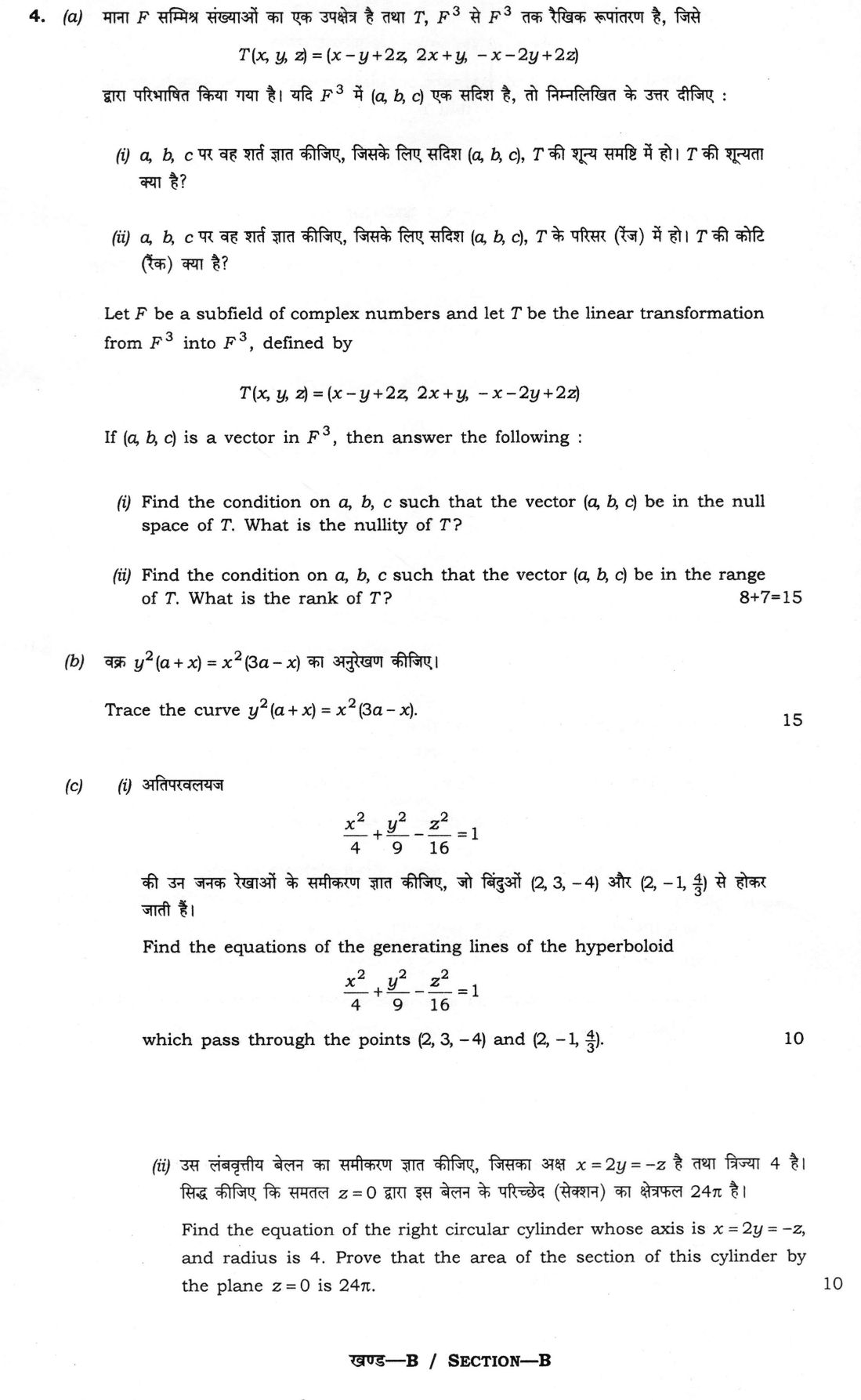
Let F be a subfield of complex numbers and let T be the linear transformation from F³ into F³, defined by
T(x, y, z) = (x – y + 2z, 2x + y, – x – 2y + 2z)
If (a, b, c) is a vector in F³, then answer the following :
Find the condition on a, b, c such that the vector (a, b, c) be in the null space of T. What is the nullity of T?
Find the condition on a, b, c such that the vector (a, b, c) be in the range of T. What is the rank of T? 8+7= 15 marks
Trace the curve y²(a + x) = x²(3a – x). 15 marks
Find the equations of the generating lines of the hyperboloid
x²/4 + y²/9 – z²/16 = 1
which pass through the points (2, 3, – 4) and (2, – 1, 4/3). 10 marks
Find the equation of the right circular cylinder whose axis is x = 2y = -z, and radius is 4. Prove that the area of the section of this cylinder by the plane z = 0 is 24π. 10 marks
हिंदी में प्रश्न पढ़ें
माना F सम्मिश्र संख्याओं का एक उपक्षेत्र है तथा T, F³ से F³ तक रैखिक रूपांतरण है, जिसे
T(x, y, z) = (x – y + 2z, 2x + y, – x – 2y + 2z)
द्वारा परिभाषित किया गया है। यदि F³ में (a, b, c) एक सदिश है, तो निम्नलिखित के उत्तर दीजिए :
a, b, c पर वह शर्त ज्ञात कीजिए, जिसके लिए सदिश (a, b, c), T की शून्य समष्टि में हो। T की शून्यता क्या है?
a, b, c पर वह शर्त ज्ञात कीजिए, जिसके लिए सदिश (a, b, c), T के परिसर (रेंज) में हो। T की कोटि (रैंक) क्या है? 8+7 = (15 अंक)
वक्र y²(a + x) = x²(3a – x) का अनुरेखण कीजिए। (15 अंक)
अतिपरवलयज
x²/4 + y²/9 – z²/16 = 1
की उन जनक रेखाओं के समीकरण ज्ञात कीजिए, जो बिंदुओं (2, 3, – 4) और (2, – 1, 4/3) से होकर जाती हैं। (10 अंक)
उस लंबवृत्तीय बेलन का समीकरण ज्ञात कीजिए, जिसका अक्ष x = 2y = -z है तथा त्रिज्या 4 है। सिद्ध कीजिए कि समतल z = 0 द्वारा इस बेलन के परिच्छेद (सेक्शन) का क्षेत्रफल 24π है। (10 अंक)
Model answer
Drafted with AI by UPSC Answer Check against this question's marking rubric, to the expected length. UPSC does not publish answers for Mains — this is one way to score well, not an official key. How we build rubrics and answers.
(a) Null space and range of T The matrix of T with respect to the standard basis is A = [1 −1 2; 2 1 0; −1 −2 2]. (i) (a, b, c) ∈ N(T) ⇔ T(a, b, c) = 0: a − b + 2c = 0, 2a + b = 0, −a − 2b + 2c = 0. From the second, b = −2a; the first gives 3a + 2c = 0, so c = −3a/2; the third is then satisfied: −a + 4a − 3a = 0. Condition: b = −2a, c = −3a/2, i.e. (a, b, c) is a multiple of (2, −4, −3). N(T) = span{(2, −4, −3)}, so nullity of T = 1. (ii) (a, b, c) ∈ R(T) ⇔ T(x, y, z) = (a, b, c) is solvable. Row-reduce the augmented matrix: [1 −1 2 | a; 2 1 0 | b; −1 −2 2 | c] R₂ → R₂ − 2R₁, R₃ → R₃ + R₁: [1 −1 2 | a; 0 3 −4 | b − 2a; 0 −3 4 | c + a] R₃ → R₃ + R₂: [1 −1 2 | a; 0 3 −4 | b − 2a; 0 0 0 | b + c − a]. The system is consistent iff b + c − a = 0. Condition: a = b + c (equivalently a − b − c = 0). Check: the columns (1, 2, −1), (−1, 1, −2), (2, 0, 2) all satisfy it. The echelon form has two non-zero rows, so rank of T = 2, and rank + nullity = 2 + 1 = 3 = dim F³.
(b) Tracing y²(a + x) = x²(3a − x), a > 0 Symmetry: only even powers of y occur, so the curve is symmetric about the x-axis. Origin: the curve passes through (0, 0); the lowest-degree terms a y² − 3a x² = 0 give the tangents y = ±√3 x, real and distinct, so the origin is a node. Intercepts: y = 0 ⇒ x = 0 or x = 3a. At (3a, 0), shifting x = 3a + X gives 4a y² ≈ −9a² X to first order, so the tangent there is vertical (x = 3a). Asymptotes: the coefficient of the highest power of y is (a + x), so x = −a is an asymptote parallel to the y-axis. The highest-degree terms x(x² + y²) have no other real linear factor, so there is no other real asymptote. Region: y² = x²(3a − x)/(a + x). x > 3a: y² < 0, no curve. x < −a: y² < 0, no curve. −a < x < 3a: y² ≥ 0, curve exists. Shape: d(y²)/dx = −2x(x² − 3a²)/(a + x)², which vanishes in (−a, 3a) only at x = 0 and x = √3 a. For 0 < x < 3a: y² rises from 0 to its maximum (6√3 − 9)a² at x = √3 a (|y| ≈ 1.18a), then falls to 0 at x = 3a, so there is a loop between x = 0 and x = 3a. For −a < x < 0: y² decreases steadily from +∞ (as x → −a⁺) to 0, so two infinite branches come in from the asymptote x = −a (one above, one below the x-axis) and pass through the origin. Conclusion: a strophoid-type curve: a loop on 0 ≤ x ≤ 3a, a node at the origin with tangents y = ±√3 x, two infinite branches in −a < x < 0 approaching the asymptote x = −a, and no part of the curve for x < −a or x > 3a.

(c)(i) Generators of the hyperboloid x²/4 + y²/9 − z²/16 = 1 ⇔ (x/2 − z/4)(x/2 + z/4) = (1 − y/3)(1 + y/3). λ-system: x/2 − z/4 = λ(1 − y/3), λ(x/2 + z/4) = 1 + y/3. μ-system: x/2 − z/4 = μ(1 + y/3), μ(x/2 + z/4) = 1 − y/3. Both points lie on the surface: 1 + 1 − 1 = 1 and 1 + 1/9 − 1/9 = 1. At (2, 3, −4): x/2 − z/4 = 2, x/2 + z/4 = 0, 1 − y/3 = 0, 1 + y/3 = 2. λ-system: 2 = λ·0 has no finite λ; λ → ∞ gives the generator 1 − y/3 = 0, x/2 + z/4 = 0, i.e. y = 3, 2x + z = 0. μ-system: 2 = 2μ ⇒ μ = 1 (second equation 0 = 0 holds): x/2 − z/4 = 1 + y/3, x/2 + z/4 = 1 − y/3; adding and subtracting, x = 2, 4y + 3z = 0. At (2, −1, 4/3): x/2 − z/4 = 2/3, x/2 + z/4 = 4/3, 1 − y/3 = 4/3, 1 + y/3 = 2/3. λ-system: 2/3 = (4/3)λ ⇒ λ = 1/2 (check: (1/2)(4/3) = 2/3): x/2 − z/4 = ½(1 − y/3), x/2 + z/4 = 2(1 + y/3), i.e. 6x + 2y − 3z = 6, 6x − 8y + 3z = 24, or (x − 2)/3 = (y + 1)/6 = (z − 4/3)/10. μ-system: 2/3 = (2/3)μ ⇒ μ = 1, the same generator x = 2, 4y + 3z = 0. Hence the generator through both points is x = 2, 4y + 3z = 0, i.e. (x − 2)/0 = (y − 3)/3 = (z + 4)/(−4) (the line joining the points lies on the surface). The other generators are y = 3, 2x + z = 0 through (2, 3, −4) and (x − 2)/3 = (y + 1)/6 = (z − 4/3)/10 through (2, −1, 4/3).
(c)(ii) Right circular cylinder and its section by z = 0 Axis x = 2y = −z: through the origin with direction u = (2, 1, −2), |u|² = 9. For a point r = (x, y, z), distance² from the axis = |r × u|²/|u|², with r × u = (−2y − z, 2x + 2z, x − 2y). Radius 4: [(2y + z)² + 4(x + z)² + (x − 2y)²]/9 = 16 ⇒ 4y² + 4yz + z² + 4x² + 8xz + 4z² + x² − 4xy + 4y² = 144 ⇒ 5x² + 8y² + 5z² − 4xy + 4yz + 8zx = 144. Section by z = 0: 5x² − 4xy + 8y² = 144. The quadratic-form matrix [5 −2; −2 8] has eigenvalues from λ² − 13λ + 36 = 0, i.e. λ = 4, 9. In principal axes, 4X² + 9Y² = 144, i.e. X²/36 + Y²/16 = 1: an ellipse with semi-axes 6 and 4. Area = π·6·4 = 24π. (Geometric check: the plane z = 0 makes angle θ with the normal section, where cos θ = |u·k|/|u| = 2/3, so area = π·4²/(2/3) = 24π.)
How this answer will be evaluated
What earns full marks: Rigorous derivation with all steps justified and verified.
Evaluation rubric
Each sub-part is marked on its own, against the marks and word limit printed on the paper.
- (a) For T(x, y, z) = (x − y + 2z, 2x + y, −x − 2y + 2z) on F³: (i) find the condition on a, b, c for (a, b, c) to lie in the null space of T and state the nullity; (ii) find the condition on a, b, c for (a, b, c) to lie in the range of T and state the rank. 15 marks
calculate— given → formula → substitution → result with units → interpretation
Must cover
- Null space: b = −2a, c = −3a/2, i.e. N(T) = span{(2, −4, −3)}; nullity 1
- Range: row-reducing the augmented matrix gives the consistency condition b + c − a = 0, i.e. a = b + c
- Rank of T = 2 (rank + nullity = 3)
Loses marks
- Confusing the null-space condition with the range condition
- Stating rank 2 without deriving the range condition on a, b, c
- Sign slip giving the range condition a + b − c = 0 or similar
Earns more
- Checks that each column of A satisfies a − b − c = 0
- States the matrix of T in the standard basis
- (b) Trace (sketch with justification) the curve y²(a + x) = x²(3a − x): symmetry, points and tangents at the origin, intercepts, asymptotes, regions where the curve exists, and the resulting shape. 15 marks
Must cover
- Symmetry about the x-axis; node at the origin with tangents y = ±√3 x
- Intercepts (0, 0) and (3a, 0) (vertical tangent at (3a, 0)); asymptote x = −a
- Curve exists only for −a < x ≤ 3a: a loop on 0 ≤ x ≤ 3a and two infinite branches in −a < x < 0 approaching x = −a
Loses marks
- Calling the origin a cusp or conjugate point
- Missing the branches in −a < x < 0 (claiming the curve is only a loop)
- Missing or misplacing the asymptote x = −a
- Claiming the curve exists for x > 3a or x < −a
Earns more
- Maximum of the loop at x = √3 a, y² = (6√3 − 9)a²
- A labelled sketch consistent with the analysis
- (c)(i) Find the equations of the generating lines of the hyperboloid x²/4 + y²/9 − z²/16 = 1 that pass through the points (2, 3, −4) and (2, −1, 4/3). 10 marks
calculate— given → formula → substitution → result with units → interpretation
Must cover
- Factorisation (x/2 − z/4)(x/2 + z/4) = (1 − y/3)(1 + y/3) and the two systems of generators
- The generator x = 2, 4y + 3z = 0 passes through both points
- Other generators: y = 3, 2x + z = 0 through (2, 3, −4); 6x + 2y − 3z = 6, 6x − 8y + 3z = 24 through (2, −1, 4/3)
Loses marks
- Incorrect factorisation of the surface equation
- Giving up at (2, 3, −4) because λ is infinite, instead of taking the limiting generator
- Finding only one generator per point without identifying the common one
Earns more
- Verifies both points lie on the hyperboloid
- Handles λ → ∞ correctly at (2, 3, −4)
- (c)(ii) Find the equation of the right circular cylinder of radius 4 whose axis is x = 2y = −z, and prove that its section by the plane z = 0 has area 24π. 10 marks
calculate— given → formula → substitution → result with units → interpretation
Must cover
- Axis direction (2, 1, −2); distance² = |r × u|²/9 = 16
- Cylinder 5x² + 8y² + 5z² − 4xy + 4yz + 8zx = 144
- Section z = 0: 5x² − 4xy + 8y² = 144, eigenvalues 4 and 9, ellipse X²/36 + Y²/16 = 1, area π·6·4 = 24π
Loses marks
- Using direction ratios (1, 2, −1) for the axis x = 2y = −z
- Expansion slip in the cylinder equation
- Asserting the area 24π without reducing the conic or computing its semi-axes
Earns more
- Geometric check: area = π·4²/cos θ with cos θ = 2/3
What "Solve" is asking you to do
Choose the method, then carry it through to a final answer. Identifying what kind of problem this is and why that method applies is the first thing marked; a correct figure arrived at invisibly earns almost nothing.
Structure that answers it
Given data and what is required → method chosen, with the reason it applies → set-up (equation, circuit, free body, trial balance) → working, step by step → answer with units and any condition of validity
Where marks are lost
Doing the middle steps mentally and writing only the result. In mathematics papers, a further loss comes from giving a decimal where the exact value in surds or fractions was wanted, or from skipping the justification a part explicitly asks for.
Practice this exact question
Write your answer and it is marked point by point against the model answer above — what you covered, what you missed, what you got wrong.
Evaluate my answer →More from Mathematics 2026 Paper I
- Q1 (a) Find all the values of a for which the system of homogeneous equations ax + y + z = 0…
- Q2 (a) Let T : P₂[x] → P₂[x] be a linear transformation defined by T(a₀ + a₁x + a₂x²) = –(a₀…
- Q3 (a) Given P₃[x] = {a₀ + a₁x + a₂x² + a₃x³ | a₀, a₁, a₂, a₃ ∈ ℝ} as a vector space over th…
- Q4 (a) Let F be a subfield of complex numbers and let T be the linear transformation from F³…
- Q5 (a) If y₁ and y₂ are two solutions of dy/dx + P(x)y = Q(x), and y₂ = y₁u, then show that…
- Q6 (a) Solve x² d²y/dx² − 3x dy/dx + y = (sin(log x) + 1)/x log x. (15 marks) (b) (i) A batt…
- Q7 (a) A light elastic string of natural length l has one extremity fixed at a point A and t…