Paper I — Q7
(a) A light elastic string of natural length l has one extremity fixed at a point A and the other attached to a stone (mass m)…
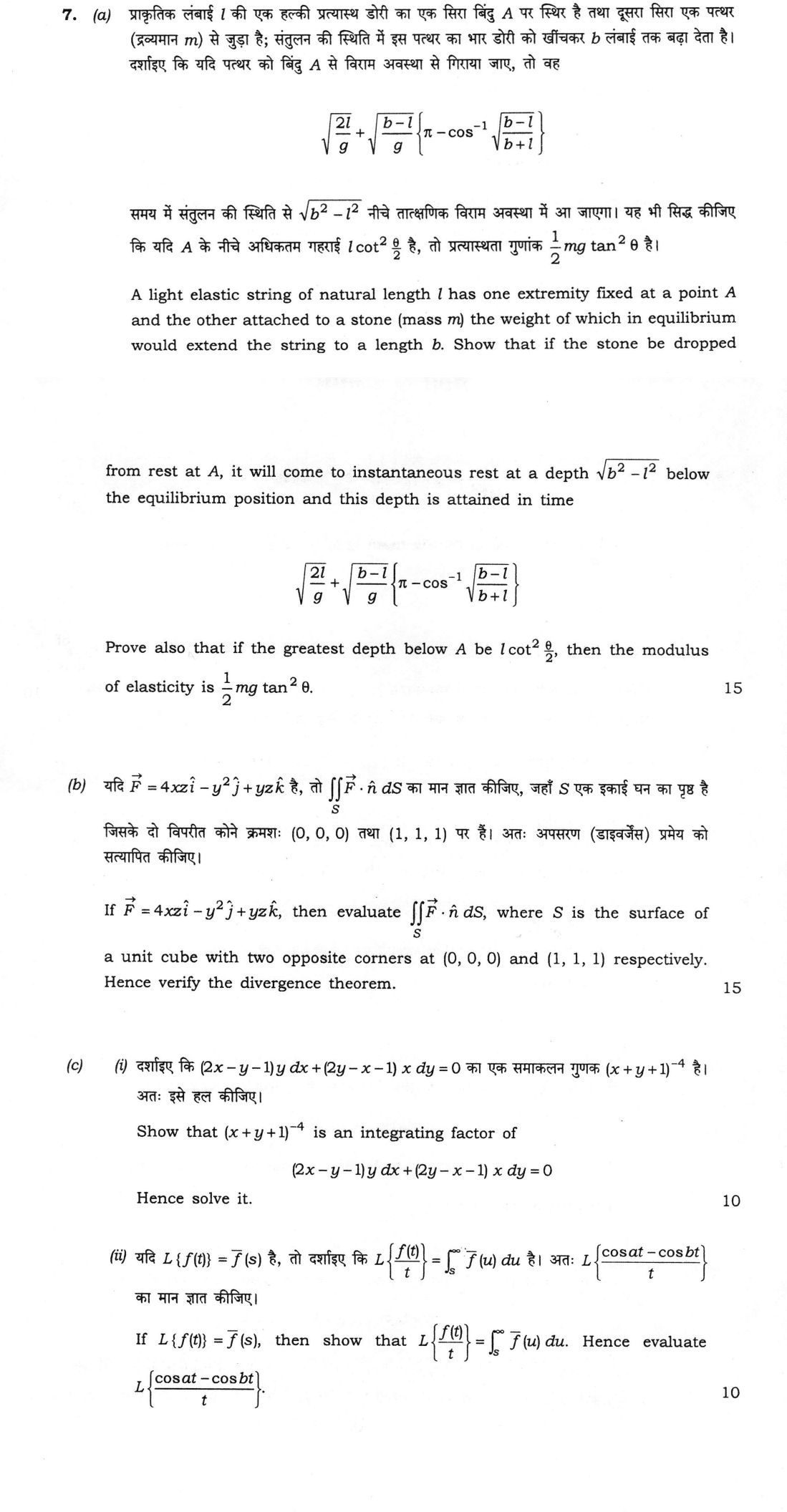
A light elastic string of natural length l has one extremity fixed at a point A and the other attached to a stone (mass m) the weight of which in equilibrium would extend the string to a length b. Show that if the stone be dropped from rest at A, it will come to instantaneous rest at a depth √(b² − l²) below the equilibrium position and this depth is attained in time
√(2l/g) + √((b − l)/g) { π − cos⁻¹ √((b − l)/(b + l)) }
Prove also that if the greatest depth below A be l cot² θ/2, then the modulus of elasticity is ½ mg tan² θ. 15 marks
If F⃗ = 4xz î − y² ĵ + yz k̂, then evaluate ∬_S F⃗ · n̂ dS, where S is the surface of a unit cube with two opposite corners at (0, 0, 0) and (1, 1, 1) respectively. Hence verify the divergence theorem. 15 marks
Show that (x + y + 1)⁻⁴ is an integrating factor of
(2x − y − 1) y dx + (2y − x − 1) x dy = 0
Hence solve it. 10 marks
If L {f(t)} = f̄(s), then show that L {f(t)/t} = ∫_s^∞ f̄(u) du. Hence evaluate
L {(cos at − cos bt)/t}. 10 marks
हिंदी में प्रश्न पढ़ें
प्राकृतिक लंबाई l की एक हल्की प्रत्यास्थ डोरी का एक सिरा बिंदु A पर स्थिर है तथा दूसरा सिरा एक पत्थर (द्रव्यमान m) से जुड़ा है; संतुलन की स्थिति में इस पत्थर का भार डोरी को खींचकर b लंबाई तक बढ़ा देता है। दर्शाइए कि यदि पत्थर को बिंदु A से विराम अवस्था से गिराया जाए, तो वह
√(2l/g) + √((b − l)/g) { π − cos⁻¹ √((b − l)/(b + l)) }
समय में संतुलन की स्थिति से √(b² − l²) नीचे तात्क्षणिक विराम अवस्था में आ जाएगा। यह भी सिद्ध कीजिए कि यदि A के नीचे अधिकतम गहराई l cot² θ/2 है, तो प्रत्यास्थता गुणांक ½ mg tan² θ है। (15 अंक)
यदि F⃗ = 4xz î − y² ĵ + yz k̂ है, तो ∬_S F⃗ · n̂ dS का मान ज्ञात कीजिए, जहाँ S एक इकाई घन का पृष्ठ है जिसके दो विपरीत कोने क्रमशः (0, 0, 0) तथा (1, 1, 1) पर हैं। अतः अपसरण (डाइवर्जेंस) प्रमेय को सत्यापित कीजिए। (15 अंक)
दर्शाइए कि (2x − y − 1) y dx + (2y − x − 1) x dy = 0 का एक समाकलन गुणक (x + y + 1)⁻⁴ है। अतः इसे हल कीजिए। (10 अंक)
यदि L {f(t)} = f̄(s) है, तो दर्शाइए कि L {f(t)/t} = ∫_s^∞ f̄(u) du है। अतः L {(cos at − cos bt)/t} का मान ज्ञात कीजिए। (10 अंक)
Model answer
Drafted with AI by UPSC Answer Check against this question's marking rubric, to the expected length. UPSC does not publish answers for Mains — this is one way to score well, not an official key. How we build rubrics and answers.
(a) Stone on an elastic string Let λ be the modulus. In equilibrium the extension is b − l, so mg = λ(b − l)/l ⇒ λ = mgl/(b − l). Free fall: the string becomes taut after the stone falls l, with speed v₀ = √(2gl), in time t₁ = √(2l/g). Beyond this, let x be the displacement below the equilibrium position (depth b below A). The tension is λ(b − l + x)/l, so m ẍ = mg − λ(b − l + x)/l = −(λ/ml)·m x ⇒ ẍ = −ω²x, ω² = λ/(ml) = g/(b − l). The SHM starts at x = −(b − l) with speed √(2gl), so the amplitude A satisfies A² = (b − l)² + v₀²/ω² = (b − l)² + 2l(b − l) = b² − l². The stone comes to instantaneous rest at the lowest extreme, x = A: depth √(b² − l²) below the equilibrium position. Time: write x = −A cos ψ with ψ = ωτ + ψ₀. At the start cos ψ₀ = (b − l)/A = (b − l)/√(b² − l²) = √((b − l)/(b + l)), with x increasing; the lowest point is ψ = π. So t₂ = (π − ψ₀)/ω = √((b − l)/g) π − cos⁻¹√((b − l)/(b + l)). Total time = t₁ + t₂ = √(2l/g) + √((b − l)/g) π − cos⁻¹√((b − l)/(b + l)). Greatest depth: let the greatest depth below A be D = l cot²(θ/2) = lk, so the extension there is e = D − l = l(k − 1). The stone is momentarily at rest at A and at D, so energy gives mgD = λe²/(2l) ⇒ mg lk = λ l(k − 1)²/2 ⇒ λ = 2mgk/(k − 1)². With k = cot²(θ/2): k − 1 = [cos²(θ/2) − sin²(θ/2)]/sin²(θ/2) = cos θ/sin²(θ/2), so 2k/(k − 1)² = 2cos²(θ/2) sin²(θ/2)/cos²θ = (sin²θ/2)/cos²θ = ½ tan²θ. Hence λ = ½ mg tan²θ.
(b) Divergence theorem for the unit cube F = 4xz î − y² ĵ + yz k̂, cube 0 ≤ x, y, z ≤ 1, outward normals. x = 1, n̂ = î: F·n̂ = 4z, ∫₀¹∫₀¹ 4z dy dz = 2. x = 0, n̂ = −î: F·n̂ = −4xz = 0. y = 1, n̂ = ĵ: F·n̂ = −y² = −1, integral = −1. y = 0, n̂ = −ĵ: F·n̂ = y² = 0. z = 1, n̂ = k̂: F·n̂ = yz = y, ∫₀¹∫₀¹ y dx dy = 1/2. z = 0, n̂ = −k̂: F·n̂ = −yz = 0. ∬_S F·n̂ dS = 2 − 1 + 1/2 = 3/2. div F = ∂(4xz)/∂x + ∂(−y²)/∂y + ∂(yz)/∂z = 4z − 2y + y = 4z − y. ∭_V (4z − y) dV = ∫₀¹ 4z dz − ∫₀¹ y dy = 2 − 1/2 = 3/2. The two values agree, so the divergence theorem is verified.
(c)(i) Integrating factor M = y(2x − y − 1), N = x(2y − x − 1). ∂M/∂y = 2x − 2y − 1 ≠ ∂N/∂x = 2y − 2x − 1, so the equation is not exact. With μ = (x + y + 1)⁻⁴, M* = μM and N* = μN: ∂M*/∂y = [(2x − 2y − 1)(x + y + 1) − 4y(2x − y − 1)]/(x + y + 1)⁵ = (2x² + 2y² − 8xy + x + y − 1)/(x + y + 1)⁵, ∂N*/∂x = [(2y − 2x − 1)(x + y + 1) − 4x(2y − x − 1)]/(x + y + 1)⁵ = (2x² + 2y² − 8xy + x + y − 1)/(x + y + 1)⁵. They are equal, so (x + y + 1)⁻⁴ is an integrating factor. Solution: V = −xy/(x + y + 1)³ satisfies ∂V/∂x = y[−(x + y + 1) + 3x]/(x + y + 1)⁴ = y(2x − y − 1)/(x + y + 1)⁴ = M*, and by symmetry ∂V/∂y = N*. Hence V = constant: xy = C(x + y + 1)³.
(c)(ii) Division by t Let f̄(s) = ∫₀^∞ e^−st f(t) dt. Then, interchanging the order of integration (valid for s large enough that the integrals converge absolutely), ∫ₛ^∞ f̄(u) du = ∫ₛ^∞ ∫₀^∞ e^−ut f(t) dt du = ∫₀^∞ f(t) [∫ₛ^∞ e^−ut du] dt = ∫₀^∞ f(t) e^−st/t dt = Lf(t)/t. For f(t) = cos at − cos bt: f̄(s) = s/(s² + a²) − s/(s² + b²). L(cos at − cos bt)/t = ∫ₛ^∞ [u/(u² + a²) − u/(u² + b²)] du = [½ ln((u² + a²)/(u² + b²))]ₛ^∞ = 0 − ½ ln((s² + a²)/(s² + b²)) = ½ ln[(s² + b²)/(s² + a²)].
How this answer will be evaluated
Evaluation rubric
Each sub-part is marked on its own, against the marks and word limit printed on the paper.
- (a) Three things must be proved for a stone dropped from rest at A on a light elastic string of natural length l (equilibrium length b): (i) it comes to instantaneous rest at depth sqrt(b^2 - l^2) below the equilibrium position; (ii) this happens at time sqrt(2l/g) + sqrt((b-l)/g){pi - arccos sqrt((b-l)/(b+l))}; (iii) if the greatest depth below A is l cot^2(theta/2) then the modulus of elasticity is (1/2) mg tan^2(theta). 15 marks
Must cover
- λ = mgl/(b − l); free fall √(2l/g) with v₀ = √(2gl); SHM about equilibrium with ω² = g/(b − l)
- Amplitude² = (b − l)² + 2l(b − l) = b² − l², and time t₂ = (π − cos⁻¹√((b − l)/(b + l)))/ω added to √(2l/g)
- Energy mgD = λe²/(2l) with D = l cot²(θ/2), e = D − l gives λ = 2mgk/(k − 1)² = ½ mg tan²θ
Loses marks
- Using ω² = λ/m instead of λ/(ml)
- Measuring the SHM from the natural-length point, giving amplitude b − l
- Phase cos⁻¹√((b − l)/(b + l)) instead of π − cos⁻¹√((b − l)/(b + l))
- Omitting the free-fall time √(2l/g)
- In the last part, taking the greatest depth below the equilibrium position instead of below A
- (b) Evaluate the outward flux of F = 4xz i - y^2 j + yz k over the surface of the unit cube 0 <= x, y, z <= 1 by computing the six face integrals, then verify the divergence theorem by evaluating the corresponding volume integral of div F. 15 marks
Must cover
- Six outward-normal face integrals: 2 (x = 1), −1 (y = 1), 1/2 (z = 1), 0 on the three faces through the origin; total 3/2
- div F = 4z − y and ∭(4z − y) dV = 2 − 1/2 = 3/2
- Both equal 3/2, so the divergence theorem is verified
Loses marks
- div F computed as 4z − 2y (omitting ∂(yz)/∂z)
- Inward normals on the faces through the origin
- Only the volume integral, without the six face integrals
- Using 4 instead of 4z on the x = 1 face
- (c)(i) Two tasks: (i) show that (x + y + 1)^{-4} is an integrating factor of (2x - y - 1)y dx + (2y - x - 1)x dy = 0, i.e. verify exactness after multiplication; (ii) hence integrate to obtain the general solution. 10 marks
Must cover
- Shows the original equation is not exact and computes ∂M*/∂y = ∂N*/∂x = (2x² + 2y² − 8xy + x + y − 1)/(x + y + 1)⁵
- Potential V = −xy/(x + y + 1)³ (∂V/∂x = M*, ∂V/∂y = N*)
- General solution xy = C(x + y + 1)³
Loses marks
- Claiming exactness without differentiating M* and N*
- Quotient-rule slip losing the −4(x + y + 1)³ factor
- Wrong potential such as xy/(x + y + 1)⁴
- Writing the answer as xy(x + y + 1)³ = C
Earns more
- M = y(2x − y − 1), N = x(2y − x − 1) with ∂M/∂y = 2x − 2y − 1 ≠ ∂N/∂x = 2y − 2x − 1
- (c)(ii) Two linked tasks: (i) prove the division-by-t theorem for Laplace transforms, L{f(t)/t} = integral from s to infinity of F(u) du, where F(s) = L{f(t)}; (ii) use it to evaluate L{(cos at - cos bt)/t}. 10 marks
Must cover
- Proof by interchanging the order: ∫ₛ^∞ f̄(u) du = ∫₀^∞ f(t)[∫ₛ^∞ e^{−ut} du] dt = ∫₀^∞ e^{−st} f(t)/t dt
- f̄(s) = s/(s² + a²) − s/(s² + b²), integrated from s to ∞ as a single logarithm of a ratio
- L{(cos at − cos bt)/t} = ½ ln[(s² + b²)/(s² + a²)]
Loses marks
- Inverted ratio ½ ln[(s² + a²)/(s² + b²)]
- Missing the factor ½
- Evaluating each logarithm separately at ∞ instead of combining them
- Quoting the theorem without proof
Earns more
- Integration giving (1/2)[ln((u^2 + a^2)/(u^2 + b^2))] from s to infinity, with the value at infinity equal to 0
What "Prove" is asking you to do
Establish that the statement holds for every case it claims, not for one representative case. The argument must be closed: each line follows from a definition, a hypothesis, or a named theorem you are entitled to use.
Structure that answers it
Given and to prove, restated → theorem or construction to be used, named → the argument line by line → conclusion stated as proved
Where marks are lost
Testing one example, which illustrates but proves nothing. On an if and only if claim, proving one direction and stopping forfeits that half outright, and degenerate cases — zero, the empty set, the equality case — have to be disposed of rather than assumed away.
Practice this exact question
Write your answer and it is marked point by point against the model answer above — what you covered, what you missed, what you got wrong.
Evaluate my answer →More from Mathematics 2026 Paper I
- Q4 (a) Let F be a subfield of complex numbers and let T be the linear transformation from F³…
- Q5 (a) If y₁ and y₂ are two solutions of dy/dx + P(x)y = Q(x), and y₂ = y₁u, then show that…
- Q6 (a) Solve x² d²y/dx² − 3x dy/dx + y = (sin(log x) + 1)/x log x. (15 marks) (b) (i) A batt…
- Q7 (a) A light elastic string of natural length l has one extremity fixed at a point A and t…
- Q8 (a) Solve \frac{d^2y}{dx^2}+a^2y=\sec ax by the method of variation of parameters. (15 ma…