Paper I — Q8
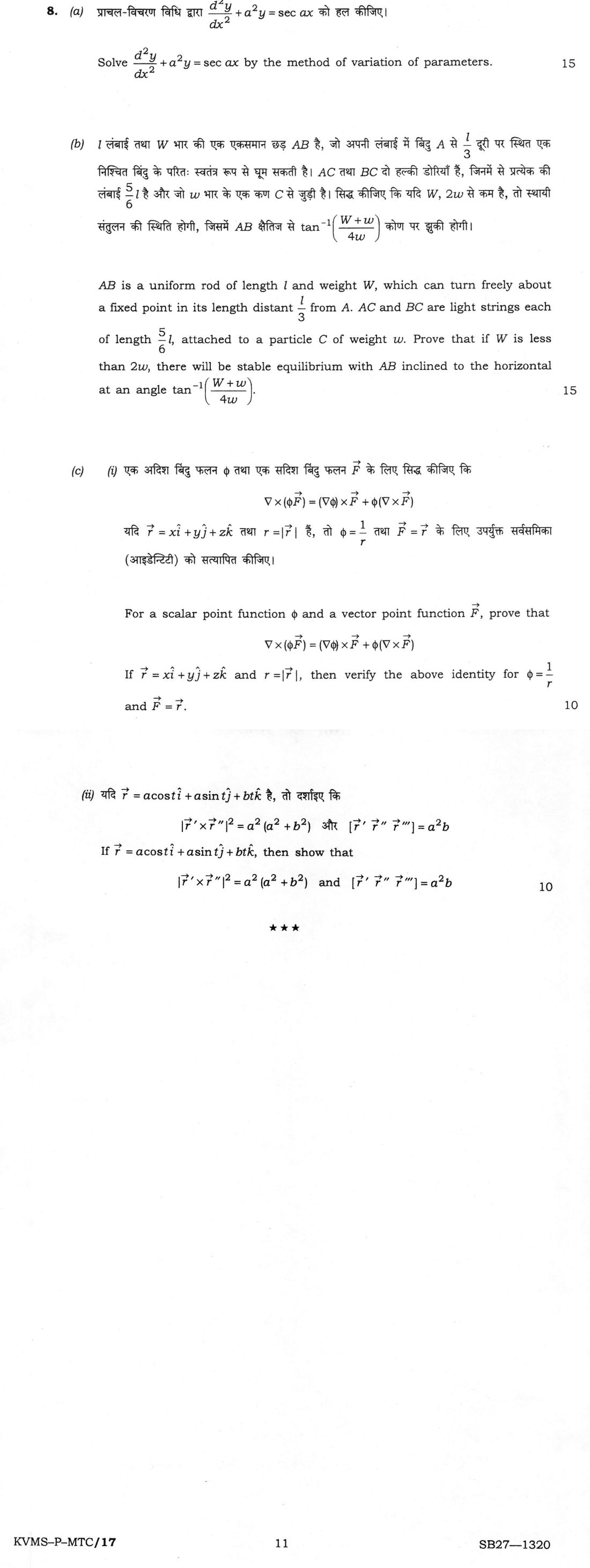
(a) Solve (d^2y)/(dx²)+a^2y=sec ax by the method of variation of parameters. (15 marks) (b) AB is a uniform rod of length l and…
Solve (d^2y)/(dx²)+a^2y=sec ax by the method of variation of parameters. 15 marks
AB is a uniform rod of length l and weight W, which can turn freely about a fixed point in its length distant l/3 from A. AC and BC are light strings each of length 5/6l, attached to a particle C of weight w. Prove that if W is less than 2w, there will be stable equilibrium with AB inclined to the horizontal at an angle tan⁻¹((W+w)/4w). 15 marks
For a scalar point function φ and a vector point function F⃗, prove that ∇×(φF⃗) = (∇φ)×F⃗ + φ(∇×F⃗) If r⃗ = xî+yĵ+zk̂ and r=|r⃗|, then verify the above identity for φ=1/r and F⃗=r⃗. 10 marks
If r⃗ = acos t î + asin t ĵ + bt k̂, then show that
| r⃗' × r⃗'' | ² = a² (a² + b²) and [r⃗' r⃗'' r⃗'''] = a² b (10 marks) |
|---|
हिंदी में प्रश्न पढ़ें
प्राचल-विचरण विधि द्वारा (d^2y)/(dx²)+a^2y=sec ax को हल कीजिए। (15 अंक)
l लंबाई तथा W भार की एक एकसमान छड़ AB है, जो अपनी लंबाई में बिंदु A से l/3 दूरी पर स्थित एक निश्चित बिंदु के परितः स्वतंत्र रूप से घूम सकती है। AC तथा BC हल्की डोरियाँ हैं, जिनमें से प्रत्येक की लंबाई 5/6l है और जो w भार के एक कण C से जुड़ी है। सिद्ध कीजिए कि यदि W, 2w से कम है, तो स्थायी संतुलन की स्थिति होगी, जिसमें AB क्षैतिज से tan⁻¹((W+w)/4w) कोण पर झुकी होगी। (15 अंक)
एक अदिश बिंदु फलन φ तथा एक सदिश बिंदु फलन F⃗ के लिए सिद्ध कीजिए कि ∇×(φF⃗) = (∇φ)×F⃗ + φ(∇×F⃗) यदि r⃗ = xî+yĵ+zk̂ तथा r=|r⃗| है, तो φ=1/r तथा F⃗=r⃗ के लिए उपर्युक्त सर्वसमिका (आइडेंटिटी) को सत्यापित कीजिए। (10 अंक)
यदि r⃗ = acos t î + asin t ĵ + bt k̂ है, तो दर्शाइए कि
| r⃗' × r⃗'' | ² = a² (a² + b²) और [r⃗' r⃗'' r⃗'''] = a² b (10 अंक) |
|---|
Model answer
Drafted with AI by UPSC Answer Check against this question's marking rubric, to the expected length. UPSC does not publish answers for Mains — this is one way to score well, not an official key. How we build rubrics and answers.
(a) Variation of parameters Auxiliary equation m² + a² = 0 ⇒ m = ±ia, so CF = c₁ cos ax + c₂ sin ax. Take y₁ = cos ax, y₂ = sin ax, R = sec ax. Wronskian W = y₁y₂′ − y₁′y₂ = cos ax·a cos ax + a sin ax·sin ax = a. Let yₚ = A(x)y₁ + B(x)y₂ with A′ = −y₂R/W, B′ = y₁R/W: A = −∫(sin ax sec ax)/a dx = −(1/a)∫tan ax dx = (1/a²) ln|cos ax|, B = ∫(cos ax sec ax)/a dx = x/a. yₚ = (1/a²) cos ax ln|cos ax| + (x/a) sin ax. y = c₁ cos ax + c₂ sin ax + (1/a²) cos ax ln|cos ax| + (x/a) sin ax.
(b) Stable equilibrium of the rod and particle Let O be the pivot (AO = l/3). The rod's centre G is at l/2 from A, so OG = l/6 towards B. Since AC = BC = 5l/6, triangle ABC is isosceles and the foot of the perpendicular from C to AB is the midpoint M = G, with CM = √((5l/6)² − (l/2)²) = 2l/3. While both strings are taut, rod, strings and particle move as one rigid body. Let the rod make angle φ with the horizontal (B above A when φ > 0), with C below AB. Heights above O: G: (l/6) sin φ; C: (l/6) sin φ − (2l/3) cos φ. Potential energy V = W(l/6) sin φ + w[(l/6) sin φ − (2l/3) cos φ] = (l/6)(W + w) sin φ − (2lw/3) cos φ. Equilibrium: dV/dφ = (l/6)(W + w) cos φ + (2lw/3) sin φ = 0 ⇒ tan φ = −(W + w)/(4w). Take the root φ = −α with α = tan⁻¹((W + w)/(4w)) ∈ (0, π/2) (end A raised). Then sin φ < 0 and cos φ > 0, so d²V/dφ² = −(l/6)(W + w) sin φ + (2lw/3) cos φ > 0: V is a minimum and the equilibrium is stable, with AB inclined at tan⁻¹((W + w)/(4w)) to the horizontal. (The other root φ = π − α is a maximum of V, hence unstable.) Role of W < 2w: the particle C is in equilibrium under w and the string tensions along CA and CB, so both tensions are non-negative only if the vertical through C lies within angle ACB. CM makes angle α with the vertical, and the half-angle ∠ACM has tan ∠ACM = (l/2)/(2l/3) = 3/4. So both strings stay taut iff tan α < 3/4, i.e. (W + w)/(4w) < 3/4 ⇔ W < 2w. If W ≥ 2w, BC would go slack and this configuration cannot exist.
(c)(i) Curl of φF Let F = F₁î + F₂ĵ + F₃k̂. The î-component of ∇ × (φF) is ∂(φF₃)/∂y − ∂(φF₂)/∂z = (F₃ ∂φ/∂y − F₂ ∂φ/∂z) + φ(∂F₃/∂y − ∂F₂/∂z), which is the î-component of (∇φ) × F plus that of φ(∇ × F). The ĵ- and k̂-components follow by cyclic permutation, so ∇ × (φF) = (∇φ) × F + φ(∇ × F). Verification with φ = 1/r, F = r (r ≠ 0): ∇r = r/r, so ∇(1/r) = −r/r³; ∇ × r = 0. RHS = (−r/r³) × r + (1/r)·0 = 0, since r × r = 0. LHS = ∇ × (r/r): its î-component is ∂(z/r)/∂y − ∂(y/r)/∂z = −zy/r³ + yz/r³ = 0, and similarly for ĵ and k̂. So LHS = 0. Both sides are the zero vector, so the identity is verified.
(c)(ii) Helix r′ = −a sin t î + a cos t ĵ + b k̂, r″ = −a cos t î − a sin t ĵ, r‴ = a sin t î − a cos t ĵ. r′ × r″ = (0 − b(−a sin t)) î − (0 − b(−a cos t)) ĵ + (a² sin²t + a² cos²t) k̂ = ab sin t î − ab cos t ĵ + a² k̂.
|r′ × r″|² = a²b²(sin²t + cos²t) + a⁴ = a²(a² + b²). [r′ r″ r‴] = (r′ × r″)·r‴ = ab sin t·a sin t + (−ab cos t)(−a cos t) + a²·0 = a²b.
How this answer will be evaluated
Evaluation rubric
Each sub-part is marked on its own, against the marks and word limit printed on the paper.
- (a) Solve y'' + a^2 y = sec(ax) by the prescribed method of variation of parameters: find the complementary function, compute the Wronskian, form the two quadratures, and write the complete general solution. 15 marks
Must cover
- CF = c₁ cos ax + c₂ sin ax and Wronskian W = a
- Quadratures −∫(sin ax sec ax)/a dx = (1/a²) ln|cos ax| and ∫(cos ax sec ax)/a dx = x/a
- y = c₁ cos ax + c₂ sin ax + (1/a²) cos ax ln|cos ax| + (x/a) sin ax
Loses marks
- Taking W = 1 instead of a
- Sign error in the logarithmic term
- Using the operator method instead of the prescribed variation of parameters
- Missing the 1/a factor on x sin ax
Earns more
- Quadratures evaluated: integral tan(ax)dx/a = -(1/a^2)ln|cos ax| and integral dx/a = x/a
- (b) A rod AB (length l, weight W) is pivoted at a point l/3 from A; light strings AC and BC, each of length 5l/6, carry a particle C of weight w. Prove that when W < 2w there is STABLE equilibrium with AB inclined to the horizontal at arctan((W + w)/(4w)). Both the equilibrium position, its stability, and the role of the condition W < 2w must be addressed. 15 marks
Must cover
- M (foot of perpendicular from C) coincides with G; CM = 2l/3, OG = l/6
- V = (l/6)(W + w) sin φ − (2lw/3) cos φ, dV/dφ = 0 ⇒ tan φ = −(W + w)/(4w), i.e. inclination tan⁻¹((W + w)/(4w)); d²V/dφ² > 0 there (stable)
- Both strings taut iff the vertical through C lies within angle ACB: tan α < tan ∠ACM = 3/4 ⇔ W < 2w
Loses marks
- Taking moments or heights about A or the midpoint instead of the pivot O
- Placing the rod's weight at the pivot instead of at G (l/6 from O)
- Mis-computing CM (e.g. √((5l/6)² − l²))
- Not addressing stability, or asserting W < 2w without linking it to the strings staying taut
- (c)(i) Two tasks: (i) prove the vector identity curl(phi F) = (grad phi) x F + phi (curl F) for a scalar field phi and a vector field F; (ii) verify it explicitly for phi = 1/r and F = r, where r = x i + y j + z k and r = |r|. 10 marks
Must cover
- Component proof: ∂(φF₃)/∂y − ∂(φF₂)/∂z split into (∇φ × F)₁ + φ(∇ × F)₁, others by cyclic symmetry
- ∇(1/r) = −r/r³, ∇ × r = 0, so RHS = (−r/r³) × r + 0 = 0
- LHS ∇ × (r/r) computed directly and found to be 0 (r ≠ 0)
Loses marks
- Writing F × ∇φ instead of ∇φ × F
- Taking ∇(1/r) as the scalar −1/r²
- Asserting the LHS is zero without computing ∇ × (r/r)
- Omitting r ≠ 0
Earns more
- Completes the argument for all three components (or invokes cyclic symmetry explicitly)
- (c)(ii) For the circular helix r(t) = a cos t i + a sin t j + b t k, show that |r' x r''|^2 = a^2(a^2 + b^2) and that the scalar triple product [r' r'' r'''] = a^2 b. 10 marks
Must cover
- r′ = (−a sin t, a cos t, b), r″ = (−a cos t, −a sin t, 0), r‴ = (a sin t, −a cos t, 0)
- r′ × r″ = (ab sin t, −ab cos t, a²), |r′ × r″|² = a²(a² + b²)
- [r′ r″ r‴] = (r′ × r″)·r‴ = a²b
Loses marks
- Sign slip in r‴ or in the ĵ-component of the cross product
- Giving |r′ × r″| instead of its square
- Triple-product determinant with rows in the wrong order, giving −a²b
What "Solve" is asking you to do
Choose the method, then carry it through to a final answer. Identifying what kind of problem this is and why that method applies is the first thing marked; a correct figure arrived at invisibly earns almost nothing.
Structure that answers it
Given data and what is required → method chosen, with the reason it applies → set-up (equation, circuit, free body, trial balance) → working, step by step → answer with units and any condition of validity
Where marks are lost
Doing the middle steps mentally and writing only the result. In mathematics papers, a further loss comes from giving a decimal where the exact value in surds or fractions was wanted, or from skipping the justification a part explicitly asks for.
Practice this exact question
Write your answer and it is marked point by point against the model answer above — what you covered, what you missed, what you got wrong.
Evaluate my answer →More from Mathematics 2026 Paper I
- Q5 (a) If y₁ and y₂ are two solutions of dy/dx + P(x)y = Q(x), and y₂ = y₁u, then show that…
- Q6 (a) Solve x² d²y/dx² − 3x dy/dx + y = (sin(log x) + 1)/x log x. (15 marks) (b) (i) A batt…
- Q7 (a) A light elastic string of natural length l has one extremity fixed at a point A and t…
- Q8 (a) Solve \frac{d^2y}{dx^2}+a^2y=\sec ax by the method of variation of parameters. (15 ma…