Paper I — Q6
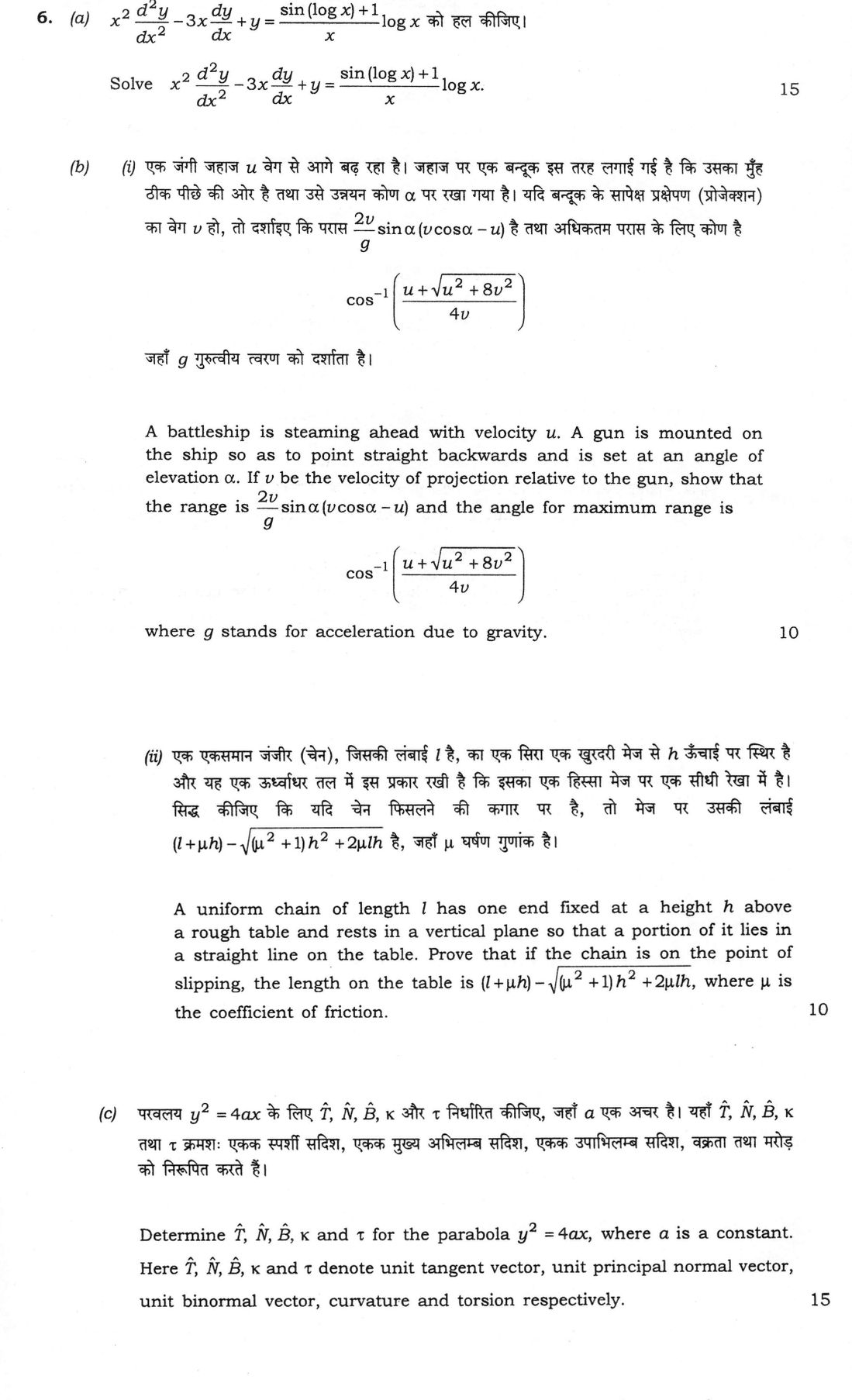
(a) Solve x² d²y/dx² − 3x dy/dx + y = (sin(log x) + 1)/x log x. (15 marks) (b) (i) A battleship is steaming ahead with velocity…
Solve x² d²y/dx² − 3x dy/dx + y = (sin(log x) + 1)/x log x. 15 marks
A battleship is steaming ahead with velocity u. A gun is mounted on the ship so as to point straight backwards and is set at an angle of elevation α. If v be the velocity of projection relative to the gun, show that the range is 2v/g sin α (v cos α − u) and the angle for maximum range is cos⁻¹((u + √(u² + 8v²))/4v) where g stands for acceleration due to gravity. 10 marks
A uniform chain of length l has one end fixed at a height h above a rough table and rests in a vertical plane so that a portion of it lies in a straight line on the table. Prove that if the chain is on the point of slipping, the length on the table is (l+μh)-√(μ²+1)h²+2μlh, where μ is the coefficient of friction. 10 marks
Determine T̂, N̂, B̂, κ and τ for the parabola y² = 4ax, where a is a constant. Here T̂, N̂, B̂, κ and τ denote unit tangent vector, unit principal normal vector, unit binormal vector, curvature and torsion respectively. 15 marks
हिंदी में प्रश्न पढ़ें
x² d²y/dx² − 3x dy/dx + y = (sin(log x) + 1)/x log x को हल कीजिए। (15 अंक)
एक जंगी जहाज u वेग से आगे बढ़ रहा है। जहाज पर एक बन्दूक इस तरह लगाई गई है कि उसका मुँह ठीक पीछे की ओर है तथा उसे उन्नयन कोण α पर रखा गया है। यदि बन्दूक के सापेक्ष प्रक्षेपण (प्रोजेक्शन) का वेग v हो, तो दर्शाइए कि परास 2v/g sin α (v cos α − u) है तथा अधिकतम परास के लिए कोण है cos⁻¹((u + √(u² + 8v²))/4v) जहाँ g गुरुत्वीय त्वरण को दर्शाता है। (10 अंक)
एक एकसमान जंजीर (चेन), जिसकी लंबाई l है, का एक सिरा एक खुरदरी मेज से h ऊँचाई पर स्थिर है और यह एक ऊर्ध्वाधर तल में इस प्रकार रखी है कि इसका एक हिस्सा मेज पर एक सीधी रेखा में है। सिद्ध कीजिए कि यदि चेन फिसलने की कगार पर है, तो मेज पर उसकी लंबाई (l+μh) - √(μ² + 1)h² + 2μlh है, जहाँ μ घर्षण गुणांक है। (10 अंक)
परवलय y² = 4ax के लिए T̂, N̂, B̂, κ और τ निर्धारित कीजिए, जहाँ a एक अचर है। यहाँ T̂, N̂, B̂, κ तथा τ क्रमशः एकक स्पर्शी सदिश, एकक मुख्य अभिलम्ब सदिश, एकक उपअभिलम्ब सदिश, वक्रता तथा मरोड़ को निरूपित करते हैं। (15 अंक)
Model answer
Drafted with AI by UPSC Answer Check against this question's marking rubric, to the expected length. UPSC does not publish answers for Mains — this is one way to score well, not an official key. How we build rubrics and answers.
(a) Cauchy–Euler equation The right-hand side is read as [(sin(log x) + 1)/x]·log x. Put x = e^z (z = log x) and D = d/dz, so x d/dx = D and x² d²/dx² = D(D − 1). The equation becomes [D(D − 1) − 3D + 1]y = (D² − 4D + 1)y = e^−z(z sin z + z). CF: m² − 4m + 1 = 0 ⇒ m = 2 ± √3, so CF = c₁x²+√3 + c₂x²−√3. PI: using 1/f(D)[e^azg(z)] = e^az·1/f(D + a) g(z) with a = −1, f(D − 1) = (D − 1)² − 4(D − 1) + 1 = D² − 6D + 6. PI = e^−z·1/(D² − 6D + 6) (z + z sin z). Term z: 1/(6(1 − D + D²/6)) z = (1/6)(1 + D + …)z = (z + 1)/6. Term z sin z = Im(z e^iz): 1/(D² − 6D + 6)(z e^iz) = e^iz·1/(D² + (2i − 6)D + (5 − 6i)) z = e^iz·[1/(5 − 6i)]·[z − (2i − 6)/(5 − 6i)] = e^iz[(5 + 6i)z/61 + (54 + 382i)/3721], since 1/(5 − 6i) = (5 + 6i)/61 and (2i − 6)(5 + 6i)/61 = −(42 + 26i)/61. Imaginary part: (5z/61 + 54/3721) sin z + (6z/61 + 382/3721) cos z. Returning to x (e^−z = 1/x, z = log x): y = c₁x²+√3 + c₂x²−√3 + (log x + 1)/(6x) + (1/x)[(5 log x/61 + 54/3721) sin(log x) + (6 log x/61 + 382/3721) cos(log x)].
(b)(i) Range of a gun firing backwards from a moving ship Relative to the ground, the shot has horizontal velocity v cos α − u (backwards; the ship moves forward with u) and vertical velocity v sin α (u is horizontal and does not affect it). Time of flight T = 2v sin α/g. Range R = (v cos α − u)·T = (2v/g) sin α (v cos α − u). For maximum range: dR/dα = (2v/g)[cos α(v cos α − u) − v sin²α] = (2v/g)(v cos 2α − u cos α) = 0 ⇒ v(2cos²α − 1) = u cos α ⇒ 2v cos²α − u cos α − v = 0 ⇒ cos α = [u ± √(u² + 8v²)]/(4v). The minus sign gives cos α < 0 (obtuse elevation), so it is rejected. At this root dR/dα changes from positive to negative, so R is a maximum. α = cos⁻¹[(u + √(u² + 8v²))/(4v)] (α = 45° when u = 0, as a check).
(b)(ii) Chain partly on a rough table Let w be the weight per unit length, x the length on the table, so the hanging part has length s = l − x. The hanging part is a catenary whose tangent is horizontal where the chain meets the table, so that point is the vertex; there the tension is horizontal, T₀ = wc (c the parameter). The part on the table is straight, with normal reaction N = wx. On the point of slipping, T₀ = μN ⇒ wc = μwx ⇒ c = μx. Measured from the directrix, the vertex has ordinate c and the fixed end has ordinate y = c + h. For the catenary, s² = y² − c²: (l − x)² = (c + h)² − c² = 2ch + h² = 2μxh + h². ⇒ x² − 2(l + μh)x + (l² − h²) = 0 ⇒ x = (l + μh) ± √[(l + μh)² − l² + h²] = (l + μh) ± √[(μ² + 1)h² + 2μlh]. The plus sign gives x > l, which is impossible. Hence length on the table = (l + μh) − √[(μ² + 1)h² + 2μlh].
(c) Frenet–Serret quantities for y² = 4ax Parametrise: r = at² î + 2at ĵ (z = 0). dr/dt = 2at î + 2a ĵ, ds/dt = |dr/dt| = 2a√(1 + t²). T̂ = (dr/dt)/(ds/dt) = (t î + ĵ)/√(1 + t²). dT̂/dt = (î − t ĵ)/(1 + t²)³/2, so dT̂/ds = (dT̂/dt)/(ds/dt) = (î − t ĵ)/[2a(1 + t²)²]. κ = |dT̂/ds| = 1/[2a(1 + t²)³/2] (radius of curvature ρ = 2a(1 + t²)³/2 = 2(a + x)³/2/√a; ρ = 2a at the vertex). N̂ = (1/κ) dT̂/ds = (î − t ĵ)/√(1 + t²). B̂ = T̂ × N̂ = [(t î + ĵ) × (î − t ĵ)]/(1 + t²) = (−t² − 1)k̂/(1 + t²) = −k̂. B̂ is constant, so dB̂/ds = 0; from dB̂/ds = −τN̂, τ = 0 (as expected for a plane curve).
How this answer will be evaluated
Evaluation rubric
Each sub-part is marked on its own, against the marks and word limit printed on the paper.
- (a) Solve the non-homogeneous Cauchy-Euler (homogeneous-linear) equation x^2 y'' - 3x y' + y = [(sin(log x) + 1)/x] log x completely: the complementary function plus a particular integral, i.e. the general solution. 15 marks
Must cover
- x = e^z, x²d²/dx² = D(D − 1): (D² − 4D + 1)y = e^{−z}(z sin z + z); CF = c₁x^{2+√3} + c₂x^{2−√3}
- Exponential shift with a = −1 giving 1/(D² − 6D + 6); PI of z e^{−z} = (log x + 1)/(6x)
- PI of z e^{−z} sin z = (1/x)[(5 log x/61 + 54/3721) sin(log x) + (6 log x/61 + 382/3721) cos(log x)] and the complete solution CF + PI
Loses marks
- Using x²d²/dx² → D² instead of D(D − 1), which gives m² − 3m + 1 = 0
- Forgetting the e^{−z} factor from 1/x, so the shift D → D − 1 is never applied
- Giving only the CF, or only the PI, as the general solution
Earns more
- Uses Im(z e^{iz}) with 1/(5 − 6i) = (5 + 6i)/61 to reach the sin/cos coefficients
- (b)(i) Projectile fired backwards from a ship moving forwards with speed u: show that the range is (2v/g) sin(alpha)(v cos alpha - u), and that the elevation for maximum range is alpha = arccos[(u + sqrt(u^2 + 8v^2))/(4v)]. 10 marks
Must cover
- Ground-frame horizontal velocity v cos α − u, vertical v sin α, time of flight 2v sin α/g
- R = (2v/g) sin α (v cos α − u)
- dR/dα = 0 ⇒ v cos 2α = u cos α ⇒ 2v cos²α − u cos α − v = 0 ⇒ cos α = (u + √(u² + 8v²))/(4v), negative root rejected
Loses marks
- Adding u instead of subtracting (the gun points backwards)
- Letting u alter the vertical component or the time of flight
- Taking the negative root (cos α < 0)
- (b)(ii) A uniform chain of length l has one end fixed at height h above a rough table, hangs in a vertical plane and lies partly straight along the table. Prove that when the chain is on the point of slipping the length resting on the table is (l + mu h) - sqrt((mu^2 + 1)h^2 + 2 mu l h). 10 marks
Must cover
- Hanging part is a catenary with vertex at the table contact point; T₀ = wc = μN = μwx ⇒ c = μx
- s² = y² − c² with s = l − x, y = c + h ⇒ (l − x)² = 2μxh + h²
- x = (l + μh) − √[(μ² + 1)h² + 2μlh], the + root rejected since it gives x > l
Loses marks
- Treating the hanging part as a straight segment
- Using y = h instead of y = c + h (ordinate measured from the directrix)
- Taking the + root (x > l)
- Wrong catenary relation such as s² = y² + c²
- (c) For the parabola y^2 = 4ax determine all five Serret-Frenet quantities: the unit tangent T, unit principal normal N, unit binormal B, curvature kappa and torsion tau. 15 marks
Must cover
- r = (at², 2at, 0), ds/dt = 2a√(1 + t²), T̂ = (t î + ĵ)/√(1 + t²)
- κ = 1/[2a(1 + t²)^{3/2}], N̂ = (î − t ĵ)/√(1 + t²)
- B̂ = T̂ × N̂ = −k̂, τ = 0 since dB̂/ds = 0
Loses marks
- Calling dT̂/dt the derivative dT̂/ds without dividing by ds/dt
- Wrong power in κ, e.g. 1/(2a(1 + t²))
- Stating τ = 0 with no reason
Earns more
- ρ = 2(a + x)^{3/2}/√a, equal to 2a at the vertex
What "Solve" is asking you to do
Choose the method, then carry it through to a final answer. Identifying what kind of problem this is and why that method applies is the first thing marked; a correct figure arrived at invisibly earns almost nothing.
Structure that answers it
Given data and what is required → method chosen, with the reason it applies → set-up (equation, circuit, free body, trial balance) → working, step by step → answer with units and any condition of validity
Where marks are lost
Doing the middle steps mentally and writing only the result. In mathematics papers, a further loss comes from giving a decimal where the exact value in surds or fractions was wanted, or from skipping the justification a part explicitly asks for.
Practice this exact question
Write your answer and it is marked point by point against the model answer above — what you covered, what you missed, what you got wrong.
Evaluate my answer →More from Mathematics 2026 Paper I
- Q3 (a) Given P₃[x] = {a₀ + a₁x + a₂x² + a₃x³ | a₀, a₁, a₂, a₃ ∈ ℝ} as a vector space over th…
- Q4 (a) Let F be a subfield of complex numbers and let T be the linear transformation from F³…
- Q5 (a) If y₁ and y₂ are two solutions of dy/dx + P(x)y = Q(x), and y₂ = y₁u, then show that…
- Q6 (a) Solve x² d²y/dx² − 3x dy/dx + y = (sin(log x) + 1)/x log x. (15 marks) (b) (i) A batt…
- Q7 (a) A light elastic string of natural length l has one extremity fixed at a point A and t…
- Q8 (a) Solve \frac{d^2y}{dx^2}+a^2y=\sec ax by the method of variation of parameters. (15 ma…