Paper I — Q3
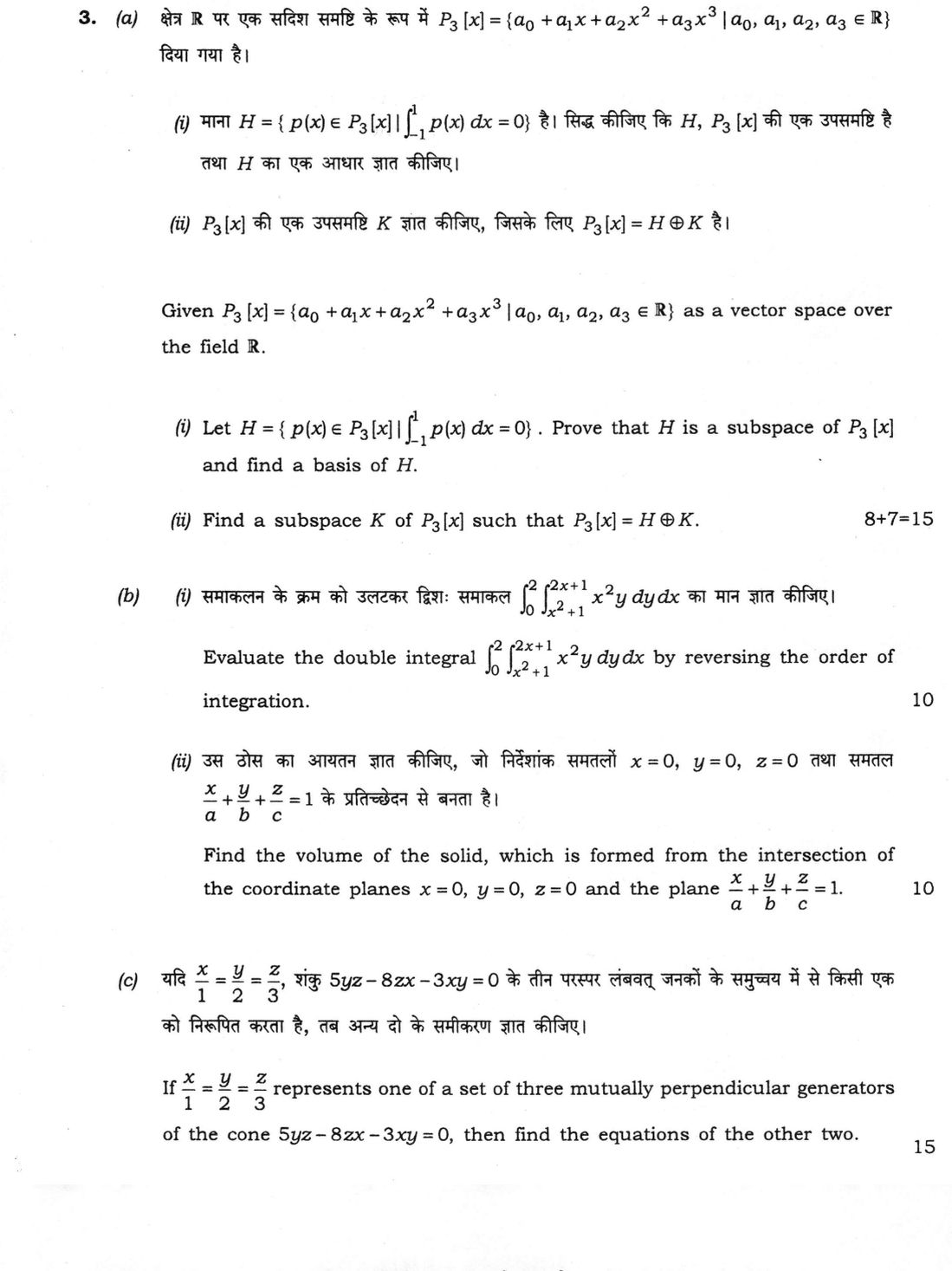
(a) Given P₃[x] = a₀ + a₁x + a₂x² + a₃x³ | a₀, a₁, a₂, a₃ ∈ ℝ as a vector space over the field ℝ. (i) Let H = p(x) ∈ P₃[x] |…
Given P₃[x] = a₀ + a₁x + a₂x² + a₃x³ | a₀, a₁, a₂, a₃ ∈ ℝ as a vector space over the field ℝ.
Let H = p(x) ∈ P₃[x] | ∫₋₁¹ p(x) dx = 0 . Prove that H is a subspace of P₃[x] and find a basis of H.
Find a subspace K of P₃[x] such that P₃[x] = H ⊕ K. 15 marks
Evaluate the double integral ∫₀² ∫ₓ²+1^2x+1 x²y dy dx by reversing the order of integration. 10 marks
Find the volume of the solid, which is formed from the intersection of the coordinate planes x = 0, y = 0, z = 0 and the plane x/a + y/b + z/c = 1. 10 marks
If x/1 = y/2 = z/3 represents one of a set of three mutually perpendicular generators of the cone 5yz – 8zx – 3xy = 0, then find the equations of the other two. 15 marks
हिंदी में प्रश्न पढ़ें
क्षेत्र ℝ पर एक सदिश समष्टि के रूप में P₃[x] = a₀ + a₁x + a₂x² + a₃x³ | a₀, a₁, a₂, a₃ ∈ ℝ दिया गया है।
माना H = p(x) ∈ P₃[x] | ∫₋₁¹ p(x) dx = 0 है। सिद्ध कीजिए कि H, P₃[x] की एक उपसमष्टि है तथा H का एक आधार ज्ञात कीजिए।
P₃[x] की एक उपसमष्टि K ज्ञात कीजिए, जिसके लिए P₃[x] = H ⊕ K है। (15 अंक)
समाकलन के क्रम को उलटकर द्विशः समाकल ∫₀² ∫ₓ²+1^2x+1 x²y dy dx का मान ज्ञात कीजिए। (10 अंक)
उस ठोस का आयतन ज्ञात कीजिए, जो निर्देशांक समतलों x = 0, y = 0, z = 0 तथा समतल x/a + y/b + z/c = 1 के प्रतिच्छेदन से बनता है। (10 अंक)
यदि x/1 = y/2 = z/3, शंकु 5yz – 8zx – 3xy = 0 के तीन परस्पर लंबवत् जनकों के समुच्चय में से किसी एक को निरूपित करता है, तब अन्य दो के समीकरण ज्ञात कीजिए। (15 अंक)
Model answer
Drafted with AI by UPSC Answer Check against this question's marking rubric, to the expected length. UPSC does not publish answers for Mains — this is one way to score well, not an official key. How we build rubrics and answers.
(a) Subspace H, its basis, and a complement K (i) Define L : P₃[x] → ℝ by L(p) = ∫₋₁¹ p(x) dx. For p, q ∈ P₃[x] and α, β ∈ ℝ, L(αp + βq) = αL(p) + βL(q) by linearity of the integral, so L is a linear functional and H = ker L = p : L(p) = 0. Subspace: 0 ∈ H since L(0) = 0; if p, q ∈ H then L(αp + βq) = α·0 + β·0 = 0, so αp + βq ∈ H. Hence H is a subspace of P₃[x]. Basis: for p = a₀ + a₁x + a₂x² + a₃x³, the odd terms integrate to zero on [−1, 1], so L(p) = 2a₀ + (2/3)a₂. L(p) = 0 ⇔ a₂ = −3a₀, so p = a₀(1 − 3x²) + a₁x + a₃x³. Thus 1 − 3x², x, x³ spans H; it is linearly independent (distinct highest powers x², x, x³), so it is a basis of H and dim H = 3. (ii) Take K = span1. Since L(1) = 2 ≠ 0, 1 ∉ H, so H ∩ K = 0. Also dim H + dim K = 3 + 1 = 4 = dim P₃[x], so H + K = P₃[x]. Hence P₃[x] = H ⊕ K. (Explicitly, p = (p − c) + c with c = ½∫₋₁¹ p dx.)
(b)(i) Reversing the order of integration Region: 0 ≤ x ≤ 2, x² + 1 ≤ y ≤ 2x + 1. The curves y = x² + 1 and y = 2x + 1 meet where x² = 2x, i.e. at (0, 1) and (2, 5). For fixed y ∈ [1, 5], x runs from the line x = (y − 1)/2 to the parabola x = √(y − 1). I = ∫₁⁵ ∫_(y−1)/2^√(y−1) x² y dx dy = ∫₁⁵ (y/3)[(y − 1)³/2 − (y − 1)³/8] dy. Put u = y − 1 (u from 0 to 4): I = (1/3)∫₀⁴ (u + 1)(u³/2 − u³/8) du = (1/3)[(2/7)u⁷/2 + (2/5)u⁵/2 − u⁵/40 − u⁴/32]₀⁴ = (1/3)(256/7 + 64/5 − 128/5 − 8) = (1/3)(552/35) = 184/35 ≈ 5.257.
(b)(ii) Volume of the tetrahedron The plane x/a + y/b + z/c = 1 (a, b, c > 0) meets the axes at (a, 0, 0), (0, b, 0), (0, 0, c); with the coordinate planes it bounds a tetrahedron in the first octant. V = ∫₀^a ∫₀^b(1 − x/a) ∫₀^c(1 − x/a − y/b) dz dy dx. Integrating in z: c(1 − x/a − y/b). Integrating in y from 0 to b(1 − x/a): (bc/2)(1 − x/a)². V = (bc/2)∫₀^a (1 − x/a)² dx = (bc/2)(a/3) = abc/6.
(c) The other two generators The cone 5yz − 8zx − 3xy = 0 has vertex at the origin, and (1, 2, 3) lies on it: 30 − 24 − 6 = 0. (Also the coefficients of x², y², z² sum to 0, the condition for the cone to have sets of three mutually perpendicular generators.) The other two generators are perpendicular to (1, 2, 3), so they lie in the plane x + 2y + 3z = 0 through the vertex. Put x = −2y − 3z in the cone: 5yz − 8z(−2y − 3z) − 3(−2y − 3z)y = 0 ⇒ 5yz + 16yz + 24z² + 6y² + 9yz = 0 ⇒ 6y² + 30yz + 24z² = 0 ⇒ y² + 5yz + 4z² = 0 ⇒ (y + z)(y + 4z) = 0. y = −z: x = 2z − 3z = −z, direction ratios (1, 1, −1): x/1 = y/1 = z/(−1). y = −4z: x = 8z − 3z = 5z, direction ratios (5, −4, 1): x/5 = y/(−4) = z/1. Check: (1, 2, 3)·(1, 1, −1) = 0, (1, 2, 3)·(5, −4, 1) = 0, (1, 1, −1)·(5, −4, 1) = 0, so the three generators are mutually perpendicular.
How this answer will be evaluated
Evaluation rubric
Each sub-part is marked on its own, against the marks and word limit printed on the paper.
- (a) Two parts on the vector space P3[x] over R: (i) prove that H = {p : integral from -1 to 1 of p(x) dx = 0} is a subspace and exhibit a basis of H; (ii) produce a subspace K with P3[x] = H (direct sum) K, i.e. a complement of H. 15 marks
Must cover
- H = ker L for the linear functional L(p) = ∫₋₁¹ p dx (or direct closure check), so H is a subspace
- L(p) = 2a₀ + (2/3)a₂ = 0 ⇔ a₂ = −3a₀; basis {1 − 3x², x, x³}, dim H = 3
- K = span{1} (any polynomial with non-zero integral): H ∩ K = {0} and dim H + dim K = 4 ⇒ P₃[x] = H ⊕ K
Loses marks
- Keeping the a₁ and a₃ terms (which vanish by oddness), giving a wrong condition
- Basis such as {x, x², x³} or {1, x, x³} whose elements do not all lie in H
- Checking only closure under addition
- Choosing K inside H (e.g. span{x³}), so the sum is not direct
Earns more
- Explicit decomposition p = (p − c) + c with c = ½∫₋₁¹ p dx
- (b)(i) Evaluate the double integral of x^2 y over the region 0 <= x <= 2, x^2 + 1 <= y <= 2x + 1 by the prescribed method of reversing the order of integration (dy dx to dx dy), and give the numerical value. 10 marks
Must cover
- Curves meet at (0, 1) and (2, 5); reversed limits 1 ≤ y ≤ 5, (y − 1)/2 ≤ x ≤ √(y − 1)
- Inner integral (y/3)[(y − 1)^{3/2} − (y − 1)³/8]
- I = 184/35 ≈ 5.257
Loses marks
- Reversed x-limits √(y − 1) to (y − 1)/2, giving −184/35
- Wrong y-range such as 0 to 5
- Inverting y = 2x + 1 as x = 2(y − 1) or x = (y + 1)/2
- Not reversing the order as prescribed (method marks lost even if 184/35 is obtained)
Earns more
- Outer integration via u = y − 1: (1/3)(256/7 + 64/5 − 128/5 − 8) = (1/3)(552/35) = 184/35
- (b)(ii) Find, by triple (or double) integration, the volume of the tetrahedron cut off from the first octant by the plane x/a + y/b + z/c = 1 together with the three coordinate planes. 10 marks
Must cover
- Intercepts (a, 0, 0), (0, b, 0), (0, 0, c); limits 0 ≤ z ≤ c(1 − x/a − y/b), 0 ≤ y ≤ b(1 − x/a), 0 ≤ x ≤ a
- After z and y integration: (bc/2)(1 − x/a)²
- V = abc/6
Loses marks
- Answer abc/3 or abc/2 from wrong limits
- Integrating over the rectangle 0 ≤ x ≤ a, 0 ≤ y ≤ b instead of the triangle
- Only quoting the geometric formula with no integration (answer marks only)
Earns more
- Check by the geometric formula V = (1/3)(ab/2)c = abc/6
- (c) Given that the line x/1 = y/2 = z/3 is one of a set of three mutually perpendicular generators of the cone 5yz - 8zx - 3xy = 0, find the equations of the other two generators. 15 marks
Must cover
- The other two generators lie in the plane x + 2y + 3z = 0 through the vertex, perpendicular to (1, 2, 3)
- Substitution gives y² + 5yz + 4z² = 0, i.e. (y + z)(y + 4z) = 0
- Generators x/1 = y/1 = z/(−1) and x/5 = y/(−4) = z/1
Loses marks
- Using a plane x + 2y + 3z = k with k ≠ 0, not through the vertex
- Sign slip in substituting x = −2y − 3z, giving a quadratic that does not factorise
- Reporting only one of the two generators
Earns more
- Verifies (1, 2, 3) lies on the cone and notes the coefficients of x², y², z² sum to 0 (condition for three mutually perpendicular generators)
- Verifies the three directions are mutually perpendicular and lie on the cone
What "Prove" is asking you to do
Establish that the statement holds for every case it claims, not for one representative case. The argument must be closed: each line follows from a definition, a hypothesis, or a named theorem you are entitled to use.
Structure that answers it
Given and to prove, restated → theorem or construction to be used, named → the argument line by line → conclusion stated as proved
Where marks are lost
Testing one example, which illustrates but proves nothing. On an if and only if claim, proving one direction and stopping forfeits that half outright, and degenerate cases — zero, the empty set, the equality case — have to be disposed of rather than assumed away.
Practice this exact question
Write your answer and it is marked point by point against the model answer above — what you covered, what you missed, what you got wrong.
Evaluate my answer →More from Mathematics 2026 Paper I
- Q1 (a) Find all the values of a for which the system of homogeneous equations ax + y + z = 0…
- Q2 (a) Let T : P₂[x] → P₂[x] be a linear transformation defined by T(a₀ + a₁x + a₂x²) = –(a₀…
- Q3 (a) Given P₃[x] = {a₀ + a₁x + a₂x² + a₃x³ | a₀, a₁, a₂, a₃ ∈ ℝ} as a vector space over th…
- Q4 (a) Let F be a subfield of complex numbers and let T be the linear transformation from F³…
- Q5 (a) If y₁ and y₂ are two solutions of dy/dx + P(x)y = Q(x), and y₂ = y₁u, then show that…
- Q6 (a) Solve x² d²y/dx² − 3x dy/dx + y = (sin(log x) + 1)/x log x. (15 marks) (b) (i) A batt…