Paper I — Q2
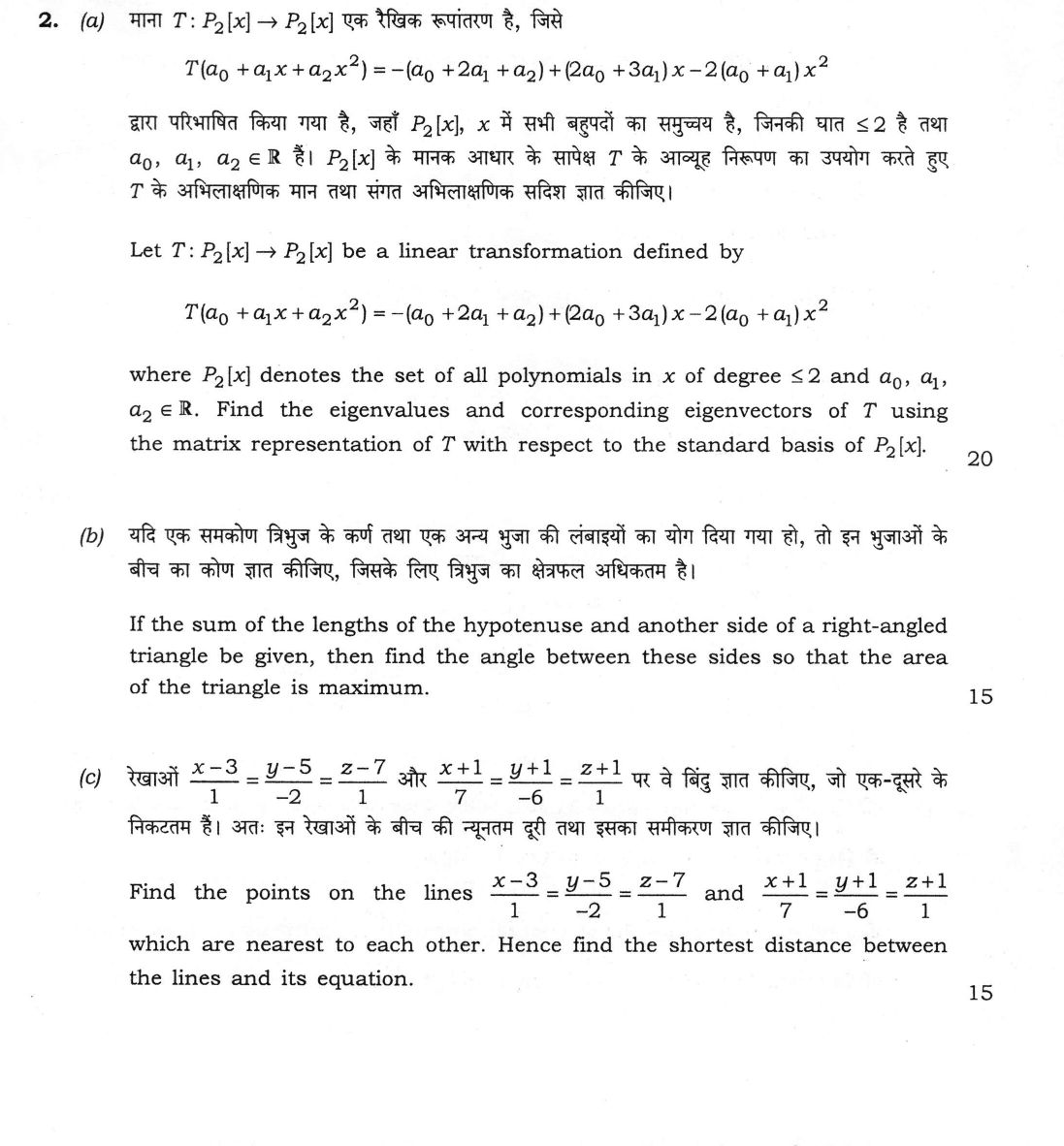
(a) Let T : P₂[x] → P₂[x] be a linear transformation defined by T(a₀ + a₁x + a₂x²) = –(a₀ + 2a₁ + a₂) + (2a₀ + 3a₁) x – 2(a₀ +…
Let T : P₂[x] → P₂[x] be a linear transformation defined by
T(a₀ + a₁x + a₂x²) = –(a₀ + 2a₁ + a₂) + (2a₀ + 3a₁) x – 2(a₀ + a₁) x²
where P₂[x] denotes the set of all polynomials in x of degree ≤ 2 and a₀, a₁, a₂ ∈ ℝ. Find the eigenvalues and corresponding eigenvectors of T using the matrix representation of T with respect to the standard basis of P₂[x]. 20 marks
If the sum of the lengths of the hypotenuse and another side of a right-angled triangle be given, then find the angle between these sides so that the area of the triangle is maximum. 15 marks
Find the points on the lines x – 3 / 1 = y – 5 / –2 = z – 7 / 1 and x + 1 / 7 = y + 1 / –6 = z + 1 / 1 which are nearest to each other. Hence find the shortest distance between the lines and its equation. 15 marks
हिंदी में प्रश्न पढ़ें
माना T : P₂[x] → P₂[x] एक रैखिक रूपांतरण है, जिसे
T(a₀ + a₁x + a₂x²) = –(a₀ + 2a₁ + a₂) + (2a₀ + 3a₁) x – 2(a₀ + a₁) x²
द्वारा परिभाषित किया गया है, जहाँ P₂[x], x में सभी बहुपदों का समुच्चय है, जिनकी घात ≤ 2 है तथा a₀, a₁, a₂ ∈ ℝ हैं। P₂[x] के मानक आधार के सापेक्ष T के आव्यूह निरूपण का उपयोग करते हुए T के अभिलाक्षणिक मान तथा संगत अभिलाक्षणिक सदिश ज्ञात कीजिए। (20 अंक)
यदि एक समकोण त्रिभुज के कर्ण तथा एक अन्य भुजा की लंबाइयों का योग दिया गया हो, तो इन भुजाओं के बीच का कोण ज्ञात कीजिए, जिसके लिए त्रिभुज का क्षेत्रफल अधिकतम है। (15 अंक)
रेखाओं x – 3 / 1 = y – 5 / –2 = z – 7 / 1 और x + 1 / 7 = y + 1 / –6 = z + 1 / 1 पर वे बिंदु ज्ञात कीजिए, जो एक-दूसरे के निकटतम हैं। अतः इन रेखाओं के बीच की न्यूनतम दूरी तथा इसका समीकरण ज्ञात कीजिए। (15 अंक)
Model answer
Drafted with AI by UPSC Answer Check against this question's marking rubric, to the expected length. UPSC does not publish answers for Mains — this is one way to score well, not an official key. How we build rubrics and answers.
(a) Eigenvalues and eigenvectors of T Standard basis B = {1, x, x²}. Images of the basis vectors: T(1) = −1 + 2x − 2x², T(x) = −2 + 3x − 2x², T(x²) = −1. Writing the coordinates of these images as columns: [T]_B = [−1 −2 −1; 2 3 0; −2 −2 0]. Characteristic equation det([T]_B − λI) = 0: (−1 − λ)[(3 − λ)(−λ) − 0] + 2[2(−λ) − 0] − 1[−4 + 2(3 − λ)] = 0 ⇒ −λ³ + 2λ² + λ − 2 = 0 ⇒ (λ − 1)(λ − 2)(λ + 1) = 0. Eigenvalues: λ = 1, 2, −1 (check: sum = 2 = trace, product = −2 = det). λ = 1: −2p − 2q − r = 0, 2p + 2q = 0, −2p − 2q − r = 0 ⇒ r = 0, q = −p ⇒ v₁ = (1, −1, 0)ᵀ ↔ 1 − x. λ = 2: −3p − 2q − r = 0, 2p + q = 0, −2p − 2q − 2r = 0 ⇒ q = −2p, r = p ⇒ v₂ = (1, −2, 1)ᵀ ↔ 1 − 2x + x² = (1 − x)². λ = −1: −2q − r = 0, 2p + 4q = 0, −2p − 2q + r = 0 ⇒ p = −2q, r = −2q ⇒ v₃ = (2, −1, 2)ᵀ ↔ 2 − x + 2x². (Eigenvectors are determined up to a non-zero scalar multiple.) Three distinct eigenvalues, so T is diagonalisable.
(b) Angle for maximum area Let the hypotenuse be h and the given side a, with a + h = k (constant). The third side is √(h² − a²), so the area is A = ½ a √(h² − a²) = ½ a √((k − a)² − a²) = ½ a √(k² − 2ka). dA/da = ½[√(k² − 2ka) − ka/√(k² − 2ka)] = 0 ⇒ k² − 2ka − ka = 0 ⇒ a = k/3, h = k − a = 2k/3. Second derivative: d²A/da² = −3√3/2 < 0 at a = k/3 (equivalently A² = ¼(k²a² − 2ka³) has (A²)″ = ½k² − 3ka = −½k² < 0 there), so the area is maximum. If θ is the angle between the hypotenuse and the side a, cos θ = a/h = (k/3)/(2k/3) = 1/2 ⇒ θ = π/3 (60°). Maximum area = √3 k²/18.
(c) Nearest points, shortest distance and its line L₁: (x − 3)/1 = (y − 5)/(−2) = (z − 7)/1, d₁ = (1, −2, 1); L₂: (x + 1)/7 = (y + 1)/(−6) = (z + 1)/1, d₂ = (7, −6, 1). General points: P = (3 + t, 5 − 2t, 7 + t) on L₁, Q = (−1 + 7s, −1 − 6s, −1 + s) on L₂. PQ = (−4 + 7s − t, −6 − 6s + 2t, −8 + s − t). PQ is perpendicular to both lines: PQ·d₁ = 0 ⇒ 20s − 6t = 0; PQ·d₂ = 0 ⇒ 86s − 20t = 0 ⇒ s = t = 0. Nearest points: P(3, 5, 7) on L₁ and Q(−1, −1, −1) on L₂. PQ = (−4, −6, −8), parallel to d₁ × d₂ = (4, 6, 8) (check). Shortest distance = √(16 + 36 + 64) = √116 = 2√29 ≈ 10.77. Line of shortest distance through P(3, 5, 7) with direction ratios 2 : 3 : 4: (x − 3)/2 = (y − 5)/3 = (z − 7)/4.
How this answer will be evaluated
Evaluation rubric
Each sub-part is marked on its own, against the marks and word limit printed on the paper.
- (a) Construct the matrix of the given linear operator T on P2[x] with respect to the standard basis {1, x, x^2}, then find all eigenvalues of T and a corresponding eigenvector (as a polynomial) for each. The method is prescribed: the matrix representation must be used. 20 marks
Must cover
- [T]_B = [−1 −2 −1; 2 3 0; −2 −2 0] (images of 1, x, x² as columns)
- Characteristic polynomial (λ − 1)(λ − 2)(λ + 1); eigenvalues 1, 2, −1
- Eigenvectors 1 − x (λ = 1), (1 − x)² = 1 − 2x + x² (λ = 2), 2 − x + 2x² (λ = −1), up to scalar multiples
Loses marks
- Writing the transpose of the correct matrix (images in rows), which changes the eigenvectors though not the eigenvalues
- Misreading the x² coefficient −2(a₀ + a₁) as −(a₀ + a₁), making the third row [−1, −1, 0]
- Leaving eigenvectors as column triples without converting back to polynomials in P₂[x]
- Giving only the eigenvalues and omitting the eigenvectors
Earns more
- Checks trace = 2 = sum and det = −2 = product of eigenvalues
- Notes that three distinct eigenvalues make T diagonalisable
- (b) A maxima-minima problem with a constraint: in a right-angled triangle the sum of the hypotenuse and one other side is a fixed constant; find the angle between those two sides that makes the area a maximum. Both the optimisation and the confirmation that it is a maximum are required. 15 marks
Must cover
- Constraint a + h = k and area A = ½ a √(h² − a²) = ½ a √(k² − 2ka)
- dA/da = 0 ⇒ a = k/3, h = 2k/3, with a second-order test showing a maximum
- cos θ = a/h = 1/2 ⇒ θ = π/3 (60°)
Loses marks
- Taking the angle between the two legs (90° by hypothesis) instead of between the hypotenuse and the given side
- Maximising without using the constraint a + h = k
- No test that the stationary point is a maximum
- Algebraic slip giving a = k/2 (θ = 0) or a = 2k/3
Earns more
- Maximum area √3 k²/18
- (c) Three linked tasks on two skew lines: find the pair of points (one on each line) that are nearest to each other, then the shortest distance between the lines, then the equation of the line of shortest distance. 15 marks
Must cover
- d₁ = (1, −2, 1), d₂ = (7, −6, 1); general points P(3 + t, 5 − 2t, 7 + t), Q(−1 + 7s, −1 − 6s, −1 + s) with PQ·d₁ = PQ·d₂ = 0 ⇒ s = t = 0
- Nearest points (3, 5, 7) and (−1, −1, −1); shortest distance 2√29 ≈ 10.77
- Line of SD: (x − 3)/2 = (y − 5)/3 = (z − 7)/4
Loses marks
- Only the scalar-triple-product distance formula, never finding the nearest points
- Cross-product slip such as (4, −6, 8), which fails the parallel check
- Leaving √116 unsimplified or mis-simplifying it
- SD line through the wrong point or with the wrong direction
Earns more
- Check that PQ = (−4, −6, −8) is parallel to d₁ × d₂ = (4, 6, 8)
What "Solve" is asking you to do
Choose the method, then carry it through to a final answer. Identifying what kind of problem this is and why that method applies is the first thing marked; a correct figure arrived at invisibly earns almost nothing.
Structure that answers it
Given data and what is required → method chosen, with the reason it applies → set-up (equation, circuit, free body, trial balance) → working, step by step → answer with units and any condition of validity
Where marks are lost
Doing the middle steps mentally and writing only the result. In mathematics papers, a further loss comes from giving a decimal where the exact value in surds or fractions was wanted, or from skipping the justification a part explicitly asks for.
Practice this exact question
Write your answer and it is marked point by point against the model answer above — what you covered, what you missed, what you got wrong.
Evaluate my answer →More from Mathematics 2026 Paper I
- Q1 (a) Find all the values of a for which the system of homogeneous equations ax + y + z = 0…
- Q2 (a) Let T : P₂[x] → P₂[x] be a linear transformation defined by T(a₀ + a₁x + a₂x²) = –(a₀…
- Q3 (a) Given P₃[x] = {a₀ + a₁x + a₂x² + a₃x³ | a₀, a₁, a₂, a₃ ∈ ℝ} as a vector space over th…
- Q4 (a) Let F be a subfield of complex numbers and let T be the linear transformation from F³…
- Q5 (a) If y₁ and y₂ are two solutions of dy/dx + P(x)y = Q(x), and y₂ = y₁u, then show that…