Paper I — Q5
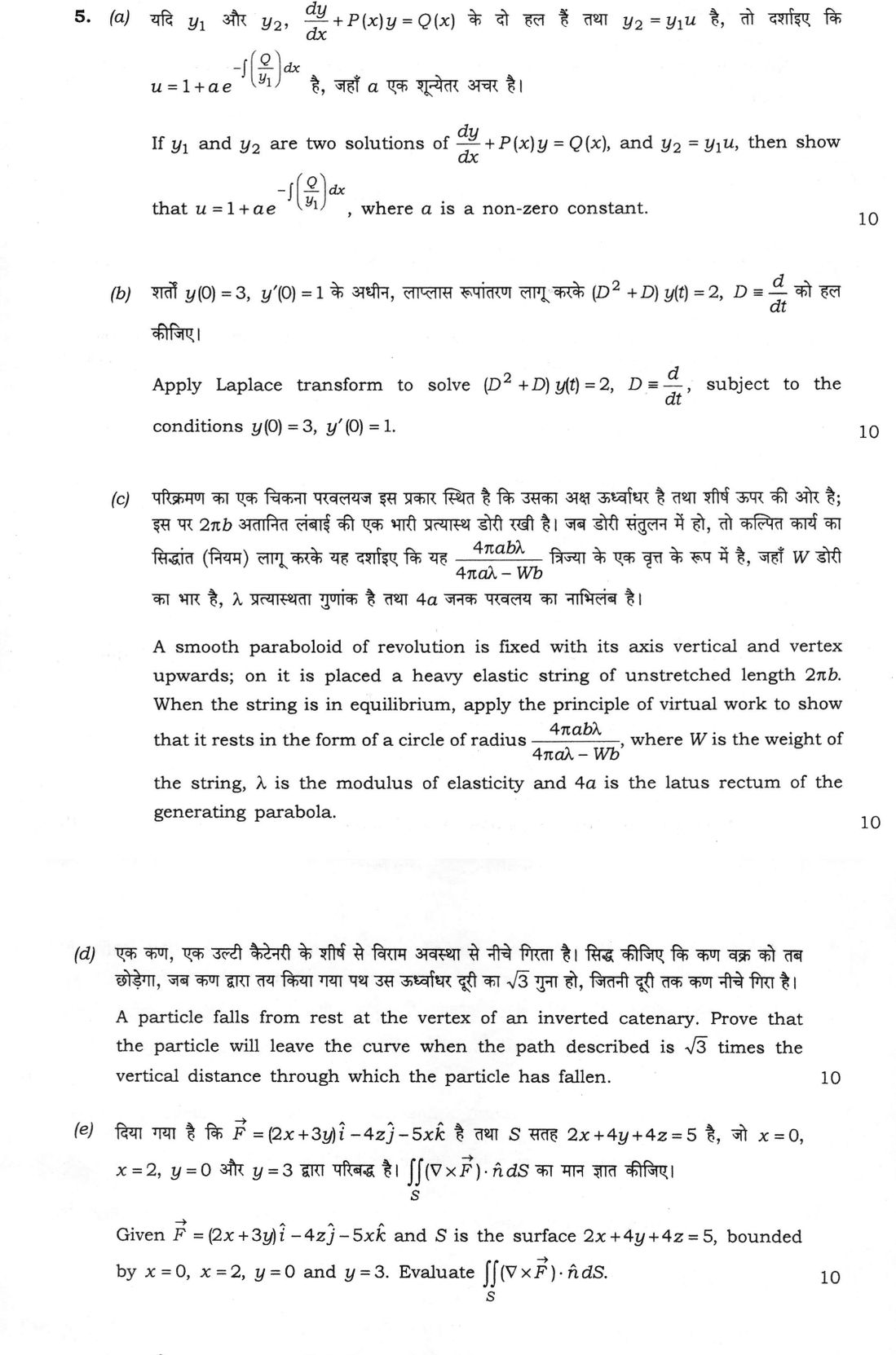
(a) If y₁ and y₂ are two solutions of dy/dx + P(x)y = Q(x), and y₂ = y₁u, then show that u = 1 + a e⁻∫(Q/y₁) dx, where a is a…
If y₁ and y₂ are two solutions of dy/dx + P(x)y = Q(x), and y₂ = y₁u, then show that u = 1 + a e⁻∫(Q/y₁) dx, where a is a non-zero constant. 10 marks
Apply Laplace transform to solve (D² + D) y(t) = 2, D = d/dt, subject to the conditions y(0) = 3, y'(0) = 1. 10 marks
A smooth paraboloid of revolution is fixed with its axis vertical and vertex upwards; on it is placed a heavy elastic string of unstretched length 2πb. When the string is in equilibrium, apply the principle of virtual work to show that it rests in the form of a circle of radius 4πabλ / (4πaλ - Wb), where W is the weight of the string, λ is the modulus of elasticity and 4a is the latus rectum of the generating parabola. 10 marks
A particle falls from rest at the vertex of an inverted catenary. Prove that the particle will leave the curve when the path described is √3 times the vertical distance through which the particle has fallen. 10 marks
Given F⃗ = (2x + 3y)î − 4zĵ − 5xk̂ and S is the surface 2x + 4y + 4z = 5, bounded by x = 0, x = 2, y = 0 and y = 3. Evaluate ∬_S (∇ × F⃗) · n̂ dS. 10 marks
हिंदी में प्रश्न पढ़ें
यदि y₁ और y₂, dy/dx + P(x)y = Q(x) के दो हल हैं तथा y₂ = y₁u है, तो दर्शाइए कि u = 1 + a e⁻∫(Q/y₁) dx है, जहाँ a एक शून्येतर अचर है। (10 अंक)
शर्तों y(0) = 3, y'(0) = 1 के अधीन, लाप्लास रूपांतरण लागू करके (D² + D) y(t) = 2, D = d/dt को हल कीजिए। (10 अंक)
परिक्रमण का एक चिकना परवलयज इस प्रकार स्थित है कि उसका अक्ष ऊर्ध्वाधर है तथा शीर्ष ऊपर की ओर है; इस पर 2πb अतानित लंबाई की एक भारी प्रत्यास्थ डोरी रखी है। जब डोरी संतुलन में हो, तो कल्पित कार्य का सिद्धांत (नियम) लागू करके यह दर्शाइए कि यह 4πabλ / (4πaλ - Wb) त्रिज्या के एक वृत्त के रूप में है, जहाँ W डोरी का भार है, λ प्रत्यास्थता गुणांक है तथा 4a जनक परवलय का नाभिलंब है। (10 अंक)
एक कण, एक उल्टी कैटेनरी के शीर्ष से विराम अवस्था से नीचे गिरता है। सिद्ध कीजिए कि कण वक्र को तब छोड़ेगा, जब कण द्वारा तय किया गया पथ उस ऊर्ध्वाधर दूरी का √3 गुना हो, जितनी दूरी तक कण नीचे गिरा है। (10 अंक)
दिया गया है कि F⃗ = (2x + 3y)î − 4zĵ − 5xk̂ है तथा S सतह 2x + 4y + 4z = 5 है, जो x = 0, x = 2, y = 0 और y = 3 द्वारा परिबद्ध है। ∬_S (∇ × F⃗) · n̂ dS का मान ज्ञात कीजिए। (10 अंक)
Model answer
Drafted with AI by UPSC Answer Check against this question's marking rubric, to the expected length. UPSC does not publish answers for Mains — this is one way to score well, not an official key. How we build rubrics and answers.
(a) Relation between two solutions of a linear equation Since y₁ is a solution, y₁′ + P y₁ = Q. (Here y₁ ≢ 0, since y₁ ≡ 0 is a solution only when Q ≡ 0.) Since y₂ = y₁u is also a solution: (y₁u)′ + P y₁u = Q ⇒ y₁u′ + u(y₁′ + P y₁) = Q. Using y₁′ + P y₁ = Q: y₁u′ + uQ = Q ⇒ y₁u′ = Q(1 − u). Separating the variables: du/(1 − u) = (Q/y₁) dx. Integrating: −ln|1 − u| = ∫(Q/y₁) dx + C ⇒ 1 − u = A e^−∫(Q/y₁) dx, A constant. Put a = −A: u = 1 + a e^−∫(Q/y₁) dx. If a = 0 then u ≡ 1 and y₂ = y₁; since y₁, y₂ are two distinct solutions, a ≠ 0.
(b) Laplace transform solution The equation is y″ + y′ = 2, y(0) = 3, y′(0) = 1. Let Y(s) = Ly(t). Ly″ = s²Y − s y(0) − y′(0) = s²Y − 3s − 1, Ly′ = sY − y(0) = sY − 3, L2 = 2/s. (s²Y − 3s − 1) + (sY − 3) = 2/s ⇒ (s² + s)Y = 3s + 4 + 2/s ⇒ Y(s) = (3s² + 4s + 2)/(s²(s + 1)). Partial fractions: Y(s) = A/s + B/s² + C/(s + 1) with 3s² + 4s + 2 = As(s + 1) + B(s + 1) + Cs². s = 0 ⇒ B = 2; s = −1 ⇒ C = 1; coefficient of s² ⇒ A + C = 3 ⇒ A = 2. Y(s) = 2/s + 2/s² + 1/(s + 1) ⇒ y(t) = 2 + 2t + e^−t. Check: y(0) = 3, y′(0) = 2 − 1 = 1, y″ + y′ = e^−t + 2 − e^−t = 2.
(c) Elastic string on a paraboloid (virtual work) Take the vertex as origin and z downward along the axis; the generating parabola with latus rectum 4a is x² = 4az. Let the string rest as a horizontal circle of radius r; its depth below the vertex is z = r²/(4a). Natural length 2πb, stretched length 2πr, so by Hooke's law the tension is T = λ(2πr − 2πb)/(2πb) = λ(r − b)/b. Give a virtual displacement r → r + δr (the string stays a horizontal circle on the surface). The smooth surface's reaction does no work. Work by the weight: W δz = W (r/2a) δr. Work by the tension: −T δ(2πr) = −2πT δr. Principle of virtual work: W r δr/(2a) − 2πλ(r − b)δr/b = 0. (Equivalently, V = πλ(r − b)²/b − W r²/(4a) and dV/dr = 0.) Since δr is arbitrary: W r/(2a) = 2πλ(r − b)/b ⇒ Wbr = 4πaλ(r − b) ⇒ r(4πaλ − Wb) = 4πabλ ⇒ r = 4πabλ/(4πaλ − Wb).
(d) Particle leaving an inverted catenary Inverted catenary with vertex at the top: s = c tan ψ, where s is the arc from the vertex and ψ the inclination of the tangent to the horizontal. Then y = c sec ψ (measured from the directrix), so the vertical distance fallen is h = c(sec ψ − 1), and the radius of curvature is ρ = ds/dψ = c sec²ψ. The curve is smooth and the particle starts from rest, so energy gives v² = 2gh = 2gc(sec ψ − 1). Along the inward normal (the curve is convex upward): mg cos ψ − N = mv²/ρ. The particle leaves the curve when N = 0: g cos ψ = 2gc(sec ψ − 1)/(c sec²ψ) = 2g cos ψ(1 − cos ψ) ⇒ 1 = 2(1 − cos ψ) ⇒ cos ψ = 1/2, ψ = 60°. Then s = c tan 60° = √3 c and h = c(2 − 1) = c. Hence s = √3 h: the particle leaves the curve when the path described is √3 times the vertical distance fallen.
(e) Flux of curl F F = (2x + 3y) î − 4z ĵ − 5x k̂. ∇ × F = (∂(−5x)/∂y − ∂(−4z)/∂z) î + (∂(2x + 3y)/∂z − ∂(−5x)/∂x) ĵ + (∂(−4z)/∂x − ∂(2x + 3y)/∂y) k̂ = 4î + 5ĵ − 3k̂. S: 2x + 4y + 4z = 5, with unit normal n̂ = (2î + 4ĵ + 4k̂)/6 = (î + 2ĵ + 2k̂)/3 (upward). (∇ × F)·n̂ = (4 + 10 − 6)/3 = 8/3. Projecting S onto the xy-plane: dS = dx dy/|n̂·k̂| = (3/2) dx dy, over the rectangle 0 ≤ x ≤ 2, 0 ≤ y ≤ 3 (area 6). ∬_S (∇ × F)·n̂ dS = ∬_R (8/3)(3/2) dx dy = 4 × 6 = 24.
How this answer will be evaluated
Evaluation rubric
Each sub-part is marked on its own, against the marks and word limit printed on the paper.
- (a) Given two solutions y1 and y2 of the linear first-order ODE dy/dx + P(x)y = Q(x), with y2 = y1 u, derive that u = 1 + a exp(-integral (Q/y1) dx) where a is a non-zero constant. 10 marks
Must cover
- Substitution with the product rule and cancellation via y₁′ + P y₁ = Q, giving y₁u′ = Q(1 − u)
- Separation du/(1 − u) = (Q/y₁) dx and integration to u = 1 + a e^{−∫(Q/y₁) dx}
- a ≠ 0 because y₂ ≠ y₁
Loses marks
- Writing (y₁u)′ = y₁u′ only, so the cancellation never occurs
- Sign error on integrating du/(1 − u), giving e^{+∫(Q/y₁) dx}
- Treating the equation as homogeneous (Q = 0)
- Not explaining why a must be non-zero
Earns more
- Integration giving ln|1 - u| = -integral (Q/y1) dx + const, i.e. 1 - u = A exp(-integral (Q/y1) dx)
- (b) Solve the initial-value problem y'' + y' = 2 with y(0) = 3, y'(0) = 1 using the Laplace transform method (the method is prescribed), and give the explicit solution y(t). 10 marks
Must cover
- L{y″} = s²Y − 3s − 1, L{y′} = sY − 3, L{2} = 2/s
- Y(s) = (3s² + 4s + 2)/(s²(s + 1)) = 2/s + 2/s² + 1/(s + 1)
- y(t) = 2 + 2t + e^{−t}
Loses marks
- Transforming the constant 2 as 2 instead of 2/s
- Dropping the initial-value terms in L{y″} or L{y′}
- Omitting the repeated-pole term B/s² in the partial fractions
- Solving by CF + PI when the Laplace method is prescribed
Earns more
- Verification: y(0) = 3, y'(0) = 2 - 1 = 1, y'' + y' = e^{-t} + (2 - e^{-t}) = 2
- (c) Using the principle of virtual work, show that a heavy elastic string of unstretched length 2 pi b resting on a smooth paraboloid of revolution (axis vertical, vertex up, latus rectum of the generating parabola 4a) is in equilibrium as a horizontal circle of radius r = 4 pi a b lambda/(4 pi a lambda - W b), where W is the weight of the string and lambda the modulus of elasticity. 10 marks
Must cover
- Depth of the circle below the vertex = r²/(4a); tension T = λ(r − b)/b (natural length 2πb)
- Virtual work: W (r/2a) δr − T δ(2πr) = 0, the smooth reaction doing no work (or V = πλ(r − b)²/b − W r²/(4a), dV/dr = 0)
- r = 4πabλ/(4πaλ − Wb)
Loses marks
- Depth r²/(2a) or r²/a instead of r²/(4a)
- Elastic energy without the factor ½, doubling the Wb term
- Using the stretched length 2πr as the natural length in Hooke's law
- A force balance without the principle of virtual work, which is prescribed
Earns more
- States that the smooth surface's reaction does no virtual work
- (d) A particle slides from rest down the outside of an inverted catenary starting at the vertex. Prove that it leaves the curve at the point where the arc length described equals sqrt(3) times the vertical distance fallen. 10 marks
Must cover
- s = c tan ψ, ρ = c sec²ψ, h = c(sec ψ − 1), v² = 2gh
- Leaving condition N = 0 in mg cos ψ − N = mv²/ρ ⇒ cos ψ = 1/2, ψ = 60°
- s = √3 c and h = c, so s = √3 h
Loses marks
- Wrong radius of curvature (e.g. c sec³ψ) for the catenary
- Normal equation with the wrong sign for motion on the convex outer side
- Measuring h from the directrix (h = c sec ψ)
- Reaching ψ = 60° but computing s or h wrongly
- (e) Evaluate the flux of the curl, double integral over S of (curl F) . n dS, where F = (2x + 3y)i - 4z j - 5x k and S is the part of the plane 2x + 4y + 4z = 5 lying over the rectangle 0 <= x <= 2, 0 <= y <= 3. 10 marks
Must cover
- ∇ × F = 4î + 5ĵ − 3k̂
- n̂ = (î + 2ĵ + 2k̂)/3, (∇ × F)·n̂ = 8/3, dS = (3/2) dx dy over the 2 × 3 rectangle
- Value = 24
Loses marks
- Sign error in the curl, especially the ĵ-component (+5)
- Using the unnormalised normal (2, 4, 4), giving 16
- Omitting the projection factor 3/2, giving 16
- Not stating the orientation of n̂
Earns more
- Projection factor dS = dx dy/|n.k| = (3/2) dx dy and projected area 2 x 3 = 6 (so area of S = 9)
What "Prove" is asking you to do
Establish that the statement holds for every case it claims, not for one representative case. The argument must be closed: each line follows from a definition, a hypothesis, or a named theorem you are entitled to use.
Structure that answers it
Given and to prove, restated → theorem or construction to be used, named → the argument line by line → conclusion stated as proved
Where marks are lost
Testing one example, which illustrates but proves nothing. On an if and only if claim, proving one direction and stopping forfeits that half outright, and degenerate cases — zero, the empty set, the equality case — have to be disposed of rather than assumed away.
Practice this exact question
Write your answer and it is marked point by point against the model answer above — what you covered, what you missed, what you got wrong.
Evaluate my answer →More from Mathematics 2026 Paper I
- Q2 (a) Let T : P₂[x] → P₂[x] be a linear transformation defined by T(a₀ + a₁x + a₂x²) = –(a₀…
- Q3 (a) Given P₃[x] = {a₀ + a₁x + a₂x² + a₃x³ | a₀, a₁, a₂, a₃ ∈ ℝ} as a vector space over th…
- Q4 (a) Let F be a subfield of complex numbers and let T be the linear transformation from F³…
- Q5 (a) If y₁ and y₂ are two solutions of dy/dx + P(x)y = Q(x), and y₂ = y₁u, then show that…
- Q6 (a) Solve x² d²y/dx² − 3x dy/dx + y = (sin(log x) + 1)/x log x. (15 marks) (b) (i) A batt…
- Q7 (a) A light elastic string of natural length l has one extremity fixed at a point A and t…
- Q8 (a) Solve \frac{d^2y}{dx^2}+a^2y=\sec ax by the method of variation of parameters. (15 ma…