Paper II — Q1
(a) Let G be a group of order pq, where p and q are primes. Show that either G is an abelian group or no non-identity element…
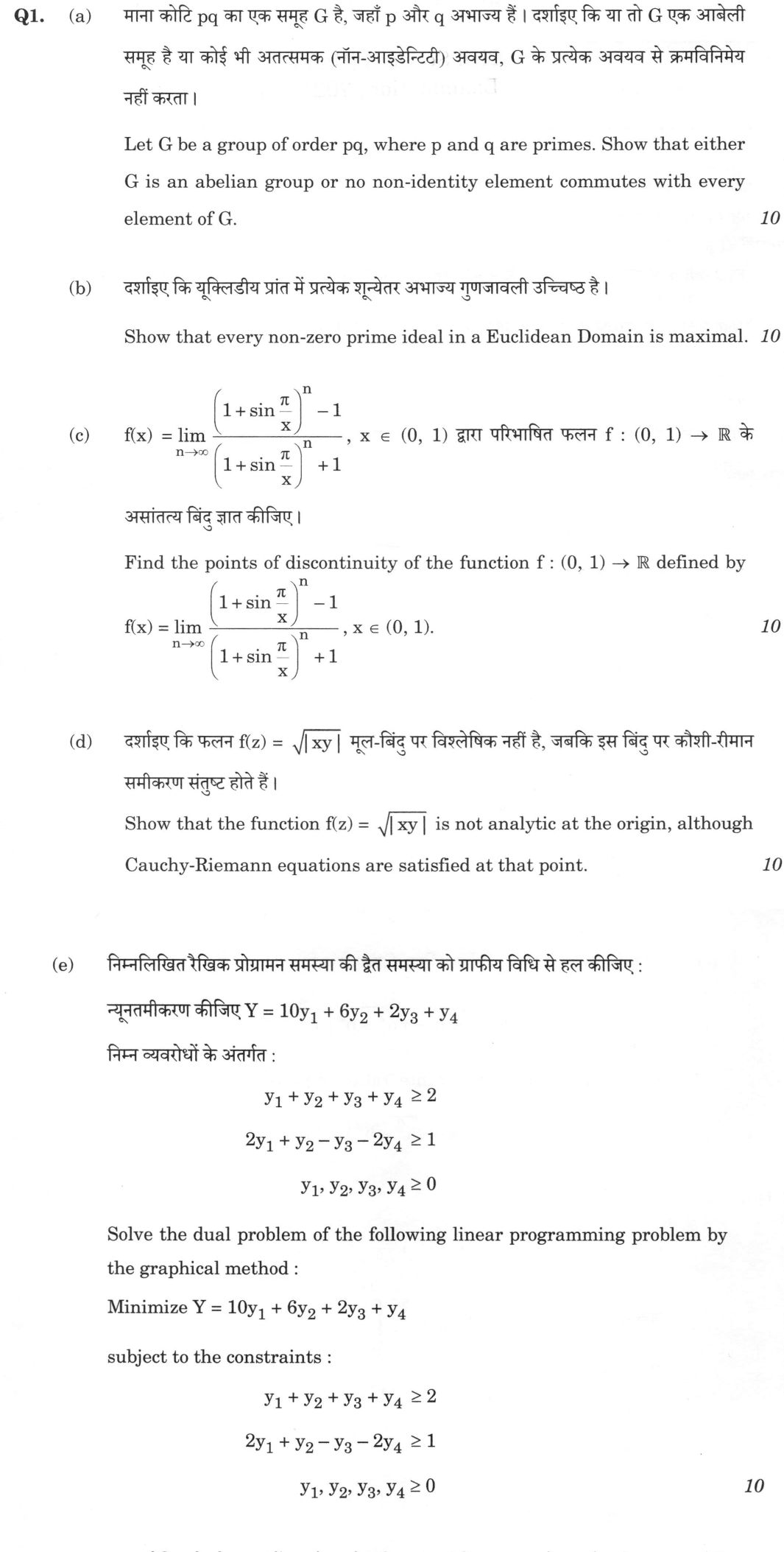
Let G be a group of order pq, where p and q are primes. Show that either G is an abelian group or no non-identity element commutes with every element of G. 10 marks
Show that every non-zero prime ideal in a Euclidean Domain is maximal. 10 marks
Find the points of discontinuity of the function f : (0, 1) → ℝ defined by f(x) = limₙ→∞ ((1 + sin π/x)ⁿ − 1) / ((1 + sin π/x)ⁿ + 1), x ∈ (0, 1). 10 marks
Show that the function f(z) = √|xy| is not analytic at the origin, although Cauchy-Riemann equations are satisfied at that point. 10 marks
Solve the dual problem of the following linear programming problem by the graphical method : Minimize Y = 10y₁ + 6y₂ + 2y₃ + y₄ subject to the constraints : y₁ + y₂ + y₃ + y₄ ≥ 2 2y₁ + y₂ − y₃ − 2y₄ ≥ 1 y₁, y₂, y₃, y₄ ≥ 0 10 marks
हिंदी में प्रश्न पढ़ें
माना कोटि pq का एक समूह G है, जहाँ p और q अभाज्य हैं। दर्शाइए कि या तो G एक आबेली समूह है या कोई भी अतत्समक (नॉन-आइडेन्टिटी) अवयव, G के प्रत्येक अवयव से क्रमविनिमेय नहीं करता। (10 अंक)
दर्शाइए कि यूक्लिडीय प्रांत में प्रत्येक शून्येतर अभाज्य गुणजावली उच्चिष्ठ है। (10 अंक)
f(x) = limₙ→∞ ((1 + sin π/x)ⁿ − 1) / ((1 + sin π/x)ⁿ + 1), x ∈ (0, 1) द्वारा परिभाषित फलन f : (0, 1) → ℝ के असांतत्य बिंदु ज्ञात कीजिए। (10 अंक)
दर्शाइए कि फलन f(z) = √|xy| मूल-बिंदु पर विश्लेषिक नहीं है, जबकि इस बिंदु पर कौशी-रीमान समीकरण संतुष्ट होते हैं। (10 अंक)
निम्नलिखित रैखिक प्रोग्रामन समस्या की द्वैत समस्या को ग्राफीय विधि से हल कीजिए : न्यूनतमीकरण कीजिए Y = 10y₁ + 6y₂ + 2y₃ + y₄ निम्न व्यवरोधों के अंतर्गत : y₁ + y₂ + y₃ + y₄ ≥ 2 2y₁ + y₂ − y₃ − 2y₄ ≥ 1 y₁, y₂, y₃, y₄ ≥ 0 (10 अंक)
Model answer
Drafted with AI by UPSC Answer Check against this question's marking rubric, to the expected length. UPSC does not publish answers for Mains — this is one way to score well, not an official key. How we build rubrics and answers.
(a) Group of order pq Let Z(G) be the centre of G (the elements commuting with every element of G). Z(G) is a subgroup, so by Lagrange's theorem |Z(G)| divides pq: |Z(G)| ∈ 1, p, q, pq. Lemma: if G/Z(G) is cyclic, G is abelian. Proof: let G/Z(G) = ⟨aZ(G)⟩. Every g ∈ G is g = aᵏz with z ∈ Z(G). For g = aᵏz, h = aʲw (z, w ∈ Z(G)), gh = aᵏ⁺ʲzw = aʲ⁺ᵏwz = hg, since z, w commute with everything. So G is abelian. Case |Z(G)| = pq: Z(G) = G, so G is abelian. Case |Z(G)| = p or q (with p ≠ q): [G : Z(G)] is prime, so G/Z(G) is cyclic and, by the lemma, G is abelian; then Z(G) = G, contradicting |Z(G)| < pq. So this case cannot occur. Case |Z(G)| = 1: Z(G) = e, i.e. no non-identity element commutes with every element of G. (If p = q, |G| = p², and a p-group has a non-trivial centre, so |Z(G)| = p or p²; the lemma again gives G abelian.) Hence either G is abelian or Z(G) = e.
(b) Non-zero prime ideals in a Euclidean domain are maximal Let R be a Euclidean domain with valuation d. R is a PID: let I ≠ (0) be an ideal and choose a ∈ I, a ≠ 0, with d(a) minimal. For b ∈ I write b = aq + r with r = 0 or d(r) < d(a). Since r = b − aq ∈ I, minimality forces r = 0, so b ∈ (a) and I = (a). Let P ≠ (0) be a prime ideal; then P = (p) with p ≠ 0, p not a unit. Suppose P ⊆ I ⊆ R with I = (a). Then p ∈ (a), so p = ab for some b ∈ R. Since ab = p ∈ P and P is prime, a ∈ P or b ∈ P. If a ∈ P, then I = (a) ⊆ P, so I = P. If b ∈ P, then b = pc, so p = apc ⇒ p(1 − ac) = 0 ⇒ ac = 1 (R is a domain and p ≠ 0); a is a unit and I = R. So there is no ideal strictly between P and R: P is maximal. (The hypothesis P ≠ (0) is essential: (0) is prime in a domain but not maximal unless R is a field.)
(c) Points of discontinuity Let t = 1 + sin(π/x) ∈ [0, 2]. As n → ∞: t > 1 (sin(π/x) > 0): tⁿ → ∞ and f(x) = lim (1 − t⁻ⁿ)/(1 + t⁻ⁿ) = 1; t = 1 (sin(π/x) = 0): f(x) = (1 − 1)/(1 + 1) = 0; 0 ≤ t < 1 (sin(π/x) < 0): tⁿ → 0 and f(x) = −1. So f(x) = sgn(sin(π/x)) on (0, 1). sin(π/x) = 0 ⇔ π/x = nπ ⇔ x = 1/n; in (0, 1) this gives n ≥ 2 (x = 1 is excluded). At x = 1/n, sin(π/x) changes sign, so f jumps between −1 and +1 (with f(1/n) = 0): a jump discontinuity. At every other point sin(π/x) ≠ 0, so by continuity it keeps its sign in a neighbourhood and f is locally constant, hence continuous. Points of discontinuity: x = 1/2, 1/3, 1/4, … (accumulating at 0, which is not in the domain).
(d) C–R equations hold at 0 but f is not analytic there f = u + iv with u = √|xy|, v = 0. At (0, 0), from first principles: uₓ(0, 0) = limₕ→0 (√|h·0| − 0)/h = 0, u_y(0, 0) = 0, and vₓ = v_y = 0. So uₓ = v_y and u_y = −vₓ at the origin: the Cauchy–Riemann equations are satisfied. Difference quotient: [f(z) − f(0)]/z = √|xy|/(x + iy). Along y = mx with x → 0⁺: √(|m|x²)/(x(1 + im)) = √|m|/(1 + im). This depends on m (0 for m = 0, 1/(1 + i) = (1 − i)/2 for m = 1), so f′(0) does not exist. Hence f is not differentiable, and so not analytic, at the origin. The C–R equations are necessary but not sufficient; here the partial derivatives are not continuous near 0.
(e) Dual LPP solved graphically Primal: minimise Y = 10y₁ + 6y₂ + 2y₃ + y₄ with two ≥ constraints. Dual (variables x₁, x₂ ≥ 0): Maximise Z = 2x₁ + x₂ subject to x₁ + 2x₂ ≤ 10, x₁ + x₂ ≤ 6, x₁ − x₂ ≤ 2, x₁ − 2x₂ ≤ 1, x₁, x₂ ≥ 0. Plotting these lines, the feasible region is the polygon with corners (0, 0): Z = 0; (1, 0): Z = 2; (3, 1): Z = 7; (4, 2): Z = 10; (2, 4): Z = 8; (0, 5): Z = 5. ((3, 1) from x₁ − x₂ = 2, x₁ − 2x₂ = 1; (4, 2) from x₁ + x₂ = 6, x₁ − x₂ = 2; (2, 4) from x₁ + 2x₂ = 10, x₁ + x₂ = 6.) Dual optimum: x₁ = 4, x₂ = 2, max Z = 10. By the duality theorem, min Y = 10. Complementary slackness: at (4, 2) the first and fourth dual constraints are slack (8 < 10, 0 < 1), so y₁ = y₄ = 0; since x₁, x₂ > 0 both primal constraints are tight: y₂ + y₃ = 2, y₂ − y₃ = 1 ⇒ y₂ = 3/2, y₃ = 1/2. Primal optimum y = (0, 3/2, 1/2, 0), min Y = 6(3/2) + 2(1/2) = 10.
How this answer will be evaluated
Evaluation rubric
Each sub-part is marked on its own, against the marks and word limit printed on the paper.
- (a) Prove a dichotomy for a group G of order pq (p, q primes): either G is abelian, or the centre Z(G) is trivial (no non-identity element commutes with every element of G). 'Show that' demands a complete proof using Lagrange's theorem and the G/Z(G) cyclic lemma. 10 marks
Must cover
- |Z(G)| divides pq by Lagrange, so |Z(G)| ∈ {1, p, q, pq}
- Proof of the lemma: G/Z(G) cyclic ⇒ G abelian
- |Z(G)| = p or q gives a prime-index (cyclic) quotient, hence G abelian, a contradiction; so G is abelian or Z(G) = {e}
Loses marks
- Asserting the G/Z(G) lemma without proof
- Not ruling out |Z(G)| = p and |Z(G)| = q
- Ignoring the case p = q or claiming a group of order p² can have trivial centre
- Confusing the centre with the centraliser of one element
Earns more
- Case |Z(G)| = pq gives G abelian; case |Z(G)| = 1 gives the second alternative, completing the dichotomy
- Comment on the degenerate case p = q (|G| = p^2 is always abelian, so the statement is still true)
- (b) Prove that in a Euclidean domain every non-zero prime ideal is maximal. Requires establishing (or quoting with justification) that a Euclidean domain is a PID and then arguing that a non-zero prime ideal (p) admits no proper intermediate ideal. 10 marks
Must cover
- Euclidean domain ⇒ PID (element of least d(a) generates the ideal, via the division algorithm)
- P = (p) ⊆ (a) ⇒ p = ab ⇒ a ∈ P or b ∈ P
- a ∈ P gives (a) = P; b = pc gives ac = 1 by cancellation (p ≠ 0, R a domain), so (a) = R; hence P is maximal
Loses marks
- Quoting ED ⇒ PID ⇒ primes maximal as named theorems without proof
- Cancelling p without noting p ≠ 0 and R a domain
- Only showing R/P is an integral domain (primeness restated)
Earns more
- Notes why P ≠ (0) is needed: (0) is prime but not maximal unless R is a field
- (c) Evaluate the pointwise limit defining f on (0, 1), identify f explicitly as a sign function, and then list precisely the points of (0, 1) at which f is discontinuous. 10 marks
Must cover
- Limits: t > 1 ⇒ 1, t = 1 ⇒ 0, 0 ≤ t < 1 ⇒ −1, so f(x) = sgn(sin(π/x))
- Discontinuities exactly at x = 1/n, n ≥ 2 (jump discontinuities; x = 1 excluded)
- Continuity at all other points (f locally constant)
Loses marks
- Missing the case sin(π/x) = 0, where the discontinuities lie
- Including x = 1
- Claiming the set of discontinuities is finite
- Not justifying continuity elsewhere
Earns more
- Notes the discontinuity set is infinite and accumulates at 0, which is outside (0, 1)
- (d) For f(z) = sqrt(|xy|) (u = sqrt(|xy|), v = 0), verify that the Cauchy-Riemann equations hold at z = 0 by computing the four partial derivatives from first principles, and then show f is not differentiable (hence not analytic) at 0 by a path-dependent difference quotient. 10 marks
Must cover
- u = √|xy|, v = 0; first-principles partials at (0, 0) all zero, so the C–R equations hold
- Along y = mx the difference quotient tends to √|m|/(1 + im), which depends on m
- Hence f′(0) does not exist and f is not analytic at 0 (C–R necessary, not sufficient)
Loses marks
- Using the chain rule for the partials at the origin instead of first principles
- Approaching only along the axes and concluding f′(0) = 0
- Treating 'C–R satisfied' as 'analytic' without testing the difference quotient
Earns more
- Form the difference quotient sqrt(|xy|)/(x + iy) and evaluate along the family y = mx
- State the principle: CR equations are necessary but not sufficient; sufficiency requires continuity of the first-order partials near the point
- (e) Form the dual of the given 4-variable minimisation LPP (which has only 2 constraints, so its dual has only 2 variables), and solve that dual graphically; report the optimal point and optimal value, and (by duality) the optimal value of the given primal. 10 marks
Must cover
- Dual: maximise Z = 2x₁ + x₂ subject to x₁ + 2x₂ ≤ 10, x₁ + x₂ ≤ 6, x₁ − x₂ ≤ 2, x₁ − 2x₂ ≤ 1, x₁, x₂ ≥ 0
- Graph with corners (0, 0), (1, 0), (3, 1), (4, 2), (2, 4), (0, 5); optimum at (4, 2) with max Z = 10
- By duality min Y = 10
Loses marks
- Wrong sense or wrong transposition in forming the dual
- Dual objective 10x₁ + 6x₂ instead of 2x₁ + x₂
- Dropping a constraint, e.g. x₁ − 2x₂ ≤ 1 or x₁ − x₂ ≤ 2
- Reading the optimum at the wrong vertex, e.g. (2, 4) with Z = 8
Earns more
- Objective evaluated at every corner: 0, 2, 7, 10, 8, 5
- Primal optimum y = (0, 3/2, 1/2, 0) recovered by complementary slackness
What "Prove" is asking you to do
Establish that the statement holds for every case it claims, not for one representative case. The argument must be closed: each line follows from a definition, a hypothesis, or a named theorem you are entitled to use.
Structure that answers it
Given and to prove, restated → theorem or construction to be used, named → the argument line by line → conclusion stated as proved
Where marks are lost
Testing one example, which illustrates but proves nothing. On an if and only if claim, proving one direction and stopping forfeits that half outright, and degenerate cases — zero, the empty set, the equality case — have to be disposed of rather than assumed away.
Practice this exact question
Write your answer and it is marked point by point against the model answer above — what you covered, what you missed, what you got wrong.
Evaluate my answer →More from Mathematics 2026 Paper II
- Q1 (a) Let G be a group of order pq, where p and q are primes. Show that either G is an abel…
- Q2 (a) Let G be a finite group generated by two elements u and v of order 2 each. Show that…
- Q3 (a) Prove that cosh ( z + 1/z ) = a₀ + Σ_{n=1}^{∞} aₙ ( zⁿ + 1/zⁿ ) , where aₙ = (1 / 2π)…
- Q4 (a) Let n be a positive integer. Show that the following statements are equivalent : (i)…