Paper II — Q4
(a) Let n be a positive integer. Show that the following statements are equivalent : (i) ℤ/nℤ is an integral domain. (ii) …
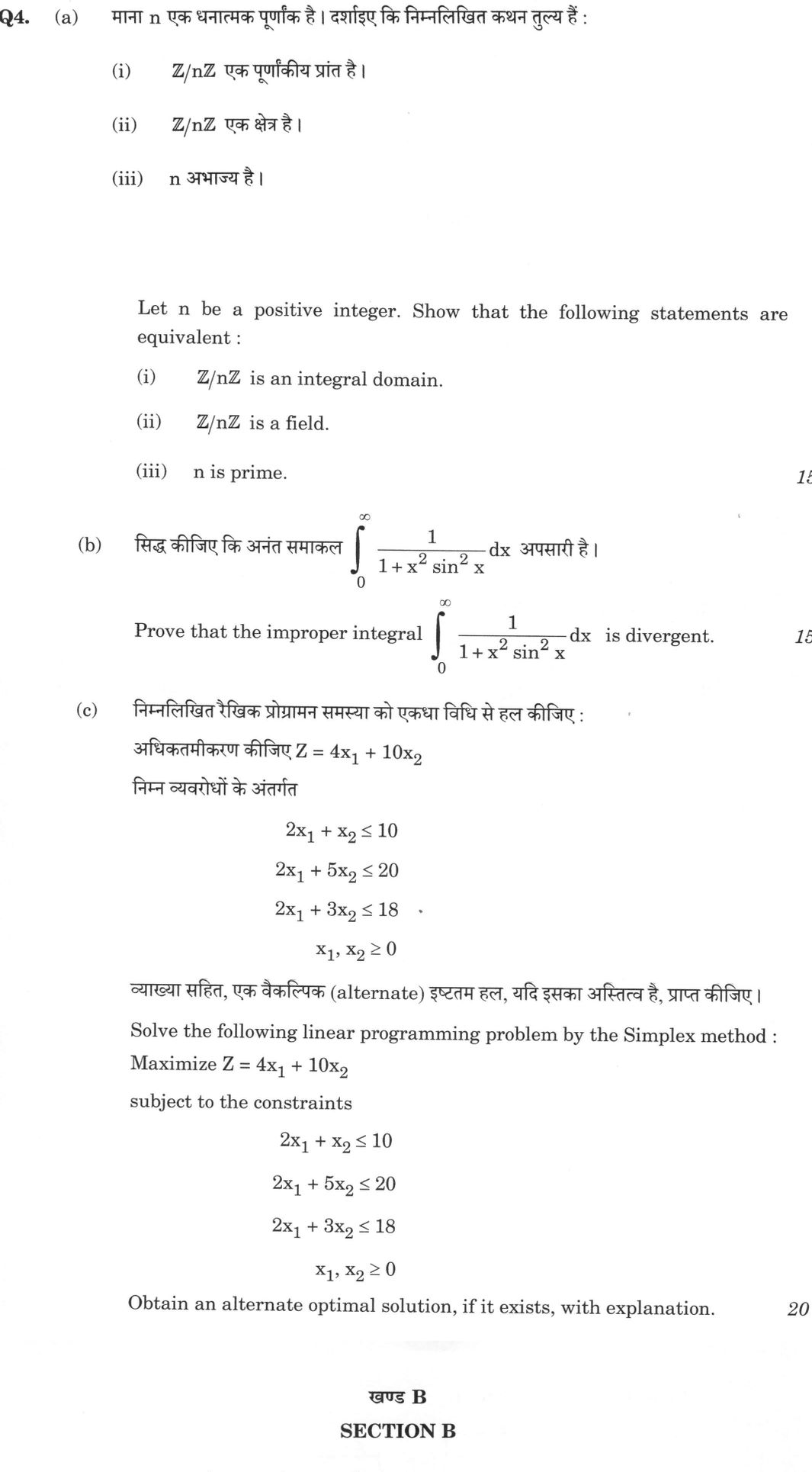
Let n be a positive integer. Show that the following statements are equivalent :
ℤ/nℤ is an integral domain.
ℤ/nℤ is a field.
n is prime. 15 marks
Prove that the improper integral ∫₀^∞ 1/(1 + x² sin² x) dx is divergent. 15 marks
Solve the following linear programming problem by the Simplex method : Maximize Z = 4x₁ + 10x₂ subject to the constraints 2x₁ + x₂ ≤ 10 2x₁ + 5x₂ ≤ 20 2x₁ + 3x₂ ≤ 18 x₁, x₂ ≥ 0 Obtain an alternate optimal solution, if it exists, with explanation. 20 marks
हिंदी में प्रश्न पढ़ें
माना n एक धनात्मक पूर्णांक है। दर्शाइए कि निम्नलिखित कथन तुल्य हैं :
ℤ/nℤ एक पूर्णांकीय प्रांत है।
ℤ/nℤ एक क्षेत्र है।
n अभाज्य है। (15 अंक)
सिद्ध कीजिए कि अनंत समाकल ∫₀^∞ 1/(1 + x² sin² x) dx अपसारी है। (15 अंक)
निम्नलिखित रैखिक प्रोग्रामन समस्या को एकधा विधि से हल कीजिए : अधिकतमीकरण कीजिए Z = 4x₁ + 10x₂ निम्न व्यवरोधों के अंतर्गत 2x₁ + x₂ ≤ 10 2x₁ + 5x₂ ≤ 20 2x₁ + 3x₂ ≤ 18 x₁, x₂ ≥ 0 व्याख्या सहित, एक वैकल्पिक (alternate) इष्टतम हल, यदि इसका अस्तित्व है, प्राप्त कीजिए। (20 अंक)
Model answer
Drafted with AI by UPSC Answer Check against this question's marking rubric, to the expected length. UPSC does not publish answers for Mains — this is one way to score well, not an official key. How we build rubrics and answers.
(a) Equivalence of the three statements To establish the equivalence of the three statements, we prove the cyclic chain of implications (iii) ⇒ (ii) ⇒ (i) ⇒ (iii). We first note that for n=1, Z/1Z is the zero ring where 1=0; it is neither a domain nor a field, and 1 is not prime, so the equivalence holds.
Step 1: (iii) ⇒ (ii) Assume n=p is prime. In Z/pZ, every non-zero element [a] is invertible. Since p is prime and a ≢ 0 (mod p), gcd(a, p) = 1. By Bézout's identity, there exist integers u, v such that au + pv = 1. In the quotient ring, [a][u] + [p][v] = [1], which simplifies to [a][u] = [1]. Thus, every non-zero element has a multiplicative inverse, making Z/pZ a field.
Step 2: (ii) ⇒ (i) Assume Z/nZ is a field. By definition, a field is a commutative ring with unity where every non-zero element is invertible. If [a][b] = [0] with [a] ≠ [0], then [b] = [a]⁻¹[0] = [0]. Thus, the ring has no zero divisors and is an integral domain.
Step 3: (i) ⇒ (iii) Assume Z/nZ is an integral domain. If n were composite, n = ab for integers a, b where 1 < a, b < n. Then [a] ≠ [0] and [b] ≠ [0], but [a][b] = [ab] = [n] = [0], so ℤ/nℤ has zero divisors. This is a contradiction. Since also n ≠ 1 (the zero ring is not a domain), n must be prime.
(b) Divergence of the improper integral To prove the improper integral ∫₀^∞ 1/(1 + x² sin² x) dx is divergent, we partition the domain into intervals of length π. Let Iₙ = ∫ₙπ^(n+1)π 1/(1 + x² sin² x) dx.
For x ∈ [nπ, (n+1)π], we have x ≤ (n+1)π. Since the integrand is a decreasing function of x², we can bound it from below: 1/(1 + x² sin² x) ≥ 1/(1 + (n+1)² π² sin² x) Thus, Iₙ ≥ ∫ₙπ^(n+1)π dx/(1 + (n+1)² π² sin² x). Using the substitution t = x - nπ, the limits become 0 to π: Iₙ ≥ ∫₀^π dt/(1 + (n+1)² π² sin² t) Using the standard integral result ∫₀^π dt/(1 + k² sin² t) = (π)/(√(1 + k²)) (derived via u = tan t), we set k = (n+1)π: Iₙ ≥ (π)/(√(1 + (n+1)² π²)) Since √(1 + (n+1)² π²) ≤ 1 + (n+1)π ≤ (n+2)π, we get Iₙ ≥ 1/(n+2). Since the harmonic series Σ 1/(n+2) diverges, the sum Σ Iₙ diverges. As the integrand is positive, the improper integral diverges.
(c) Simplex method and alternate optimum We solve the LPP using the Simplex method. Introducing slack variables s₁, s₂, s₃, the standard form is: Max Z = 4x₁ + 10x₂ Subject to: 2x₁ + x₂ + s₁ = 10 2x₁ + 5x₂ + s₂ = 20 2x₁ + 3x₂ + s₃ = 18
Initial Tableau:
| Basis | x₁ | x₂ | s₁ | s₂ | s₃ | RHS | Ratio |
|---|---|---|---|---|---|---|---|
| s₁ | 2 | 1 | 1 | 0 | 0 | 10 | 10 |
| s₂ | 2 | 5 | 0 | 1 | 0 | 20 | 4 |
| s₃ | 2 | 3 | 0 | 0 | 1 | 18 | 6 |
| Z | -4 | -10 | 0 | 0 | 0 | 0 |
The most negative coefficient is -10 (x₂ enters). The minimum ratio is 20/5 = 4 (s₂ leaves).
Iteration 1:
| Basis | x₁ | x₂ | s₁ | s₂ | s₃ | RHS | Ratio |
|---|---|---|---|---|---|---|---|
| s₁ | 1.6 | 0 | 1 | -0.2 | 0 | 6 | 3.75 |
| x₂ | 0.4 | 1 | 0 | 0.2 | 0 | 4 | 10 |
| s₃ | 0.8 | 0 | 0 | -0.6 | 1 | 6 | 7.5 |
| Z | 0 | 0 | 0 | 2 | 0 | 40 |
The Z-row contains no negative coefficients, so the current solution is optimal: x₁ = 0, x₂ = 4, Z = 40. However, the non-basic variable x₁ has a reduced cost of 0, indicating an alternate optimal solution.
Iteration 2 (Pivoting x₁ in): The minimum ratio for x₁ is 6/1.6 = 3.75 (s₁ leaves).
| Basis | x₁ | x₂ | s₁ | s₂ | s₃ | RHS |
|---|---|---|---|---|---|---|
| x₁ | 1 | 0 | 0.625 | -0.125 | 0 | 3.75 |
| x₂ | 0 | 1 | -0.25 | 0.25 | 0 | 2.5 |
| s₃ | 0 | 0 | -0.5 | -0.5 | 1 | 3 |
| Z | 0 | 0 | 0 | 2 | 0 | 40 |
The alternate optimal solution is x₁ = 15/4 = 3.75, x₂ = 5/2 = 2.5, Z = 40. The full optimal set is the line segment joining (0, 4) and (3.75, 2.5), because the objective 4x₁ + 10x₂ = 2(2x₁ + 5x₂) is parallel to the binding constraint 2x₁ + 5x₂ = 20. Every point (x₁, x₂) = λ(0, 4) + (1 − λ)(3.75, 2.5), 0 ≤ λ ≤ 1, is optimal with Z = 40.
How this answer will be evaluated
Evaluation rubric
Each sub-part is marked on its own, against the marks and word limit printed on the paper.
- (a) Prove the equivalence of three statements about Z/nZ for a positive integer n: (i) it is an integral domain, (ii) it is a field, (iii) n is prime. A cyclic chain of implications (iii) => (ii) => (i) => (iii) is the expected structure. 15 marks
Must cover
- (iii) ⇒ (ii): for p prime and a ≢ 0, gcd(a, p) = 1, Bézout au + pv = 1 gives [a][u] = [1]
- (ii) ⇒ (i): a field has no zero divisors
- (i) ⇒ (iii): n = ab with 1 < a, b < n gives [a][b] = [0], a zero divisor; n = 1 gives the zero ring
Loses marks
- Proving only two of the three implications
- Calling (ii) ⇒ (i) obvious without the no-zero-divisors argument
- Ignoring n = 1 (zero ring)
- Confusing the domain condition with the field condition
Earns more
- Explicit statement of the proof strategy as a cycle of implications (iii) => (ii) => (i) => (iii)
- Handle n = 1 (zero ring: not a domain, not a field, 1 not prime) so the equivalence is genuinely valid for all positive integers n
- (b) Prove that the improper integral from 0 to infinity of dx/(1 + x^2 sin^2 x) diverges. The expected route is to bound the integral over each period [n pi, (n+1) pi] from below and compare with the harmonic series. 15 marks
Must cover
- Split into periods [nπ, (n+1)π] and use x ≤ (n+1)π to get Iₙ ≥ ∫₀^π dt/(1 + (n+1)²π² sin²t)
- ∫₀^π dt/(1 + k² sin²t) = π/√(1 + k²), giving Iₙ ≥ 1/(n+2)
- Positive integrand and divergent Σ 1/(n+2), so the integral diverges
Loses marks
- Using an upper bound (e.g. 1/(x² sin²x)) and concluding anything about divergence
- Bounding x below instead of above on the period
- Wrong standard integral (e.g. π/(1 + k²))
- Arguing only from the integrand's behaviour at infinity
Earns more
- Bound x <= (n+1) pi on that interval, giving I_n >= integral_0^pi dt/(1 + (n+1)^2 pi^2 sin^2 t)
- Conclude by comparison with the harmonic series (positive integrand, so partial integrals increase without bound), hence the improper integral diverges
- (c) Solve the given 2-variable, 3-constraint maximisation LPP by the Simplex method (tableaux required, not a graph), state the optimal solution and value, and then obtain and explain the alternate optimal solution. 20 marks
Must cover
- Standard form with slacks; x₂ enters, s₂ leaves (ratio 4); tableau gives x₁ = 0, x₂ = 4, Z = 40 with Z-row (0, 0, 0, 2, 0)
- Zero reduced cost of non-basic x₁ signals alternate optima; pivot x₁ in (s₁ leaves, ratio 3.75)
- Alternate optimum x₁ = 15/4, x₂ = 5/2, Z = 40; the whole segment between (0, 4) and (15/4, 5/2) is optimal because Z = 2(2x₁ + 5x₂)
Loses marks
- Solving graphically when the simplex method is demanded
- Wrong leaving variable (ratio 6 or 10 instead of 4)
- Missing the alternate optimum despite the zero in the Z-row
- Giving an infeasible point such as (7.5, 1) as the alternate optimum
Earns more
- Correct standard form with slacks s1, s2, s3 and a correctly set-up initial simplex tableau
- Alternate optimal basic feasible solution obtained by pivoting x1 in: x1 = 15/4 = 3.75, x2 = 5/2 = 2.5, Z = 40; full optimal set is the segment joining (0, 4) and (3.75, 2.5)
What "Prove" is asking you to do
Establish that the statement holds for every case it claims, not for one representative case. The argument must be closed: each line follows from a definition, a hypothesis, or a named theorem you are entitled to use.
Structure that answers it
Given and to prove, restated → theorem or construction to be used, named → the argument line by line → conclusion stated as proved
Where marks are lost
Testing one example, which illustrates but proves nothing. On an if and only if claim, proving one direction and stopping forfeits that half outright, and degenerate cases — zero, the empty set, the equality case — have to be disposed of rather than assumed away.
Practice this exact question
Write your answer and it is marked point by point against the model answer above — what you covered, what you missed, what you got wrong.
Evaluate my answer →More from Mathematics 2026 Paper II
- Q1 (a) Let G be a group of order pq, where p and q are primes. Show that either G is an abel…
- Q2 (a) Let G be a finite group generated by two elements u and v of order 2 each. Show that…
- Q3 (a) Prove that cosh ( z + 1/z ) = a₀ + Σ_{n=1}^{∞} aₙ ( zⁿ + 1/zⁿ ) , where aₙ = (1 / 2π)…
- Q4 (a) Let n be a positive integer. Show that the following statements are equivalent : (i)…
- Q5 (a) Find the integral surface of the equations dx/(xz − y) = dy/(yz − x) = dz/(1 − z²) .…
- Q6 (a) Reduce the partial differential equation y ∂²z/∂x² + (x + y) ∂²z/∂x∂y + x ∂²z/∂y² = 0…
- Q7 (a) Solve the partial differential equation (2D² - 5DD' + 2D'²) z = 24 (y - x) + sin (y -…