Paper II — Q3
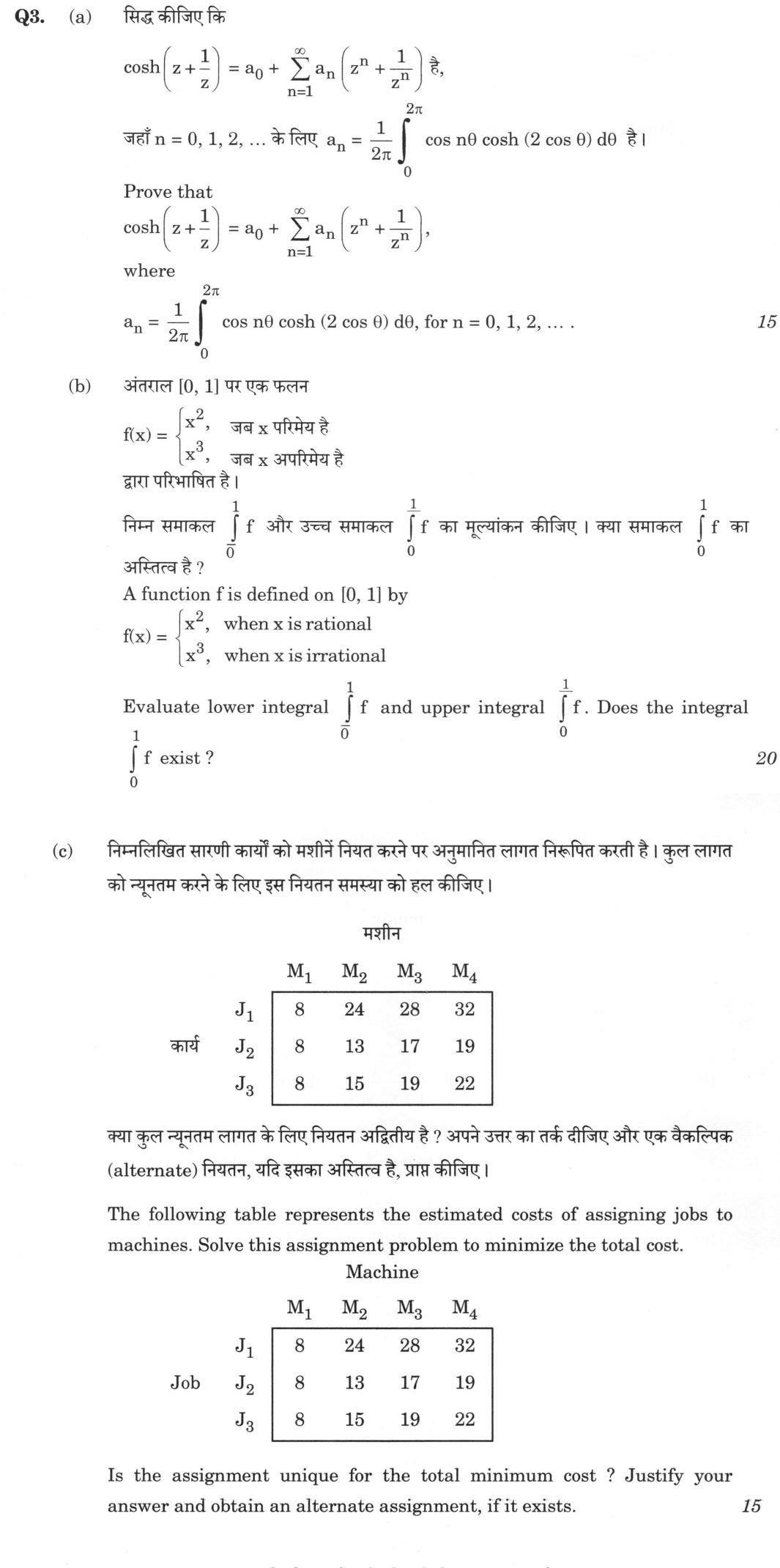
(a) Prove that cosh ( z + 1/z ) = a₀ + Σₙ₌₁^∞ aₙ ( zⁿ + 1/zⁿ ) , where aₙ = (1 / 2π) ∫₀²π cos nθ cosh (2 cos θ) dθ, for n = 0…
Prove that
cosh ( z + 1/z ) = a₀ + Σₙ₌₁^∞ aₙ ( zⁿ + 1/zⁿ ) ,
where
aₙ = (1 / 2π) ∫₀²π cos nθ cosh (2 cos θ) dθ, for n = 0, 1, 2, ... . 15 marks
A function f is defined on [0, 1] by
f(x) = x² , when x is rational x³ , when x is irrational
Evaluate lower integral ∫₀¹ f and upper integral ∫₀¹ f. Does the integral ∫₀¹ f exist? 20 marks
The following table represents the estimated costs of assigning jobs to machines. Solve this assignment problem to minimize the total cost.
Machine
M₁ M₂ M₃ M₄
┌─────────────────┐ J₁ │ 8 24 28 32 │ Job J₂ │ 8 13 17 19 │ J₃ │ 8 15 19 22 │ └─────────────────┘
Is the assignment unique for the total minimum cost ? Justify your answer and obtain an alternate assignment, if it exists. 15 marks
हिंदी में प्रश्न पढ़ें
सिद्ध कीजिए कि
cosh ( z + 1/z ) = a₀ + Σₙ₌₁^∞ aₙ ( zⁿ + 1/zⁿ ) है,
जहाँ n = 0, 1, 2, ... के लिए aₙ = (1 / 2π) ∫₀²π cos nθ cosh (2 cos θ) dθ है। (15 अंक)
अंतराल [0, 1] पर एक फलन
f(x) = x² , जब x परिमेय है x³ , जब x अपरिमेय है
द्वारा परिभाषित है।
निम्न समाकल ∫₀¹ f और उच्च समाकल ∫₀¹ f का मूल्यांकन कीजिए। क्या समाकल ∫₀¹ f का अस्तित्व है? (20 अंक)
निम्नलिखित सारणी कार्यों को मशीनें नियत करने पर अनुमानित लागत निरूपित करती है। कुल लागत को न्यूनतम करने के लिए इस नियतन समस्या को हल कीजिए।
मशीन
M₁ M₂ M₃ M₄
┌─────────────────┐ J₁ │ 8 24 28 32 │ कार्य J₂ │ 8 13 17 19 │ J₃ │ 8 15 19 22 │ └─────────────────┘
क्या कुल न्यूनतम लागत के लिए नियतन अद्वितीय है ? अपने उत्तर का तर्क दीजिए और एक वैकल्पिक (alternate) नियतन, यदि इसका अस्तित्व है, प्राप्त कीजिए। (15 अंक)
Model answer
Drafted with AI by UPSC Answer Check against this question's marking rubric, to the expected length. UPSC does not publish answers for Mains — this is one way to score well, not an official key. How we build rubrics and answers.
(a) Laurent expansion of cosh(z + 1/z) Let f(z) = cosh(z + 1/z). The function f is analytic in the entire annulus 0 < |z| < ∞; it has an essential singularity at z = 0, so a Taylor expansion about 0 is impossible and only a Laurent series exists. Hence f admits a Laurent expansion f(z) = Σₙ₌₋∞^∞ cₙ zⁿ valid throughout that annulus, with coefficients given by the standard contour formula cₙ = (1/2πi) ∮_|z|=1 f(z) z⁻⁽ⁿ⁺¹⁾ dz, where the contour is the unit circle.
Symmetry of the coefficients. Observe that f(1/z) = cosh(1/z + z) = f(z). Substituting the Laurent series, f(1/z) = Σ cₙ z⁻ⁿ = Σ c₋ₙ zⁿ. Comparing term-by-term with f(z) = Σ cₙ zⁿ gives c₋ₙ = cₙ for every integer n. This symmetry is precisely what allows the series to be regrouped as f(z) = c₀ + Σₙ₌₁^∞ cₙ (zⁿ + z⁻ⁿ).
Evaluation of cₙ for n ≥ 0. Parametrise the unit circle by z = eⁱθ, so dz = i eⁱθ dθ and z⁻⁽ⁿ⁺¹⁾ = e⁻i(n+1)θ. On |z| = 1, z + 1/z = eⁱθ + e⁻iθ = 2 cos θ. Substituting into the coefficient integral: cₙ = (1/2πi) ∫₀²π cosh(2 cos θ) e⁻i(n+1)θ (i eⁱθ) dθ = (1/2π) ∫₀²π cosh(2 cos θ) e⁻inθ dθ. Now expand e⁻inθ = cos(nθ) − i sin(nθ). The factor cosh(2 cos θ) is unchanged under θ → 2π − θ, while sin(nθ) changes sign; hence the integral of cosh(2 cos θ) sin(nθ) over [0, 2π] vanishes. Therefore cₙ = (1/2π) ∫₀²π cosh(2 cos θ) cos(nθ) dθ. Setting aₙ = cₙ (with a₀ = c₀, the same formula with cos 0 = 1) and using c₋ₙ = cₙ = aₙ, the Laurent series becomes cosh(z + 1/z) = a₀ + Σₙ₌₁^∞ aₙ (zⁿ + 1/zⁿ), where aₙ = (1/2π) ∫₀²π cos(nθ) cosh(2 cos θ) dθ. Q.E.D.
(b) Upper and lower integrals The function f is defined on [0, 1] by f(x) = x² when x is rational and f(x) = x³ when x is irrational. To compute the lower and upper Darboux integrals, take an arbitrary partition P = {0 = x₀ < x₁ < … < xₙ = 1} of [0, 1].
Supremum and infimum on each subinterval. In every subinterval [xᵢ₋₁, xᵢ], both the rationals and the irrationals are dense. On [0, 1] we have 0 ≤ x ≤ 1, so x³ ≤ x². Consequently, the largest values of f on [xᵢ₋₁, xᵢ] are attained at the rational points (where f = x²), and the smallest at the irrational points (where f = x³). Because x² is increasing on [0, 1], the supremum is the value of x² at the right endpoint: sup f = xᵢ². Because x³ is increasing, the infimum is the value of x³ at the left endpoint: inf f = xᵢ₋₁³.
Upper and lower sums. The upper Darboux sum is U(f, P) = Σᵢ₌₁ⁿ xᵢ² Δxᵢ and the lower sum is L(f, P) = Σᵢ₌₁ⁿ xᵢ₋₁³ Δxᵢ. As the mesh ‖P‖ → 0, these Riemann sums converge to the definite integrals of the bounding functions x² and x³ respectively. Hence the upper integral is ∫₀¹ x² dx = [x³/3]₀¹ = 1/3, and the lower integral is ∫₀¹ x³ dx = [x⁴/4]₀¹ = 1/4.
Existence of the Riemann integral. By the Darboux criterion, the Riemann integral exists if and only if the upper and lower integrals are equal. Here 1/3 ≠ 1/4, so the Riemann integral ∫₀¹ f does not exist. This is consistent with the Lebesgue criterion: f is discontinuous at every point of (0, 1) (the rationals and irrationals are dense, and x² ≠ x³ there), a set of positive measure, so f is not Riemann integrable. (The Lebesgue integral does exist and equals 1/4, since f = x³ almost everywhere, but that is a different question.)
(c) Assignment problem There are 3 jobs and 4 machines, so the problem is unbalanced: add a dummy job J₄ with zero costs (the machine it receives stays idle). Cost matrix (rows J₁–J₄, columns M₁–M₄): J₁: 8 24 28 32 J₂: 8 13 17 19 J₃: 8 15 19 22 J₄: 0 0 0 0 Row reduction (row minima 8, 8, 8, 0); every column then already has a zero, so column reduction changes nothing: J₁: 0 16 20 24 J₂: 0 5 9 11 J₃: 0 7 11 14 J₄: 0 0 0 0 Iteration 1: all zeros are covered by 2 lines (column M₁, row J₄) < 4. The smallest uncovered entry is 5; subtract it from the uncovered entries and add it at the intersection (J₄, M₁): J₁: 0 11 15 19 J₂: 0 0 4 6 J₃: 0 2 6 9 J₄: 5 0 0 0 Iteration 2: minimum cover is 3 lines (column M₁, rows J₂ and J₄) < 4. Smallest uncovered entry 2; subtract from uncovered entries, add at (J₂, M₁) and (J₄, M₁): J₁: 0 9 13 17 J₂: 2 0 4 6 J₃: 0 0 4 7 J₄: 7 0 0 0 Iteration 3: minimum cover is 3 lines (columns M₁, M₂ and row J₄) < 4. Smallest uncovered entry 4; subtract from uncovered entries, add at (J₄, M₁) and (J₄, M₂): J₁: 0 9 9 13 J₂: 2 0 0 2 J₃: 0 0 0 3 J₄: 11 4 0 0 Now 4 independent zeros exist, so the assignment is optimal. J₁ has its only zero in M₁, so J₁ → M₁. Then J₄ must take M₄ (M₃ would leave M₄ with no zero among J₂, J₃). J₂ and J₃ share the zeros in M₂ and M₃: J₁ → M₁ (8), J₂ → M₂ (13), J₃ → M₃ (19), M₄ idle: total 8 + 13 + 19 = 40. Uniqueness: the zeros at (J₂, M₂), (J₂, M₃), (J₃, M₂), (J₃, M₃) form two independent choices, so the optimum is not unique. The alternate optimal assignment is J₁ → M₁ (8), J₂ → M₃ (17), J₃ → M₂ (15), M₄ idle: total 8 + 17 + 15 = 40. (Check by enumeration of all 24 assignments: 40 is the minimum and is attained only by these two; the next best is 42.)
How this answer will be evaluated
Evaluation rubric
Each sub-part is marked on its own, against the marks and word limit printed on the paper.
- (a) Prove that cosh(z + 1/z) has the stated symmetric Laurent expansion a_0 + sum a_n(z^n + z^{-n}), and that the coefficients are given by the real integral a_n = (1/2pi) times the integral over [0, 2pi] of cos(n theta) cosh(2 cos theta) d theta. 15 marks
Must cover
- f analytic in 0 < |z| < ∞ (essential singularity at 0), so a Laurent series with cₙ = (1/2πi)∮_{|z|=1} f(z) z^{−(n+1)} dz
- f(1/z) = f(z) ⇒ c₋ₙ = cₙ, giving the grouping a₀ + Σ aₙ(zⁿ + z⁻ⁿ)
- With z = e^{iθ}, z + 1/z = 2 cos θ and the sin nθ part vanishes, so aₙ = (1/2π)∫₀^{2π} cos nθ cosh(2 cos θ) dθ
Loses marks
- Attempting a Taylor expansion about the essential singularity z = 0
- Not deriving c₋ₙ = cₙ
- Missing the 1/(2πi) factor or the z^{−(n+1)} in the coefficient formula
- Not showing that the sin nθ part integrates to zero
Earns more
- State that f(z) = cosh(z + 1/z) is analytic in the annulus 0 < |z| < infinity (essential singularity at 0), hence has a Laurent series sum c_n z^n valid there
- Vanishing of the sine part (by the substitution theta -> 2 pi - theta or by evenness), giving a_n = (1/2 pi) integral of cos(n theta) cosh(2 cos theta) d theta
- (b) For f on [0,1] equal to x^2 at rationals and x^3 at irrationals, compute the lower Darboux integral, compute the upper Darboux integral, and decide (with reason) whether the Riemann integral exists. Three distinct answers are required. 20 marks
Must cover
- On every subinterval sup f = xᵢ² and inf f = xᵢ₋₁³, using density of rationals and irrationals and x³ ≤ x² on [0, 1]
- Upper integral = ∫₀¹ x² dx = 1/3; lower integral = ∫₀¹ x³ dx = 1/4
- 1/3 ≠ 1/4, so the Riemann integral does not exist
Loses marks
- Swapping the values (lower 1/3, upper 1/4)
- Claiming the integral exists, or averaging the two values
- Asserting sup/inf without appealing to density
- Concluding Riemann integrability from f = x³ almost everywhere
Earns more
- Justify sup f = x_i^2 and inf f = x_{i-1}^3 on each subinterval using density of the rationals and irrationals together with x^3 <= x^2 on [0, 1]
- Remark that f is discontinuous at every point of (0, 1), matching the Lebesgue criterion (measure-zero discontinuity set) for non-integrability
- (c) Solve a 3-job x 4-machine unbalanced assignment problem (add a dummy job) by the Hungarian method to minimise total cost; then decide whether the optimal assignment is unique, justify the answer, and exhibit the alternate optimal assignment. 15 marks
Must cover
- Balance with a dummy job (zero row) and apply the Hungarian method: reduction, line covering, and the adjustment iterations until 4 lines are needed
- Optimal assignment J₁ → M₁, J₂ → M₂, J₃ → M₃, M₄ idle; minimum cost 40
- Not unique: alternate optimum J₁ → M₁, J₂ → M₃, J₃ → M₂, M₄ idle, also 40, justified by the alternative independent zeros
Loses marks
- Adding a dummy machine (column) instead of a dummy job (row)
- Reading an assignment off before the covering test needs 4 lines
- Asserting uniqueness, or saying 'not unique' without exhibiting the second optimum
- Not stating that M₄ is idle
Earns more
- Explicit reduced matrices for each Hungarian iteration
- Check by enumeration that 40 is the minimum (next best 42)
What "Prove" is asking you to do
Establish that the statement holds for every case it claims, not for one representative case. The argument must be closed: each line follows from a definition, a hypothesis, or a named theorem you are entitled to use.
Structure that answers it
Given and to prove, restated → theorem or construction to be used, named → the argument line by line → conclusion stated as proved
Where marks are lost
Testing one example, which illustrates but proves nothing. On an if and only if claim, proving one direction and stopping forfeits that half outright, and degenerate cases — zero, the empty set, the equality case — have to be disposed of rather than assumed away.
Practice this exact question
Write your answer and it is marked point by point against the model answer above — what you covered, what you missed, what you got wrong.
Evaluate my answer →More from Mathematics 2026 Paper II
- Q1 (a) Let G be a group of order pq, where p and q are primes. Show that either G is an abel…
- Q2 (a) Let G be a finite group generated by two elements u and v of order 2 each. Show that…
- Q3 (a) Prove that cosh ( z + 1/z ) = a₀ + Σ_{n=1}^{∞} aₙ ( zⁿ + 1/zⁿ ) , where aₙ = (1 / 2π)…
- Q4 (a) Let n be a positive integer. Show that the following statements are equivalent : (i)…
- Q5 (a) Find the integral surface of the equations dx/(xz − y) = dy/(yz − x) = dz/(1 − z²) .…
- Q6 (a) Reduce the partial differential equation y ∂²z/∂x² + (x + y) ∂²z/∂x∂y + x ∂²z/∂y² = 0…