Paper II — Q5
(a) Find the integral surface of the equations dx/(xz − y) = dy/(yz − x) = dz/(1 − z²) . (10 marks) (b) By using the…
Find the integral surface of the equations dx/(xz − y) = dy/(yz − x) = dz/(1 − z²) . 10 marks
By using the Newton-Raphson iterative formula, establish the formula xᵢ₊₁ = (1/3) ( 2xᵢ + N/xᵢ² ) to find the cube root of N.
Use this formula, if established, to find the cube root of 63 correct to four decimal places with the initial approximation 3.9. 10 marks
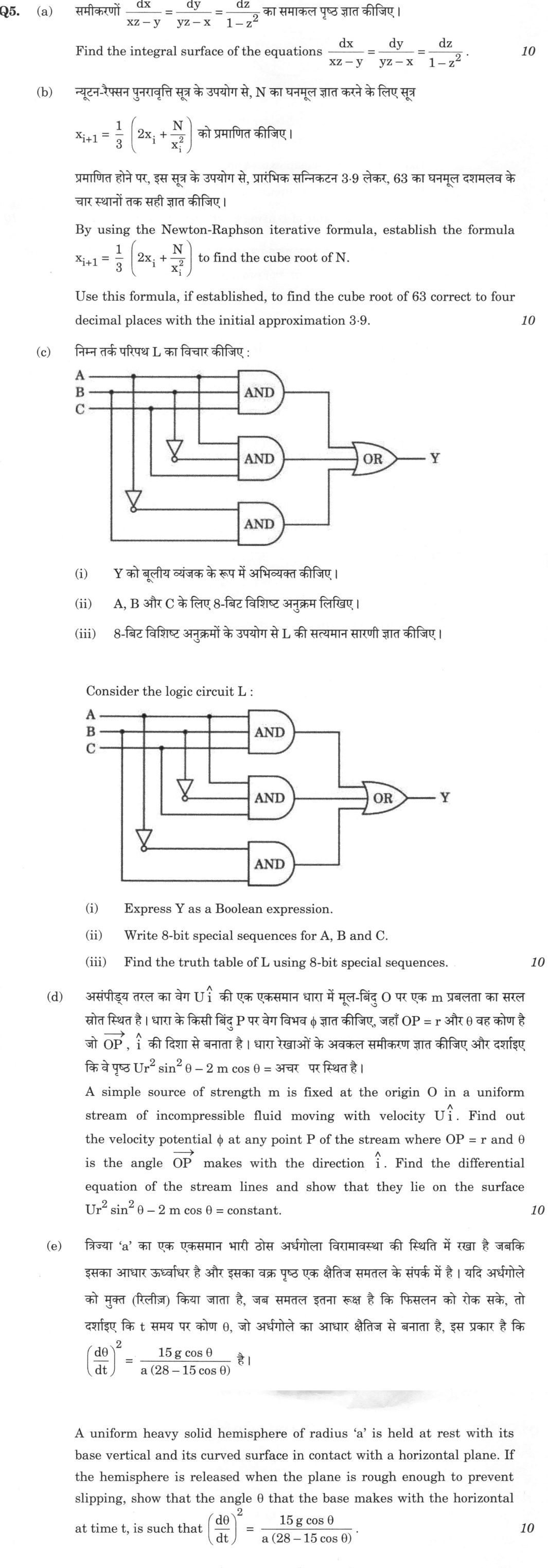
Consider the following logic circuit L :
Express Y as a Boolean expression.
Write the 8-bit distinct sequences for A, B and C.
Using the 8-bit distinct sequences, find the truth table of L. 10 marks
A simple source of strength m is fixed at the origin O in a uniform stream of incompressible fluid moving with velocity U î . Find out the velocity potential φ at any point P of the stream where OP = r and θ is the angle ⟶OP makes with the direction î . Find the differential equation of the stream lines and show that they lie on the surface Ur² sin²θ − 2 m cos θ = constant. 10 marks
A uniform heavy solid hemisphere of radius 'a' is placed in a position of rest with its base vertical and its curved surface in contact with a horizontal plane. If the hemisphere is released, when the plane is rough enough to prevent slipping, show that at time t, the angle θ, which the base of the hemisphere makes with the horizontal, is such that ( dθ/dt )² = 15 g cos θ / a (28 − 15 cos θ) . 10 marks
हिंदी में प्रश्न पढ़ें
समीकरणों dx/(xz − y) = dy/(yz − x) = dz/(1 − z²) का समाकल पृष्ठ ज्ञात कीजिए। (10 अंक)
न्यूटन-रैफसन पुनरावृत्ति सूत्र के उपयोग से, N का घनमूल ज्ञात करने के लिए सूत्र xᵢ₊₁ = (1/3) ( 2xᵢ + N/xᵢ² ) को प्रमाणित कीजिए।
प्रमाणित होने पर, इस सूत्र के उपयोग से, प्रारंभिक सन्निकटन 3.9 लेकर, 63 का घनमूल दशमलव के चार स्थानों तक सही ज्ञात कीजिए। (10 अंक)
निम्न तर्क परिपथ L का विचार कीजिए :
Y को बूलीय व्यंजक के रूप में अभिव्यक्त कीजिए।
A, B और C के लिए 8-बिट विशिष्ट अनुक्रम लिखिए।
8-बिट विशिष्ट अनुक्रमों के उपयोग से L की सत्यमान सारणी ज्ञात कीजिए। (10 अंक)
असंपीड्य तरल का वेग U î की एक एकसमान धारा में मूल-बिंदु O पर एक m प्रबलता का सरल स्रोत स्थित है। धारा के किसी बिंदु P पर वेग विभव φ ज्ञात कीजिए, जहाँ OP = r और θ वह कोण है जो ⟶OP , î की दिशा से बनाता है। धारा रेखाओं के अवकल समीकरण ज्ञात कीजिए और दर्शाइए कि वे पृष्ठ Ur² sin²θ − 2 m cos θ = अचर पर स्थित हैं। (10 अंक)
त्रिज्या 'a' का एक एकसमान भारी ठोस अर्धगोला विरामावस्था की स्थिति में रखा है जबकि इसका आधार ऊर्ध्वाधर है और इसका वक्र पृष्ठ एक क्षैतिज समतल के संपर्क में है। यदि अर्धगोले को मुक्त (रिलीज़) किया जाता है, जब समतल इतना रूक्ष है कि फिसलन को रोक सके, तो दर्शाइए कि t समय पर कोण θ, जो अर्धगोले का आधार क्षैतिज से बनाता है, इस प्रकार है कि ( dθ/dt )² = 15 g cos θ / a (28 − 15 cos θ) है। (10 अंक)
Model answer
Drafted with AI by UPSC Answer Check against this question's marking rubric, to the expected length. UPSC does not publish answers for Mains — this is one way to score well, not an official key. How we build rubrics and answers.
(a) Integral surface The given equations represent Lagrange's auxiliary system for a quasi-linear partial differential equation. To find the integral surface, we must determine two independent first integrals. We employ the method of multipliers to simplify the ratios.
First, we select multipliers (1, 1, 0). The sum of the numerators is dx + dy, and the sum of the denominators is (xz - y) + (yz - x) = (z - 1)(x + y). Thus, we have: (dx + dy) / [(z - 1)(x + y)] = dz / (1 - z²) Since 1 - z² = (1 - z)(1 + z) = -(z - 1)(1 + z), the equation becomes: d(x + y) / (x + y) = -(dz / (1 + z)) Integrating both sides yields: ln(x + y) = -ln(1 + z) + ln(c₁) (x + y)(1 + z) = c₁
Next, we select multipliers (1, -1, 0). The sum of the numerators is dx - dy, and the sum of the denominators is (xz - y) - (yz - x) = (z + 1)(x - y). Thus: (dx - dy) / [(z + 1)(x - y)] = dz / (1 - z²) d(x - y) / (x - y) = (dz / (1 - z)) Integrating gives: ln(x - y) = -ln(1 - z) + ln(c₂) (x - y)(1 - z) = c₂
The general integral surface is the arbitrary relation between these two independent integrals: F((x + y)(1 + z), (x - y)(1 - z)) = 0
(b) Newton–Raphson cube-root formula To find the cube root of N, we define the function f(x) = x³ - N. The Newton-Raphson iterative formula is xᵢ₊₁ = xᵢ - f(xᵢ) / f'(xᵢ). Differentiating f(x) gives f'(x) = 3x². Substituting these into the formula: xᵢ₊₁ = xᵢ - (xᵢ³ - N) / (3xᵢ²) = (3xᵢ³ - xᵢ³ + N) / (3xᵢ²) = (2xᵢ³ + N) / (3xᵢ²) This simplifies to the required formula: xᵢ₊₁ = (1/3)(2xᵢ + N/xᵢ²).
For N = 63 and initial approximation x₀ = 3.9: x₁ = (1/3)(2(3.9) + 63/3.9²) = 3.9806706 x₂ = (1/3)(2(3.9806706) + 63/3.9806706²) = 3.9790579 x₃ = (1/3)(2(3.9790579) + 63/3.9790579²) = 3.9790572 Since x₂ and x₃ agree to four decimal places, the cube root of 63 is 3.9791.
(c) Logic circuit (i) By tracing the logic circuit L, the inputs to the three AND gates are (A, B, C), (A, B', C), and (A', B). The output Y is the OR of these terms: Y = ABC + AB'C + A'B Simplifying the expression: Y = AC(B + B') + A'B = AC + A'B
(ii) The standard 8-bit distinct sequences for the inputs are: A = 00001111 B = 00110011 C = 01010101
(iii) Using these sequences, we evaluate the AND gate outputs: ABC = 00000001 AB'C = 00000100 A'B = 00110000 Performing the bitwise OR operation for Y: Y = 00110101 This corresponds to the truth table values Y = 0, 0, 1, 1, 0, 1, 0, 1 for ABC from 000 to 111.
(d) Source in a uniform stream The velocity potential for a simple source of strength m at the origin in a uniform stream U is the superposition of the source potential and the uniform stream potential: φ = m/r - Ur cos θ (convention q = −∇φ) The velocity components are uᵣ = -∂φ/∂r = U cos θ + m/r² and u_θ = -(1/r)∂φ/∂θ = -U sin θ. The differential equation for the streamlines is dr/uᵣ = r dθ/u_θ. Substituting the components: dr / (U cos θ + m/r²) = r dθ / (-U sin θ) Cross-multiplying and multiplying by r sin θ: −U r sin²θ dr − U r² sin θ cos θ dθ − m sin θ dθ = 0, i.e. −d((1/2)Ur² sin²θ) + d(m cos θ) = 0. Integrating (the left side is the Stokes stream function ψ, constant along a streamline): (1/2)Ur² sin²θ - m cos θ = constant Multiplying by 2, the streamlines lie on the surface: Ur² sin²θ - 2m cos θ = constant The stagnation point occurs at θ = π and r = √(m/U).
(e) Rolling hemisphere The center of mass G of a uniform solid hemisphere is located at a distance 3a/8 from the center O of its flat base. When the hemisphere rolls without slipping on a rough plane, the contact point is the instantaneous center of rotation. The moment of inertia about a diameter of the base is I_O = (2/5)ma². Using the parallel axis theorem, the moment of inertia about the center of mass G is: I_G = I_O - m(3a/8)² = (2/5)ma² - (9/64)ma² = (83/320)ma² The moment of inertia about the instantaneous contact point P is: I_P = I_G + m·GP², where GP² = a² + (3a/8)² - 2a(3a/8)cos θ, so I_P = (83/320 + 320/320 + 45/320 - (240/320)cos θ)ma² = ma²(28 - 15 cos θ)/20 There is no slipping, so friction does no work. Using energy conservation, the loss in potential energy equals the gain in kinetic energy. The center of mass G falls by (3a/8)cos θ from its initial position at θ = π/2. (1/2)I_P (dθ/dt)² = mg(3a/8)cos θ Substituting I_P: (1/2)(ma²(28 - 15 cos θ)/20)(dθ/dt)² = (3/8)mg a cos θ Solving for (dθ/dt)²: (dθ/dt)² = (15g cos θ) / (a(28 - 15 cos θ))
How this answer will be evaluated
Evaluation rubric
Each sub-part is marked on its own, against the marks and word limit printed on the paper.
- (a) Find the integral surface (general solution) of the Lagrange auxiliary system dx/(xz - y) = dy/(yz - x) = dz/(1 - z^2), i.e. obtain two independent first integrals and write the surface as an arbitrary relation between them. 10 marks
Must cover
- Multipliers (1, 1, 0): d(x + y)/(x + y) = −dz/(1 + z) ⇒ (x + y)(1 + z) = c₁
- Multipliers (1, −1, 0): d(x − y)/(x − y) = dz/(1 − z) ⇒ (x − y)(1 − z) = c₂
- Integral surface F((x + y)(1 + z), (x − y)(1 − z)) = 0, F arbitrary
Loses marks
- Sign slips giving (x + y)(1 − z) or (x − y)(1 + z)
- Giving only one first integral
- Giving a particular relation instead of the general surface with an arbitrary function
Earns more
- Recognise Lagrange's auxiliary system and the need for two independent first integrals u = c1, v = c2
- FINAL ANSWER stated as the general integral surface F((x + y)(1 + z), (x - y)(1 - z)) = 0 with F arbitrary
- (b) Two tasks: (a) derive the cube-root iteration x_{i+1} = (1/3)(2x_i + N/x_i^2) from Newton-Raphson applied to f(x) = x^3 - N; (b) use it with x_0 = 3.9 to compute the cube root of 63 correct to four decimal places, showing the successive iterates. 10 marks
Must cover
- f(x) = x³ − N, f′(x) = 3x² in xᵢ₊₁ = xᵢ − f(xᵢ)/f′(xᵢ) gives xᵢ₊₁ = (1/3)(2xᵢ + N/xᵢ²)
- Iterates from 3.9: 3.9806706, 3.9790579, 3.9790572
- ∛63 = 3.9791 (successive iterates agree to 4 decimals)
Loses marks
- Wrong f or f′ giving a different iteration
- Stopping after one iteration (3.9807)
- Rounding intermediate values too early
- Reporting 3.9790 instead of 3.9791
Earns more
- Second and third iterates x_2 = 3.9790579 and x_3 = 3.9790572, showing agreement to 4 decimal places
- FINAL ANSWER: cube root of 63 = 3.9791 to four decimal places, with a verification such as 3.9791^3 approximately 63.0020
- (c) Read the printed three-AND-plus-OR logic circuit L and answer three sub-parts: (i) write Y as a Boolean expression, (ii) write the standard 8-bit distinct input sequences for A, B and C, (iii) build the truth table of L from those sequences. 10 marks
Must cover
- Y = ABC + AB′C + A′B, simplified to Y = AC + A′B
- A = 00001111, B = 00110011, C = 01010101
- AND outputs 00000001, 00000100, 00110000 and Y = 00110101 (truth table Y = 0, 0, 1, 1, 0, 1, 0, 1 for ABC = 000 … 111)
Loses marks
- Mis-tracing which rail feeds each inverter
- Wrong number of inputs on an AND gate
- Non-standard sequence order without saying so
- Incorrect simplification (e.g. A + A′B)
Earns more
- Bitwise evaluation giving the AND outputs 00000001, 00000100, 00110000 and hence Y = 00110101
- Truth table with all 8 rows: Y = 0, 0, 1, 1, 0, 1, 0, 1 for ABC = 000 to 111
- (d) Three tasks for a three-dimensional simple source of strength m at the origin in a uniform stream U i: find the velocity potential phi at a point P with OP = r and polar angle theta; find the differential equation of the streamlines; and show the streamlines lie on U r^2 sin^2(theta) - 2 m cos(theta) = constant. 10 marks
Must cover
- φ = m/r − Ur cos θ (q = −∇φ), u_r = U cos θ + m/r², u_θ = −U sin θ
- Streamline equation dr/u_r = r dθ/u_θ
- Integration to (1/2)Ur² sin²θ − m cos θ = constant, i.e. Ur² sin²θ − 2m cos θ = constant
Loses marks
- Using the 2-D source potential m ln r
- Inconsistent sign convention for φ
- Interchanging components in the streamline equation
- Stopping at the differential equation without integrating it
Earns more
- Stagnation point at θ = π, r = √(m/U) (Rankine half-body)
- (e) A uniform solid hemisphere of radius a rests with its base vertical and its curved surface on a rough horizontal plane; it is released and rolls without slipping. Derive, by energy conservation, that (d(theta)/dt)^2 = 15 g cos(theta)/[a(28 - 15 cos theta)], where theta is the angle of the base with the horizontal. 10 marks
Must cover
- OG = 3a/8; I_G = (2/5)ma² − m(3a/8)² = (83/320)ma²
- I_P = I_G + m·GP² with GP² = a² + 9a²/64 − (3a²/4) cos θ, giving I_P = ma²(28 − 15 cos θ)/20
- Energy from rest at θ = π/2 (friction does no work): (1/2)I_P θ̇² = mg(3a/8) cos θ ⇒ θ̇² = 15g cos θ/[a(28 − 15 cos θ)]
Loses marks
- Measuring 3a/8 from the contact point or the curved surface instead of from O
- Using (2/5)ma² as the moment of inertia about G
- Omitting the translational kinetic energy of G
- Taking the initial position as θ = 0 instead of θ = π/2
Earns more
- Moment of inertia I_O = (2/5) m a^2 about a diameter of the base, giving I_G = (2/5)ma^2 - m(3a/8)^2 = (83/320) m a^2
- Energy equation (1/2) I_P (d theta/dt)^2 = m g (3a/8) cos theta, using release from rest at theta = pi/2
What "Solve" is asking you to do
Choose the method, then carry it through to a final answer. Identifying what kind of problem this is and why that method applies is the first thing marked; a correct figure arrived at invisibly earns almost nothing.
Structure that answers it
Given data and what is required → method chosen, with the reason it applies → set-up (equation, circuit, free body, trial balance) → working, step by step → answer with units and any condition of validity
Where marks are lost
Doing the middle steps mentally and writing only the result. In mathematics papers, a further loss comes from giving a decimal where the exact value in surds or fractions was wanted, or from skipping the justification a part explicitly asks for.
Practice this exact question
Write your answer and it is marked point by point against the model answer above — what you covered, what you missed, what you got wrong.
Evaluate my answer →More from Mathematics 2026 Paper II
- Q2 (a) Let G be a finite group generated by two elements u and v of order 2 each. Show that…
- Q3 (a) Prove that cosh ( z + 1/z ) = a₀ + Σ_{n=1}^{∞} aₙ ( zⁿ + 1/zⁿ ) , where aₙ = (1 / 2π)…
- Q4 (a) Let n be a positive integer. Show that the following statements are equivalent : (i)…
- Q5 (a) Find the integral surface of the equations dx/(xz − y) = dy/(yz − x) = dz/(1 − z²) .…
- Q6 (a) Reduce the partial differential equation y ∂²z/∂x² + (x + y) ∂²z/∂x∂y + x ∂²z/∂y² = 0…
- Q7 (a) Solve the partial differential equation (2D² - 5DD' + 2D'²) z = 24 (y - x) + sin (y -…
- Q8 (a) Two-dimensional harmonic equation in plane polar coordinates (r, θ) takes the form :…