Paper II — Q8
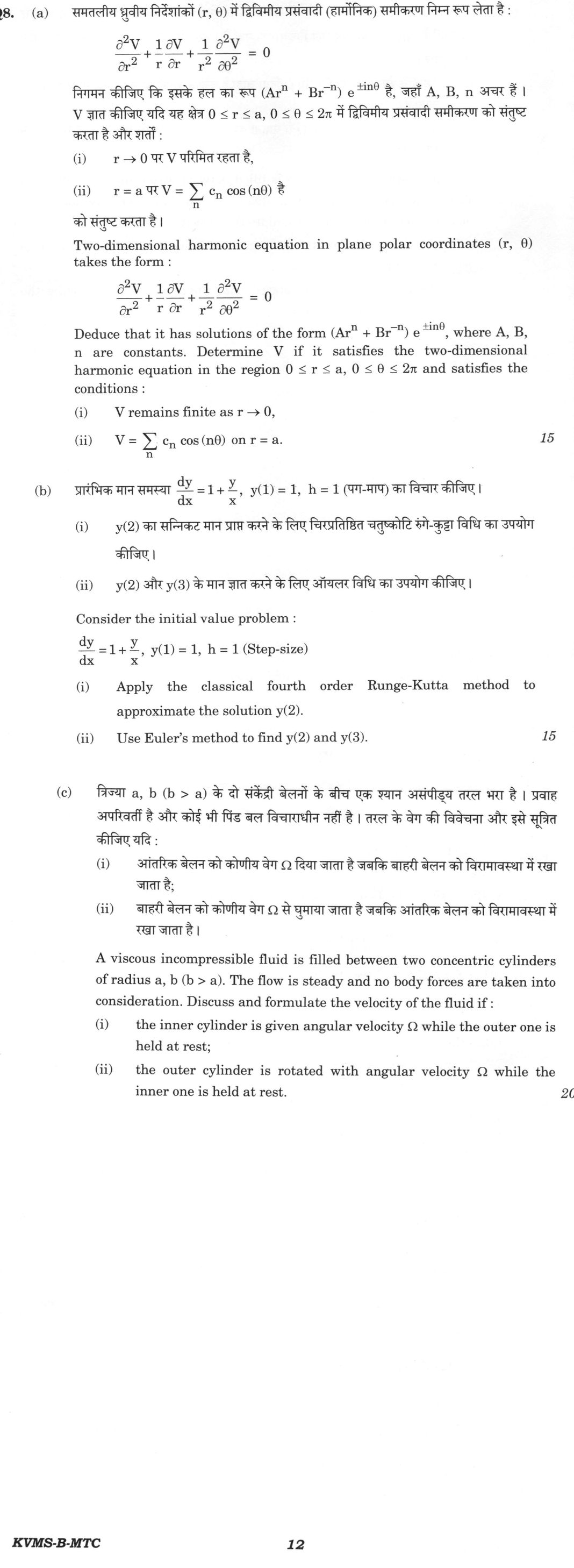
(a) Two-dimensional harmonic equation in plane polar coordinates (r, θ) takes the form : ∂²V/∂r² + (1/r) ∂V/∂r + (1/r²) ∂²V/∂θ²…
Two-dimensional harmonic equation in plane polar coordinates (r, θ) takes the form :
∂²V/∂r² + (1/r) ∂V/∂r + (1/r²) ∂²V/∂θ² = 0
Deduce that it has solutions of the form (Arⁿ + Br⁻ⁿ) e^±inθ, where A, B, n are constants. Determine V if it satisfies the two-dimensional harmonic equation in the region 0 ≤ r ≤ a, 0 ≤ θ ≤ 2π and satisfies the conditions :
V remains finite as r → 0,
V = Σₙ cₙ cos(nθ) on r = a. 15 marks
Consider the initial value problem :
dy/dx = 1 + y/x, y(1) = 1, h = 1 (Step-size)
Apply the classical fourth order Runge-Kutta method to approximate the solution y(2).
Use Euler's method to find y(2) and y(3). 15 marks
A viscous incompressible fluid is filled between two concentric cylinders of radius a, b (b > a). The flow is steady and no body forces are taken into consideration. Discuss and formulate the velocity of the fluid if : the inner cylinder is given angular velocity Ω while the outer one is held at rest;
the outer cylinder is rotated with angular velocity Ω while the inner one is held at rest. 20 marks
हिंदी में प्रश्न पढ़ें
समतलीय ध्रुवीय निर्देशांकों (r, θ) में द्विविमीय प्रसंवादी (हार्मोनिक) समीकरण निम्न रूप लेता है :
∂²V/∂r² + (1/r) ∂V/∂r + (1/r²) ∂²V/∂θ² = 0
निगमन कीजिए कि इसके हल का रूप (Arⁿ + Br⁻ⁿ) e^±inθ है, जहाँ A, B, n अचर हैं । V ज्ञात कीजिए यदि यह क्षेत्र 0 ≤ r ≤ a, 0 ≤ θ ≤ 2π में द्विविमीय प्रसंवादी समीकरण को संतुष्ट करता है और शर्तों :
r → 0 पर V परिमित रहता है,
r = a पर V = Σₙ cₙ cos(nθ) है
को संतुष्ट करता है । (15 अंक)
प्रारंभिक मान समस्या dy/dx = 1 + y/x, y(1) = 1, h = 1 (पग-माप) का विचार कीजिए ।
y(2) का सन्निकट मान प्राप्त करने के लिए चिरप्रतिष्ठित चतुष्कोटि रूंगे-कुट्टा विधि का उपयोग कीजिए ।
y(2) और y(3) के मान ज्ञात करने के लिए ऑयलर विधि का उपयोग कीजिए । (15 अंक)
त्रिज्या a, b (b > a) के दो संकेंद्री बेलनों के बीच एक श्यान असंपीड्य तरल भरा है । प्रवाह अपरिवर्ती है और कोई भी पिंड बल विचाराधीन नहीं है । तरल के वेग की विवेचना और इसे सूत्रित कीजिए यदि : आंतरिक बेलन को कोणीय वेग Ω दिया जाता है जबकि बाहरी बेलन को विरामावस्था में रखा जाता है;
बाहरी बेलन को कोणीय वेग Ω से घुमाया जाता है जबकि आंतरिक बेलन को विरामावस्था में रखा जाता है । (20 अंक)
Model answer
Drafted with AI by UPSC Answer Check against this question's marking rubric, to the expected length. UPSC does not publish answers for Mains — this is one way to score well, not an official key. How we build rubrics and answers.
(a) Two-dimensional harmonic equation (15 marks)
Assume V(r, θ) = R(r)Θ(θ). Substituting in ∂²V/∂r² + (1/r)∂V/∂r + (1/r²)∂²V/∂θ² = 0 and multiplying by r²/(RΘ) gives (r²R″ + rR′)/R = -Θ″/Θ = n², where n² is the separation constant. The angular equation Θ″ + n²Θ = 0 has solutions e^(±inθ); since V must be single-valued and 2π-periodic, n is an integer. The radial equation r²R″ + rR′ - n²R = 0 is an Euler-Cauchy equation; putting r = eᵗ turns it into d²R/dt² = n²R, so R = Arⁿ + Br⁻ⁿ (for n = 0, R = A + B ln r). Hence the solutions are (Arⁿ + Br⁻ⁿ)e^(±inθ).
In the disc 0 ≤ r ≤ a, condition (i) requires V to stay finite as r → 0, so every r⁻ⁿ term and the ln r term must vanish: B = 0 for all n. The general finite solution is therefore V = Σ Aₙ rⁿ cos(nθ) (with sine terms allowed in general). Condition (ii), V = Σ cₙ cos(nθ) on r = a, contains only cosines, so the sine terms are absent and matching coefficients (orthogonality of the Fourier modes) gives Aₙaⁿ = cₙ, that is Aₙ = cₙ/aⁿ. Therefore
V(r, θ) = c₀ + Σₙ≥₁ cₙ (r/a)ⁿ cos(nθ).
(b) Runge-Kutta and Euler methods (15 marks)
Here f(x, y) = 1 + y/x, x₀ = 1, y₀ = 1, h = 1.
(i) Classical fourth-order Runge-Kutta, y₁ = y₀ + (1/6)(k₁ + 2k₂ + 2k₃ + k₄): k₁ = h f(x₀, y₀) = 1 + 1/1 = 2 k₂ = h f(x₀ + h/2, y₀ + k₁/2) = 1 + 2/1.5 = 2.3333 k₃ = h f(x₀ + h/2, y₀ + k₂/2) = 1 + 2.1667/1.5 = 2.4444 k₄ = h f(x₀ + h, y₀ + k₃) = 1 + 3.4444/2 = 2.7222 y(2) ≈ 1 + (2 + 4.6667 + 4.8889 + 2.7222)/6 = 3.3796.
(ii) Euler's method, yₙ₊₁ = yₙ + h f(xₙ, yₙ): y(2) = 1 + 1·(1 + 1/1) = 3.00; then y(3) = 3 + 1·(1 + 3/2) = 5.50.
The exact solution (integrating factor 1/x) is y = x(1 + ln x), giving y(2) = 3.3863 and y(3) = 6.2958. The RK4 error at x = 2 is about 0.007, while the Euler errors are about 0.386 at x = 2 and 0.796 at x = 3.
(c) Flow between concentric cylinders (20 marks)
For steady flow with no body forces the velocity is purely circumferential, u_θ = v(r), with no dependence on θ or z, so the convective terms vanish and the θ-momentum equation reduces to d²v/dr² + (1/r)dv/dr - v/r² = 0, that is d/dr[(1/r)d(rv)/dr] = 0. Its general solution is v(r) = Ar + B/r: a rigid-rotation part plus a free-vortex part. The radial momentum equation dp/dr = ρv²/r then gives the pressure.
(i) Inner cylinder rotating, outer at rest: v(a) = Ωa, v(b) = 0. These give A = -Ωa²/(b² - a²) and B = Ωa²b²/(b² - a²), so v(r) = Ωa²(b² - r²) / [r(b² - a²)].
(ii) Outer cylinder rotating, inner at rest: v(a) = 0, v(b) = Ωb. These give A = Ωb²/(b² - a²) and B = -Ωa²b²/(b² - a²), so v(r) = Ωb²(r² - a²) / [r(b² - a²)].
The shear stress is τ_rθ = μ(dv/dr - v/r) = -2μB/r², so the torque per unit length on the rotating inner cylinder in case (i) is 4πμΩa²b²/(b² - a²), the principle of the Couette viscometer. As b → ∞, case (i) reduces to the free vortex Ωa²/r.
How this answer will be evaluated
Evaluation rubric
Each sub-part is marked on its own, against the marks and word limit printed on the paper.
- (a) Two tasks: deduce by separation of variables that the two-dimensional Laplace equation in polar form has solutions (Ar^n + Br^-n)e^(±inθ); then determine V in the disc 0 ≤ r ≤ a subject to finiteness at r = 0 and V = Σ c_n cos(nθ) on r = a. 15 marks
Must cover
- Separation of variables V = R(r)Θ(θ), giving (r²R'' + rR')/R = -Θ''/Θ = n²
- Θ'' + n²Θ = 0, so Θ = e^(±inθ), and n an integer from 2π-periodicity
- Euler-Cauchy equation r²R'' + rR' - n²R = 0 with R = Ar^n + Br^-n; for n = 0, R = A + B ln r
- Finiteness at r = 0 gives B = 0 (also for the ln r term)
- V(r, θ) = Σ c_n (r/a)^n cos(nθ), with the constant term c_0
Loses marks
- Keeping the r^-n terms in the interior problem, which blow up at r = 0.
- Forgetting the n = 0 case (A + B ln r) so that c_0 is lost.
- Not justifying that n is an integer (single-valuedness of V).
- Writing Σ c_n r^n cos(nθ) without dividing by a^n, or including sine terms.
Earns more
- Method marks for correct separation of variables and the radial equation even if the boundary fit is wrong.
- Matching coefficients on r = a (A_n a^n = c_n) with the cosine-only data justified by orthogonality of the Fourier modes.
Extra mark
- Uniqueness of the solution by the maximum principle or Fourier completeness
- (b) For dy/dx = 1 + y/x, y(1) = 1, h = 1: (i) apply the classical fourth-order Runge-Kutta method (one step) to approximate y(2); (ii) apply Euler's method to obtain y(2) and then y(3). 15 marks
Must cover
- RK4 formula y₁ = y₀ + (1/6)(k₁ + 2k₂ + 2k₃ + k₄)
- k₁ = 2, k₂ = 2.3333, k₃ = 2.4444, k₄ = 2.7222, so y(2) = 3.3796
- Euler: y(2) = 3 and y(3) = 5.5 (second step from (2, 3))
- Comparison with the exact solution y = x(1 + ln x): y(2) = 3.3863, y(3) = 6.2958
Loses marks
- Evaluating k₂ and k₃ at x₀ + h instead of x₀ + h/2.
- Using wrong RK4 weights such as (1, 3, 3, 1)/8 instead of (1, 2, 2, 1)/6.
- Starting the second Euler step from the wrong point or omitting y(3).
Earns more
- Correct evaluation points x₀ + h/2 = 1.5 for k₂ and k₃, and x₀ + h = 2 for k₄, even if arithmetic slips occur later.
- Error comparison: RK4 error about 0.007 against Euler error about 0.386 at x = 2.
Extra mark
- Noting that with h = 1 the Euler error grows to about 0.80 at x = 3
- (c) For steady viscous incompressible flow between concentric cylinders of radii a and b (b > a) with no body forces, formulate the governing equation for the circumferential velocity and solve it for (i) inner cylinder rotating with Ω, outer at rest; (ii) outer rotating with Ω, inner at rest. 20 marks
Must cover
- Circular Couette flow: u_θ = v(r) only; governing equation d²v/dr² + (1/r)dv/dr - v/r² = 0
- General solution v = Ar + B/r
- Case (i) v(a) = Ωa, v(b) = 0: v = Ωa²(b² - r²)/[r(b² - a²)]
- Case (ii) v(a) = 0, v(b) = Ωb: v = Ωb²(r² - a²)/[r(b² - a²)]
Loses marks
- Dropping the -v/r² term from the reduced equation.
- Applying the boundary condition as v(a) = Ω instead of Ωa.
- Interchanging the two cases so that the a² and b² factors are swapped.
Earns more
- No-slip boundary conditions written as wall speeds (Ωa, Ωb), not as Ω.
- Physical discussion: rigid-rotation part Ar plus free-vortex part B/r; shear stress τ_rθ = -2μB/r² and torque per unit length 4πμΩa²b²/(b² - a²) for the inner-rotating case; radial momentum dp/dr = ρv²/r.
Extra mark
- Limit b → ∞ in case (i) giving the free vortex Ωa²/r
What "Calculate" is asking you to do
Apply the standard formula or schedule to data the question has already supplied — a table of readings, cost records, a balance sheet — and produce the number. The method is rarely in doubt; the marks sit in the named intermediate quantities, each of which has to appear as a labelled line.
Structure that answers it
Data as given → formula or standard treatment, named → substitution → each intermediate, labelled → result with units
Where marks are lost
Omitting an intermediate the marking scheme pays for separately, or rounding at an intermediate line so the final figure drifts. In commerce and accountancy, any figure in a statement that no numbered working note supports is treated as unearned.
Practice this exact question
Write your answer and it is marked point by point against the model answer above — what you covered, what you missed, what you got wrong.
Evaluate my answer →More from Mathematics 2026 Paper II
- Q5 (a) Find the integral surface of the equations dx/(xz − y) = dy/(yz − x) = dz/(1 − z²) .…
- Q6 (a) Reduce the partial differential equation y ∂²z/∂x² + (x + y) ∂²z/∂x∂y + x ∂²z/∂y² = 0…
- Q7 (a) Solve the partial differential equation (2D² - 5DD' + 2D'²) z = 24 (y - x) + sin (y -…
- Q8 (a) Two-dimensional harmonic equation in plane polar coordinates (r, θ) takes the form :…