Paper II — Q6
(a) Reduce the partial differential equation y ∂²z/∂x² + (x + y) ∂²z/∂x∂y + x ∂²z/∂y² = 0 to canonical form and hence solve it…
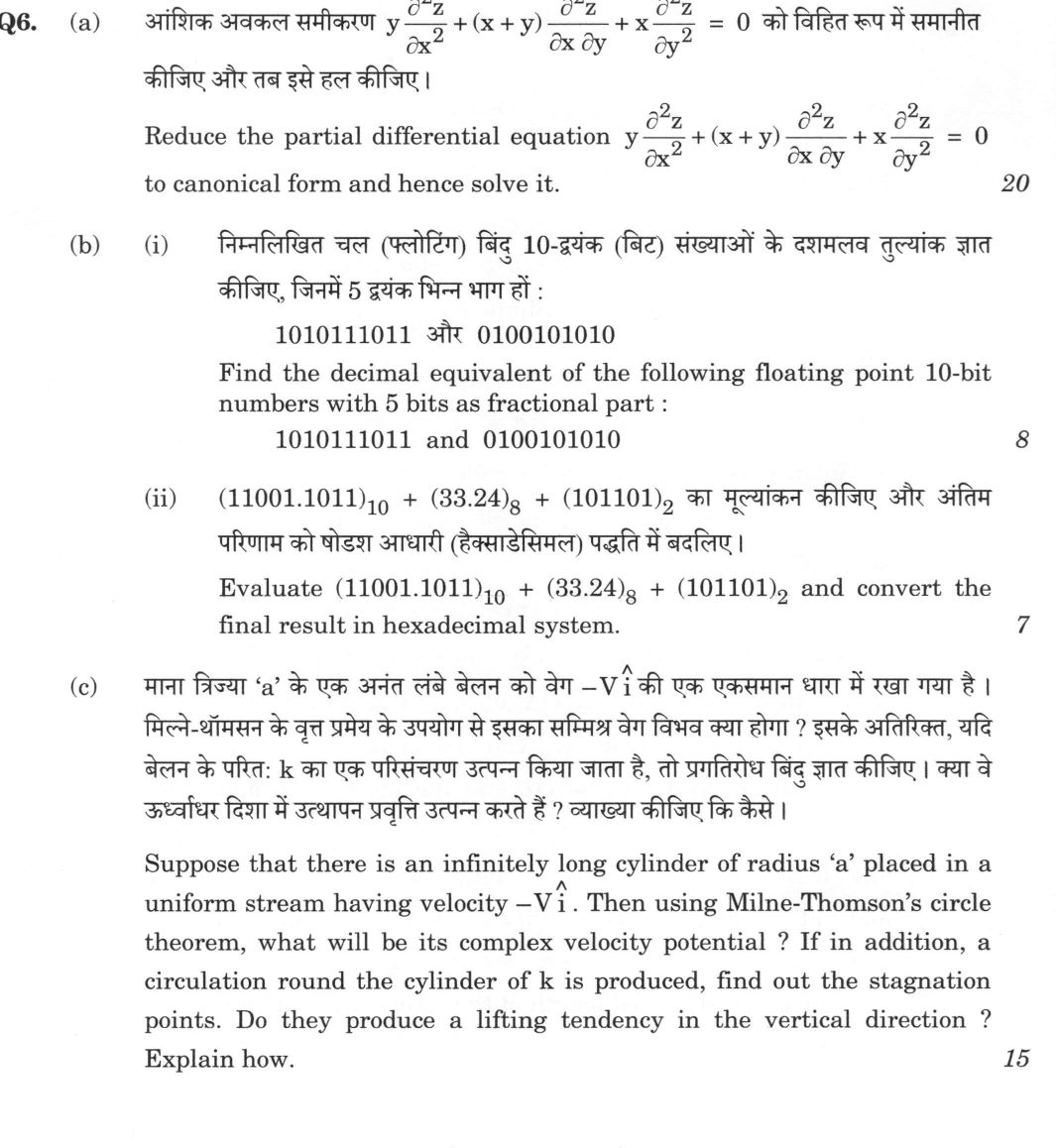
Reduce the partial differential equation y ∂²z/∂x² + (x + y) ∂²z/∂x∂y + x ∂²z/∂y² = 0 to canonical form and hence solve it. 20 marks
Find the decimal equivalent of the following floating point 10-bit numbers with 5 bits as fractional part : 1010111011 and 0100101010 8 marks
Evaluate (11001.1011)₁₀ + (33.24)₈ + (101101)₂ and convert the final result in hexadecimal system. 7 marks
Suppose that there is an infinitely long cylinder of radius 'a' placed in a uniform stream having velocity −V î. Then using Milne-Thomson's circle theorem, what will be its complex velocity potential ? If in addition, a circulation round the cylinder of k is produced, find out the stagnation points. Do they produce a lifting tendency in the vertical direction ? Explain how. 15 marks
हिंदी में प्रश्न पढ़ें
आंशिक अवकल समीकरण y ∂²z/∂x² + (x + y) ∂²z/∂x∂y + x ∂²z/∂y² = 0 को विहित रूप में समानीत कीजिए और तब इससे हल कीजिए। (20 अंक)
निम्नलिखित चल (फ्लोटिंग) बिंदु 10-द्वयंक (बिट) संख्याओं के दशमलव तुल्यांक ज्ञात कीजिए, जिनमें 5 द्वयंक भिन्न भाग हैं : 1010111011 और 0100101010 (8 अंक)
(11001.1011)₁₀ + (33.24)₈ + (101101)₂ का मूल्यांकन कीजिए और अंतिम परिणाम को षोडश आधारी (हैक्साडेसिमल) पद्धति में बदलिए। (7 अंक)
माना त्रिज्या 'a' के एक अनंत लंबे बेलन को वेग −V î की एक एकसमान धारा में रखा गया है। मिल्ने-थॉमसन के वृत्त प्रमेय के उपयोग से इसका सम्मिश्र वेग विभव क्या होगा ? इसके अतिरिक्त, यदि बेलन के परितः k का एक परिसंचरण उत्पन्न किया जाता है, तो प्रगतिरोध बिंदु ज्ञात कीजिए। क्या वे ऊर्ध्वाधर दिशा में उत्थापन प्रवृत्ति उत्पन्न करते हैं ? व्याख्या कीजिए कि कैसे। (15 अंक)
Model answer
Drafted with AI by UPSC Answer Check against this question's marking rubric, to the expected length. UPSC does not publish answers for Mains — this is one way to score well, not an official key. How we build rubrics and answers.
(a) Canonical form and solution The given partial differential equation is y (∂² z)/(∂ x²) + (x + y) (∂² z)/(∂ x ∂ y) + x (∂² z)/(∂ y²) = 0. Comparing this with the standard form A zₓₓ + B z_xy + C z_yy = 0, we identify the coefficients as A = y, B = x + y, and C = x. The discriminant is calculated as Δ = B² - 4AC = (x + y)² - 4xy = x² + 2xy + y² - 4xy = (x - y)². Since Δ > 0 for x ≠ y, the equation is of the hyperbolic type. The characteristic equation is A (dy)² - B dx dy + C (dx)² = 0, which becomes y (dy)² - (x + y) dx dy + x (dx)² = 0. Factoring this expression yields (dy - dx)(y dy - x dx) = 0. This provides two families of characteristic curves: dy - dx = 0 implies y - x = c₁ and y dy - x dx = 0 implies y² - x² = c₂. We define the new variables ξ = y - x and η = y² - x².
With ξₓ = −1, ξ_y = 1, ηₓ = −2x, η_y = 2y the chain rule gives zₓ = −z_ξ − 2x z_η, z_y = z_ξ + 2y z_η and zₓₓ = z_ξξ + 4x z_ξη + 4x² z_ηη − 2z_η, z_xy = −z_ξξ − 2(x + y) z_ξη − 4xy z_ηη, z_yy = z_ξξ + 4y z_ξη + 4y² z_ηη + 2z_η. Substituting, the z_ξξ and z_ηη terms cancel and y zₓₓ + (x + y) z_xy + x z_yy = −2(x − y)² z_ξη − 2(y − x) z_η = −2ξ² z_ξη − 2ξ z_η = 0, so the canonical form is z_ξη + (1/ξ) z_η = 0 (ξ ≠ 0). To solve this, we set u = z_η, which simplifies the equation to u_ξ + 1/(ξ) u = 0. This is a first-order linear differential equation in ξ. The integrating factor is e^∫ 1/(ξ) dξ = ξ. Multiplying the equation by ξ gives ξ u_ξ + u = 0, or d/(dξ)(ξ u) = 0. Integrating with respect to ξ yields ξ u = F(η), where F is an arbitrary function. Substituting back u = z_η, we get z_η = (F(η))/(ξ). Integrating with respect to η gives the general solution z = 1/(ξ) ∫ F(η) dη + H(ξ). Letting G(η) = ∫ F(η) dη, the final solution is z = (G(η))/(ξ) + H(ξ). Substituting the original variables, the general solution is z = (G(y² - x²))/(y - x) + H(y - x).
(b)(i) Fixed-point binary to decimal The problem specifies 10-bit floating point numbers with 5 bits as the fractional part. This implies the binary point is located after the fifth bit, creating a 5-bit integer part and a 5-bit fractional part.
For the number 1010111011, the binary point is placed as 10101.11011. The integer part 10101₂ = 16 + 4 + 1 = 21. The fractional part .11011₂ is calculated as 2⁻¹ + 2⁻² + 2⁻⁴ + 2⁻⁵ = 0.5 + 0.25 + 0.0625 + 0.03125 = 0.84375. Thus, the decimal equivalent is 21.84375.
For the number 0100101010, the binary point is placed as 01001.01010. The integer part 01001₂ = 8 + 1 = 9. The fractional part .01010₂ is calculated as 2⁻² + 2⁻⁴ = 0.25 + 0.0625 = 0.3125. Thus, the decimal equivalent is 9.3125.
(b)(ii) Mixed-base sum in hexadecimal To evaluate the sum, we convert all terms to the decimal system. The first term is printed with subscript 10, but its digits are only 0 and 1 and it is added to octal and binary numbers, so it is taken as the binary number (11001.1011)₂. (Read literally in base 10, the sum would be 11073.4136, whose hexadecimal form does not terminate.) Converting (11001.1011)₂ to decimal: 16 + 8 + 1 + 0.5 + 0.125 + 0.0625 = 25.6875. Converting the octal term (33.24)₈ to decimal: 3 × 8 + 3 + 2 × 8⁻¹ + 4 × 8⁻² = 24 + 3 + 0.25 + 0.0625 = 27.3125. Converting the binary term (101101)₂ to decimal: 32 + 8 + 4 + 1 = 45. The sum is 25.6875 + 27.3125 + 45 = 98. To convert 98 to hexadecimal: 98 = 6 × 16 + 2. Therefore, the final result is (62)₁₆.
(c) Cylinder in a stream with circulation The complex velocity potential for a uniform stream of velocity V in the negative x-direction is f(z) = -Vz. According to Milne-Thomson's circle theorem, the complex potential w(z) for flow around a cylinder of radius a is given by w(z) = f(z) + f̄(a²/z), where f̄ is the conjugate function. Since f(z) = −Vz has the real coefficient −V, f̄(a²/z) = −V(a²/z). Thus, the potential for the cylinder is w(z) = -V(z + (a²)/z).
When a circulation k is added, the potential becomes w(z) = -V(z + (a²)/z) - ik/(2π) ln z. To find the stagnation points, we solve dw/dz = 0: -V(1 - (a²)/(z²)) - ik/(2π z) = 0. Multiplying by z²: -V(z² - a²) - ikz/(2π) = 0, which simplifies to Vz² + ik/(2π)z - Va² = 0. Using the quadratic formula, the stagnation points are z = (-ik/(2π) ± √((ik/(2π))² + 4V² a²))/2V = -ik/(4π V) ± √(a² - (k²)/(16π² V²)). For k < 4πVa, |z| = a, so both stagnation points lie on the cylinder at z = a eⁱθ with sin θ = −k/(4πVa): they are below the horizontal diameter, symmetric about the y-axis. For k = 4πVa they coincide at z = −ia; for k > 4πVa both lie on the imaginary axis and only the one with |z| > a is in the fluid.
Yes, a lifting tendency in the vertical direction is produced. By Blasius' theorem, Fₓ − iF_y = (iρ/2)∮(dw/dz)² dz; the coefficient of 1/z in (dw/dz)² is 2(−V)(−ik/2π) = iVk/π, so Fₓ − iF_y = (iρ/2)(2πi)(iVk/π) = −iρVk. Hence Fₓ = 0 and F_y = ρVk: an upward lift ρVk per unit length (Kutta–Joukowski) with zero drag. The circulation creates an asymmetry in the flow velocity around the cylinder; the velocity is higher on the upper side (where the anticlockwise circulation adds to the leftward stream) and lower on the lower side, which is why the stagnation points move below the horizontal. By Bernoulli's theorem, this velocity difference results in a pressure difference, generating a net force perpendicular to the free stream. This is the Magnus effect, which results in lift while the drag remains zero (d'Alembert's paradox).
How this answer will be evaluated
Evaluation rubric
Each sub-part is marked on its own, against the marks and word limit printed on the paper.
- (a) Classify and reduce y z_xx + (x + y) z_xy + x z_yy = 0 to canonical form via its characteristic curves, and then integrate the canonical equation to obtain the general solution. 20 marks
Must cover
- Δ = (x − y)² > 0 (hyperbolic for x ≠ y); characteristics (dy − dx)(y dy − x dx) = 0 ⇒ ξ = y − x, η = y² − x²
- Transformation giving −2ξ² z_ξη − 2ξ z_η = 0, i.e. canonical form z_ξη + (1/ξ) z_η = 0
- (ξ z_η)_ξ = 0 ⇒ z = G(y² − x²)/(y − x) + H(y − x)
Loses marks
- Wrong sign in the characteristic equation
- Second characteristic taken as y + x = c instead of y² − x² = c
- Dropping the z_η term, giving z_ξη = 0 and z = F(η) + H(ξ)
- Stopping at the canonical form without solving
Earns more
- Classification: B^2 - 4AC = (x - y)^2 > 0 for x not equal to y, so the equation is hyperbolic (parabolic on x = y)
- Characteristic coordinates xi = y - x and eta = y^2 - x^2 from the two families
- (b)(i) Convert two 10-bit binary numbers to decimal, where the last 5 bits are the fractional part (i.e. the binary point sits after the fifth bit, giving a 5-bit integer part and a 5-bit fraction). 8 marks
Must cover
- Binary point after the fifth bit: 10101.11011 and 01001.01010
- 10101.11011₂ = 21 + 0.84375 = 21.84375
- 01001.01010₂ = 9 + 0.3125 = 9.3125
Loses marks
- Placing the binary point elsewhere, or using a sign bit without saying so
- Positive powers of 2 for the fractional bits
- Fraction slips (.11011 = 0.84375)
- Rounding 21.84375
Earns more
- Integer parts evaluated: 10101 = 21 and 01001 = 9
- Fractional parts evaluated by negative powers of 2: .11011 = 0.84375 and .01010 = 0.3125
- (b)(ii) Add three numbers given in different bases — (11001.1011) with the printed subscript 10, (33.24) octal and (101101) binary — by converting to a common base, and then express the final result in hexadecimal. 7 marks
Must cover
- (11001.1011)₂ = 25.6875 (subscript 10 read as a misprint, stated), (33.24)₈ = 27.3125, (101101)₂ = 45
- Sum = 98
- 98 = 6 × 16 + 2 = (62)₁₆
Loses marks
- Octal fraction .24 evaluated as 0.24 instead of 2/8 + 4/64 = 0.3125
- Adding digits across bases without converting
- Binary fraction .1011 evaluated as anything other than 0.6875
- Leaving the answer in decimal
Earns more
- Convert (101101) base 2 to decimal correctly: 45
- Sum obtained: 25.6875 + 27.3125 + 45 = 98 exactly (or 11073.4136 under the literal base-10 reading)
- (c) Four tasks for a circular cylinder of radius a in a uniform stream -V i: apply the Milne-Thomson circle theorem to obtain the complex potential; add a circulation k; locate the stagnation points; and decide, with explanation, whether a vertical lifting tendency results. 15 marks
Must cover
- Circle theorem w = f(z) + f̄(a²/z) with f = −Vz gives w = −V(z + a²/z); with circulation w = −V(z + a²/z) − (ik/2π) ln z
- dw/dz = 0 ⇒ Vz² + (ik/2π)z − Va² = 0 ⇒ z = −ik/(4πV) ± √(a² − k²/(16π²V²)), on the cylinder with sin θ = −k/(4πVa) when k < 4πVa
- Yes: Blasius/Kutta–Joukowski gives a transverse force ρVk per unit length (upward for this sense of k) and zero drag, from the velocity asymmetry and Bernoulli
Loses marks
- Wrong sign of w for a stream in the −x direction
- Circulation term with the wrong factor (k/2π required)
- Losing a stagnation point by not multiplying through by z²
- Saying there is lift without the magnitude ρVk or the mechanism
Earns more
- Statement of Milne-Thomson's circle theorem w(z) = f(z) + conjugate-f(a^2/z) and identification of the undisturbed potential f(z) = -Vz
- Yes, a lifting tendency exists: by Blasius/Kutta-Joukowski the force is purely transverse with magnitude rho V k per unit length (zero drag), explained by the asymmetry of the stagnation points plus Bernoulli's theorem (Magnus effect)
What "Solve" is asking you to do
Choose the method, then carry it through to a final answer. Identifying what kind of problem this is and why that method applies is the first thing marked; a correct figure arrived at invisibly earns almost nothing.
Structure that answers it
Given data and what is required → method chosen, with the reason it applies → set-up (equation, circuit, free body, trial balance) → working, step by step → answer with units and any condition of validity
Where marks are lost
Doing the middle steps mentally and writing only the result. In mathematics papers, a further loss comes from giving a decimal where the exact value in surds or fractions was wanted, or from skipping the justification a part explicitly asks for.
Practice this exact question
Write your answer and it is marked point by point against the model answer above — what you covered, what you missed, what you got wrong.
Evaluate my answer →More from Mathematics 2026 Paper II
- Q3 (a) Prove that cosh ( z + 1/z ) = a₀ + Σ_{n=1}^{∞} aₙ ( zⁿ + 1/zⁿ ) , where aₙ = (1 / 2π)…
- Q4 (a) Let n be a positive integer. Show that the following statements are equivalent : (i)…
- Q5 (a) Find the integral surface of the equations dx/(xz − y) = dy/(yz − x) = dz/(1 − z²) .…
- Q6 (a) Reduce the partial differential equation y ∂²z/∂x² + (x + y) ∂²z/∂x∂y + x ∂²z/∂y² = 0…
- Q7 (a) Solve the partial differential equation (2D² - 5DD' + 2D'²) z = 24 (y - x) + sin (y -…
- Q8 (a) Two-dimensional harmonic equation in plane polar coordinates (r, θ) takes the form :…