Paper II — Q7
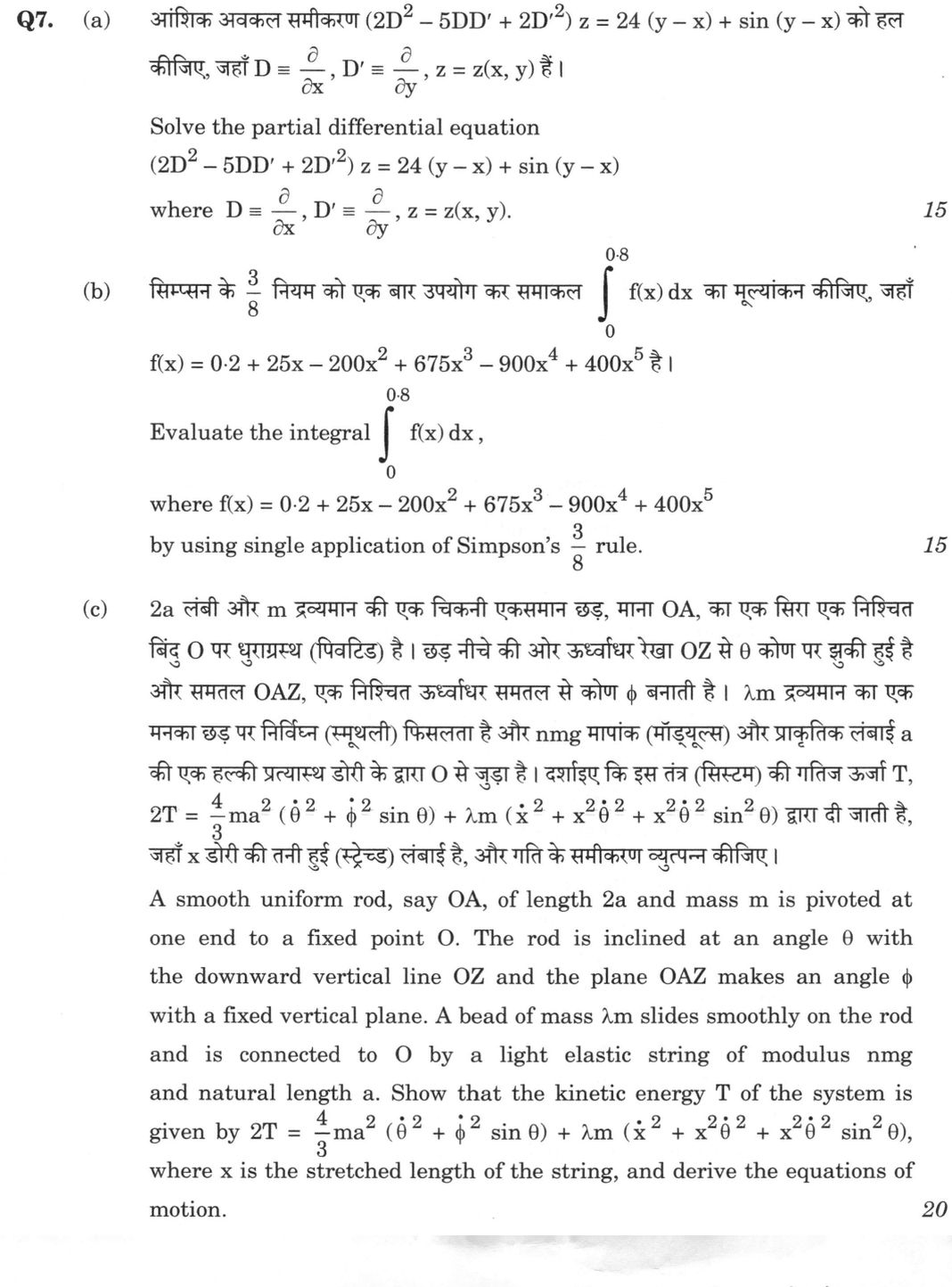
(a) Solve the partial differential equation (2D² - 5DD' + 2D'²) z = 24 (y - x) + sin (y - x) where D ≡ ∂/∂x , D' ≡ ∂/∂y , z =…
Solve the partial differential equation (2D² - 5DD' + 2D'²) z = 24 (y - x) + sin (y - x) where D ≡ ∂/∂x , D' ≡ ∂/∂y , z = z(x, y). 15 marks
Evaluate the integral ∫₀⁰.8 f(x) dx, where f(x) = 0.2 + 25x - 200x² + 675x³ - 900x⁴ + 400x⁵ by using single application of Simpson's 3/8 rule. 15 marks
A smooth uniform rod, say OA, of length 2a and mass m is pivoted at one end to a fixed point O. The rod is inclined at an angle θ with the downward vertical line OZ and the plane OAZ makes an angle φ with a fixed vertical plane. A bead of mass λm slides smoothly on the rod and is connected to O by a light elastic string of modulus nmg and natural length a. Show that the kinetic energy T of the system is given by 2T = (4/3) ma² (θ̇² + φ̇² sin θ) + λm (ẋ² + x²θ̇² + x²θ̇² sin² θ), where x is the stretched length of the string, and derive the equations of motion. 20 marks
हिंदी में प्रश्न पढ़ें
आंशिक अवकल समीकरण (2D² - 5DD' + 2D'²) z = 24 (y - x) + sin (y - x) को हल कीजिए, जहाँ D ≡ ∂/∂x , D' ≡ ∂/∂y , z = z(x, y) हैं। (15 अंक)
सिम्पसन के 3/8 नियम को एक बार उपयोग कर समाकल ∫₀⁰.8 f(x) dx का मूल्यांकन कीजिए, जहाँ f(x) = 0.2 + 25x - 200x² + 675x³ - 900x⁴ + 400x⁵ है। (15 अंक)
2a लंबी और m द्रव्यमान की एक चिकनी एकसमान छड़, माना OA, का एक सिरा एक निश्चित बिंदु O पर धुराग्रस्थ (पिवटिड) है। छड़ नीचे की ओर ऊर्ध्वाधर रेखा OZ से θ कोण पर झुकी हुई है और समतल OAZ, एक निश्चित ऊर्ध्वाधर समतल से कोण φ बनाती है। λm द्रव्यमान का एक मनका छड़ पर निर्विघ्न (स्मूथली) फिसलता है और nmg मापांक (मॉड्यूल्स) और प्राकृतिक लंबाई a की एक हल्की प्रत्यास्थ डोरी के द्वारा O से जुड़ा है। दर्शाइए कि इस तंत्र (सिस्टम) की गतिज ऊर्जा T, 2T = (4/3) ma² (θ̇² + φ̇² sin θ) + λm (ẋ² + x²θ̇² + x²θ̇² sin² θ) द्वारा दी जाती है, जहाँ x डोरी की तनी हुई (स्ट्रेच्ड) लंबाई है, और गति के समीकरण व्युत्पन्न कीजिए। (20 अंक)
Model answer
Drafted with AI by UPSC Answer Check against this question's marking rubric, to the expected length. UPSC does not publish answers for Mains — this is one way to score well, not an official key. How we build rubrics and answers.
(a) Linear PDE with constant coefficients Auxiliary equation (D = mD′): 2m² − 5m + 2 = 0 ⇒ m = 2, 1/2, so 2D² − 5DD′ + 2D′² = (D − 2D′)(2D − D′). (D − 2D′)z = 0 gives z = φ₁(y + 2x); (2D − D′)z = 0 gives z = φ₂(2y + x). CF = φ₁(y + 2x) + φ₂(2y + x). PI for 24(y − x): try z = k(y − x)³. Then zₓₓ = 6k(y − x), z_xy = −6k(y − x), z_yy = 6k(y − x), so F(D, D′)z = [2(6k) − 5(−6k) + 2(6k)](y − x) = 54k(y − x) = 24(y − x) ⇒ k = 4/9. PI₁ = (4/9)(y − x)³. PI for sin(y − x) (a = −1, b = 1): D² → −a² = −1, DD′ → −ab = 1, D′² → −b² = −1, so F = 2(−1) − 5(1) + 2(−1) = −9 and PI₂ = −(1/9) sin(y − x). z = φ₁(y + 2x) + φ₂(2y + x) + (4/9)(y − x)³ − (1/9) sin(y − x).
(b) Simpson's 3/8 rule A single application uses n = 3 subintervals: h = 0.8/3 = 0.266667, nodes 0, 0.266667, 0.533333, 0.8. f(0) = 0.2 f(0.266667) = 1.432724 f(0.533333) = 3.487177 f(0.8) = 0.232 I ≈ (3h/8)[f₀ + 3f₁ + 3f₂ + f₃] = 0.1 × [0.2 + 4.298173 + 10.461531 + 0.232] = 0.1 × 15.191704 I ≈ 1.5192. (The exact value is 1.640533; the true error of about 7.4% arises because the 3/8 rule is exact only for polynomials of degree ≤ 3, while f is of degree 5.)
(c) Rod and bead: kinetic energy and equations of motion Rod: moment of inertia about a perpendicular axis through O is I_O = (1/3)m(2a)² = (4/3)ma². The rod's angular velocity has components θ̇ (in the plane OAZ) and φ̇ sin θ (perpendicular to it, about the rod's normal), so 2T_rod = (4/3)ma²(θ̇² + φ̇² sin²θ). Bead: at distance x from O along the rod, in spherical coordinates (x, θ, φ) its speed satisfies v² = ẋ² + x²θ̇² + x²φ̇² sin²θ, so 2T_bead = λm(ẋ² + x²θ̇² + x²φ̇² sin²θ). Hence 2T = (4/3)ma²(θ̇² + φ̇² sin²θ) + λm(ẋ² + x²θ̇² + x²φ̇² sin²θ). (This is the printed expression with the sin²θ factors read as φ̇² sin²θ, which dimensional consistency requires.) Potential energy (θ from the downward vertical; string stretched, x > a): V = −mga cos θ − λmgx cos θ + nmg(x − a)²/(2a). With L = T − V, Lagrange's equations give: φ (cyclic): ∂L/∂φ̇ = [(4/3)ma² + λmx²] sin²θ φ̇ = constant (angular momentum about the vertical). θ: d/dt{[(4/3)ma² + λmx²]θ̇} = [(4/3)ma² + λmx²] φ̇² sin θ cos θ − mg(a + λx) sin θ. x: λm ẍ = λm x(θ̇² + φ̇² sin²θ) + λmg cos θ − nmg(x − a)/a. (If the string becomes slack, x < a, the last term is dropped.)
How this answer will be evaluated
Evaluation rubric
Each sub-part is marked on its own, against the marks and word limit printed on the paper.
- (a) Solve the linear PDE with constant coefficients (2D^2 - 5DD' + 2D'^2)z = 24(y - x) + sin(y - x): find the complementary function by factorising the operator and the particular integral for both terms on the right-hand side. 15 marks
Must cover
- (D − 2D′)(2D − D′), CF = φ₁(y + 2x) + φ₂(2y + x)
- PI of 24(y − x): z = k(y − x)³, 54k = 24 ⇒ (4/9)(y − x)³
- PI of sin(y − x): F = −9 ⇒ −(1/9) sin(y − x); z = CF + PI
Loses marks
- CF with wrong signs, e.g. φ(y − 2x)
- Substituting DD′ → −1 instead of +1 for sin(y − x)
- Operator value +9 instead of −9
- Omitting one of the two right-hand-side terms
Earns more
- Correct factorisation 2D^2 - 5DD' + 2D'^2 = (D - 2D')(2D - D')
- FINAL ANSWER assembled: z = phi1(y + 2x) + phi2(2y + x) + [4(y - x)^3 - sin(y - x)]/9
- (b) Evaluate the definite integral from 0 to 0.8 of the given quintic by a SINGLE application of Simpson's 3/8 rule (n = 3 subintervals, h = 0.8/3), computing all four ordinates and the resulting estimate. 15 marks
Must cover
- n = 3, h = 0.8/3 = 0.266667, weights (1, 3, 3, 1) with factor 3h/8
- Ordinates 0.2, 1.432724, 3.487177, 0.232
- I ≈ 1.5192
Loses marks
- Using 1/3-rule weights or an even number of subintervals
- h = 0.2 or 0.4 instead of 0.8/3
- Slips in the quintic (f(0.8) = 0.232 is a checkpoint)
- Giving the exact value 1.6405 as the answer
Earns more
- End ordinates f(0) = 0.2 and f(0.8) = 0.232
- Comparison with the exact value 1.640533 and the resulting true error of about 7.4 per cent, with the reason (the 3/8 rule is exact only for polynomials of degree <= 3)
- (c) For a rod OA (length 2a, mass m) pivoted at O with spherical angles (theta from the downward vertical, phi azimuth) carrying a bead of mass (lambda)m on an elastic string of modulus nmg and natural length a: derive the kinetic energy expression 2T and then obtain the Lagrange equations of motion in the coordinates theta, phi, x. 20 marks
Must cover
- I_O = (4/3)ma², rod angular velocity components θ̇ and φ̇ sin θ, bead v² = ẋ² + x²θ̇² + x²φ̇² sin²θ, giving 2T = (4/3)ma²(θ̇² + φ̇² sin²θ) + λm(ẋ² + x²θ̇² + x²φ̇² sin²θ)
- V = −mga cos θ − λmgx cos θ + nmg(x − a)²/(2a)
- Equations: [(4/3)ma² + λmx²] sin²θ φ̇ = const; d/dt{[(4/3)ma² + λmx²]θ̇} = [(4/3)ma² + λmx²]φ̇² sin θ cos θ − mg(a + λx) sin θ; λmẍ = λmx(θ̇² + φ̇² sin²θ) + λmg cos θ − nmg(x − a)/a
Loses marks
- Rod moment of inertia about its centre instead of about O
- Transverse angular velocity φ̇ instead of φ̇ sin θ
- Elastic energy without division by the natural length a
- Omitting the bead's radial or centrifugal terms in the x equation
Earns more
- phi is cyclic, so the momentum integral [(4/3)m a^2 + (lambda)m x^2] sin^2(theta) phi-dot = constant (angular momentum about the vertical)
- theta equation: d/dt{[(4/3)m a^2 + (lambda)m x^2] theta-dot} = [(4/3)m a^2 + (lambda)m x^2] phi-dot^2 sin(theta) cos(theta) - g(ma + (lambda)m x) sin(theta)
- x equation: (lambda)m x-double-dot = (lambda)m x(theta-dot^2 + phi-dot^2 sin^2 theta) + (lambda)m g cos(theta) - nmg(x - a)/a
What "Solve" is asking you to do
Choose the method, then carry it through to a final answer. Identifying what kind of problem this is and why that method applies is the first thing marked; a correct figure arrived at invisibly earns almost nothing.
Structure that answers it
Given data and what is required → method chosen, with the reason it applies → set-up (equation, circuit, free body, trial balance) → working, step by step → answer with units and any condition of validity
Where marks are lost
Doing the middle steps mentally and writing only the result. In mathematics papers, a further loss comes from giving a decimal where the exact value in surds or fractions was wanted, or from skipping the justification a part explicitly asks for.
Practice this exact question
Write your answer and it is marked point by point against the model answer above — what you covered, what you missed, what you got wrong.
Evaluate my answer →More from Mathematics 2026 Paper II
- Q4 (a) Let n be a positive integer. Show that the following statements are equivalent : (i)…
- Q5 (a) Find the integral surface of the equations dx/(xz − y) = dy/(yz − x) = dz/(1 − z²) .…
- Q6 (a) Reduce the partial differential equation y ∂²z/∂x² + (x + y) ∂²z/∂x∂y + x ∂²z/∂y² = 0…
- Q7 (a) Solve the partial differential equation (2D² - 5DD' + 2D'²) z = 24 (y - x) + sin (y -…
- Q8 (a) Two-dimensional harmonic equation in plane polar coordinates (r, θ) takes the form :…