Paper II — Q2
(a) Let G be a finite group generated by two elements u and v of order 2 each. Show that G is isomorphic to the dihedral group of…
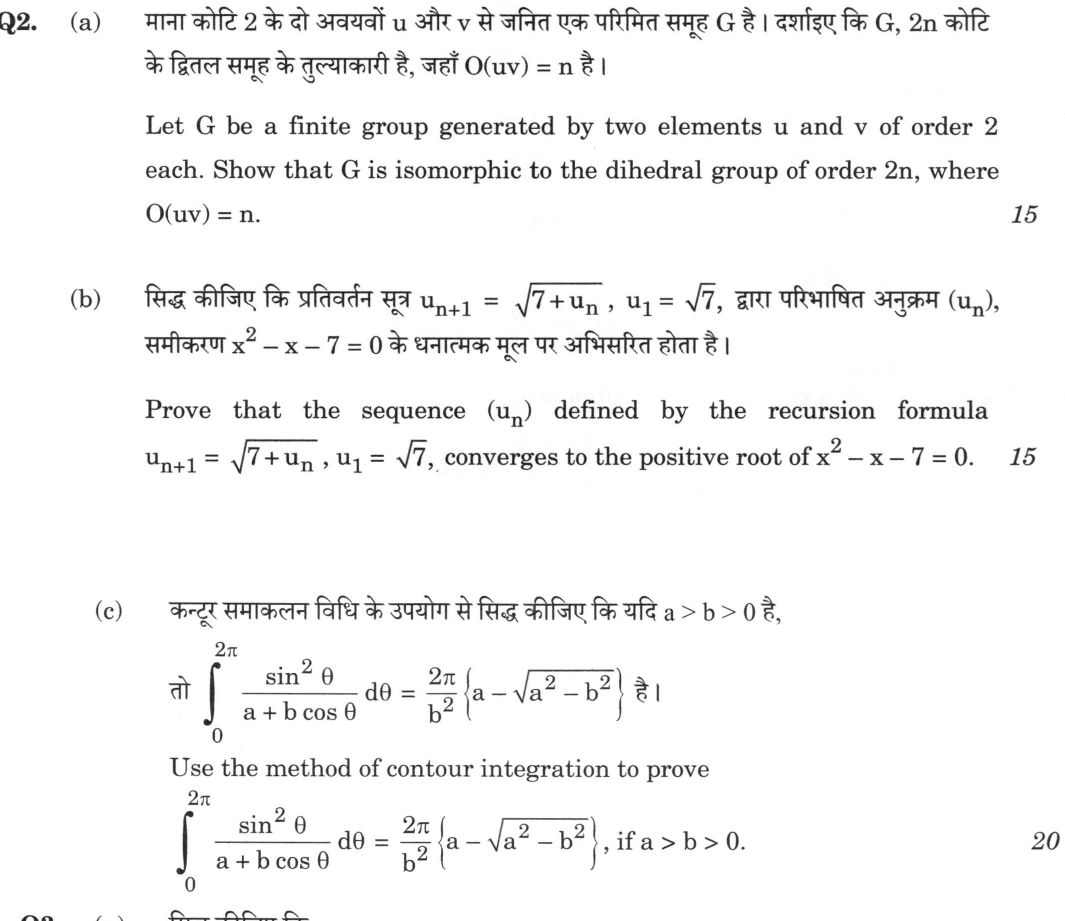
Let G be a finite group generated by two elements u and v of order 2 each. Show that G is isomorphic to the dihedral group of order 2n, where O(uv) = n. 15 marks
Prove that the sequence (uₙ) defined by the recursion formula uₙ₊₁ = √7 + uₙ , u₁ = √7, converges to the positive root of x² − x − 7 = 0. 15 marks
Use the method of contour integration to prove
∫₀²π ( sin² θ / (a + b cos θ) ) dθ = (2π / b²) { a − √(a² − b²) } , if a > b > 0. 20 marks
हिंदी में प्रश्न पढ़ें
माना कोटि 2 के दो अवयवों u और v से जनित एक परिमित समूह G है । दर्शाइए कि G, 2n कोटि के द्वितल समूह के तुल्याकारी है, जहाँ O(uv) = n है । (15 अंक)
सिद्ध कीजिए कि पुनरावृत्ति सूत्र uₙ₊₁ = √7 + uₙ , u₁ = √7, द्वारा परिभाषित अनुक्रम (uₙ), समीकरण x² − x − 7 = 0 के धनात्मक मूल पर अभिसरित होता है । (15 अंक)
कन्टूर समाकलन विधि के उपयोग से सिद्ध कीजिए कि यदि a > b > 0 है,
तो ∫₀²π ( sin² θ / (a + b cos θ) ) dθ = (2π / b²) { a − √(a² − b²) } है। (20 अंक)
Model answer
Drafted with AI by UPSC Answer Check against this question's marking rubric, to the expected length. UPSC does not publish answers for Mains — this is one way to score well, not an official key. How we build rubrics and answers.
(a) G is the dihedral group of order 2n Set-up. G = ⟨u, v⟩ is finite, with o(u) = o(v) = 2, so u² = v² = e, u⁻¹ = u and v⁻¹ = v. Put r = uv. Since G is finite, r has finite order, and we are given o(r) = n.
Step 1: G = ⟨r, u⟩. Because u⁻¹ = u, we have v = u(uv) = ur. So every word in u and v is a word in u and r, and G = ⟨r, u⟩.
Step 2: the dihedral relation. Using u⁻¹ = u and v⁻¹ = v:
u r u⁻¹ = u(uv)u = u²·vu = vu = v⁻¹u⁻¹ = (uv)⁻¹ = r⁻¹.
So ur = r⁻¹u, and more generally u rᵏ = r⁻ᵏ u for every integer k.
Step 3: |G| = 2n. By the relation ur = r⁻¹u, any product of the generators r and u can be rewritten with all powers of r moved to the left. Hence every element of G has the form rᵏ or rᵏu (0 ≤ k ≤ n − 1). So G = ⟨r⟩ ∪ ⟨r⟩u and |G| ≤ 2n.
Next we show u ∉ ⟨r⟩. Suppose u = rᵏ. Then u commutes with r, so r = uru⁻¹ = r⁻¹, i.e. r² = e and n ≤ 2.
- If n = 1, then r = e and u ∈ ⟨r⟩ = {e}, which contradicts o(u) = 2.
- If n = 2, then u ∈ {e, r}. So u = r = uv, which gives v = e, contradicting o(v) = 2.
Hence u ∉ ⟨r⟩, and the two cosets ⟨r⟩ and ⟨r⟩u are disjoint, each with n elements. Therefore |G| = 2n and the 2n elements rᵏ, rᵏu are distinct.
Step 4: the isomorphism. The dihedral group of order 2n has the presentation D₂ₙ = ⟨a, b | aⁿ = b² = e, bab⁻¹ = a⁻¹⟩, and it has exactly 2n elements aᵏ, aᵏb. Define φ on generators by φ(a) = r and φ(b) = u. The defining relations are preserved: rⁿ = e (because o(r) = n), u² = e, and uru⁻¹ = r⁻¹ (Step 2). By von Dyck's theorem, φ therefore extends to a homomorphism D₂ₙ → G. Explicitly, φ(aᵏbᵉ) = rᵏuᵉ. φ is onto because r and u generate G. A surjection between finite sets of the same size 2n is also one-one. Hence φ is an isomorphism and G ≅ D₂ₙ.
Degenerate cases. For n = 1, u = v and G = {e, u} is cyclic of order 2, which is D₂. For n = 2, uv = vu and G = {e, u, v, uv} is the Klein four-group, which is D₄. For n ≥ 3, G is the group of symmetries of a regular n-gon: r is the rotation through 2π/n and u is a reflection.
(b) Convergence of the recursive sequence Here uₙ₊₁ = √(7 + uₙ) and u₁ = √7. Let L = (1 + √29)/2 ≈ 3.1926 be the positive root of x² − x − 7 = 0, so that L² = L + 7 and L = √(7 + L).
Bounded above by L (induction). First, u₁ = √7 ≈ 2.6458 < L. If uₙ < L, then uₙ₊₁ = √(7 + uₙ) < √(7 + L) = L. So 0 < uₙ < L for all n.
Monotone increasing. Since uₙ > 0,
uₙ₊₁² − uₙ² = 7 + uₙ − uₙ² = −(uₙ² − uₙ − 7) = −(uₙ − L)(uₙ − L′),
where L′ = (1 − √29)/2 < 0 is the other root. For 0 < uₙ < L we have uₙ − L < 0 and uₙ − L′ > 0, so uₙ₊₁² > uₙ². As all terms are positive, uₙ₊₁ > uₙ. (Numerically: u₁ = 2.6458, u₂ = 3.1058, u₃ = 3.1790, u₄ = 3.1904, …)
Existence of the limit. (uₙ) is increasing and bounded above by L. By the monotone convergence theorem it converges to some l, with √7 ≤ l ≤ L.
Identifying the limit. The function t ↦ √(7 + t) is continuous. Letting n → ∞ in uₙ₊₁ = √(7 + uₙ) gives l = √(7 + l), so l² − l − 7 = 0 and l = (1 ± √29)/2. The negative root (1 − √29)/2 ≈ −2.19 is impossible, because l ≥ √7 > 0.
Conclusion. lim uₙ = (1 + √29)/2 ≈ 3.1926, the positive root of x² − x − 7 = 0. The limit was taken only after its existence had been established.
(c) Contour integration Let I = ∫₀²π sin²θ/(a + b cos θ) dθ, with a > b > 0.
Substitution. On the unit circle C: |z| = 1, put z = e^(iθ). Then dθ = dz/(iz), cos θ = (z² + 1)/(2z) and sin θ = (z² − 1)/(2iz), so sin²θ = −(z² − 1)²/(4z²). Also a + b cos θ = (bz² + 2az + b)/(2z). Hence
I = ∮_C [−(z² − 1)²/(4z²)]·[2z/(bz² + 2az + b)]·dz/(iz) = (i/2) ∮_C f(z) dz,
where f(z) = (z² − 1)²/[z²(bz² + 2az + b)] and −1/(2i) = i/2.
Poles. f has a double pole at z = 0. It also has simple poles at the roots of bz² + 2az + b = 0:
α = (−a + √(a² − b²))/b, β = (−a − √(a² − b²))/b, with αβ = 1 and α − β = 2√(a² − b²)/b.
Location. |α| = (a − √(a² − b²))/b. The inequality a − √(a² − b²) < b is equivalent to a − b < √(a² − b²), i.e. (a − b)² < (a − b)(a + b), i.e. a − b < a + b. This is true since b > 0, and squaring was legitimate because a − b > 0. So |α| < 1, and |β| = 1/|α| > 1. Only z = 0 and z = α lie inside C.
Residue at z = 0 (double pole). Res = d/dz[(z² − 1)²/(bz² + 2az + b)] at z = 0 = [4z(z² − 1)(bz² + 2az + b) − (z² − 1)²(2bz + 2a)]/(bz² + 2az + b)² at z = 0 = (0 − 2a)/b² = −2a/b².
Residue at z = α (simple pole). Here bz² + 2az + b = b(z − α)(z − β), so
Res = (α² − 1)²/[α²·b(α − β)] = (α − 1/α)²/[b(α − β)].
Since 1/α = β, this equals (α − β)²/[b(α − β)] = (α − β)/b = 2√(a² − b²)/b².
Residue theorem. I = (i/2)·2πi·[−2a/b² + 2√(a² − b²)/b²] = −π·(2/b²)[√(a² − b²) − a],
so I = (2π/b²){a − √(a² − b²)}, as required.
Check. The result is positive, as it must be for a positive integrand. For a = 3, b = 2 it gives (π/2)(3 − √5) ≈ 1.2000, which agrees with direct numerical integration.
How this answer will be evaluated
Evaluation rubric
Each sub-part is marked on its own, against the marks and word limit printed on the paper.
- (a) Given a finite group G = <u, v> with u^2 = v^2 = e, prove G is isomorphic to the dihedral group D_{2n} of order 2n where n = o(uv). Requires producing the rotation element r = uv, the relation uru^{-1} = r^{-1}, the coset decomposition, the order count and an explicit isomorphism. 15 marks
Must cover
- r = uv with o(r) = n, v = ur so G = ⟨r, u⟩, and the derived relation uru⁻¹ = r⁻¹
- Every element is rᵏ or rᵏu, and u ∉ ⟨r⟩, so |G| = 2n
- φ: a ↦ r, b ↦ u preserves aⁿ = b² = e, bab⁻¹ = a⁻¹ and is a bijective homomorphism, so G ≅ D₂ₙ
Loses marks
- Asserting uru⁻¹ = r⁻¹ or 'G looks dihedral' without derivation
- Proving only |G| ≤ 2n without ruling out u ∈ ⟨r⟩
- Defining a map on generators without checking the defining relations
- Ignoring n = 1 and n = 2
Earns more
- Set r = uv, note o(r) = n and G = <u, r> since v = ur
- Explicit isomorphism with D_{2n} = <a, b | a^n = b^2 = e, bab^{-1} = a^{-1}> via a -> r, b -> u; surjective homomorphism between groups of equal order is an isomorphism
- Treatment of the degenerate cases n = 1 (G of order 2) and n = 2 (Klein four-group)
- (b) For u_{n+1} = sqrt(7 + u_n), u_1 = sqrt(7), prove convergence (monotone increasing and bounded above) and identify the limit as the positive root of x^2 - x - 7 = 0, i.e. (1 + sqrt(29))/2. 15 marks
Must cover
- Boundedness 0 < uₙ < L = (1 + √29)/2 by induction, and monotonicity from uₙ₊₁² − uₙ² = −(uₙ − L)(uₙ − L′) > 0
- Existence of the limit by the monotone convergence theorem before computing it
- l = √(7 + l) ⇒ l² − l − 7 = 0 ⇒ l = (1 + √29)/2 ≈ 3.193, negative root rejected
Loses marks
- Computing l from l = √(7 + l) without first proving the limit exists
- Proving monotonicity but not boundedness, or vice versa
- Accepting the negative root
- Reading the recursion as √7 + uₙ
Earns more
- Identify the candidate limit L = (1 + sqrt(29))/2 approximately 3.193 as the positive root, with the fixed-point property L = sqrt(7 + L)
- Invoke the monotone convergence theorem to assert existence of the limit l before computing it
- (c) Prove, by contour integration on the unit circle, that the integral of sin^2(theta)/(a + b cos theta) over [0, 2pi] equals (2pi/b^2){a - sqrt(a^2 - b^2)} for a > b > 0. The method (contour integration) is prescribed, so a real-variable evaluation does not answer the demand. 20 marks
Must cover
- z = e^{iθ}: I = (i/2)∮ (z² − 1)²/[z²(bz² + 2az + b)] dz over |z| = 1
- Poles inside: z = 0 (double, residue −2a/b²) and α = (−a + √(a² − b²))/b with |α| < 1 (simple, residue 2√(a² − b²)/b²)
- Residue theorem gives I = (2π/b²){a − √(a² − b²)}
Loses marks
- Treating z = 0 as a simple pole
- Including the outside root β in the residue sum
- Sign slip in sin²θ = −(z² − 1)²/(4z²)
- Not proving |α| < 1
- Real-variable evaluation (e.g. t = tan(θ/2)) instead of the prescribed contour method
Earns more
- Roots alpha = (-a + sqrt(a^2 - b^2))/b, beta = (-a - sqrt(a^2 - b^2))/b with alpha*beta = 1, and the proof that |alpha| < 1 < |beta| (using a - sqrt(a^2 - b^2) < b for a > b > 0)
- Residue theorem applied and simplified to the FINAL RESULT (2 pi/b^2){a - sqrt(a^2 - b^2)}
What "Prove" is asking you to do
Establish that the statement holds for every case it claims, not for one representative case. The argument must be closed: each line follows from a definition, a hypothesis, or a named theorem you are entitled to use.
Structure that answers it
Given and to prove, restated → theorem or construction to be used, named → the argument line by line → conclusion stated as proved
Where marks are lost
Testing one example, which illustrates but proves nothing. On an if and only if claim, proving one direction and stopping forfeits that half outright, and degenerate cases — zero, the empty set, the equality case — have to be disposed of rather than assumed away.
Practice this exact question
Write your answer and it is marked point by point against the model answer above — what you covered, what you missed, what you got wrong.
Evaluate my answer →More from Mathematics 2026 Paper II
- Q1 (a) Let G be a group of order pq, where p and q are primes. Show that either G is an abel…
- Q2 (a) Let G be a finite group generated by two elements u and v of order 2 each. Show that…
- Q3 (a) Prove that cosh ( z + 1/z ) = a₀ + Σ_{n=1}^{∞} aₙ ( zⁿ + 1/zⁿ ) , where aₙ = (1 / 2π)…
- Q4 (a) Let n be a positive integer. Show that the following statements are equivalent : (i)…
- Q5 (a) Find the integral surface of the equations dx/(xz − y) = dy/(yz − x) = dz/(1 − z²) .…