Paper I — Q1
(a) A heavy carriage wheel of weight W, and radius r is to be dragged over an obstacle of height h by a horizontal force P…
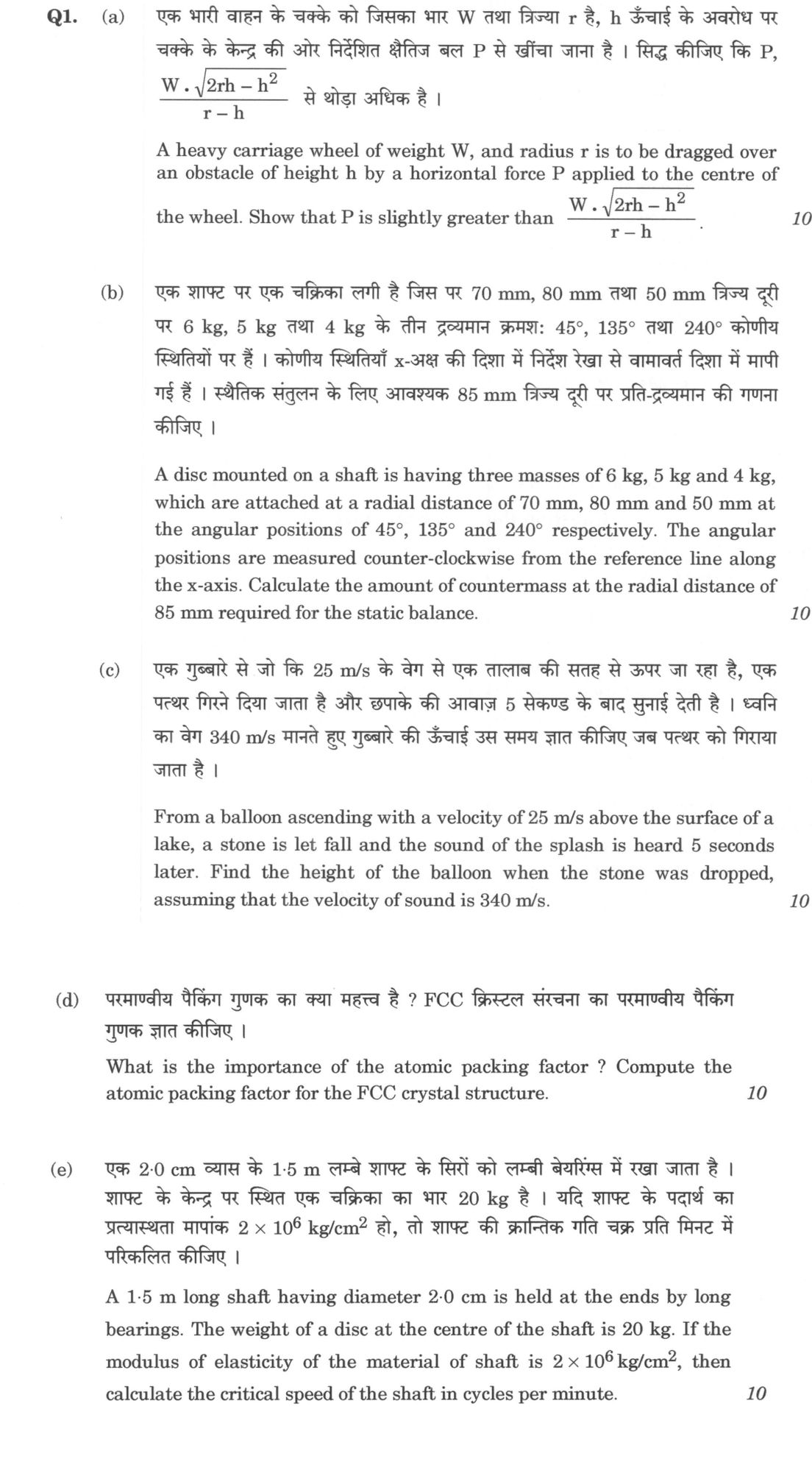
A heavy carriage wheel of weight W, and radius r is to be dragged over an obstacle of height h by a horizontal force P applied to the centre of the wheel. Show that P is slightly greater than (W · √(2rh - h²))/(r - h). 10 marks
A disc mounted on a shaft is having three masses of 6 kg, 5 kg and 4 kg, which are attached at a radial distance of 70 mm, 80 mm and 50 mm at the angular positions of 45°, 135° and 240° respectively. The angular positions are measured counter-clockwise from the reference line along the x-axis. Calculate the amount of countermass at the radial distance of 85 mm required for the static balance. 10 marks
From a balloon ascending with a velocity of 25 m/s above the surface of a lake, a stone is let fall and the sound of the splash is heard 5 seconds later. Find the height of the balloon when the stone was dropped, assuming that the velocity of sound is 340 m/s. 10 marks
What is the importance of the atomic packing factor ? Compute the atomic packing factor for the FCC crystal structure. 10 marks
A 1·5 m long shaft having diameter 2·0 cm is held at the ends by long bearings. The weight of a disc at the centre of the shaft is 20 kg. If the modulus of elasticity of the material of shaft is 2 × 10⁶ kg/cm², then calculate the critical speed of the shaft in cycles per minute. 10 marks
हिंदी में प्रश्न पढ़ें
एक भारी वाहन के चक्के को जिसका भार W तथा त्रिज्या r है, h ऊँचाई के अवरोध पर चक्के के केन्द्र की ओर निर्देशित क्षैतिज बल P से खींचा जाना है । सिद्ध कीजिए कि P, (W · √(2rh - h²))/(r - h) से थोड़ा अधिक है । (10 अंक)
एक शाफ्ट पर एक चक्रिका लगी है जिस पर 70 mm, 80 mm तथा 50 mm त्रिज्या दूरी पर 6 kg, 5 kg तथा 4 kg के तीन द्रव्यमान क्रमशः 45°, 135° तथा 240° कोणीय स्थितियों पर हैं । कोणीय स्थितियाँ x-अक्ष की दिशा में निर्देश रेखा से बामावर्त दिशा में मापी गई हैं । स्थैतिक संतुलन के लिए आवश्यक 85 mm त्रिज्या दूरी पर प्रति-द्रव्यमान की गणना कीजिए । (10 अंक)
एक गुब्बारे से जो कि 25 m/s के वेग से एक तालाब की सतह से ऊपर जा रहा है, एक पत्थर गिरने दिया जाता है और छपाके की आवाज 5 सेकंड के बाद सुनाई देती है । ध्वनि का वेग 340 m/s मानते हुए गुब्बारे की ऊँचाई उस समय ज्ञात कीजिए जब पत्थर को गिराया जाता है । (10 अंक)
परमाणवीय पैकिंग गुणक का क्या महत्व है ? FCC क्रिस्टल संरचना का परमाणवीय पैकिंग गुणक ज्ञात कीजिए । (10 अंक)
एक 2·0 cm व्यास के 1·5 m लम्बे शाफ्ट के सिरों को लम्बी बेयरिंग्स में रखा जाता है । शाफ्ट के केन्द्र पर स्थित एक चक्रिका का भार 20 kg है । यदि शाफ्ट के पदार्थ का प्रत्यास्थता मापांक 2 × 10⁶ kg/cm² हो, तो शाफ्ट की क्रांतिक गति चक्र प्रति मिनट में परिकलित कीजिए । (10 अंक)
Model answer
Written by UPSC Answer Check against this question's marking rubric, to the expected length. UPSC does not publish answers for Mains — this is one way to score well, not an official key.
(a) Let C be the point where the wheel touches the obstacle, O the centre of the wheel. At the instant the wheel is just about to lift over the obstacle, the reaction at C passes through O, so it has no moment about C.
The vertical distance from C to O is r − h. Let the horizontal distance from C to the vertical line through O be x. Since OC = r, x² + (r − h)² = r² x² = r² − (r − h)² = 2rh − h² x = √(2rh − h²)
Taking moments about C:
- Moment of horizontal force P = P(r − h)
- Moment of weight W = Wx
For just lifting, P(r − h) = Wx P = W√(2rh − h²)/(r − h)
For actual dragging over the obstacle, P must be slightly larger than this value, because the above condition is only the verge of lifting. Hence P is slightly greater than W√(2rh − h²)/(r − h) valid for 0 < h < r.
(b) For static balance, the vector sum of the mass-radius products must be zero. Let the reference line be the +x-axis.
Given:
- m₁r₁ = 6 × 70 = 420 kg·mm at θ₁ = 45°
- m₂r₂ = 5 × 80 = 400 kg·mm at θ₂ = 135°
- m₃r₃ = 4 × 50 = 200 kg·mm at θ₃ = 240°
Resolve along x and y: x = 420 cos45° + 400 cos135° + 200 cos240° x = 210√2 − 200√2 − 100 = 10√2 − 100 = −85.858 kg·mm
y = 420 sin45° + 400 sin135° + 200 sin240° y = 210√2 + 200√2 − 100√3 = 410√2 − 100√3 = 406.622 kg·mm
Resultant of the existing masses: R = √(x² + y²) = √((−85.858)² + (406.622)²) R ≈ 415.588 kg·mm
The countermass is placed at radius 85 mm. If its mass is m_c, m_c × 85 = 415.588 m_c = 415.588/85 = 4.889 kg
Angle of the resultant of existing masses: θ_R = tan⁻¹(406.622 / −85.858) = 101.92° So the countermass must be opposite this direction: θ_c = θ_R + 180° = 281.92°
Countermass required ≈ 4.89 kg at 281.92° from the reference line, or equivalently 78.08° clockwise from the +x-axis.
(c) Let H be the height of the balloon when the stone is dropped. The balloon is ascending at 25 m/s, so the stone initially has velocity 25 m/s upward. Take upward positive and g = 9.8 m/s².
Let t₁ be the time for the stone to reach the lake surface. −H = 25t₁ − (1/2)(9.8)t₁² H = 4.9t₁² − 25t₁
For H > 0, this requires t₁ > 25/4.9 ≈ 5.102 s. But the total time from drop to hearing the splash is 5 s, so the sound travel time t₂ = 5 − t₁ must be positive, giving t₁ < 5 s. These two conditions cannot both hold. Hence the given data are inconsistent, and no physically admissible positive height exists. If the balloon velocity were ignored and the stone assumed to start from rest relative to the ground, the height would be about 107.5 m, but that contradicts the stated ascending motion.
(d) The atomic packing factor (APF) measures how densely atoms are packed in a crystal structure. It is important because it influences theoretical density, slip behaviour, ductility, diffusion, phase stability, mechanical properties, and alloy design. A higher APF generally means a more closely packed structure.
For FCC:
- Atoms per unit cell, n = 4
- Atoms touch along the face diagonal, so 4r = a√2
- Thus a = 2√2 r
Volume of unit cell: V_cell = a³ = (2√2 r)³ = 16√2 r³
Volume occupied by atoms: V_atoms = 4 × (4/3)πr³ = (16/3)πr³
Therefore, APF = V_atoms / V_cell APF = [(16/3)πr³] / [16√2 r³] APF = π/(3√2) = π√2/6 ≈ 0.74048
APF for FCC = π√2/6 ≈ 0.7405.
(e) Since the shaft is held in long bearings, the ends are effectively fixed in bending. For a fixed-fixed beam with a central load, the static central deflection is δ = W L³/(192 E I)
Given: L = 1.5 m = 150 cm d = 2.0 cm W = 20 kg E = 2 × 10⁶ kg/cm²
I = πd⁴/64 = π(2)⁴/64 = π/4 cm⁴
Substitute: δ = 20 × 150³ / [192 × 2 × 10⁶ × (π/4)] δ = 67,500,000 / (96,000,000π) δ = 0.703125/π ≈ 0.2238 cm
Critical angular speed: ω_n = √(g/δ) = √(981/0.2238) ≈ 66.20 rad/s
Critical speed in cycles/min: N_c = (60/2π)ω_n = (30/π) × 66.20 N_c ≈ 632.2 cycles/min
Critical speed ≈ 632 rpm.
What "Solve" is asking you to do
Choose the method, then carry it through to a final answer. Identifying what kind of problem this is and why that method applies is the first thing marked; a correct figure arrived at invisibly earns almost nothing.
Structure that answers it
Given data and what is required → method chosen, with the reason it applies → set-up (equation, circuit, free body, trial balance) → working, step by step → answer with units and any condition of validity
Where marks are lost
Doing the middle steps mentally and writing only the result. In mathematics papers, a further loss comes from giving a decimal where the exact value in surds or fractions was wanted, or from skipping the justification a part explicitly asks for.
How this answer will be evaluated
Approach
(a) derive: given > assumptions > stepwise derivation > result > check | (b) calculate: given > formula > substitution > result with units > interpretation | (c) calculate: given > formula > substitution > result with units > interpretation | (d) explain: definition/context > points in order > small example > short close | (e) calculate: given > formula > substitution > result with units > interpretation Full marks: Rigorous derivations, clear diagrams, and correct final values with units.
Key points expected
- Free body diagram with P, W, and reaction R
- Moment equilibrium about the contact point
- Geometric relation for lever arm using r and h
- Final expression P = W√(2rh-h²)/(r-h)
- Calculation of mr for each of the three masses
- Resolution of forces into horizontal and vertical components
- Determination of resultant unbalanced force magnitude
- Calculation of balancing mass at 85 mm radius
Evaluation rubric
Each sub-part is marked on its own, against the marks and word limit printed on the paper.
- (a) Derive the expression for force P to drag wheel over obstacle. 10 marks
derive— given → assumptions → stepwise derivation → result → check
Must cover
- Free body diagram with P, W, and reaction R
- Moment equilibrium about the contact point
- Geometric relation for lever arm using r and h
- Final expression P = W√(2rh-h²)/(r-h)
Loses marks
- Taking moments about the wheel center
- Incorrect geometric derivation of the lever arm
Earns more
- Explicit definition of the angle of reaction
- Clear labeling of the obstacle contact point
Extra mark
- Discussion of the 'slightly greater' condition
- (b) Calculate the magnitude and position of the balancing mass. 10 marks
calculate— given → formula → substitution → result with units → interpretation
Must cover
- Calculation of mr for each of the three masses
- Resolution of forces into horizontal and vertical components
- Determination of resultant unbalanced force magnitude
- Calculation of balancing mass at 85 mm radius
Loses marks
- Using degrees in trigonometric functions without conversion
- Omitting the angular position of the counter-mass
Earns more
- Tabular presentation of the force components
- Calculation of the angular position of the counter-mass
Extra mark
- Vector diagram showing the force polygon
- (c) Determine the height of the balloon when the stone was dropped. 10 marks
calculate— given → formula → substitution → result with units → interpretation
Must cover
- Equation of motion for the falling stone
- Equation for the time taken by sound to travel
- Setting up the total time equation (t1 + t2 = 5s)
- Solving the resulting quadratic equation for height
Loses marks
- Ignoring the initial velocity of the stone
- Assuming the stone starts from rest
Earns more
- Explicit definition of t1 (fall time) and t2 (sound time)
- Correct handling of the initial upward velocity
Extra mark
- Verification of the solution by substituting back
- (d) Explain the importance of APF and compute it for FCC. 10 marks
explain— definition/context → points in order → small example → short close
Must cover
- Definition of Atomic Packing Factor (APF)
- Significance of APF in material properties
- Derivation of the relationship between r and a
- Final calculation of APF for FCC structure
Loses marks
- Using the wrong number of atoms per unit cell
- Incorrect relationship between radius and lattice parameter
Earns more
- Comparison with BCC or SC structures
- Mention of specific properties like density or ductility
Extra mark
- Diagram of the FCC unit cell with atoms
- (e) Calculate the critical speed of the shaft in cycles per minute. 10 marks
calculate— given → formula → substitution → result with units → interpretation
Must cover
- Formula for static deflection of a simply supported shaft
- Calculation of the moment of inertia (I) of the shaft
- Determination of the static deflection δ
- Calculation of critical speed using the deflection formula
Loses marks
- Using the wrong formula for deflection
- Incorrect unit conversion for the modulus of elasticity
Earns more
- Unit conversion for modulus of elasticity
- Explicit statement of the formula for critical speed
Extra mark
- Mention of the effect of shaft weight (neglected here)
Practice this exact question
Write your answer and it is marked point by point against the model answer above — what you covered, what you missed, what you got wrong.
Evaluate my answer →More from Mechanical Engineering 2023 Paper I
- Q1 (a) A heavy carriage wheel of weight W, and radius r is to be dragged over an obstacle of…
- Q2 (a) In Figure 2(a), AB is a rigid bar, CE is a steel rod of 20 mm diameter and DF is a co…
- Q3 (a) The coefficient of friction for all contacting surfaces in Figure 3(a) is 0·2. Does t…
- Q4 (a) Two involute gears in mesh have pressure angle of 20° and module of 6 mm. The number…