Paper I — Q2
(a) In Figure 2(a), AB is a rigid bar, CE is a steel rod of 20 mm diameter and DF is a copper rod of 20 mm diameter. If the end A…
In Figure 2(a), AB is a rigid bar, CE is a steel rod of 20 mm diameter and DF is a copper rod of 20 mm diameter. If the end A is hinged and a load of 30 kN acts at the free end B, find the stresses in the steel and copper rods and the reaction at A. Given : E_S = 200 GN/m² and E_C = 100 GN/m² 20 marks
The length of each arm of a Porter governor is 350 mm. The lower arms are attached to a sleeve at a distance of 25 mm from the axis and the upper arms are pivoted on the axis of rotation. The load on the sleeve is 250 N and the weight of each ball is 25 N. If the radius of rotation of the balls is 125 mm at a speed of 225 rpm, then calculate the following : (20 marks) Speed of governor after the sleeve has lifted 55 mm
Effort
Power of the governor
Discuss three reasons why ferrous alloys are used so extensively and also discuss three characteristics of ferrous alloys that limit their utilization. 10 marks
हिंदी में प्रश्न पढ़ें
चित्र 2(a) में, AB एक दृढ़ छड़ है, CE, 20 mm व्यास की इस्पात की छड़ तथा DF, 20 mm व्यास की ताँबे की छड़ है । यदि छोर A हिंजड़ है तथा 30 kN का एक भार स्वतंत्र छोर B पर लग रहा है, तो इस्पात और ताँबे की छड़ों का प्रतिबल तथा A पर प्रतिक्रिया ज्ञात कीजिए । दिया गया है : Eₛ = 200 GN/m² तथा E꜀ = 100 GN/m² (20 अंक)
एक पोर्टर गवर्नर की प्रत्येक भुजा की लंबाई 350 mm है । निचली भुजाएं घूर्णन अक्ष से 25 mm की दूरी पर स्लीव से संलग्न हैं तथा ऊपरी भुजाएं घूर्णन अक्ष पर घूर्णायस्थ हैं । स्लीव पर 250 N का भार है तथा प्रत्येक गेंद का वजन 25 N है । यदि गेंदों की घूर्णन त्रिज्या 225 rpm पर 125 mm है, तो निम्नलिखित को परिकलित कीजिए : (20 अंक) गवर्नर की गति जब स्लीव 55 mm उठ गई हो
प्रयास
गवर्नर की शक्ति
लोहे मिश्रधातु के बहुतायत उपयोग होने के तीन कारणों की विवेचना कीजिए तथा लोहे मिश्रधातु के तीन लक्षणों की भी विवेचना कीजिए जो इनकी उपयोगिता को सीमित करते हों । (10 अंक)
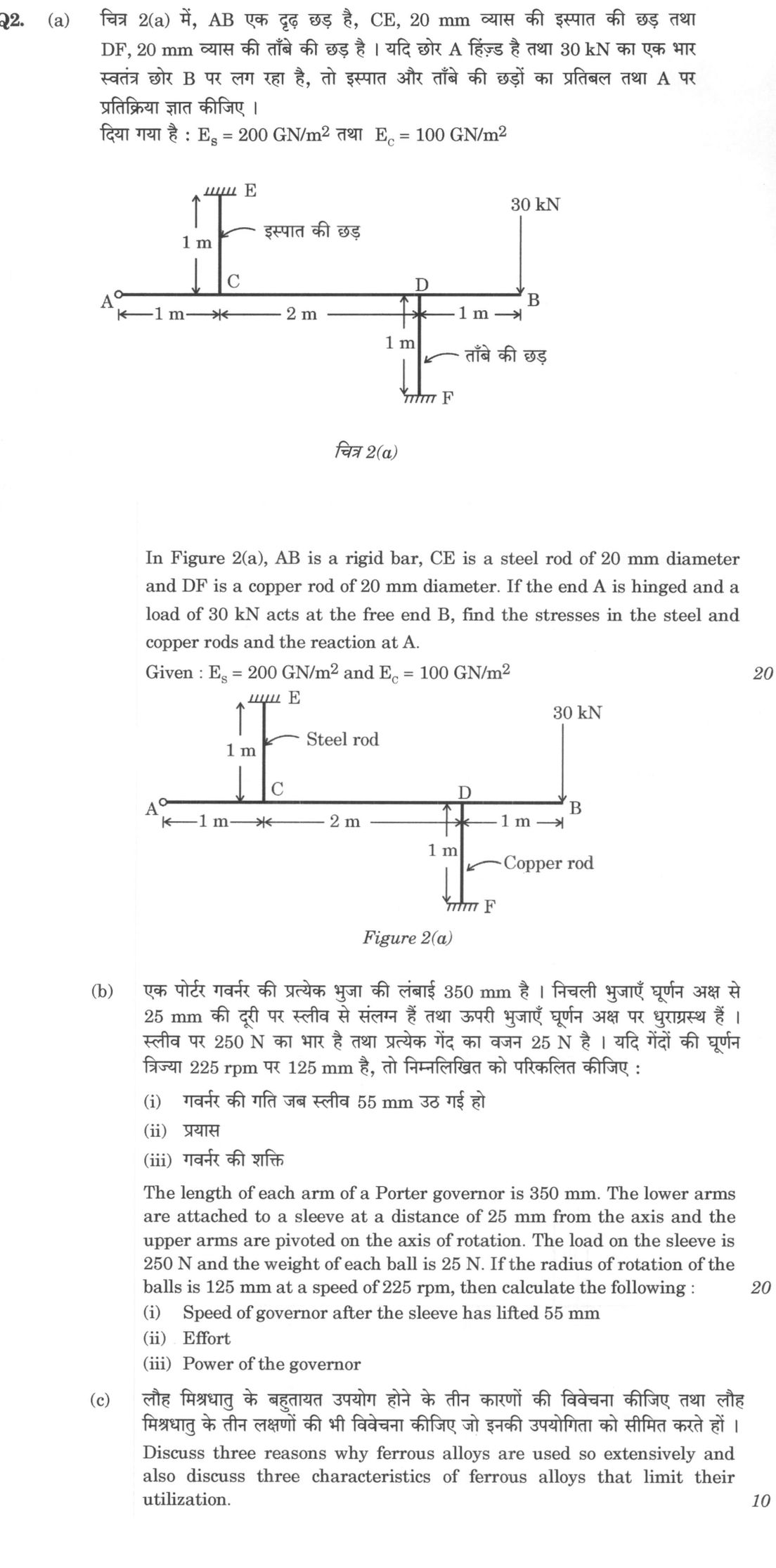
The figure this question refers to, in words
The question paper is a scan and the diagram did not survive as text. This is the figure as read from the original page — every component, value and label — so the question can be worked from the text below.
(a) A horizontal rigid bar AB is hinged at the left end A. A vertical steel rod CE is attached to the bar at point C, extending upwards to a fixed support at E. A vertical copper rod DF is attached to the bar at point D, extending downwards to a fixed support at F. The distance from the hinge A to the steel rod attachment C is 1 m. The distance from C to the copper rod attachment D is 2 m. The distance from D to the free end B is 1 m. The length of the steel rod CE is 1 m. The length of the copper rod DF is 1 m. A vertical downward load of 30 kN is applied at the free end B. The steel rod and copper rod are both 20 mm in diameter.
What "Solve" is asking you to do
Choose the method, then carry it through to a final answer. Identifying what kind of problem this is and why that method applies is the first thing marked; a correct figure arrived at invisibly earns almost nothing.
Structure that answers it
Given data and what is required → method chosen, with the reason it applies → set-up (equation, circuit, free body, trial balance) → working, step by step → answer with units and any condition of validity
Where marks are lost
Doing the middle steps mentally and writing only the result. In mathematics papers, a further loss comes from giving a decimal where the exact value in surds or fractions was wanted, or from skipping the justification a part explicitly asks for.
How this answer will be evaluated
Approach
(a) calculate: given > formula > substitution > result with units > interpretation | (b(i)) calculate: given > formula > substitution > result with units > interpretation | (b(ii)) calculate: given > formula > substitution > result with units > interpretation | (b(iii)) calculate: given > formula > substitution > result with units > interpretation | (c) discuss: intro > 3-4 dimensions > example > balanced close Full marks: Complete method with all steps, units, and physical interpretation; clear diagrams and logical flow.
Key points expected
- Equilibrium equation summing moments about A
- Compatibility equation relating rod extensions
- Force-displacement relation using E and A
- Final values with units for stress and reaction
- Geometry of governor at initial and final positions
- Force balance equation for Porter governor
- Calculation of new radius of rotation
- Final speed in rpm
Evaluation rubric
Each sub-part is marked on its own, against the marks and word limit printed on the paper.
- (a) Stresses in steel and copper rods and reaction at A. 20 marks
calculate— given → formula → substitution → result with units → interpretation
Must cover
- Equilibrium equation summing moments about A
- Compatibility equation relating rod extensions
- Force-displacement relation using E and A
- Final values with units for stress and reaction
Loses marks
- Ignoring compatibility of deformation
- Unit inconsistency in force or length
- Missing reaction at A
Earns more
- Free body diagram of rigid bar AB
- Explicit calculation of cross-sectional area
- Verification of equilibrium with calculated forces
Extra mark
- Check for tensile/compressive nature of forces
- (b(i)) Speed of governor after sleeve lift of 55 mm.
calculate— given → formula → substitution → result with units → interpretation
Must cover
- Geometry of governor at initial and final positions
- Force balance equation for Porter governor
- Calculation of new radius of rotation
- Final speed in rpm
Loses marks
- Incorrect geometric relationship
- Missing centrifugal force term
Earns more
- Labeled diagram of governor geometry
- Explicit calculation of angles
Extra mark
- Comparison of initial and final speeds
- (b(ii)) Effort of the governor.
calculate— given → formula → substitution → result with units → interpretation
Must cover
- Definition of effort in context
- Formula for effort calculation
- Substitution of given values
- Result in Newtons
Loses marks
- Confusing effort with power
- Missing units
Earns more
- Explanation of effort concept
Extra mark
- Relation between effort and power
- (b(iii)) Power of the governor.
calculate— given → formula → substitution → result with units → interpretation
Must cover
- Formula for power calculation
- Use of effort and speed values
- Result in Watts or kW
- Interpretation of power value
Loses marks
- Incorrect formula application
- Missing units
Earns more
- Step-by-step calculation shown
Extra mark
- Efficiency calculation if applicable
- (c) Three reasons for extensive use and three limiting characteristics of ferrous alloys. 10 marks
discuss— intro → 3-4 dimensions → example → balanced close
Must cover
- Three distinct reasons for extensive use
- Three distinct limiting characteristics
- Specific examples for each point
- Balanced discussion of advantages and limitations
Loses marks
- Vague or generic statements
- Missing specific examples
- Confusing reasons with characteristics
Earns more
- Reference to specific alloys (e.g., steel, cast iron)
- Mention of industrial applications
Extra mark
- Comparison with non-ferrous alloys
Model answer coming soon
Every evaluation on this site is marked against a verified model answer. This question's answer is still being written; evaluation opens the moment it lands.
More from Mechanical Engineering 2023 Paper I
- Q1 (a) A heavy carriage wheel of weight W, and radius r is to be dragged over an obstacle of…
- Q2 (a) In Figure 2(a), AB is a rigid bar, CE is a steel rod of 20 mm diameter and DF is a co…
- Q3 (a) The coefficient of friction for all contacting surfaces in Figure 3(a) is 0·2. Does t…
- Q4 (a) Two involute gears in mesh have pressure angle of 20° and module of 6 mm. The number…
- Q5 (a) In an electrochemical machining process of an iron surface using sodium chloride solu…