Paper I — Q5
(a) In an electrochemical machining process of an iron surface using sodium chloride solution as electrolyte, following…
In an electrochemical machining process of an iron surface using sodium chloride solution as electrolyte, following observations were made:
Specific resistance of the electrolyte = 5 Ω cm (ohm-cm) Supply voltage = 15 V DC Cross-sectional area of iron surface = 20 mm × 20 mm Gap between the tool and workpiece = 0·3 mm
Use the following data for iron: Valency = 2, Atomic weight = 55·85, and Density = 7860 kg/m³
Consider the current efficiency as 100% and Faraday's constant = 96540 Coulombs.
Calculate the material removal rate and electrode feed rate in the above mentioned electrochemical machining process. 10 marks
A laser beam with power intensity of 2 × 10⁵ W/mm² falls on a stainless steel sheet. Find out the time required for the stainless steel surface to reach melting temperature, assuming that only 10% of the beam power is absorbed.
Use: Thermal conductivity = 0·27 W/cm-°C Volume specific heat = 3·36 J/cm³-°C Melting point temperature = 1455°C 10 marks
Discuss the trade-off between cost and quality considering various costs of conformance and costs of non-conformance. 10 marks
The corporation 'X' is designing its new assembly line. The line will produce 50 units per hour. The tasks, their times, and their predecessors are shown in the following table:
| Task | Immediate Predecessor | Task Time (sec.) |
|---|---|---|
| A | — | 55 |
| B | A | 30 |
| C | A | 22 |
| D | B | 35 |
| E | B, C | 50 |
| F | C | 15 |
| G | F | 5 |
| H | G | 10 |
Draw the network diagram.
Compute the cycle time with a desired output of 50 units/hour.
Compute the theoretical number of work-stations and assign the task on the work-stations. Did you end up using more work-stations than the theoretical minimum?
Compute the efficiency and balance delay of the line. (Use longest time method) 10 marks
On the given data, perform regression analysis to forecast the demand for the 6th year, considering that the demand is increasing approximately exponentially. (y = aeᵇˣ; where a and b are constants, x is the number of the year and y is forecasted demand)
| No. of the year | 1 | 2 | 3 | 4 | 5 |
|---|---|---|---|---|---|
| Demand (units) | 40 | 60 | 200 | 700 | 1000 |
10 marks
हिंदी में प्रश्न पढ़ें
विद्युत-अपघट्य के रूप में सोडियम क्लोराइड विलयन का उपयोग करते हुए एक लोहे की सतह की विद्युत-रासायनिक मशीन प्रक्रिया की गई जिसमें निम्नलिखित प्रेक्षण पाए गए :
विद्युत-अपघट्य का विशिष्ट प्रतिरोध = 5 Ω cm (ohm-cm) बोल्टेज आपूर्ति = 15 V दिष्ट धारा लोहे की सतह का अनुप्रस्थ-काट क्षेत्रफल = 20 mm × 20 mm औजार और कार्यखंड के बीच का अंतराल = 0·3 mm
लोहे के लिए निम्नलिखित आँकड़ों का प्रयोग कीजिए : संयोजकता = 2, परमाणु भार = 55·85, तथा घनत्व = 7860 kg/m³
धारा की दक्षता को 100% तथा फैराडे स्थिरांक = 96540 कूलॉम मानिए ।
उपयुक्त विद्युत-रासायनिक मशीन प्रक्रिया में पदार्थ-पृथक्करण दर तथा इलेक्ट्रोड प्रभरण दर की गणना कीजिए । (10 अंक)
एक 2 × 10⁵ W/mm² शक्ति-क्षमता की लेजर किरण-पुंज एक जंगरोधी-इस्पात (स्टेनलेस स्टील) की चादर पर गिरती है । यदि केवल 10% किरण-पुंज की शक्ति अवशोषित होती है, तो यह ज्ञात कीजिए कि जंगरोधी-इस्पात की सतह कितने समय बाद गलनांक पर पहुँच जाएगी ।
निम्नलिखित का प्रयोग कीजिए : ऊष्मा चालकता = 0·27 W/cm-°C आयतनी विशिष्ट ऊष्मा = 3·36 J/cm³-°C गलन बिंदु तापमान = 1455°C (10 अंक)
अनुक्रुपता की विभिन्न लागतों और गैर-अनुक्रुपता की लागतों पर विचार करते हुए लागत और गुणवत्ता के बीच अदला-बदली (दुविधा) की विवेचना कीजिए । (10 अंक)
एक निगम 'X' अपनी नयी असेंबली लाइन की अभिकल्पना कर रहा है । यह लाइन 50 इकाई एक घंटे में उत्पादित करेगी । इसके कार्य, समय तथा पूर्ववर्तियों को निम्नांकित तालिका में दिखाया गया है :
| कार्य | तात्कालिक पूर्ववर्ती | कार्य का समय (सेकंड) |
|---|---|---|
| A | — | 55 |
| B | A | 30 |
| C | A | 22 |
| D | B | 35 |
| E | B, C | 50 |
| F | C | 15 |
| G | F | 5 |
| H | G | 10 |
नेटवर्क आरेख खींचिए ।
अपेक्षित 50 इकाई/घंटा का चक्र समय परिकलित कीजिए ।
कार्य-स्थानों की सैद्धांतिक संख्या ज्ञात कीजिए तथा कार्य-स्थानों पर कार्य को निर्दिष्ट कीजिए । क्या आप सैद्धांतिक न्यूनतम से अधिक कार्य-स्थानों का उपयोग करके इसे प्राप्त किए हैं ?
लाइन की दक्षता एवं बैलेंस डिले ज्ञात कीजिए । (सबसे लंबे समय विधि का उपयोग कीजिए) (10 अंक)
यह अनुमानित करते हुए कि माँग लगभग चरघातांकी विधि से बढ़ रही है, दिए गए आँकड़ों पर माँग का छठे साल में पूर्वानुमान लगाने के लिए समाश्रयण विश्लेषण कीजिए । (y = aeᵇˣ ; जहाँ a और b स्थिरांक हैं, x वर्षों की संख्या तथा y पूर्वानुमानित माँग है)
| वर्षों की संख्या | 1 | 2 | 3 | 4 | 5 |
|---|---|---|---|---|---|
| माँग (इकाइयाँ) | 40 | 60 | 200 | 700 | 1000 |
(10 अंक)
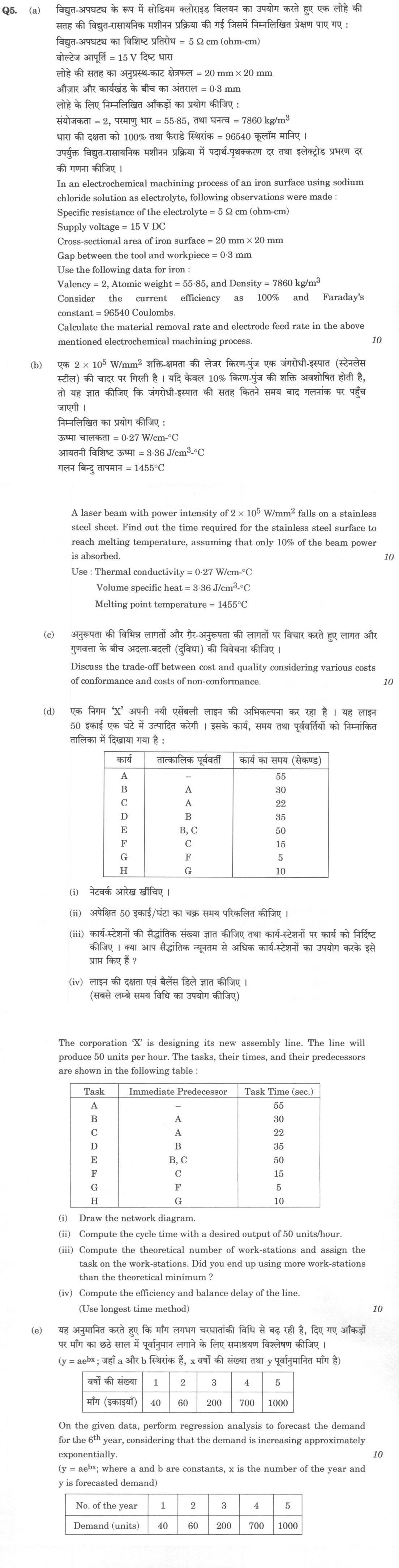
The figure this question refers to, in words
The question paper is a scan and the diagram did not survive as text. This is the figure as read from the original page — every component, value and label — so the question can be worked from the text below.
(d) Table with columns 'Task', 'Immediate Predecessor', and 'Task Time (sec.)': A | - | 55 B | A | 30 C | A | 22 D | B | 35 E | B, C | 50 F | C | 15 G | F | 5 H | G | 10
(e) Table with two rows: No. of the year: 1 | 2 | 3 | 4 | 5 Demand (units): 40 | 60 | 200 | 700 | 1000
Model answer
Written by UPSC Answer Check against this question's marking rubric, to the expected length. UPSC does not publish answers for Mains — this is one way to score well, not an official key.
(a) Given: electrolyte specific resistance ρ = 5 Ω cm, voltage V = 15 V, workpiece area A = 20 mm × 20 mm = 400 mm² = 4 cm², gap g = 0.3 mm = 0.03 cm, valency z = 2, atomic weight M = 55.85 g/mol, density ρm = 7860 kg/m³ = 7.86 g/cm³, Faraday constant F = 96540 C, current efficiency η = 1.
Using Ohm’s law for the electrolyte gap, R = ρg/A = 5 × 0.03 / 4 = 0.0375 Ω. Current, I = V/R = 15 / 0.0375 = 400 A.
By Faraday’s law of electrolysis, mass removal rate is ṁ = η I M / (z F) = 400 × 55.85 / (2 × 96540) = 0.1157 g/s = 1.157 × 10⁻⁴ kg/s.
Volume removal rate, Q = ṁ / ρm = 0.1157 / 7.86 = 0.01472 cm³/s = 14.72 mm³/s.
Thus material removal rate = 14.72 mm³/s = 883.2 mm³/min.
Electrode feed rate is f = Q/A = 0.01472 / 4 = 0.00368 cm/s = 0.0368 mm/s = 2.208 mm/min.
This assumes 100% current efficiency, constant gap, no polarization, and uniform current density.
(b) Given incident intensity I₀ = 2 × 10⁵ W/mm². Only 10% is absorbed, so absorbed heat flux is q = 0.1 × 2 × 10⁵ = 2 × 10⁴ W/mm² = 2 × 10⁶ W/cm².
For a semi-infinite solid heated by a constant surface heat flux, the surface temperature rise is ΔT = (2q/k) √(αt/π), where α = k/(ρc) = k/Cv.
Here k = 0.27 W/cm-°C, Cv = 3.36 J/cm³-°C. Taking initial temperature as 0°C, as no ambient value is given, ΔT = 1455°C.
Solving for time, t = π k Cv ΔT² / (4q²) = π × 0.27 × 3.36 × (1455)² / [4 × (2 × 10⁶)²] = 6.0336 × 10⁶ / 1.6 × 10¹³ = 3.77 × 10⁻⁷ s.
If initial temperature is taken as 25°C, ΔT = 1430°C and t ≈ 3.64 × 10⁻⁷ s.
(c) Cost and quality trade-off is analysed through cost of quality, divided into cost of conformance and cost of non-conformance.
Cost of conformance includes prevention costs and appraisal costs. Prevention costs are incurred to stop defects before they occur: design review, training, supplier development, process capability studies and quality planning. Appraisal costs are incurred to detect defects: inspection, testing, audits and gauging.
Cost of non-conformance includes internal failure and external failure. Internal failure costs arise before delivery: scrap, rework, re-inspection, downtime and yield loss. External failure costs arise after delivery: warranty claims, returns, recalls, liability, complaint handling and loss of goodwill.
At low quality levels, non-conformance costs dominate because defects, rework and customer complaints are high. Spending more on prevention and appraisal reduces defects and hence reduces failure costs. Initially the reduction in failure costs exceeds the extra conformance cost, so total quality cost falls.
Beyond an optimum point, additional conformance spending gives diminishing returns. Over-inspection, excessive testing, over-specification and slowed throughput raise cost without proportional reduction in failure cost. The total quality cost curve is therefore roughly U-shaped, with a minimum where marginal conformance cost equals marginal non-conformance cost. Modern quality practice emphasises prevention because it is usually cheaper than failure, and continuous improvement can shift the optimum toward higher quality and lower total cost. However, zero defects may not always be economically optimal if customer requirements are already met.
(d)(i) The network diagram is:
A → B A → C B → D B → E C → E C → F F → G G → H
Thus E depends on both B and C, D depends on B, F depends on C, and H is reached through G. No dummy activity is needed.
(d)(ii) Desired output = 50 units/hour. Cycle time, C = available time per hour / output = 3600 / 50 = 72 seconds/unit.
(d)(iii) Total task time = 55 + 30 + 22 + 35 + 50 + 15 + 5 + 10 = 222 seconds.
Theoretical minimum number of workstations: Nmin = ceil(222/72) = ceil(3.083) = 4.
Using the longest-time method, assigning tasks without exceeding 72 seconds and respecting precedence:
- Station 1: A (55 s). Idle = 17 s.
- Station 2: B (30 s), D (35 s). Total = 65 s. Idle = 7 s.
- Station 3: C (22 s), E (50 s). Total = 72 s. Idle = 0 s.
- Station 4: F (15 s), G (5 s), H (10 s). Total = 30 s. Idle = 42 s.
Number of workstations used = 4. This is equal to the theoretical minimum, so no, more workstations than the theoretical minimum were not used.
(d)(iv) Efficiency = total task time / (actual stations × cycle time) = 222 / (4 × 72) = 222 / 288 = 0.7708 = 77.08%.
Balance delay = 1 − efficiency = 1 − 0.7708 = 0.2292 = 22.92%.
(e) For exponential demand, y = a exp(bx). Taking natural logarithms, ln y = ln a + b x.
Data: x = 1, 2, 3, 4, 5 y = 40, 60, 200, 700, 1000 ln y = 3.6889, 4.0943, 5.2983, 6.5511, 6.9078.
Sums: n = 5 Σx = 15 Σx² = 55 Σln y = 26.54038 Σx ln y = 88.51562.
Normal equations: 26.54038 = 5 ln a + 15b 88.51562 = 15 ln a + 55b.
Solving, b = (5 × 88.51562 − 15 × 26.54038) / (5 × 55 − 15²) = 44.47244 / 50 = 0.88945.
ln a = (26.54038 − 15 × 0.88945) / 5 = 2.63973.
So a = exp(2.63973) = 14.009.
Thus the regression equation is y = 14.009 exp(0.88945x).
For the 6th year, x = 6: ln y₆ = 2.63973 + 0.88945 × 6 = 7.97642.
y₆ = exp(7.97642) = 2911.5 units.
Forecast demand for the 6th year = approximately 2912 units.
What "Solve" is asking you to do
Choose the method, then carry it through to a final answer. Identifying what kind of problem this is and why that method applies is the first thing marked; a correct figure arrived at invisibly earns almost nothing.
Structure that answers it
Given data and what is required → method chosen, with the reason it applies → set-up (equation, circuit, free body, trial balance) → working, step by step → answer with units and any condition of validity
Where marks are lost
Doing the middle steps mentally and writing only the result. In mathematics papers, a further loss comes from giving a decimal where the exact value in surds or fractions was wanted, or from skipping the justification a part explicitly asks for.
How this answer will be evaluated
Approach
(a) calculate: given > formula > substitution > result with units > interpretation | (b) calculate: given > formula > substitution > result with units > interpretation | (c) discuss: intro > 3-4 dimensions > example > balanced close | (d) calculate: given > formula > substitution > result with units > interpretation | (e) calculate: given > formula > substitution > result with units > interpretation Full marks: All parts solved with correct methods, clear working, and physical interpretation.
Key points expected
- Calculate current using Ohm's law and electrolyte resistance
- Apply Faraday's law for material removal rate
- State assumptions (100% efficiency, constant gap)
- Derive feed rate from removal rate and area
- Use heat transfer equation with absorbed power
- Apply 10% absorption factor to beam intensity
- Use given thermal conductivity and specific heat
- Calculate time to reach 1455°C
Evaluation rubric
Each sub-part is marked on its own, against the marks and word limit printed on the paper.
- (a) Material removal rate and electrode feed rate for the ECM process. 10 marks
calculate— given → formula → substitution → result with units → interpretation
Must cover
- Calculate current using Ohm's law and electrolyte resistance
- Apply Faraday's law for material removal rate
- State assumptions (100% efficiency, constant gap)
- Derive feed rate from removal rate and area
Loses marks
- Plugging numbers without governing equations
- Ignoring unit consistency in resistance calculation
Earns more
- Correct unit conversion for resistance and area
- Explicit calculation of electrolyte resistance
- Physical interpretation of feed rate
Extra mark
- Schematic of ECM setup with labelled gap
- (b) Time required for stainless steel to reach melting temperature. 10 marks
calculate— given → formula → substitution → result with units → interpretation
Must cover
- Use heat transfer equation with absorbed power
- Apply 10% absorption factor to beam intensity
- Use given thermal conductivity and specific heat
- Calculate time to reach 1455°C
Loses marks
- Ignoring absorption factor in calculation
- No governing equation for heat transfer
Earns more
- Correct application of 10% absorption
- Dimensional consistency in heat transfer terms
- Clear statement of assumptions
Extra mark
- Schematic of laser interaction with sheet
- (c) Trade-off between cost and quality in conformance and non-conformance. 10 marks
discuss— intro → 3-4 dimensions → example → balanced close
Must cover
- Define conformance and non-conformance costs
- Explain trade-off with examples
- Discuss impact on quality and cost
- Provide balanced conclusion
Loses marks
- Vague discussion without specific cost types
- No examples or practical context
Earns more
- Specific examples of conformance costs
- Clear distinction between cost types
- Practical implications for manufacturing
Extra mark
- Reference to quality management frameworks
- (d) Network diagram, cycle time, work-stations, efficiency, and balance delay. 10 marks
calculate— given → formula → substitution → result with units → interpretation
Must cover
- Draw correct network diagram with predecessors
- Calculate cycle time for 50 units/hour
- Assign tasks using longest time method
- Compute efficiency and balance delay
Loses marks
- Incorrect network diagram or task assignment
- No calculation of theoretical minimum stations
Earns more
- Correct task assignment to work-stations
- Clear calculation of theoretical minimum stations
- Accurate efficiency and delay formulas
Extra mark
- Labelled network diagram with task times
- (e) Regression analysis to forecast 6th year demand. 10 marks
calculate— given → formula → substitution → result with units → interpretation
Must cover
- Use exponential model y = ae^(bx)
- Perform regression to find a and b
- Calculate forecast for 6th year
- Show step-by-step regression calculations
Loses marks
- Incorrect regression method or constants
- No step-by-step calculation shown
Earns more
- Correct transformation to linear form
- Accurate calculation of constants a and b
- Clear presentation of regression results
Extra mark
- Graphical representation of data and fit
Practice this exact question
Write your answer and it is marked point by point against the model answer above — what you covered, what you missed, what you got wrong.
Evaluate my answer →More from Mechanical Engineering 2023 Paper I
- Q2 (a) In Figure 2(a), AB is a rigid bar, CE is a steel rod of 20 mm diameter and DF is a co…
- Q3 (a) The coefficient of friction for all contacting surfaces in Figure 3(a) is 0·2. Does t…
- Q4 (a) Two involute gears in mesh have pressure angle of 20° and module of 6 mm. The number…
- Q5 (a) In an electrochemical machining process of an iron surface using sodium chloride solu…
- Q6 (a) Following data were observed while machining two different work materials X and Y usi…
- Q7 (a) (i) A tube is to be drawn as per the dimensions given in the following Figure 7(a)(i)…
- Q8 (a) The following data represents the results of inspecting 50 units/day of personal comp…