Paper I — Q6
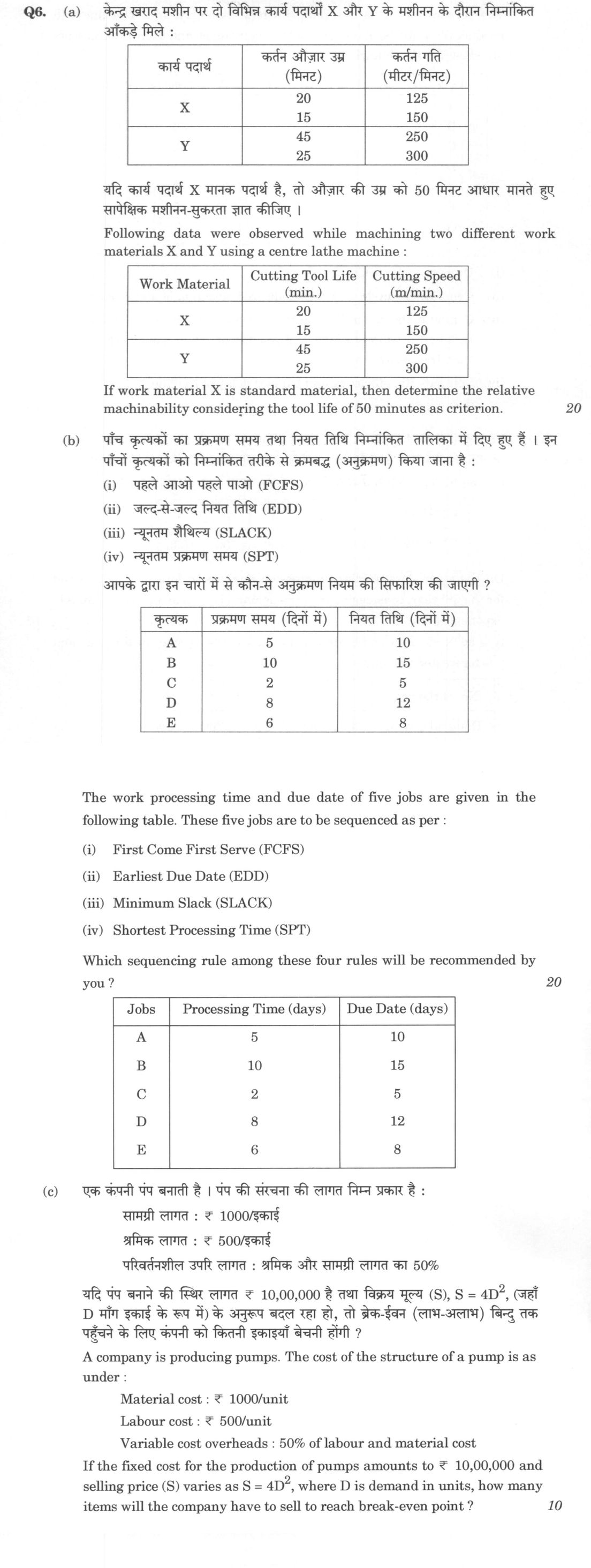
(a) Following data were observed while machining two different work materials X and Y using a centre lathe machine: If work…
Following data were observed while machining two different work materials X and Y using a centre lathe machine:
If work material X is standard material, then determine the relative machinability considering the tool life of 50 minutes as criterion. 20 marks
The work processing time and due date of five jobs are given in the following table. These five jobs are to be sequenced as per:
| Jobs | Processing Time (days) | Due Date (days) |
|---|---|---|
| A | 5 | 10 |
| B | 10 | 15 |
| C | 2 | 5 |
| D | 8 | 12 |
| E | 6 | 8 |
First Come First Serve (FCFS)
Earliest Due Date (EDD)
Minimum Slack (SLACK)
Shortest Processing Time (SPT)
Which sequencing rule among these four rules will be recommended by you? 20 marks
A company is producing pumps. The cost of the structure of a pump is as under:
Material cost: ₹ 1000/unit Labour cost: ₹ 500/unit Variable cost overheads: 50% of labour and material cost
If the fixed cost for the production of pumps amounts to ₹ 10,00,000 and selling price (S) varies as S = 4D², where D is demand in units, how many items will the company have to sell to reach break-even point? 10 marks
हिंदी में प्रश्न पढ़ें
केन्द्र खराद मशीन पर दो विभिन्न कार्य पदार्थ X और Y के मशीनिंग के दौरान निम्नांकित आँकड़े मिले :
यदि कार्य पदार्थ X मानक पदार्थ है, तो औजार की उम्र को 50 मिनट आधार मानते हुए सापेक्षिक मशीनिंग-सुकरता ज्ञात कीजिए । (20 अंक)
पाँच कृत्यों का प्रक्रमण समय तथा नियत तिथि निम्नांकित तालिका में दिए हुए हैं । इन पाँचों कृत्यों को निम्नांकित तरीके से क्रमबद्ध (अनुक्रमण) किया जाना है :
| कृत्य | प्रक्रमण समय (दिन) | नियत तिथि (दिन) |
|---|---|---|
| A | 5 | 10 |
| B | 10 | 15 |
| C | 2 | 5 |
| D | 8 | 12 |
| E | 6 | 8 |
पहले आओ पहले पाओ (FCFS)
जल्द-से-जल्द नियत तिथि (EDD)
न्यूनतम शैथिल्य (SLACK)
न्यूनतम प्रक्रमण समय (SPT)
आपके द्वारा इन चारों में से कौन-से अनुक्रमण नियम की सिफारिश की जाएगी ? (20 अंक)
एक कंपनी पंप बनाती है । पंप की संरचना की लागत निम्न प्रकार है :
सामग्री लागत : ₹ 1000/इकाई श्रमिक लागत : ₹ 500/इकाई परिवर्तनशील ऊपरि लागत : श्रमिक और सामग्री लागत का 50%
यदि पंप बनाने की स्थिर लागत ₹ 10,00,000 है तथा विक्रय मूल्य (S), S = 4D², (जहाँ D माँग इकाई के रूप में) के अनुसरूप बदल रहा हो, तो ब्रेक-ईवन (लाभ-अलाभ) बिंदु तक पहुँचने के लिए कंपनी को कितनी इकाइयाँ बेचनी होंगी ? (10 अंक)
The figure this question refers to, in words
The question paper is a scan and the diagram did not survive as text. This is the figure as read from the original page — every component, value and label — so the question can be worked from the text below.
(a) Table with columns: Work Material, Cutting Tool Life (min.), Cutting Speed (m/min.). Rows: X, 20, 125 X, 15, 150 Y, 45, 250 Y, 25, 300
(b) Table with columns: Jobs, Processing Time (days), Due Date (days). Rows: A, 5, 10; B, 10, 15; C, 2, 5; D, 8, 12; E, 6, 8.
Model answer
Written by UPSC Answer Check against this question's marking rubric, to the expected length. UPSC does not publish answers for Mains — this is one way to score well, not an official key.
(a) The data are X: (V,T) = (125 m/min, 20 min) and (150 m/min, 15 min); Y: (250 m/min, 45 min) and (300 m/min, 25 min).
- Method: Taylor’s tool-life equation, V Tⁿ = C. It is valid for the same tool, feed, depth of cut and cooling; the 50 min value is an extrapolation from the tested range. Natural logarithms are used; the base is immaterial because it cancels in the ratio.
- For X: 125×20ⁿ = 150×15ⁿ. Hence (20/15)ⁿ = 150/125 = 6/5, so nₓ = ln(6/5)/ln(4/3) ≈ 0.6338. Then Cₓ = 125×20ⁿₓ ≈ 834 m/min, with T in min. The second point gives the same Cₓ. At T = 50 min, Vₓ = Cₓ/50ⁿₓ = 125(20/50)ⁿₓ = 125(2/5)ⁿₓ ≈ 69.9 m/min.
- For Y: 250×45ⁿ = 300×25ⁿ. Hence (45/25)ⁿ = 6/5, so nᵧ = ln(6/5)/ln(9/5) ≈ 0.3102. Then Cᵧ = 250×45ⁿᵧ ≈ 814 m/min. The second point gives the same Cᵧ. At T = 50 min, Vᵧ = 250(45/50)ⁿᵧ = 250(9/10)ⁿᵧ ≈ 242.0 m/min.
- Relative machinability with X as standard at a common tool life of 50 min is M = (V of material / Vₓ)×100. The ratio is dimensionless. Substituting the logarithmic n values in the speed ratio gives 345.8, rounded to 346. Final: Mₓ = 100; Mᵧ ≈ 346, i.e. Y is about 3.46 times as machinable as X at 50 min tool life.
(b) All jobs are available at time 0. All times are in days. For each sequence, completion time C is cumulative processing time; flow time F = C; waiting time W = C - processing time; tardiness = max(0, C - due date). Tardiness is used rather than lateness because negative lateness is not penalised. The final completion time is 31 days for all four sequences because total processing time is 31 days.
- (i) First Come First Serve (FCFS): order A-B-C-D-E. C = 5, 15, 17, 25, 31 days. Flow sum = 93 days, average = 18.6 days. W = 0, 5, 15, 17, 25 days; sum = 62 days, average = 12.4 days. Tardiness = 0, 0, 12, 13, 23 days; total = 48 days, average = 9.6 days, maximum = 23 days, late jobs = 3.
- (ii) Earliest Due Date (EDD): sort by due date: C(5), E(8), A(10), D(12), B(15). C = 2, 8, 13, 21, 31 days. Flow sum = 75 days, average = 15.0 days. W = 0, 2, 8, 13, 21 days; sum = 44 days, average = 8.8 days. Tardiness = 0, 0, 3, 9, 16 days; total = 28 days, average = 5.6 days, maximum = 16 days, late jobs = 3.
- (iii) Minimum Slack (SLACK): slack = due date - processing time: A 5, B 5, C 3, D 4, E 2. Minimum-slack order E-C-D-A-B, with the A/B tie taken as A before B. C = 6, 8, 16, 21, 31 days. Flow sum = 82 days, average = 16.4 days. W = 0, 6, 8, 16, 21 days; sum = 51 days, average = 10.2 days. Tardiness = 0, 3, 4, 11, 16 days; total = 34 days, average = 6.8 days, maximum = 16 days, late jobs = 4.
- (iv) Shortest Processing Time (SPT): sort by processing time: C(2), A(5), E(6), D(8), B(10). C = 2, 7, 13, 21, 31 days. Flow sum = 74 days, average = 14.8 days. W = 0, 2, 7, 13, 21 days; sum = 43 days, average = 8.6 days. Tardiness = 0, 0, 5, 9, 16 days; total = 30 days, average = 6.0 days, maximum = 16 days, late jobs = 3.
- SPT gives the lowest average flow and waiting times. EDD gives the lowest total and average tardiness, and its maximum tardiness is tied for best. Since due dates are explicitly supplied, due-date performance should dominate. Recommended rule: EDD; if the only objective were minimum flow time, SPT would be recommended.
(c)
- Variable overhead per unit = 50% × (1000 + 500) = 750 ₹/unit.
- Variable cost per unit v = 1000 + 500 + 750 = 2250 ₹/unit. Fixed cost F = 10,00,000 ₹, and D is the number of units sold. The break-even condition is total revenue = F + vD, assuming fixed cost is constant, variable cost is linear with D, all units produced are sold, and the revenue function is valid over the break-even range.
- In break-even notation S is normally total sales. Taking the given S = 4D² as total revenue, 4D² = 10,00,000 + 2250D. 4D² - 2250D - 1,000,000 = 0. D = [2250 + √(2250² + 4×4×1,000,000)]/(2×4) = [2250 + √21,062,500]/8 = 125(9 + √337)/4. The positive root is selected because demand must be positive. Check whole units: f(854) = 4×854² - 2250×854 - 1,000,000 = -4,236 ₹, and f(855) = 350 ₹. Hence the minimum whole number of units is 855.
- If S is read literally as unit selling price, total revenue is D×S = 4D³. Then 4D³ = 10,00,000 + 2250D. f(65) = -47,750 ₹ and f(66) = 1,484 ₹, so the minimum whole number would be 66 units. Final: 855 units under the usual total-sales reading; 66 units under the literal unit-price reading.
What "Solve" is asking you to do
Choose the method, then carry it through to a final answer. Identifying what kind of problem this is and why that method applies is the first thing marked; a correct figure arrived at invisibly earns almost nothing.
Structure that answers it
Given data and what is required → method chosen, with the reason it applies → set-up (equation, circuit, free body, trial balance) → working, step by step → answer with units and any condition of validity
Where marks are lost
Doing the middle steps mentally and writing only the result. In mathematics papers, a further loss comes from giving a decimal where the exact value in surds or fractions was wanted, or from skipping the justification a part explicitly asks for.
How this answer will be evaluated
Approach
(a) calculate: given > formula > substitution > result with units > interpretation | (b) calculate: given > formula > substitution > result with units > interpretation | (c) calculate: given > formula > substitution > result with units > interpretation Full marks: All parts solved with correct formulas, clear steps, and accurate final answers.
Key points expected
- State Taylor's tool life equation (VT^n = C)
- Calculate tool life exponent n for material X
- Calculate tool life exponent n for material Y
- Calculate relative machinability ratio (C_Y/C_X)
- Calculate sequence for FCFS (A, B, C, D, E)
- Calculate sequence for EDD (C, E, A, D, B)
- Calculate sequence for SLACK (C, E, A, D, B)
- Calculate sequence for SPT (C, A, E, D, B)
Evaluation rubric
Each sub-part is marked on its own, against the marks and word limit printed on the paper.
- (a) Determine relative machinability of material Y with respect to X using Taylor's tool life criterion. 20 marks
calculate— given → formula → substitution → result with units → interpretation
Must cover
- State Taylor's tool life equation (VT^n = C)
- Calculate tool life exponent n for material X
- Calculate tool life exponent n for material Y
- Calculate relative machinability ratio (C_Y/C_X)
Loses marks
- Omitting the tool life exponent calculation
- Using incorrect reference tool life
- Confusing cutting speed with tool life
Earns more
- Correctly identifies X as standard material
- Uses 50 minutes as the reference tool life
- Shows step-by-step logarithmic calculation
Extra mark
- Mentions physical interpretation of machinability ratio
- (b) Sequence five jobs using FCFS, EDD, SLACK, and SPT rules; recommend the best rule. 20 marks
calculate— given → formula → substitution → result with units → interpretation
Must cover
- Calculate sequence for FCFS (A, B, C, D, E)
- Calculate sequence for EDD (C, E, A, D, B)
- Calculate sequence for SLACK (C, E, A, D, B)
- Calculate sequence for SPT (C, A, E, D, B)
Loses marks
- Incorrect sequencing for any rule
- Failing to provide a recommendation
- Not calculating slack correctly
Earns more
- Calculates flow time and lateness for each rule
- Provides a clear recommendation with justification
- Uses a table to present results
Extra mark
- Compares average flow time and average lateness across rules
- (c) Determine the break-even point for pump production given variable costs and a non-linear selling price. 10 marks
calculate— given → formula → substitution → result with units → interpretation
Must cover
- Calculate total variable cost per unit (₹2250)
- Set up break-even equation: Total Revenue = Total Cost
- Substitute S = 4D² into the revenue equation
- Solve the quadratic equation for D
Loses marks
- Incorrect calculation of variable cost per unit
- Failing to set up the correct break-even equation
- Solving the quadratic equation incorrectly
Earns more
- Correctly identifies fixed cost as ₹10,00,000
- Shows the quadratic formula application
- States the final answer in units
Extra mark
- Verifies the solution by substituting back into the equation
Practice this exact question
Write your answer and it is marked point by point against the model answer above — what you covered, what you missed, what you got wrong.
Evaluate my answer →More from Mechanical Engineering 2023 Paper I
- Q3 (a) The coefficient of friction for all contacting surfaces in Figure 3(a) is 0·2. Does t…
- Q4 (a) Two involute gears in mesh have pressure angle of 20° and module of 6 mm. The number…
- Q5 (a) In an electrochemical machining process of an iron surface using sodium chloride solu…
- Q6 (a) Following data were observed while machining two different work materials X and Y usi…
- Q7 (a) (i) A tube is to be drawn as per the dimensions given in the following Figure 7(a)(i)…
- Q8 (a) The following data represents the results of inspecting 50 units/day of personal comp…