Paper I — Q2
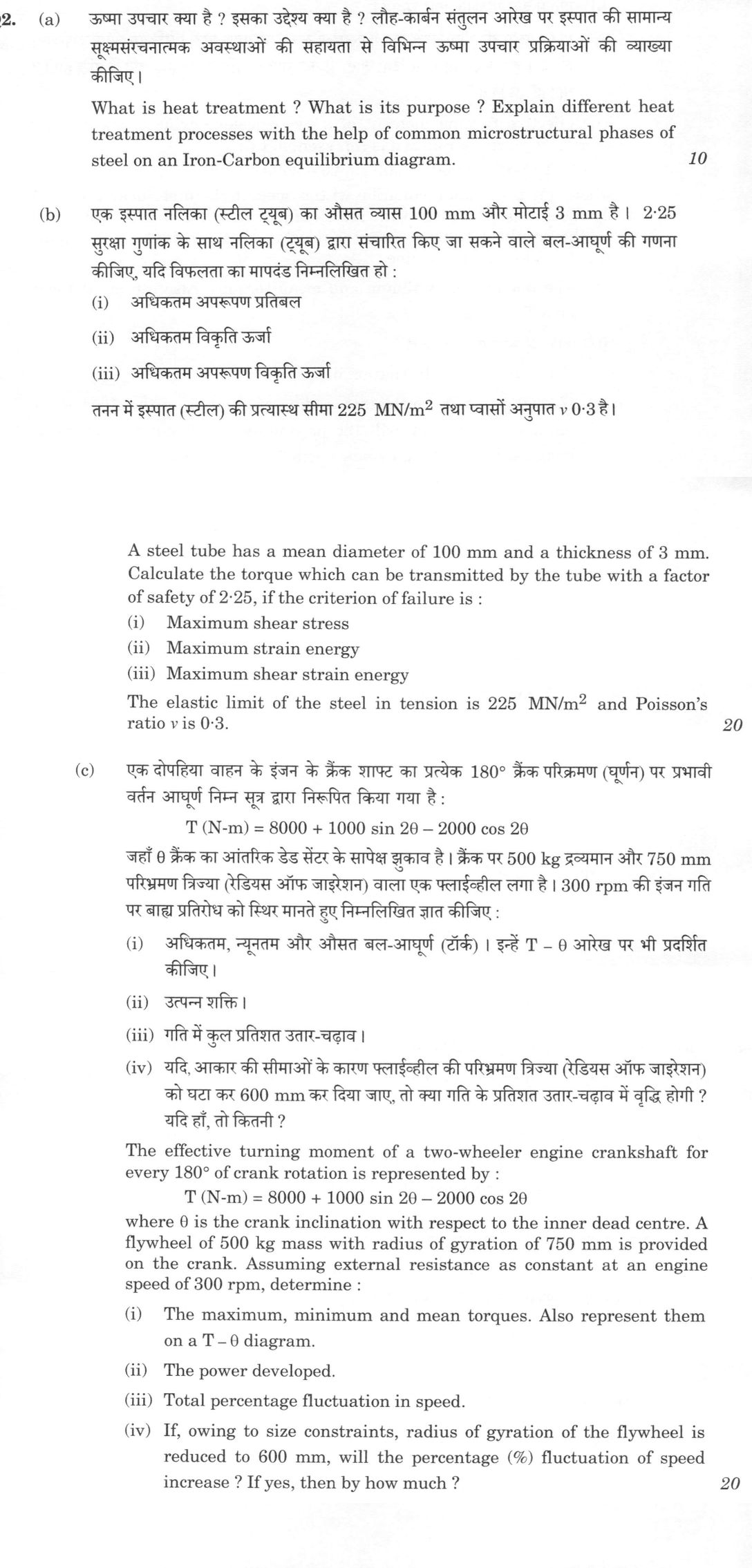
(a) What is heat treatment ? What is its purpose ? Explain different heat treatment processes with the help of common…
What is heat treatment ? What is its purpose ? Explain different heat treatment processes with the help of common microstructural phases of steel on an Iron-Carbon equilibrium diagram. 10 marks
A steel tube has a mean diameter of 100 mm and a thickness of 3 mm. Calculate the torque which can be transmitted by the tube with a factor of safety of 2·25, if the criterion of failure is : Maximum shear stress
Maximum strain energy
Maximum shear strain energy The elastic limit of the steel in tension is 225 MN/m² and Poisson's ratio v is 0·3. 20 marks
The effective turning moment of a two-wheeler engine crankshaft for every 180° of crank rotation is represented by : T (N-m) = 8000 + 1000 sin 2θ − 2000 cos 2θ where θ is the crank inclination with respect to the inner dead centre. A flywheel of 500 kg mass with radius of gyration of 750 mm is provided on the crank. Assuming external resistance as constant at an engine speed of 300 rpm, determine : The maximum, minimum and mean torques. Also represent them on a T – θ diagram.
The power developed.
Total percentage fluctuation in speed.
If, owing to size constraints, radius of gyration of the flywheel is reduced to 600 mm, will the percentage (%) fluctuation of speed increase ? If yes, then by how much ? 20 marks
हिंदी में प्रश्न पढ़ें
ऊष्मा उपचार क्या है ? इसका उद्देश्य क्या है ? लौह-कार्बन संतुलन आरेख पर इस्पात की सामान्य सूक्ष्मसंरचनात्मक अवस्थाओं की सहायता से विभिन्न ऊष्मा उपचार प्रक्रियाओं की व्याख्या कीजिए। (10 अंक)
एक इस्पात नलिका (स्टील ट्यूब) का औसत व्यास 100 mm और मोटाई 3 mm है । 2·25 सुरक्षा गुणांक के साथ नलिका (ट्यूब) द्वारा संचारित किए जा सकने वाले बल-आघूर्ण की गणना कीजिए, यदि विफलता का मापदंड निम्नलिखित हो : अधिकतम अपरूपण प्रतिबल
अधिकतम विकृति ऊर्जा
अधिकतम अपरूपण विकृति ऊर्जा तनन में इस्पात (स्टील) की प्रत्यास्थ सीमा 225 MN/m2 तथा प्वासों अनुपात ν 0·3 है। (20 अंक)
एक दोपहिया वाहन के इंजन के क्रैंक शाफ्ट का प्रत्येक 180° क्रैंक परिक्रमण (घूर्णन) पर प्रभावी वर्तन आघूर्ण निम्न सूत्र द्वारा निरूपित किया गया है : T (N-m) = 8000 + 1000 sin 2θ − 2000 cos 2θ जहाँ θ क्रैंक का आंतरिक डेड सेंटर के सापेक्ष झुकाव है। क्रैंक पर 500 kg द्रव्यमान और 750 mm परिभ्रमण त्रिज्या (रेडियस ऑफ़ जाइरेशन) वाला एक फ्लाईव्हील लगा है। 300 rpm की इंजन गति पर बाह्य प्रतिरोध को स्थिर मानते हुए निम्नलिखित ज्ञात कीजिए : अधिकतम, न्यूनतम और औसत बल-आघूर्ण (टॉर्क)। इन्हें T – θ आरेख पर भी प्रदर्शित कीजिए।
उत्पन्न शक्ति।
गति में कुल प्रतिशत उतार-चढ़ाव।
यदि, आकार की सीमाओं के कारण फ्लाईव्हील की परिभ्रमण त्रिज्या (रेडियस ऑफ़ जाइरेशन) को घटा कर 600 mm कर दिया जाए, तो क्या गति के प्रतिशत उतार-चढ़ाव में वृद्धि होगी ? यदि हाँ, तो कितनी ? (20 अंक)
Model answer
Drafted with AI by UPSC Answer Check against this question's marking rubric, to the expected length. UPSC does not publish answers for Mains — this is one way to score well, not an official key. How we build rubrics and answers.
(a) Heat treatment: purposes and processes on the Fe–Fe₃C diagram (10 marks)
Definition. Heat treatment is the controlled heating of a solid metal to a set temperature, holding it, and cooling it at a set rate, to alter its microstructure and hence its properties without changing its shape.
Purposes. To relieve internal stress, refine grains, soften for machining or cold work, increase hardness and strength, improve toughness and ductility, improve wear resistance of the surface, and homogenise the structure.
Processes. On the Fe–Fe₃C diagram the eutectoid is at 0.8% C and 727 °C (A₁), and A₃ and A_cm are the upper critical lines. Below A₁ steel is ferrite (α, BCC) with cementite (Fe₃C), and above it austenite (γ, FCC).

- Annealing (full): a hypoeutectoid steel is heated 30–50 °C above A₃, held, and furnace cooled. The result is coarse pearlite with ferrite, which is soft and ductile. Spheroidising (just below A₁ for long) gives cementite spheroids in ferrite in high-carbon steel, and process annealing (550–650 °C) recovers cold-worked steel.
- Normalising: heated 30–50 °C above A₃ (A_cm for hypereutectoid) and cooled in still air. Faster cooling gives fine pearlite with ferrite, which is harder and stronger than annealed steel and has a refined, uniform grain.
- Hardening: austenitised at the same temperature, then quenched in water or oil faster than the critical cooling rate. Austenite transforms to martensite, a hard, brittle body-centred tetragonal supersaturated solid solution, with some retained austenite.
- Tempering: quenched steel is reheated below A₁ (150–650 °C), which lets carbon escape as fine carbide. Tempered martensite (ferrite plus cementite) is tough, and higher temperature gives lower hardness and higher toughness.
- Austempering: quenched to 250–400 °C in a salt bath and held until austenite becomes bainite, giving good toughness and little distortion. Martempering quenches to just above the M_s temperature, equalises, and cools in air to form martensite with less cracking.
- Case hardening: carburising (0.8–1.2% C in austenite at 900–950 °C, then quench) gives a hard martensitic case on a tough low-carbon core. Nitriding (500–550 °C, in the ferrite region) forms hard nitrides without quenching, and induction or flame hardening gives a hard skin locally.
(b) Torque transmitted by a thin steel tube by three failure theories (20 marks)
Data. d_m = 100 mm, t = 3 mm, σ_y = 225 MN/m², ν = 0.3, factor of safety 2.25, so the permissible simple tensile stress is σ_y/2.25 = 100 MN/m².
Torsion of a thin tube. The mean enclosed area is A_m = π d_m²/4 = 7853.98 mm². The shear stress is τ = T/(2 A_m t) = T/(2 × 7853.98 × 3) = T/47 123.9 (T in N·mm, τ in N/mm²). Pure shear gives principal stresses σ₁ = +τ, σ₂ = −τ and σ₃ = 0.
(i) Maximum shear stress theory. The maximum shear stress is (σ₁ − σ₂)/2 = τ, and the permissible value is σ_y/(2 × FS) = 50 N/mm². So τ = 50 N/mm², and
T = 50 × 47 123.9 = 2.356 × 10⁶ N·mm = 2.36 kN·m.
(ii) Maximum strain energy theory (Haigh). The strain energy per unit volume is proportional to σ₁² + σ₂² − 2ν σ₁σ₂ and must not exceed its value at the permissible stress, (σ_y/FS)²:
τ² + τ² + 2(0.3) τ² = 2.6 τ² = 100²
τ = 100/√2.6 = 62.02 N/mm², and T = 62.02 × 47 123.9 = 2.923 × 10⁶ N·mm = 2.92 kN·m.
(iii) Maximum shear strain energy (distortion energy) theory. The condition is σ₁² + σ₂² − σ₁σ₂ = (σ_y/FS)², so 3τ² = 100²:
τ = 100/√3 = 57.74 N/mm², and T = 57.74 × 47 123.9 = 2.721 × 10⁶ N·mm = 2.72 kN·m.
Comparison. The order is Tresca (2.36) < von Mises (2.72) < Haigh (2.92 kN·m). The maximum shear stress theory is the most conservative, and it is the usual choice for ductile steel in design.
(c) Flywheel of a two-wheeler engine (20 marks)
(i) Maximum, minimum and mean torque. T = 8000 + 1000 sin 2θ − 2000 cos 2θ can be written as 8000 + R sin(2θ − α), where R = √(1000² + 2000²) = 2236.07 N·m and α = tan⁻¹(2000/1000) = 63.43°.
- T_max = 8000 + 2236.07 = 10 236 N·m, at 2θ − α = 90°, i.e. θ = 76.7°.
- T_min = 8000 − 2236.07 = 5764 N·m, at 2θ − α = 270°, i.e. θ = 166.7°.
- T_mean = 8000 N·m, the constant term, because the sine term averages to zero over the 180° cycle (its 2θ period is 360°).

The curve is a sine wave about the mean line, which is the constant resistance torque. The torque exceeds the resistance (energy accumulates) between θ = 31.7° and 121.7°, and is below it for the rest of the cycle.
(ii) Power developed. ω = 2π × 300/60 = 31.416 rad/s.
P = T_mean ω = 8000 × 31.416 = 251 327 W ≈ 251.3 kW.
(iii) Total percentage fluctuation of speed. The maximum fluctuation of energy is the area of the torque curve above the mean line, between the two crossings where 2θ − α = 0 and 180°:
ΔE = ∫ R sin(2θ − α) dθ = (R/2)[−cos(2θ − α)] from 0 to π = R = 2236.07 J
The moment of inertia is I = m k² = 500 × 0.75² = 281.25 kg·m². Using ΔE = I ω² C_s:
C_s = ΔE/(I ω²) = 2236.07/(281.25 × 31.416²) = 2236.07/277 583 = 0.008055
The total fluctuation of speed is 0.806%.
(iv) With k = 0.60 m. I = 500 × 0.6² = 180 kg·m², and ΔE is unchanged.
C_s = 2236.07/(180 × 986.96) = 0.012587, that is 1.259%.
Yes, the fluctuation increases, by 1.259 − 0.806 = 0.453 percentage points. This is a rise of 56.25% of the original value, since C_s varies as 1/k² and (0.75/0.60)² = 1.5625.
How this answer will be evaluated
Evaluation rubric
Each sub-part is marked on its own, against the marks and word limit printed on the paper.
- (a) What is heat treatment and what is its purpose? Explain the heat-treatment processes with the help of the microstructural phases of steel on the iron–carbon diagram (10 marks). 10 marks
Must cover
- Definition and purposes of heat treatment
- Critical lines A₁, A₃, A_cm and 0.8% C eutectoid on the Fe–Fe₃C diagram
- Annealing and normalising with temperature ranges and products (coarse and fine pearlite)
- Hardening to martensite, tempering, austempering/martempering (bainite) and case hardening
Loses marks
- Describing processes without phases.
- Confusing annealing with normalising.
Earns more
- Cooling rate linked to the microstructure formed.
- Temperatures given for each process.
Extra mark
- TTT diagram remark
- (b) Calculate the torque transmitted by the tube (d_m = 100 mm, t = 3 mm, FS 2.25, σ_y = 225 MN/m², ν = 0.3) by (i) maximum shear stress, (ii) maximum strain energy and (iii) maximum shear strain energy theories (20 marks). 20 marks
Must cover
- Thin-tube shear stress τ = T/(2A_m t) with A_m = πd²/4 and principal stresses ±τ
- Tresca: τ = 50 N/mm², T ≈ 2.36 kN·m
- Haigh: 2.6τ² = 100², T ≈ 2.92 kN·m
- von Mises: 3τ² = 100², T ≈ 2.72 kN·m
Loses marks
- Using yield stress in shear as 225 without the theory.
- Omitting Poisson's ratio in the strain energy theory.
Earns more
- Permissible stress 225/2.25 = 100 N/mm².
- Unit consistency and comparison of the three results.
Extra mark
- Note that Tresca is the most conservative
- (c) For the flywheel with T = 8000 + 1000 sin 2θ − 2000 cos 2θ: (i) T_max, T_min, T_mean with a T–θ diagram; (ii) power; (iii) total percentage fluctuation of speed; (iv) effect of reducing k to 600 mm (20 marks). 20 marks
Must cover
- T_max = 10 236 N·m, T_min = 5764 N·m, T_mean = 8000 N·m, with labelled T–θ diagram
- Power = 8000 × 31.416 ≈ 251.3 kW
- ΔE = 2236 J, I = 281.25 kg·m², C_s ≈ 0.806%
- New C_s ≈ 1.259%, an increase of about 0.453 percentage points
Loses marks
- Using the wrong mean torque.
- Taking the whole area under the curve as the energy fluctuation.
Earns more
- Amplitude R = √(1000² + 2000²) and phase angle used.
- Energy fluctuation from the area above the mean line.
Extra mark
- Relative rise of 56.25% from the (0.75/0.60)² factor
What "Explain" is asking you to do
Make the working of something clear — what sets it off, what follows from what, and what it produces. Explain is the Commission's mechanism word: it dominates the technical papers and the “explain why” stems, where the marks sit in the causal chain and not in the label.
Structure that answers it
State what it is → the initiating condition → the chain of cause, step by step → an instance where it plays out → what the chain produces
Where marks are lost
Describing what something looks like instead of why it works that way. Naming the stages without linking them reads as description too.
Practice this exact question
Write your answer and it is marked point by point against the model answer above — what you covered, what you missed, what you got wrong.
Evaluate my answer →More from Mechanical Engineering 2026 Paper I
- Q1 (a) A uniform beam has a mass of 50 kg per metre length. Compute the reactions at the sup…
- Q2 (a) What is heat treatment ? What is its purpose ? Explain different heat treatment proce…
- Q3 (a) (i) The acceleration of a particle along a straight line is defined by a = (2t – 9) m…
- Q4 (a) A simple beam is loaded as shown in the figure. Using the double-integration method,…
- Q5 (a) A cylindrical workpiece of 60 mm diameter is turned down to 50 mm over a length of 12…