Paper I — Q4
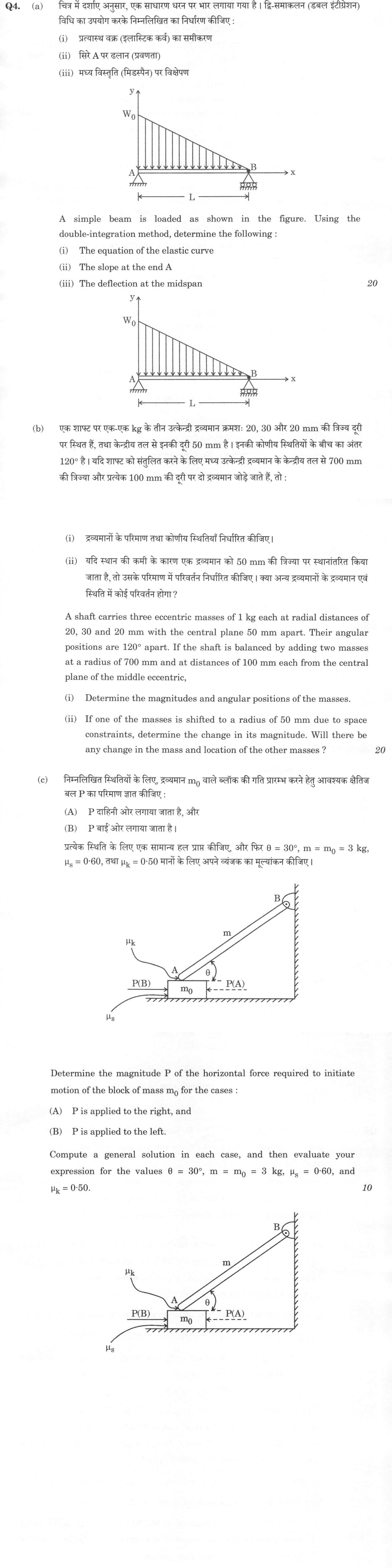
(a) A simple beam is loaded as shown in the figure. Using the double-integration method, determine the following : (i) The…
A simple beam is loaded as shown in the figure. Using the double-integration method, determine the following : The equation of the elastic curve
The slope at the end A
The deflection at the midspan 20 marks
A shaft carries three eccentric masses of 1 kg each at radial distances of 20, 30 and 20 mm with the central plane 50 mm apart. Their angular positions are 120° apart. If the shaft is balanced by adding two masses at a radius of 700 mm and at distances of 100 mm each from the central plane of the middle eccentric,
Determine the magnitudes and angular positions of the masses.
If one of the masses is shifted to a radius of 50 mm due to space constraints, determine the change in its magnitude. Will there be any change in the mass and location of the other masses ? 20 marks
Determine the magnitude P of the horizontal force required to initiate motion of the block of mass m0 for the cases : (A) P is applied to the right, and (B) P is applied to the left. Compute a general solution in each case, and then evaluate your expression for the values θ = 30°, m = m0 = 3 kg, μs = 0·60, and μk = 0·50. 10 marks
हिंदी में प्रश्न पढ़ें
चित्र में दर्शाए अनुसार, एक साधारण धरन पर भार लगाया गया है । द्वि-समाकलन (डबल इंटीग्रेशन) विधि का उपयोग करके निम्नलिखित का निर्धारण कीजिए : प्रत्यास्थ वक्र (इलास्टिक कर्व) का समीकरण
सिरे A पर ढलान (प्रवणता)
मध्य विस्तृति (मिडस्पैन) पर विक्षेपण (20 अंक)
एक शाफ्ट पर एक-एक kg के तीन उत्केन्द्री द्रव्यमान क्रमश: 20, 30 और 20 mm की त्रिज्य दूरी पर स्थित हैं, तथा केन्द्रीय तल से इनकी दूरी 50 mm है । इनकी कोणीय स्थितियों के बीच का अंतर 120° है । यदि शाफ्ट को संतुलित करने के लिए मध्य उत्केन्द्री द्रव्यमान के केन्द्रीय तल से 700 mm की त्रिज्या और प्रत्येक 100 mm की दूरी पर दो द्रव्यमान जोड़े जाते हैं, तो :
द्रव्यमानों के परिमाण तथा कोणीय स्थितियाँ निर्धारित कीजिए।
यदि स्थान की कमी के कारण एक द्रव्यमान को 50 mm की त्रिज्या पर स्थानांतरित किया जाता है, तो उसके परिमाण में परिवर्तन निर्धारित कीजिए। क्या अन्य द्रव्यमानों के द्रव्यमान एवं स्थिति में कोई परिवर्तन होगा ? (20 अंक)
निम्नलिखित स्थितियों के लिए, द्रव्यमान m₀ वाले ब्लॉक की गति प्रारम्भ करने हेतु आवश्यक क्षैतिज बल P का परिमाण ज्ञात कीजिए :
(A) P दाहिनी ओर लगाया जाता है, और
(B) P बाईं ओर लगाया जाता है।
प्रत्येक स्थिति के लिए एक सामान्य हल प्राप्त कीजिए, और फिर θ = 30°, m = m₀ = 3 kg, μs = 0·60, तथा μk = 0·50 मानों के लिए अपने व्यंजक का मूल्यांकन कीजिए। (10 अंक)
Model answer
Drafted with AI by UPSC Answer Check against this question's marking rubric, to the expected length. UPSC does not publish answers for Mains — this is one way to score well, not an official key. How we build rubrics and answers.
(a) Simply supported beam under a triangular load, by double integration (20 marks)
Reactions. The load intensity is w = w₀(1 − x/L), with x measured from A. The total load is W = w₀L/2, acting at L/3 from A. Moments about B give R_A = W(2L/3)/L = w₀L/3, and R_B = w₀L/6.
Bending moment. For a section at x from A, with sagging moment positive:
M = R_A x − ∫₀ˣ w₀(1 − ξ/L)(x − ξ) dξ = w₀Lx/3 − w₀x²/2 + w₀x³/(6L)
(M = 0 at x = L, as required.)
(i) Elastic curve. Take y positive upward, so EI d²y/dx² = M:
EI y″ = w₀Lx/3 − w₀x²/2 + w₀x³/(6L)
EI y′ = w₀Lx²/6 − w₀x³/6 + w₀x⁴/(24L) + C₁
EI y = w₀Lx³/18 − w₀x⁴/24 + w₀x⁵/(120L) + C₁x + C₂
Boundary conditions: y = 0 at x = 0 gives C₂ = 0. y = 0 at x = L gives w₀L⁴(1/18 − 1/24 + 1/120) + C₁L = 0, that is w₀L⁴/45 + C₁L = 0, so C₁ = −w₀L³/45. Hence
y = (w₀/(360 EI L)) (20L²x³ − 15Lx⁴ + 3x⁵ − 8L⁴x)
which is negative (downward) throughout.
(ii) Slope at A. At x = 0, y′ = C₁/EI:
θ_A = −w₀L³/(45 EI)
This is a slope of magnitude w₀L³/(45EI) = 8w₀L³/(360EI), with the beam falling to the right (clockwise). The slope at B is 7w₀L³/(360EI) in magnitude, and it is smaller because R_B is smaller.
(iii) Deflection at midspan. At x = L/2:
EI y = w₀L⁴(1/144 − 1/384 + 1/3840 − 1/90) = w₀L⁴ (80 − 30 + 3 − 128)/11 520 = −75 w₀L⁴/11 520
y(L/2) = −5w₀L⁴/(768 EI), that is a downward deflection of 5w₀L⁴/(768EI).
(b) Balancing of three eccentric masses in different planes (20 marks)
Data. Three masses of 1 kg at radii 20, 30 and 20 mm, in planes 50 mm apart, with the middle mass (r = 30 mm) in the central plane. Angular positions are 120° apart. The balancing masses A and B are at r = 700 mm, in planes 100 mm either side of the central plane. Take the central plane as reference, and measure angles from mass 1 (the mass on the side of A) in the sense mass 1 → 2 → 3, so mass 1 at 0°, mass 2 at 120° and mass 3 at 240°.
For each mass, mr (kg·mm), position z along the shaft from the central plane (mm) and angle are:
- 1: mr = 20, z = −50, angle 0°.
- 2: mr = 30, z = 0, angle 120°.
- 3: mr = 20, z = +50, angle 240°.
- A: unknown, z = −100.
- B: unknown, z = +100.
Force balance (Σ mr = 0). Components x, y in kg·mm:
- 1: (20, 0)
- 2: (−15, 25.98)
- 3: (−10, −17.32)
Sum of the three = (−5, 8.66), so the balancing masses must satisfy (mr)_A + (mr)_B = (5, −8.66).
Couple balance about the central plane (Σ mr z = 0). The couples of the three masses are 20(−50) = −1000 at 0°, zero, and 20(50) = +1000 at 240°:
−1000∠0° = (−1000, 0) and 1000∠240° = (−500, −866.0), sum (−1500, −866.0).
With (mr)_A at z = −100 and (mr)_B at z = +100: −100 (mr)_A + 100 (mr)_B = (1500, 866.0), so (mr)_B − (mr)_A = (15, 8.66).
Solving. Adding and subtracting the two vector equations:
- (mr)_B = ½[(5, −8.66) + (15, 8.66)] = (10, 0), so (mr)_B = 10 kg·mm at 0°.
- (mr)_A = ½[(5, −8.66) − (15, 8.66)] = (−5, −8.66), so (mr)_A = 10 kg·mm at 240°.
(i) Balancing masses. With r = 700 mm:
- m_A = 10/700 = 0.01429 kg = 14.3 g at 240°, in the plane 100 mm on the mass-1 side of the central plane.
- m_B = 10/700 = 0.01429 kg = 14.3 g at 0°, in the plane 100 mm on the mass-3 side.
(ii) One mass moved to r = 50 mm. The balance conditions involve only the products mr, the planes and the angles, so the product (mr) of the shifted mass must remain 10 kg·mm at the same angle and plane. At r = 50 mm:
m = 10/50 = 0.20 kg = 200 g, an increase of about 186 g (14 times the original 14.3 g).
Other masses. The other balancing mass, and the angular positions and planes of both, do not change, because the force and couple polygons are unchanged.
(c) Force to start the block, with the bar pinned at B (10 marks)
Model. The uniform bar AB (mass m, length ℓ) is pinned at B and rests at A on the block (mass m₀), at angle θ to the horizontal. The contact at A is sliding with μ_k (the block slides under the bar's end), and the block-floor contact is at the point of slipping with μ_s. Let N be the normal force at A, and f = ±μ_k N the friction force on the bar at A.
Bar in equilibrium. Take moments about B. The weight mg acts at the middle, at horizontal distance (ℓ/2) cos θ from B, and N and f act at A, at horizontal distance ℓ cos θ and vertical distance ℓ sin θ:
N ℓ cos θ − f ℓ sin θ = mg (ℓ/2) cos θ
Block in equilibrium. The normal force from the floor is N_f = m₀g + N, and the floor friction is μ_s N_f. The friction from the bar on the block is μ_k N, opposing the motion, so
P = μ_k N + μ_s (m₀g + N) = (μ_k + μ_s) N + μ_s m₀ g
(A) P towards the right. The block slides to the right under A, so the friction on the bar is f = +μ_k N, to the right. Then N (cos θ − μ_k sin θ) = mg cos θ/2:
N = mg / [2 (1 − μ_k tan θ)]
P_A = (μ_k + μ_s) mg / [2 (1 − μ_k tan θ)] + μ_s m₀ g
(B) P towards the left. The friction on the bar is now to the left, f = −μ_k N, so N (cos θ + μ_k sin θ) = mg cos θ/2:
N = mg / [2 (1 + μ_k tan θ)]
P_B = (μ_k + μ_s) mg / [2 (1 + μ_k tan θ)] + μ_s m₀ g
Numerical values. θ = 30° (tan θ = 0.5774), m = m₀ = 3 kg, mg = 29.43 N, μ_s = 0.60, μ_k = 0.50, so μ_k tan θ = 0.2887.
- Case (A): N = 29.43/(2 × 0.7113) = 20.69 N, and P_A = 1.1 × 20.69 + 0.6 × 29.43 = 22.76 + 17.66 = 40.4 N.
- Case (B): N = 29.43/(2 × 1.2887) = 11.42 N, and P_B = 1.1 × 11.42 + 17.66 = 12.56 + 17.66 = 30.2 N.
Pushing towards the wall needs more force, because the friction at A then presses the bar end harder onto the block (the bar wedges), which raises the normal force on the floor. The result holds only while 1 − μ_k tan θ > 0, that is μ_k tan θ < 1; if it fails, the block cannot be moved towards the wall at all (self-locking).
How this answer will be evaluated
Evaluation rubric
Each sub-part is marked on its own, against the marks and word limit printed on the paper.
- (a) For the simply supported beam with triangular load, use double integration to find (i) the elastic curve, (ii) the slope at A, (iii) the deflection at midspan (20 marks). 20 marks
Must cover
- Reactions R_A = w₀L/3 and R_B = w₀L/6, and bending moment M(x) = w₀Lx/3 − w₀x²/2 + w₀x³/(6L)
- EI y″ = M integrated twice with constants from y(0) = y(L) = 0
- Elastic curve y = (w₀/(360EIL))(20L²x³ − 15Lx⁴ + 3x⁵ − 8L⁴x), C₁ = −w₀L³/(45)
- θ_A = w₀L³/(45EI) and y(L/2) = 5w₀L⁴/(768EI), both downward
Loses marks
- Using moment-area or superposition tables without integration.
- Using load at the wrong end.
Earns more
- Sign convention stated.
- Boundary conditions applied correctly.
Extra mark
- Slope at B as 7w₀L³/(360EI)
- (b) Find the magnitudes and angular positions of the two balancing masses at 700 mm, and the change in one when moved to a radius of 50 mm, and whether the other masses change (20 marks). 20 marks
Must cover
- Force polygon Σ mr = 0 and couple polygon Σ mrz = 0 about the central plane
- (mr)_A = (mr)_B = 10 kg·mm at 240° and 0° respectively
- Balancing masses 14.3 g each at 700 mm
- Shifted mass = 10/50 = 0.2 kg (200 g), with no change to the other mass or the angular positions
Loses marks
- Ignoring the couple balance.
- Changing the other mass or angle.
Earns more
- Reference angle and plane stated.
- Vector components computed correctly.
Extra mark
- Graphical polygons drawn
- (c) Derive a general expression for the horizontal force P to start the block moving, to the right and to the left, and evaluate for θ = 30°, m = m₀ = 3 kg, μ_s = 0.6, μ_k = 0.5 (10 marks). 10 marks
Must cover
- Moment equilibrium of the bar about B with normal force N and friction ±μ_k N at A
- N = mg/[2(1 ∓ μ_k tan θ)] for the two directions
- P = (μ_k + μ_s)N + μ_s m₀ g
- P_A ≈ 40.4 N (right) and P_B ≈ 30.2 N (left)
Loses marks
- Ignoring the bar's contribution to the floor normal force.
- Using μ_s at the bar contact.
Earns more
- Friction direction on the bar reversed between the two cases.
- Floor normal force m₀g + N used.
Extra mark
- Self-locking condition μ_k tan θ < 1
What "Calculate" is asking you to do
Apply the standard formula or schedule to data the question has already supplied — a table of readings, cost records, a balance sheet — and produce the number. The method is rarely in doubt; the marks sit in the named intermediate quantities, each of which has to appear as a labelled line.
Structure that answers it
Data as given → formula or standard treatment, named → substitution → each intermediate, labelled → result with units
Where marks are lost
Omitting an intermediate the marking scheme pays for separately, or rounding at an intermediate line so the final figure drifts. In commerce and accountancy, any figure in a statement that no numbered working note supports is treated as unearned.
Practice this exact question
Write your answer and it is marked point by point against the model answer above — what you covered, what you missed, what you got wrong.
Evaluate my answer →More from Mechanical Engineering 2026 Paper I
- Q1 (a) A uniform beam has a mass of 50 kg per metre length. Compute the reactions at the sup…
- Q2 (a) What is heat treatment ? What is its purpose ? Explain different heat treatment proce…
- Q3 (a) (i) The acceleration of a particle along a straight line is defined by a = (2t – 9) m…
- Q4 (a) A simple beam is loaded as shown in the figure. Using the double-integration method,…
- Q5 (a) A cylindrical workpiece of 60 mm diameter is turned down to 50 mm over a length of 12…
- Q6 (a) A strip of width 250 mm is reduced from 30 mm to 20 mm thickness in a rolling mill of…
- Q7 (a) (i) In an orthogonal cutting operation, the following data are obtained : Cutting for…