Paper I — Q7
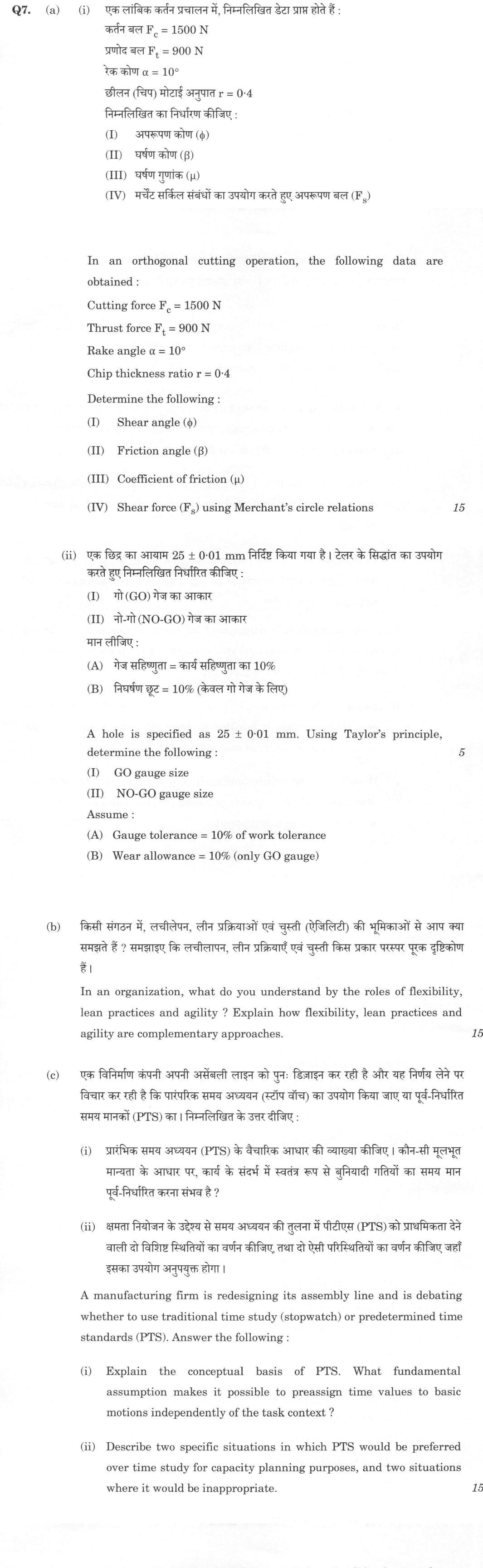
(a) (i) In an orthogonal cutting operation, the following data are obtained : Cutting force F_c = 1500 N Thrust force F_t = 900…
In an orthogonal cutting operation, the following data are obtained :
Cutting force F_c = 1500 N
Thrust force F_t = 900 N
Rake angle α = 10°
Chip thickness ratio r = 0·4
Determine the following :
(I) Shear angle (φ)
(II) Friction angle (β)
(III) Coefficient of friction (μ)
(IV) Shear force (F_s) using Merchant's circle relations 15 marks
A hole is specified as 25 ± 0·01 mm. Using Taylor's principle, determine the following :
(I) GO gauge size
(II) NO-GO gauge size
Assume :
(A) Gauge tolerance = 10% of work tolerance
(B) Wear allowance = 10% (only GO gauge) 5 marks
In an organization, what do you understand by the roles of flexibility, lean practices and agility ? Explain how flexibility, lean practices and agility are complementary approaches. 15 marks
A manufacturing firm is redesigning its assembly line and is debating whether to use traditional time study (stopwatch) or predetermined time standards (PTS). Answer the following :
Explain the conceptual basis of PTS. What fundamental assumption makes it possible to preassign time values to basic motions independently of the task context ?
Describe two specific situations in which PTS would be preferred over time study for capacity planning purposes, and two situations where it would be inappropriate. 15 marks
हिंदी में प्रश्न पढ़ें
एक लांबिक कर्तन प्रचालन में, निम्नलिखित डेटा प्राप्त होते हैं :
कर्तन बल F_c = 1500 N
प्रणोद बल F_t = 900 N
रेक कोण α = 10°
छीलन (चिप) मोटाई अनुपात r = 0·4
निम्नलिखित का निर्धारण कीजिए :
(I) अपरूपण कोण (φ)
(II) घर्षण कोण (β)
(III) घर्षण गुणांक (μ)
(IV) मर्चेंट सर्किल संबंधों का उपयोग करते हुए अपरूपण बल (F_s) (15 अंक)
एक छिद्र का आयाम 25 ± 0·01 mm निर्दिष्ट किया गया है। टेलर के सिद्धांत का उपयोग करते हुए निम्नलिखित निर्धारित कीजिए :
(I) गो (GO) गेज का आकार
(II) नो-गो (NO-GO) गेज का आकार
मान लीजिए :
(A) गेज सहिष्णुता = कार्य सहिष्णुता का 10%
(B) निघर्षण छूट = 10% (केवल गो गेज के लिए) (5 अंक)
किसी संगठन में, लचीलेपन, लीन प्रक्रियाओं एवं चुस्ती (ऐजिलिटी) की भूमिकाओं से आप क्या समझते हैं? समझाइए कि लचीलापन, लीन प्रक्रियाएँ एवं चुस्ती किस प्रकार परस्पर पूरक दृष्टिकोण हैं। (15 अंक)
एक विनिर्माण कंपनी अपनी असेंबली लाइन को पुन: डिज़ाइन कर रही है और यह निर्णय लेने पर विचार कर रही है कि पारंपरिक समय अध्ययन (स्टॉप वॉच) का उपयोग किया जाए या पूर्व-निर्धारित समय मानकों (PTS) का। निम्नलिखित के उत्तर दीजिए :
प्रारंभिक समय अध्ययन (PTS) के वैचारिक आधार की व्याख्या कीजिए। कौन-सी मूलभूत मान्यता के आधार पर, कार्य के संदर्भ में स्वतंत्र रूप से बुनियादी गतियों का समय मान पूर्व-निर्धारित करना संभव है?
क्षमता नियोजन के उद्देश्य से समय अध्ययन की तुलना में पीटीएस (PTS) को प्राथमिकता देने वाली दो विशिष्ट स्थितियों का वर्णन कीजिए तथा दो ऐसी परिस्थितियों का वर्णन कीजिए जहाँ इसका उपयोग अनुपयुक्त होगा। (15 अंक)
Model answer
Drafted with AI by UPSC Answer Check against this question's marking rubric, to the expected length. UPSC does not publish answers for Mains — this is one way to score well, not an official key. How we build rubrics and answers.
(a)(i) Orthogonal cutting analysis (15 marks)
Data: F_c = 1500 N, F_t = 900 N, α = 10° and chip thickness ratio r = t/t_c = 0.4.
(I) Shear angle. tan φ = r cos α/(1 − r sin α) = 0.4 × 0.9848/(1 − 0.4 × 0.1736) = 0.3939/0.9305 = 0.4233, so φ = 22.9°.
(II) Friction angle. Resolve the forces along and normal to the tool face:
- Friction force F = F_c sin α + F_t cos α = 1500 × 0.1736 + 900 × 0.9848 = 260.5 + 886.3 = 1146.8 N.
- Normal force N = F_c cos α − F_t sin α = 1477.2 − 156.3 = 1320.9 N.
tan β = F/N = 1146.8/1320.9 = 0.868, so β = 41.0°.
(III) Coefficient of friction. μ = tan β = F/N = 0.868.
(IV) Shear force. From Merchant's circle, F_s = F_c cos φ − F_t sin φ = 1500 × 0.9209 − 900 × 0.3899 = 1381.3 − 350.9 = 1030 N.
Check. The resultant is R = √(1500² + 900²) = 1749.3 N, and F_s = R cos(φ + β − α) = 1749.3 × cos 53.9° = 1749.3 × 0.5891 = 1030 N. This agrees.
(a)(ii) Limit gauges for a 25 ± 0.01 mm hole, by Taylor's principle (5 marks)
Work limits. The hole limits are 25.01 mm (maximum, least material) and 24.99 mm (minimum, maximum material), so the work tolerance is 0.02 mm.
Gauge allowances. Gauge tolerance = 10% of 0.02 = 0.002 mm. Wear allowance = 10% of 0.02 = 0.002 mm, applied to the GO gauge only, since only it wears in use. For a plug gauge, wear reduces the size, so the wear allowance is added above the minimum hole limit, and both gauge tolerance zones lie inside the work tolerance.
(I) GO plug gauge (checks the minimum hole limit, so it is the full-form gauge):
- Lower limit = 24.99 + 0.002 (wear allowance) = 24.992 mm.
- Upper limit = 24.992 + 0.002 (gauge tolerance) = 24.994 mm.
- Size: 24.992 mm to 24.994 mm, that is 24.992 (+0.002/0) mm.
(II) NO-GO plug gauge (checks the maximum hole limit, and has no wear allowance):
- Upper limit = 25.01 mm.
- Lower limit = 25.01 − 0.002 = 25.008 mm.
- Size: 25.008 mm to 25.010 mm, that is 25.010 (−0.002/0) mm.
By Taylor's principle, the GO gauge is a full-length plug that checks all the elements of the hole at once, and the NO-GO gauge checks only one dimension at a time, so it is a short plug.
(b) Flexibility, lean practices and agility (15 marks)
Roles.
- Flexibility is the capability of a manufacturing system to change or adapt to variety, in product mix, volume, routing, machines or process, quickly and at low cost. It is built through programmable machines, quick changeover, cross-trained workers and modular design.
- Lean practices aim to remove waste (muda) from the flow, and cover just-in-time and pull systems (kanban), continuous improvement (kaizen), 5S, standard work, poka-yoke, TPM and value-stream mapping. The role of lean is low cost, high quality and short lead time in a stable flow.
- Agility is an organisation-wide capability to sense unpredictable change in the market and respond quickly by reconfiguring products, processes, people and partners (for example virtual enterprises). Its role is competitive survival and opportunity capture in turbulent conditions.
How they are complementary.
- They work at different levels. Lean improves the efficiency of the existing flow, flexibility gives the operational room to vary that flow, and agility is the strategic ability to change direction. Each covers what the others do not.
- Lean needs flexibility. Levelled, small-batch pull production (heijunka) needs quick changeover (SMED) and multi-skilled workers, which are flexibility resources. Without them, lean would work only for a fixed, high-volume product.
- Agility rests on a lean base and flexibility. A firm that carries waste and rigid, slow processes cannot respond quickly, so lean removes the delay and cost that would hold back a response, and flexibility supplies the capacity to switch. Agility in turn tells the firm where to apply flexibility.
- Where they appear to conflict (lean removes buffers, while agility wants slack), firms resolve it with a decoupling point: lean upstream for standard components, and agile downstream for customer-specific assembly, together with modular design and postponement ("leagile").
Thus the three are complementary parts of one competitive system, and firms need all three, in different proportions, to give low cost, quality, variety and speed together.
(c) Predetermined time standards versus time study (15 marks)
(i) Conceptual basis of PTS. Any manual task can be broken down into a small set of basic motions, such as reach, move, grasp, position, release, turn and apply pressure, plus body and eye movements. PTS systems (MTM, MOST, Work-Factor) tabulate the time for each basic motion according to its type and the conditions that affect it, such as distance, weight, precision and difficulty. The time of a task is found by adding the tabulated times of its motions, in TMUs (1 TMU = 0.00001 h = 0.036 s), and then adding allowances.
Fundamental assumption. The time to perform a basic motion depends only on the characteristics of the motion itself (its type, distance, control and load), and not on the task it forms part of. It is also assumed that the motion times are additive, and that they refer to a qualified operator working at a normal pace, so no performance rating is needed. This allows the times to be pre-assigned and reused.
(ii) Situations for capacity planning.
PTS is preferred:
- When the line or workstation does not yet exist (design stage of a new assembly line), so no operator can be timed. Times can be set from the method on paper, and alternative layouts can be compared before building.
- For short-cycle, high-volume repetitive assembly work, where the standard must be consistent across stations and shifts and free of the rating bias of a stopwatch study, and where small method changes must be costed quickly.
PTS is inappropriate:
- For long-cycle, low-volume or non-repetitive work such as job-shop and maintenance tasks, where each job has different motions and the analysis costs more than the task is worth.
- For work dominated by mental activity, judgement or process (machine) time, such as inspection with decisions, or a task paced by a machine, because PTS covers only manual motion.
How this answer will be evaluated
Evaluation rubric
Each sub-part is marked on its own, against the marks and word limit printed on the paper.
- (a)(i) (a)(i) From F_c = 1500 N, F_t = 900 N, α = 10°, r = 0.4, find (I) shear angle, (II) friction angle, (III) coefficient of friction, (IV) shear force using Merchant's circle (15 marks). 15 marks
Must cover
- Shear angle φ = 22.9° from tan φ = r cos α/(1 − r sin α)
- Friction force 1146.8 N and normal force 1320.9 N resolved on the tool face
- β ≈ 41.0° and μ ≈ 0.868
- Shear force F_s ≈ 1030 N from F_c cos φ − F_t sin φ
Loses marks
- Using r = t_c/t.
- Swapping F_c and F_t in the friction force.
Earns more
- Cross-check F_s = R cos(φ + β − α).
- Sign convention for the force resolution shown.
Extra mark
- Comment on comparison with the Merchant prediction 2φ + β − α = 90°
- (a)(ii) (a)(ii) For a 25 ± 0.01 mm hole, give the GO and NO-GO plug gauge sizes by Taylor's principle with gauge tolerance and wear allowance each 10% of work tolerance (5 marks). 5 marks
Must cover
- Work limits 25.01 and 24.99 mm, tolerance 0.02 mm
- Gauge tolerance 0.002 mm and wear allowance 0.002 mm on the GO gauge only
- GO gauge 24.992 to 24.994 mm
- NO-GO gauge 25.008 to 25.010 mm
Loses marks
- Applying wear allowance to the NO-GO gauge.
- Placing the gauge tolerance outside the work limits.
Earns more
- Wear allowance placed inside the work limits.
- Taylor's principle (full form GO, single dimension NO-GO) stated.
Extra mark
- Notation 24.992 (+0.002/0) and 25.010 (−0.002/0)
- (b) Explain the roles of flexibility, lean practices and agility in an organisation and how they are complementary (15 marks). 15 marks
Must cover
- Flexibility defined as adaptability to variety at low cost and time
- Lean practices as waste removal with JIT, kaizen and pull
- Agility as strategic response to unpredictable change
- Complementarity: lean needs flexibility, agility rests on both, a decoupling point resolves conflicts
Loses marks
- Treating the three as synonyms.
- Describing them as competing approaches.
Earns more
- Examples such as SMED, heijunka and virtual enterprises.
- Argument that they act at different levels.
Extra mark
- Leagile concept and postponement
- (c) Explain the conceptual basis of PTS and the fundamental assumption; give two situations where PTS is preferable to time study for capacity planning and two where it is inappropriate (15 marks). 15 marks
Must cover
- Tasks broken into basic motions with tabulated times
- Assumption: motion time depends only on the motion, not on the task, and times are additive at a normal pace
- Two situations favouring PTS, such as a line that does not yet exist and high-volume short-cycle assembly
- Two inappropriate situations, such as long-cycle job-shop or mental or machine-paced work
Loses marks
- Confusing PTS with stopwatch study.
- Giving fewer than two situations in either category.
Earns more
- PTS systems named (MTM, MOST) with TMU.
- Reasons linked to cost, rating bias and variability.
Extra mark
- TMU conversion 1 TMU = 0.036 s
What "Calculate" is asking you to do
Apply the standard formula or schedule to data the question has already supplied — a table of readings, cost records, a balance sheet — and produce the number. The method is rarely in doubt; the marks sit in the named intermediate quantities, each of which has to appear as a labelled line.
Structure that answers it
Data as given → formula or standard treatment, named → substitution → each intermediate, labelled → result with units
Where marks are lost
Omitting an intermediate the marking scheme pays for separately, or rounding at an intermediate line so the final figure drifts. In commerce and accountancy, any figure in a statement that no numbered working note supports is treated as unearned.
Practice this exact question
Write your answer and it is marked point by point against the model answer above — what you covered, what you missed, what you got wrong.
Evaluate my answer →More from Mechanical Engineering 2026 Paper I
- Q4 (a) A simple beam is loaded as shown in the figure. Using the double-integration method,…
- Q5 (a) A cylindrical workpiece of 60 mm diameter is turned down to 50 mm over a length of 12…
- Q6 (a) A strip of width 250 mm is reduced from 30 mm to 20 mm thickness in a rolling mill of…
- Q7 (a) (i) In an orthogonal cutting operation, the following data are obtained : Cutting for…
- Q8 (a) A shaft of nominal size 60 mm is to be fitted into a hole. The tolerances are : Hole…