Paper I — Q8
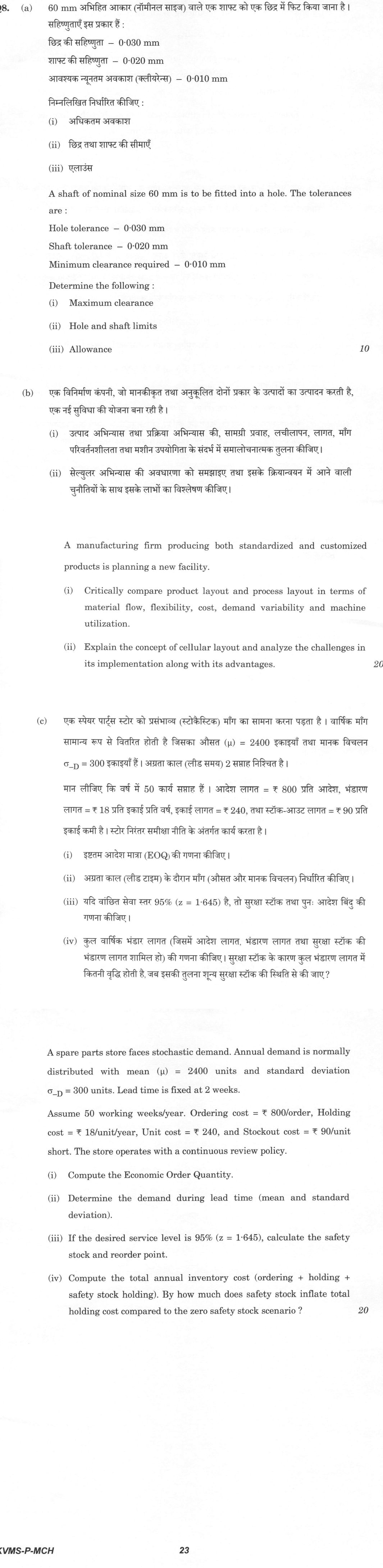
(a) A shaft of nominal size 60 mm is to be fitted into a hole. The tolerances are : Hole tolerance – 0·030 mm Shaft tolerance –…
A shaft of nominal size 60 mm is to be fitted into a hole. The tolerances are : Hole tolerance – 0·030 mm Shaft tolerance – 0·020 mm Minimum clearance required – 0·010 mm Determine the following : Maximum clearance
Hole and shaft limits
Allowance 10 marks
A manufacturing company, which produces both standardised and customised products, is planning a new facility. Compare analytically product layout and process layout with respect to material flow, flexibility, cost, demand variability and machine utilisation.
Explain the concept of cellular layout and analyse its benefits along with the challenges faced in its implementation. 20 marks
A spare parts store faces stochastic demand. Annual demand is normally distributed with mean (μ) = 2400 units and standard deviation σ_D = 300 units. Lead time is fixed at 2 weeks.
Assume 50 working weeks/year. Ordering cost = ₹ 800/order, Holding cost = ₹ 18/unit/year, Unit cost = ₹ 240, and Stockout cost = ₹ 90/unit short. The store operates with a continuous review policy.
Compute the Economic Order Quantity.
Determine the demand during lead time (mean and standard deviation).
If the desired service level is 95% (z = 1·645), calculate the safety stock and reorder point.
Compute the total annual inventory cost (ordering + holding + safety stock holding). By how much does safety stock inflate total holding cost compared to the zero safety stock scenario ? 20 marks
हिंदी में प्रश्न पढ़ें
60 mm अभिहित आकार (नॉमिनल साइज़) वाले एक शाफ्ट को एक छिद्र में फिट किया जाना है। सहिष्णुताएँ इस प्रकार हैं : छिद्र की सहिष्णुता – 0·030 mm शाफ्ट की सहिष्णुता – 0·020 mm आवश्यक न्यूनतम अवकाश (क्लीयरेन्स) – 0·010 mm निम्नलिखित निर्धारित कीजिए : अधिकतम अवकाश
छिद्र तथा शाफ्ट की सीमाएँ
एलाउंस (10 अंक)
एक विनिर्माण कंपनी, जो मानकीकृत तथा अनुकूलित दोनों प्रकार के उत्पादों का उत्पादन करती है, एक नई सुविधा की योजना बना रही है। उत्पाद अभिन्यास तथा प्रक्रिया अभिन्यास की, सामग्री प्रवाह, लचीलापन, लागत, माँग परिवर्तनशीलता तथा मशीन उपयोगिता के संदर्भ में समालोचनात्मक तुलना कीजिए।
सेल्युलर अभिन्यास की अवधारणा को समझाइए तथा इसके क्रियान्वयन में आने वाली चुनौतियों के साथ इसके लाभों का विश्लेषण कीजिए। (20 अंक)
एक स्पेयर पार्ट्स स्टोर को स्टोकेस्टिक माँग का सामना करना पड़ता है। वार्षिक माँग सामान्य रूप से वितरित होती है जिसका माध्य (μ) = 2400 इकाई तथा मानक विचलन σ_D = 300 इकाई है। लीड टाइम 2 सप्ताह नियत है।
मान लीजिए 50 कार्य-सप्ताह/वर्ष हैं। ऑर्डरिंग लागत = ₹ 800/ऑर्डर, धारण लागत = ₹ 18/इकाई/वर्ष, इकाई लागत = ₹ 240, तथा स्टॉकआउट लागत = ₹ 90/इकाई कमी। स्टोर सतत पुनरीक्षण नीति के साथ कार्य करता है।
आर्थिक ऑर्डर मात्रा की गणना कीजिए।
लीड टाइम के दौरान माँग (माध्य तथा मानक विचलन) निर्धारित कीजिए।
यदि वांछित सेवा स्तर 95% (z = 1·645) है, तो सुरक्षा स्टॉक तथा पुनःऑर्डर बिंदु की गणना कीजिए।
कुल वार्षिक इन्वेंटरी लागत (ऑर्डरिंग + धारण + सुरक्षा स्टॉक धारण) की गणना कीजिए। शून्य सुरक्षा स्टॉक परिदृश्य की तुलना में सुरक्षा स्टॉक कुल धारण लागत को कितना बढ़ा देता है? (20 अंक)
Model answer
Drafted with AI by UPSC Answer Check against this question's marking rubric, to the expected length. UPSC does not publish answers for Mains — this is one way to score well, not an official key. How we build rubrics and answers.
(a) Limits and fits for a 60 mm shaft and hole (10 marks)
Data: nominal size 60 mm, hole tolerance T_h = 0.030 mm, shaft tolerance T_s = 0.020 mm, and minimum clearance 0.010 mm. The hole-basis system is used, so the lower limit of the hole is the basic size.
(ii) Limits.
- Hole: lower limit 60.000 mm, upper limit 60.000 + 0.030 = 60.030 mm.
- Shaft: the upper limit is the smallest hole minus the minimum clearance, 60.000 − 0.010 = 59.990 mm, and the lower limit is 59.990 − 0.020 = 59.970 mm.
(i) Maximum clearance. Largest hole − smallest shaft = 60.030 − 59.970 = 0.060 mm. As a check, 0.010 + 0.030 + 0.020 = 0.060 mm.
(iii) Allowance. The allowance is the intentional difference between the smallest hole and the largest shaft, that is the tightest fit: 60.000 − 59.990 = +0.010 mm (positive, a clearance fit).
The maximum clearance of 0.060 mm does not depend on the choice of basis. (In a shaft-basis system, the shaft would be 60.000/59.980 and the hole 60.010/60.040.)
(b) Facility layout for standardised and customised products (20 marks)
(i) Product layout and process layout compared.
- Material flow: in a product layout, machines are arranged in the sequence of operations, so flow is a smooth, short, linear path with little handling and low work-in-process. In a process layout, similar machines are grouped by function, so parts follow long, criss-crossing routes with much handling, queues and backtracking.
- Flexibility: a product layout is rigid, since it is dedicated to one product or a narrow range, and a change of design means re-laying or re-balancing the line. A process layout is flexible in product mix, routing and design, because general-purpose machines and skilled workers can do many jobs.
- Cost: the product layout needs a large investment in special-purpose equipment and material-handling systems, but the unit cost is low at high volume because of low handling, low inventory and low labour skill. The process layout has a lower investment, but a higher unit cost because of handling, set-ups, work-in-process and more supervision.
- Demand variability: a product layout suits stable, high, predictable demand, and it loses money if demand falls or the product mix changes. A process layout copes with variable demand and a varying mix, since load can be shifted between machines.
- Machine utilisation: in a product layout, utilisation is high only if the line is balanced and demand fills it, and a breakdown stops the whole line. In a process layout, each machine can be used for many jobs, but flow inefficiency and set-ups cut real productive time, and utilisation of individual machines is often 40–60%.
Overall, the product layout is the choice for the standardised products at high volume, and the process layout for the customised products at low volume. A firm making both needs a hybrid.
(ii) Cellular layout. In a cellular layout (based on group technology), parts with similar shape, size or processing are grouped into part families, and the machines needed to complete a family are grouped into a cell placed together. Each cell is a small process-focused unit that behaves like a mini product line for one family. It sits between the two layouts above and suits a mix of standard and customised parts, with the high-volume standard families in dedicated cells or lines.
Advantages.
- Reduced set-up time, since parts in a family need similar tooling and fixtures.
- Shorter travel distances, lower work-in-process, shorter throughput time and lead time.
- Simple scheduling and control, and improved quality, since defects are spotted quickly.
- Team responsibility, multi-skilled workers and better morale.
- Reasonable flexibility combined with much of the efficiency of a product layout.
Challenges.
- Forming part families and cells is difficult and takes time (classification and coding, production flow analysis, clustering methods), and some parts do not fit any family (exceptional parts, bottleneck machines shared between cells).
- Machines may need to be duplicated, and some machines are under-used within a cell, which raises investment and lowers utilisation.
- Loss of flexibility if the product mix or demand changes, since the cells are built round today's families and load between cells may be unbalanced.
- Re-layout cost and disruption of production, and workers need cross-training, teamwork skills and a changed pay and supervision system.
- The management must change its ways, including cell-based performance measures and maintenance.
(c) Continuous-review (Q, R) inventory system (20 marks)
Data: D = 2400 units/year (σ_D = 300 units/year), lead time L = 2 weeks, 50 weeks/year, S = ₹800 per order, h = ₹18/unit/year, unit cost ₹240 and stock-out cost ₹90/unit.
(i) EOQ. Q* = √(2DS/h) = √(2 × 2400 × 800/18) = √213 333 = 462 units (461.9).
(ii) Demand during lead time. The weekly mean demand is 2400/50 = 48 units and the weekly standard deviation is 300/√50 = 42.43 units.
- Mean: μ_L = 48 × 2 = 96 units.
- Standard deviation: σ_L = 42.43 × √2 = 300 √(2/50) = 60 units.
(iii) Safety stock and reorder point. For a 95% service level, z = 1.645:
- Safety stock SS = z σ_L = 1.645 × 60 = 98.7 ≈ 99 units.
- Reorder point R = μ_L + SS = 96 + 98.7 = 194.7 ≈ 195 units.
The policy is therefore to order 462 units whenever the inventory position falls to 195 units. (The stock-out cost is not needed here, because the service level is specified, and the purchase cost of 2400 × 240 = ₹5,76,000 does not vary with the policy.)
(iv) Total annual inventory cost.
- Ordering cost = (D/Q) S = (2400/461.9) × 800 = 5.196 × 800 = ₹4157.
- Cycle-stock holding cost = (Q/2) h = 230.9 × 18 = ₹4157.
- Safety-stock holding cost = SS × h = 98.7 × 18 = ₹1777.
Total = 4157 + 4157 + 1777 = ₹10 090 per year.
Effect of safety stock. Without safety stock, the holding cost is ₹4157, and with it, it is 4157 + 1777 = ₹5934. So the safety stock adds ₹1777 a year, which inflates the holding cost by 42.7% (and the total cost of ₹8314 without safety stock by 21.4%). This is the price of protecting the store against stock-outs during the lead time.
How this answer will be evaluated
Evaluation rubric
Each sub-part is marked on its own, against the marks and word limit printed on the paper.
- (a) For a 60 mm shaft and hole with T_h = 0.030 mm, T_s = 0.020 mm and minimum clearance 0.010 mm, find (i) maximum clearance, (ii) hole and shaft limits, (iii) allowance (10 marks). 10 marks
Must cover
- Hole limits 60.000 and 60.030 mm (hole basis)
- Shaft limits 59.970 and 59.990 mm
- Maximum clearance 0.060 mm
- Allowance 0.010 mm
Loses marks
- Taking allowance as the maximum clearance.
- Shaft limits above the hole lower limit.
Earns more
- Check 0.010 + 0.030 + 0.020 = 0.060 mm.
- Hole basis stated.
Extra mark
- Shaft-basis alternative with the same maximum clearance
- (b) Compare product and process layouts on material flow, flexibility, cost, demand variability and machine utilisation; explain cellular layout with its advantages and implementation challenges (20 marks). 20 marks
Must cover
- Product layout versus process layout compared on all five named criteria
- Recommendation matching layout to standardised and customised products
- Cellular layout concept: part families, group technology, machine cells
- Cell advantages (set-up, WIP, lead time, quality) and challenges (family formation, duplication, inflexibility, re-layout cost)
Loses marks
- Comparing fewer than the five criteria.
- Listing advantages without any challenges.
Earns more
- Each criterion supported with a reason.
- Hybrid layout for a firm with both product types.
Extra mark
- Methods for cell formation such as production flow analysis
- (c) For the (Q, R) system with D = 2400, σ_D = 300, L = 2 weeks, S = ₹800, h = ₹18, z = 1.645, find (i) EOQ, (ii) lead-time demand mean and standard deviation, (iii) safety stock and reorder point, (iv) total cost and inflation of holding cost (20 marks). 20 marks
Must cover
- EOQ = 462 units
- Lead-time demand mean 96 and standard deviation 60 units
- Safety stock ≈ 99 units and reorder point ≈ 195 units
- Total cost ≈ ₹10 090 and holding cost inflated by 42.7% because of the safety stock
Loses marks
- Using annual σ_D as the lead-time deviation.
- Leaving safety-stock holding cost out of the total.
Earns more
- σ_L computed as 300√(2/50), not 300 × 2.
- Three cost components computed separately.
Extra mark
- Note that unit cost and stock-out cost are not needed
What "Calculate" is asking you to do
Apply the standard formula or schedule to data the question has already supplied — a table of readings, cost records, a balance sheet — and produce the number. The method is rarely in doubt; the marks sit in the named intermediate quantities, each of which has to appear as a labelled line.
Structure that answers it
Data as given → formula or standard treatment, named → substitution → each intermediate, labelled → result with units
Where marks are lost
Omitting an intermediate the marking scheme pays for separately, or rounding at an intermediate line so the final figure drifts. In commerce and accountancy, any figure in a statement that no numbered working note supports is treated as unearned.
Practice this exact question
Write your answer and it is marked point by point against the model answer above — what you covered, what you missed, what you got wrong.
Evaluate my answer →More from Mechanical Engineering 2026 Paper I
- Q5 (a) A cylindrical workpiece of 60 mm diameter is turned down to 50 mm over a length of 12…
- Q6 (a) A strip of width 250 mm is reduced from 30 mm to 20 mm thickness in a rolling mill of…
- Q7 (a) (i) In an orthogonal cutting operation, the following data are obtained : Cutting for…
- Q8 (a) A shaft of nominal size 60 mm is to be fitted into a hole. The tolerances are : Hole…