Paper I — Q6
(a) A strip of width 250 mm is reduced from 30 mm to 20 mm thickness in a rolling mill of roll radius 400 mm. Considering…
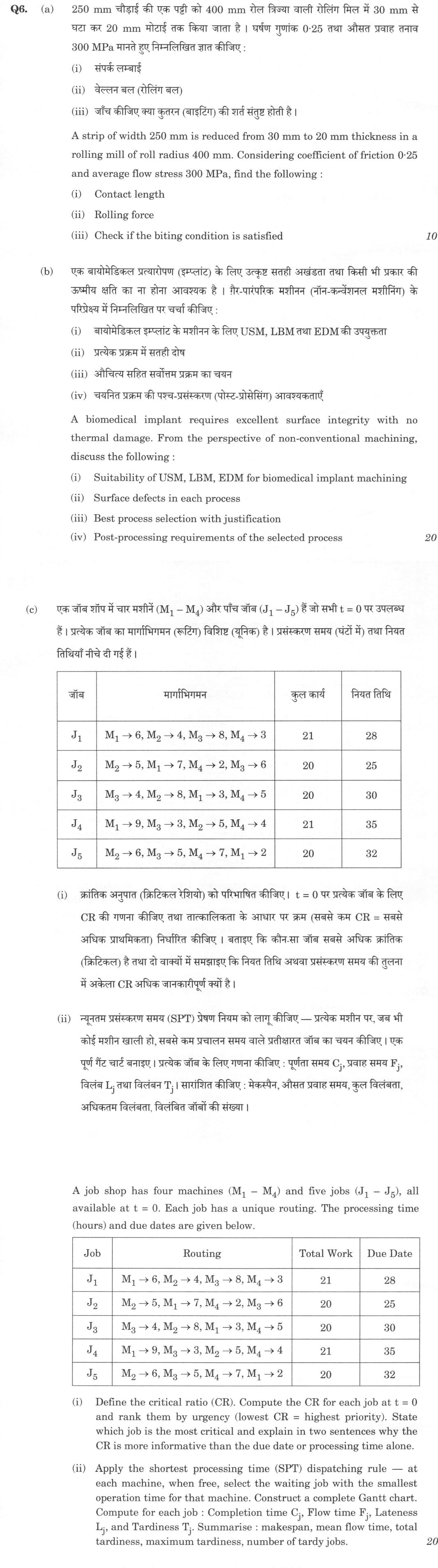
A strip of width 250 mm is reduced from 30 mm to 20 mm thickness in a rolling mill of roll radius 400 mm. Considering coefficient of friction 0·25 and average flow stress 300 MPa, find the following : Contact length
Rolling force
Check if the biting condition is satisfied 10 marks
A biomedical implant requires excellent surface integrity with no thermal damage. From the perspective of non-conventional machining, discuss the following : Suitability of USM, LBM, EDM for biomedical implant machining
Surface defects in each process
Best process selection with justification
Post-processing requirements of the selected process 20 marks
In a job shop there are four machines (M₁ – M₄) and five jobs (J₁ – J₅) which are all available at t = 0. The routing of each job is unique. The processing times (in hours) and due dates are given below.
Job | Routing | Total work | Due date J₁ | M₁ → 6, M₂ → 4, M₃ → 8, M₄ → 3 | 21 | 28 J₂ | M₂ → 5, M₁ → 7, M₄ → 2, M₃ → 6 | 20 | 25 J₃ | M₃ → 4, M₂ → 8, M₁ → 3, M₄ → 5 | 20 | 30 J₄ | M₁ → 9, M₃ → 3, M₂ → 5, M₄ → 4 | 21 | 35 J₅ | M₂ → 6, M₃ → 5, M₄ → 7, M₁ → 2 | 20 | 32 Define Critical Ratio (CR). Compute CR for each job at t = 0 and determine the sequence on the basis of urgency (lowest CR = highest priority). State which job is the most critical and explain in two sentences why CR alone is more informative than due date or processing time alone.
Apply the Shortest Processing Time (SPT) dispatching rule — on each machine, whenever a machine is free, select the waiting job with the shortest operation time. Construct a complete Gantt chart. For each job compute: completion time Cⱼ, flow time Fⱼ, lateness Lⱼ and tardiness Tⱼ. Summarise: makespan, average flow time, total tardiness, maximum tardiness, number of tardy jobs. 20 marks
हिंदी में प्रश्न पढ़ें
250 mm चौड़ाई की एक पट्टी को 400 mm रोल त्रिज्या वाली रोलिंग मिल में 30 mm से घटा कर 20 mm मोटाई तक किया जाता है । घर्षण गुणांक 0·25 तथा औसत प्रवाह तनाव 300 MPa मानते हुए निम्नलिखित ज्ञात कीजिए : संपर्क लंबाई
वेल्लन बल (रोलिंग बल)
जाँच कीजिए क्या कुतरन (बाइटिंग) की शर्त संतुष्ट होती है । (10 अंक)
एक बायोमेडिकल प्रत्यारोपण (इम्प्लांट) के लिए उत्कृष्ट सतही अखंडता तथा किसी भी प्रकार की ऊष्मीय क्षति का न होना आवश्यक है । गैर-पारंपरिक मशीनिंग (नॉन-कन्वेंशनल मशीनिंग) के परिप्रेक्ष्य में निम्नलिखित पर चर्चा कीजिए : बायोमेडिकल इम्प्लांट के मशीनन के लिए USM, LBM तथा EDM की उपयुक्तता
प्रत्येक प्रक्रम में सतही दोष
औचित्य सहित सर्वोत्तम प्रक्रम का चयन
चयनित प्रक्रम की पश्च-प्रसंस्करण (पोस्ट-प्रोसेसिंग) आवश्यकताएँ (20 अंक)
एक जॉब शॉप में चार मशीनें (M₁ – M₄) और पाँच जॉब (J₁ – J₅) हैं जो सभी t = 0 पर उपलब्ध हैं। प्रत्येक जॉब का मार्गाभिगमन (रूटिंग) विशिष्ट (यूनिक) है। प्रसंस्करण समय (घंटों में) तथा नियत तिथियाँ नीचे दी गई हैं।
जॉब | मार्गाभिगमन | कुल कार्य | नियत तिथि J₁ | M₁ → 6, M₂ → 4, M₃ → 8, M₄ → 3 | 21 | 28 J₂ | M₂ → 5, M₁ → 7, M₄ → 2, M₃ → 6 | 20 | 25 J₃ | M₃ → 4, M₂ → 8, M₁ → 3, M₄ → 5 | 20 | 30 J₄ | M₁ → 9, M₃ → 3, M₂ → 5, M₄ → 4 | 21 | 35 J₅ | M₂ → 6, M₃ → 5, M₄ → 7, M₁ → 2 | 20 | 32 क्रांतिक अनुपात (क्रिटिकल रेशियो) को परिभाषित कीजिए। t = 0 पर प्रत्येक जॉब के लिए CR की गणना कीजिए तथा तात्कालिकता के आधार पर क्रम (सबसे कम CR = सबसे अधिक प्राथमिकता) निर्धारित कीजिए। बताइए कि कौन-सा जॉब सबसे अधिक क्रांतिक (क्रिटिकल) है तथा दो वाक्यों में समझाइए कि नियत तिथि अथवा प्रसंस्करण समय की तुलना में अकेला CR अधिक जानकारीपूर्ण क्यों है।
न्यूनतम प्रसंस्करण समय (SPT) प्रेषण नियम को लागू कीजिए — प्रत्येक मशीन पर, जब भी कोई मशीन खाली हो, सबसे कम प्रचालन समय वाले प्रतीक्षारत जॉब का चयन कीजिए। एक पूर्ण गैंट चार्ट बनाइए। प्रत्येक जॉब के लिए गणना कीजिए : पूर्णता समय Cⱼ, प्रवाह समय Fⱼ, विलंब Lⱼ तथा विलंबन Tⱼ। सारांशित कीजिए : मेक्स्पैन, औसत प्रवाह समय, कुल विलंबता, अधिकतम विलंबता, विलंबित जॉबों की संख्या। (20 अंक)
Model answer
Drafted with AI by UPSC Answer Check against this question's marking rubric, to the expected length. UPSC does not publish answers for Mains — this is one way to score well, not an official key. How we build rubrics and answers.
(a) Flat rolling of a strip (10 marks)
Data: width w = 250 mm, h₀ = 30 mm, h_f = 20 mm, roll radius R = 400 mm, μ = 0.25 and average flow stress Y = 300 MPa. The draft is Δh = 30 − 20 = 10 mm.
(i) Contact length. L = √(R Δh) = √(400 × 10) = 63.2 mm.
(ii) Rolling force. F = Y L w = 300 × 63.25 × 250 = 4.74 × 10⁶ N ≈ 4.74 MN. This uses the average flow stress over the contact area and ignores the extra force needed for friction.
(iii) Biting condition. The strip is drawn in by the rolls if μ ≥ tan α, where cos α = 1 − Δh/(2R) = 1 − 10/800 = 0.9875. So α = 9.07° and tan α = 0.160 (approximately √(Δh/R) = 0.158). Since μ = 0.25 > 0.160, biting is satisfied. The maximum draft possible for this friction is Δh_max = μ²R = 0.0625 × 400 = 25 mm, which is larger than the 10 mm taken.
(b) Non-conventional machining of a biomedical implant (20 marks)
(i) Suitability. An implant needs a sound, contamination-free surface with no thermal damage, since heat affected material can crack, corrode or shed particles in the body.
- USM (ultrasonic machining): material is removed mechanically by abrasive grains driven by a vibrating tool, with no heat or electrical effect. It suits hard, brittle, biocompatible materials such as zirconia, alumina, bioglass and hydroxyapatite, and it cuts non-conductors. Its material removal rate is low, and it is slow on ductile titanium and cobalt–chromium alloys.
- LBM (laser beam machining): removal is by melting and vaporisation. It is fast and flexible, but it is thermal, so it leaves damage on the surface of an implant.
- EDM (electrical discharge machining): removal is by spark erosion at 8000–12 000 °C. It cuts hard conductive metals (titanium alloys) accurately, but it is thermal and needs conductive material.
(ii) Surface defects.
- USM: embedded abrasive particles, small edge chipping at the exit, taper and overcut, a matt surface (Ra of about 0.4–1.6 μm), and possible micro-cracks in very brittle ceramics. There is no heat-affected zone and no recast layer, and the residual stress is compressive.
- LBM: a recast layer, heat-affected zone, micro-cracks, tensile residual stress, dross and spatter, taper, and oxidation (an oxygen-rich alpha case on titanium).
- EDM: a white (recast) layer with micro-cracks, a heat-affected zone, craters, tensile residual stress, and contamination from electrode material and carbon from the dielectric, which is a biocompatibility concern.
(iii) Best process. USM is the best of the three for this requirement, because it is a cold, purely mechanical process that leaves no recast layer, heat-affected zone or tensile residual stress, and it leaves no metallurgical change to the implant material. Its slow removal rate is acceptable for a small, high-value part. For tough metallic implants, rotary or ultrasonic-assisted machining can raise the rate. (Electrochemical machining, which is outside the three, is also thermal-damage free.)
(iv) Post-processing of the USM part.
- Thorough ultrasonic cleaning in solvent and water, to remove the abrasive slurry and any embedded grains.
- Light lapping, polishing or electropolishing to lower roughness and remove edge chips and micro-cracks, since roughness affects fatigue life and cell attachment.
- Deburring and edge finishing, and passivation of titanium or stainless steel (nitric or citric acid) to restore the protective oxide film.
- Inspection of dimensions, surface roughness and cracks (SEM or dye penetrant), followed by sterilisation (autoclave, gamma or ethylene oxide) and packaging.
(c) Job shop scheduling (20 marks)
(i) Critical ratio. The critical ratio is the time remaining to the due date divided by the remaining processing time: CR = (d − t)/(remaining work). CR < 1 means the job will be late, CR = 1 means it is just on time, and CR > 1 means it has slack.
At t = 0:
- J₁: 28/21 = 1.333
- J₂: 25/20 = 1.250
- J₃: 30/20 = 1.500
- J₄: 35/21 = 1.667
- J₅: 32/20 = 1.600
The priority order (lowest CR first) is J₂ (1.25) > J₁ (1.33) > J₃ (1.50) > J₅ (1.60) > J₄ (1.67). J₂ is the most critical job, although all CR values exceed 1, so none is yet late.
CR is more informative than the due date alone because it says how much work still has to fit in the time left, and than the processing time alone because it says how urgent the job is; it combines both in one dimensionless number that can be recomputed as time advances.
(ii) SPT dispatching. Rule: whenever a machine is free, it takes the waiting job with the shortest operation on it. The operations, as (start–end), are:
- M₁: J₁ (0–6), J₂ (6–13), J₄ (13–22), J₅ (23–25), J₃ (25–28)
- M₂: J₂ (0–5), J₅ (5–11), J₁ (11–15), J₃ (15–23), J₄ (25–30)
- M₃: J₃ (0–4), J₅ (11–16), J₂ (16–22), J₄ (22–25), J₁ (25–33)
- M₄: J₂ (13–15), J₅ (16–23), J₃ (28–33), J₁ (33–36), J₄ (36–40)
At t = 23, J₃ and J₅ both wait for M₁, and SPT selects J₅ (2 h) before J₃ (3 h). At t = 33, J₄ (4 h) and J₁ (3 h) both wait for M₄, and SPT selects J₁.

Job results. All jobs are released at t = 0, so F_j = C_j, L_j = C_j − d_j and T_j = max(0, L_j).
- J₁: C = 36, F = 36, L = +8, T = 8
- J₂: C = 22, F = 22, L = −3, T = 0
- J₃: C = 33, F = 33, L = +3, T = 3
- J₄: C = 40, F = 40, L = +5, T = 5
- J₅: C = 25, F = 25, L = −7, T = 0
Summary. Makespan = 40 h. Mean flow time = (36 + 22 + 33 + 40 + 25)/5 = 31.2 h. Total tardiness = 8 + 0 + 3 + 5 + 0 = 16 h. Maximum tardiness = 8 h (J₁). Number of tardy jobs = 3 (J₁, J₃, J₄).
How this answer will be evaluated
Evaluation rubric
Each sub-part is marked on its own, against the marks and word limit printed on the paper.
- (a) Flat rolling of a 250 mm wide strip from 30 to 20 mm with a 400 mm roll radius, μ = 0.25, Y = 300 MPa: (i) contact length, (ii) rolling force, (iii) check the biting condition (10 marks). 10 marks
Must cover
- Contact length L = √(RΔh) = 63.2 mm
- Rolling force F = Y L w ≈ 4.74 MN
- Biting condition μ ≥ tan α with α = 9.07°, tan α ≈ 0.16
- Conclusion that biting is satisfied (μ = 0.25 > 0.16, Δh_max = 25 mm)
Loses marks
- Using strip thickness instead of Δh in the contact length.
- Concluding that biting fails.
Earns more
- Draft Δh = 10 mm used correctly.
- Units of force consistent.
Extra mark
- Maximum possible draft μ²R
- (b) For biomedical implant machining with no thermal damage: (i) suitability of USM, LBM, EDM, (ii) surface defects of each, (iii) best process with justification, (iv) post-processing of the selected process (20 marks). 20 marks
Must cover
- Suitability of the three processes: mechanical USM against thermal LBM and EDM
- Surface defects: recast layer, heat-affected zone and micro-cracks in LBM and EDM, embedded abrasive and chipping in USM
- USM selected as best, justified by no thermal damage, no recast layer and compressive residual stress
- Post-processing of USM: ultrasonic cleaning, polishing, passivation and inspection or sterilisation
Loses marks
- Choosing LBM or EDM despite thermal damage.
- Giving post-processing without linking it to the defects.
Earns more
- Material limits of each process (brittle ceramics, conductors only).
- Reasons linking defects to implant performance.
Extra mark
- Mention of ECM or rotary ultrasonic machining as options
- (c) For the 5-job, 4-machine shop: (i) define critical ratio, compute it for each job, rank them and explain why CR is informative; (ii) simulate SPT dispatching, draw the Gantt chart and compute C_j, F_j, L_j, T_j and summary measures (20 marks). 20 marks
Must cover
- CR = (due date − now)/remaining work; values 1.333, 1.250, 1.500, 1.667, 1.600 with J₂ most critical
- SPT dispatching applied at every machine, including tie decisions at t = 23 and t = 33
- Gantt chart with completion times J₁ = 36, J₂ = 22, J₃ = 33, J₄ = 40, J₅ = 25
- Makespan 40, mean flow time 31.2, total tardiness 16, maximum tardiness 8, three tardy jobs
Loses marks
- Ranking by highest CR.
- A Gantt chart with overlaps or ignored job routing precedence.
Earns more
- L_j and T_j computed for each job.
- Two-sentence reason for CR being informative.
Extra mark
- Meaning of CR below and above 1
What "Solve" is asking you to do
Choose the method, then carry it through to a final answer. Identifying what kind of problem this is and why that method applies is the first thing marked; a correct figure arrived at invisibly earns almost nothing.
Structure that answers it
Given data and what is required → method chosen, with the reason it applies → set-up (equation, circuit, free body, trial balance) → working, step by step → answer with units and any condition of validity
Where marks are lost
Doing the middle steps mentally and writing only the result. In mathematics papers, a further loss comes from giving a decimal where the exact value in surds or fractions was wanted, or from skipping the justification a part explicitly asks for.
Practice this exact question
Write your answer and it is marked point by point against the model answer above — what you covered, what you missed, what you got wrong.
Evaluate my answer →More from Mechanical Engineering 2026 Paper I
- Q3 (a) (i) The acceleration of a particle along a straight line is defined by a = (2t – 9) m…
- Q4 (a) A simple beam is loaded as shown in the figure. Using the double-integration method,…
- Q5 (a) A cylindrical workpiece of 60 mm diameter is turned down to 50 mm over a length of 12…
- Q6 (a) A strip of width 250 mm is reduced from 30 mm to 20 mm thickness in a rolling mill of…
- Q7 (a) (i) In an orthogonal cutting operation, the following data are obtained : Cutting for…
- Q8 (a) A shaft of nominal size 60 mm is to be fitted into a hole. The tolerances are : Hole…