Paper I — Q5
(a) A cylindrical workpiece of 60 mm diameter is turned down to 50 mm over a length of 120 mm on a CNC lathe with cutting speed…
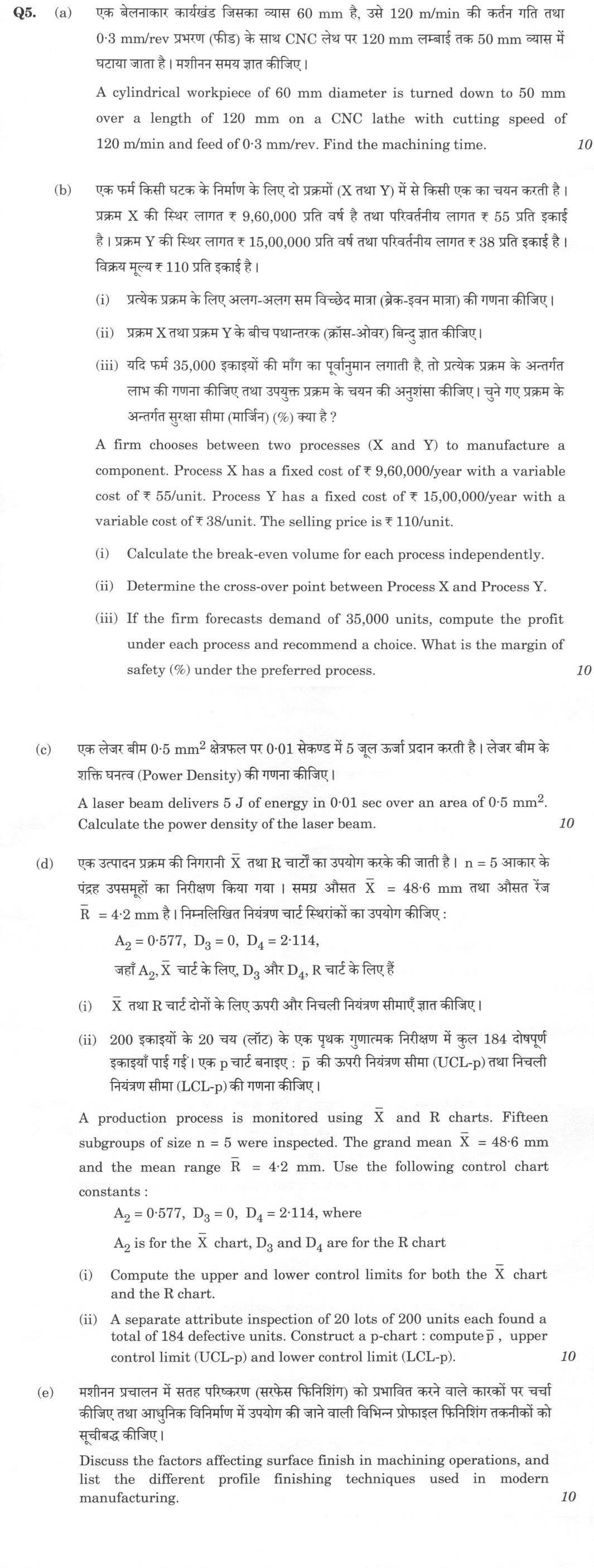
A cylindrical workpiece of 60 mm diameter is turned down to 50 mm over a length of 120 mm on a CNC lathe with cutting speed of 120 m/min and feed of 0·3 mm/rev. Find the machining time. 10 marks
A firm chooses between two processes (X and Y) to manufacture a component. Process X has a fixed cost of ₹ 9,60,000/year with a variable cost of ₹ 55/unit. Process Y has a fixed cost of ₹ 15,00,000/year with a variable cost of ₹ 38/unit. The selling price is ₹ 110/unit. Calculate the break-even volume for each process independently.
Determine the cross-over point between Process X and Process Y.
If the firm forecasts demand of 35,000 units, compute the profit under each process and recommend a choice. What is the margin of safety (%) under the preferred process. 10 marks
A laser beam delivers 5 J of energy in 0·01 sec over an area of 0·5 mm². Calculate the power density of the laser beam. 10 marks
A production process is monitored using X̄ and R charts. Fifteen subgroups of size n = 5 were inspected. The grand mean X̄ = 48·6 mm and the mean range R̄ = 4·2 mm. Use the following control chart constants : A₂ = 0·577, D₃ = 0, D₄ = 2·114, where A₂ is for the X̄ chart, D₃ and D₄ are for the R chart Compute the upper and lower control limits for both the X̄ chart and the R chart.
A separate attribute inspection of 20 lots of 200 units each found a total of 184 defective units. Construct a p-chart : compute p̄ , upper control limit (UCL-p) and lower control limit (LCL-p). 10 marks
Discuss the factors affecting surface finish in machining operations, and list the different profile finishing techniques used in modern manufacturing. 10 marks
हिंदी में प्रश्न पढ़ें
एक बेलनाकार कार्यखंड जिसका व्यास 60 mm है, उसे 120 m/min की कर्तन गति तथा 0·3 mm/rev प्रभरण (फीड) के साथ CNC लेथ पर 120 mm लम्बाई तक 50 mm व्यास में घटाया जाता है। मशीनन समय ज्ञात कीजिए। (10 अंक)
एक फर्म किसी घटक के निर्माण के लिए दो प्रक्रमों (X तथा Y) में से किसी एक का चयन करती है। प्रक्रम X की स्थिर लागत रु 9,60,000 प्रति वर्ष है तथा परिवर्तनीय लागत रु 55 प्रति इकाई है। प्रक्रम Y की स्थिर लागत रु 15,00,000 प्रति वर्ष तथा परिवर्तनीय लागत रु 38 प्रति इकाई है। विक्रय मूल्य रु 110 प्रति इकाई है। प्रत्येक प्रक्रम के लिए अलग-अलग सम विच्छेद मात्रा (ब्रेक-इवन मात्रा) की गणना कीजिए।
प्रक्रम X तथा प्रक्रम Y के बीच पथान्तरक (क्रॉस-ओवर) बिन्दु ज्ञात कीजिए।
यदि फर्म 35,000 इकाइयों की माँग का पूर्वानुमान लगाती है, तो प्रत्येक प्रक्रम के अन्तर्गत लाभ की गणना कीजिए तथा उपयुक्त प्रक्रम के चयन की अनुशंसा कीजिए। चुने गए प्रक्रम के अन्तर्गत सुरक्षा सीमा (मार्जिन) (%) क्या है? (10 अंक)
एक लेजर बीम 0·5 mm² क्षेत्रफल पर 0·01 सेकण्ड में 5 जूल ऊर्जा प्रदान करती है। लेजर बीम के शक्ति घनत्व (Power Density) की गणना कीजिए। (10 अंक)
एक उत्पादन प्रक्रम की निगरानी X̄ तथा R चार्टों का उपयोग करके की जाती है। n = 5 आकार के पंद्रह उपसमूहों का निरीक्षण किया गया। समग्र औसत X̄ = 48·6 mm तथा औसत रेंज R̄ = 4·2 mm है। निम्नलिखित नियंत्रण चार्ट स्थिरांकों का उपयोग कीजिए : A₂ = 0·577, D₃ = 0, D₄ = 2·114, जहाँ A₂, X̄ चार्ट के लिए, D₃ और D₄, R चार्ट के लिए हैं X̄ तथा R चार्ट दोनों के लिए ऊपरी और निचली नियंत्रण सीमाएँ ज्ञात कीजिए।
200 इकाइयों के 20 चय (लॉट) के एक पृथक गुणात्मक निरीक्षण में कुल 184 दोषपूर्ण इकाइयाँ पाई गईं। एक p चार्ट बनाइए : p̄ की ऊपरी नियंत्रण सीमा (UCL-p) तथा निचली नियंत्रण सीमा (LCL-p) की गणना कीजिए। (10 अंक)
मशीनन प्रचालन में सतह परिष्करण (सरफेस फिनिशिंग) को प्रभावित करने वाले कारकों पर चर्चा कीजिए तथा आधुनिक विनिर्माण में उपयोग की जाने वाली विभिन्न प्रोफाइल फिनिशिंग तकनीकों को सूचीबद्ध कीजिए। (10 अंक)
Model answer
Drafted with AI by UPSC Answer Check against this question's marking rubric, to the expected length. UPSC does not publish answers for Mains — this is one way to score well, not an official key. How we build rubrics and answers.
(a) Machining time for straight turning (10 marks)
Data: D = 60 mm, L = 120 mm, V = 120 m/min, f = 0.3 mm/rev. The pass reduces the diameter to 50 mm (depth of cut 5 mm), which is done in one pass.
Spindle speed: N = 1000 V/(πD) = 1000 × 120/(π × 60) = 636.6 rpm.
Feed rate: f_m = f N = 0.3 × 636.6 = 191 mm/min.
Machining time: t = L/(f N) = 120/191 = 0.628 min ≈ 37.7 s.
This ignores the approach and over-travel of the tool. The speed is set on the initial workpiece diameter (60 mm).
(b) Break-even and cross-over analysis of processes X and Y (10 marks)
Data: X has F = ₹9,60,000 and v = ₹55/unit, Y has F = ₹15,00,000 and v = ₹38/unit, and the price is ₹110/unit. The contribution per unit is 110 − 55 = ₹55 for X and 110 − 38 = ₹72 for Y.
(i) Break-even volumes.
- X: Q = F/(p − v) = 9,60,000/55 = 17,455 units (17,454.5).
- Y: Q = 15,00,000/72 = 20,834 units (20,833.3).
(ii) Cross-over point. The total costs are equal when 9,60,000 + 55Q = 15,00,000 + 38Q, so 17Q = 5,40,000 and Q = 31,765 units (31,764.7). Below this volume X has the lower total cost, and above it Y is cheaper because of its lower variable cost.
(iii) Profit at 35,000 units.
- X: 35,000 × 55 − 9,60,000 = 19,25,000 − 9,60,000 = ₹9,65,000.
- Y: 35,000 × 72 − 15,00,000 = 25,20,000 − 15,00,000 = ₹10,20,000.
Since 35,000 exceeds the cross-over volume of 31,765, process Y is recommended, with ₹55,000 more profit per year.
Margin of safety under Y. MoS = (35,000 − 20,833)/35,000 = 14,167/35,000 = 40.5%. (Under X it would be 50.1%, so Y is the riskier choice if demand falls below about 31,765 units.)
(c) Power density of a laser beam (10 marks)
Data: E = 5 J, t = 0.01 s, A = 0.5 mm² = 0.5 × 10⁻⁶ m².
Power: P = E/t = 5/0.01 = 500 W.
Power density = P/A = 500/(0.5 × 10⁻⁶) = 1 × 10⁹ W/m², that is 1000 W/mm² or 1 × 10⁵ W/cm² (1 GW/m²).
Comment. In laser beam machining the material is removed by melting and vaporisation of a small spot. What matters is the power density, not the energy alone: it must be high enough that the absorbed energy heats the spot faster than conduction carries it away into the bulk. Focusing the beam to a smaller area, or shortening the pulse at the same energy, raises the power density and confines the heat-affected zone.
(d) Control charts and a p-chart (10 marks)
(i) X̄ and R charts. Data: X̄̄ = 48.6 mm, R̄ = 4.2 mm, n = 5, A₂ = 0.577, D₃ = 0, D₄ = 2.114.
X̄ chart:
- UCL = X̄̄ + A₂R̄ = 48.6 + 0.577 × 4.2 = 48.6 + 2.423 = 51.02 mm.
- CL = 48.6 mm.
- LCL = X̄̄ − A₂R̄ = 48.6 − 2.423 = 46.18 mm.
R chart:
- UCL = D₄R̄ = 2.114 × 4.2 = 8.88 mm.
- CL = 4.2 mm.
- LCL = D₃R̄ = 0.
(ii) p-chart. Total inspected = 20 × 200 = 4000 units, with 184 defective:
p̄ = 184/4000 = 0.046 (4.6%).
The standard deviation for n = 200 is σ_p = √(p̄(1 − p̄)/n) = √(0.046 × 0.954/200) = 0.01481.
- UCL_p = p̄ + 3σ_p = 0.046 + 0.0444 = 0.0904 (9.04%).
- LCL_p = p̄ − 3σ_p = 0.046 − 0.0444 = 0.0016 (0.16%).
A lot with a fraction defective above 0.0904 signals an out-of-control condition.
(e) Surface finish in machining, and profile finishing techniques (10 marks)
Factors affecting surface finish.
- Cutting conditions: feed is the main one, since the theoretical peak-to-valley roughness is R_max = f²/(8r) (with r the tool nose radius), so a smaller feed gives a finer surface. Cutting speed matters through the built-up edge, which forms at low speed and roughens the surface, and depth of cut has a smaller effect.
- Tool: a larger nose radius, sharp edge, suitable rake and clearance angles, and low wear all improve finish. Tool material and coating affect adhesion.
- Workpiece: material, hardness and microstructure (ductile materials tear, and free-machining grades finish better).
- Machine and set-up: rigidity, vibration and chatter, spindle run-out, slide accuracy and work holding.
- Cutting fluid, which lubricates, cools and reduces the built-up edge, and the temperature and chip flow.
Profile finishing techniques in modern manufacturing.
- Conventional: fine grinding, honing, lapping, superfinishing, buffing and polishing, and burnishing.
- Advanced: abrasive flow machining, magnetic abrasive finishing, magnetorheological finishing, chemical mechanical polishing, electropolishing and chemical polishing, ultrasonic and laser polishing, and vibratory or barrel (mass) finishing.
How this answer will be evaluated
Evaluation rubric
Each sub-part is marked on its own, against the marks and word limit printed on the paper.
- (a) A 60 mm workpiece is turned to 50 mm over 120 mm on a CNC lathe at 120 m/min and 0.3 mm/rev; find the machining time (10 marks). 10 marks
Must cover
- N = 1000V/(πD) = 636.6 rpm
- Feed rate = fN ≈ 191 mm/min
- t = L/(fN) ≈ 0.628 min (37.7 s)
Loses marks
- Using V in m/s without conversion.
- Time in wrong units.
Earns more
- Diameter used for N stated.
- Units of min and s consistent.
Extra mark
- Note on approach and over-travel
- (b) Process X (₹9,60,000 fixed, ₹55 variable) versus Y (₹15,00,000 fixed, ₹38 variable) at price ₹110: (i) break-even volumes, (ii) cross-over point, (iii) profit at 35,000 units, recommendation and margin of safety (10 marks). 10 marks
Must cover
- Break-even X = 17,455 units and Y = 20,834 units
- Cross-over at 31,765 units from equating total costs
- Profits ₹9,65,000 (X) and ₹10,20,000 (Y) at 35,000 units
- Recommend Y, margin of safety about 40.5%
Loses marks
- Taking margin of safety over the break-even instead of actual sales.
- Wrong recommendation.
Earns more
- Contribution per unit 55 and 72 used.
- Reason for choosing Y given (demand above cross-over).
Extra mark
- MoS under X for comparison and risk remark
- (c) A laser beam delivers 5 J in 0.01 s over 0.5 mm²; calculate the power density (10 marks). 10 marks
Must cover
- Power = E/t = 500 W
- Area converted to 0.5 × 10⁻⁶ m²
- Power density = 10⁹ W/m² (1000 W/mm² or 10⁵ W/cm²)
- Comment on why power density governs material removal
Loses marks
- Error of a factor of 10⁶ from the area conversion.
- Reporting energy density in place of power density.
Earns more
- Unit conversions handled correctly.
- Result stated with units.
Extra mark
- Effect of focusing or shorter pulse
- (d) Compute the UCL and LCL of the X̄ and R charts, and the p̄, UCL and LCL of a p-chart (10 marks). 10 marks
Must cover
- X̄ chart limits 51.02 and 46.18 mm about 48.6 mm
- R chart UCL 8.88 mm, LCL 0
- p̄ = 184/4000 = 0.046
- p-chart UCL 0.0904 and LCL 0.0016
Loses marks
- Using n = 4000 for the p-chart sigma.
- Negative LCL not set to zero.
Earns more
- Formulas X̄̄ ± A₂R̄ and D₄R̄ stated.
- σ_p = √(p̄(1 − p̄)/n) with n = 200.
Extra mark
- Interpretation of a point above UCL
- (e) Discuss the factors affecting surface finish in machining and list the profile finishing techniques used in modern manufacturing (10 marks). 10 marks
Must cover
- Cutting parameters: feed, speed (built-up edge) and depth
- Tool factors: nose radius, geometry, wear
- Workpiece and machine factors: material, rigidity, vibration
- List of finishing techniques: honing, lapping, superfinishing, polishing, burnishing and advanced processes such as abrasive flow, magnetic abrasive and magnetorheological finishing
Loses marks
- Listing only factors or only techniques.
- Confusing finishing with roughing processes.
Earns more
- Theoretical roughness f²/(8r).
- Role of cutting fluid.
Extra mark
- Chemical mechanical polishing and laser polishing
What "Solve" is asking you to do
Choose the method, then carry it through to a final answer. Identifying what kind of problem this is and why that method applies is the first thing marked; a correct figure arrived at invisibly earns almost nothing.
Structure that answers it
Given data and what is required → method chosen, with the reason it applies → set-up (equation, circuit, free body, trial balance) → working, step by step → answer with units and any condition of validity
Where marks are lost
Doing the middle steps mentally and writing only the result. In mathematics papers, a further loss comes from giving a decimal where the exact value in surds or fractions was wanted, or from skipping the justification a part explicitly asks for.
Practice this exact question
Write your answer and it is marked point by point against the model answer above — what you covered, what you missed, what you got wrong.
Evaluate my answer →More from Mechanical Engineering 2026 Paper I
- Q2 (a) What is heat treatment ? What is its purpose ? Explain different heat treatment proce…
- Q3 (a) (i) The acceleration of a particle along a straight line is defined by a = (2t – 9) m…
- Q4 (a) A simple beam is loaded as shown in the figure. Using the double-integration method,…
- Q5 (a) A cylindrical workpiece of 60 mm diameter is turned down to 50 mm over a length of 12…
- Q6 (a) A strip of width 250 mm is reduced from 30 mm to 20 mm thickness in a rolling mill of…
- Q7 (a) (i) In an orthogonal cutting operation, the following data are obtained : Cutting for…
- Q8 (a) A shaft of nominal size 60 mm is to be fitted into a hole. The tolerances are : Hole…