Paper I — Q1
(a) A uniform rod of length L and mass m stands vertically upright on a rough floor and then tips over. What is the rod's angular…
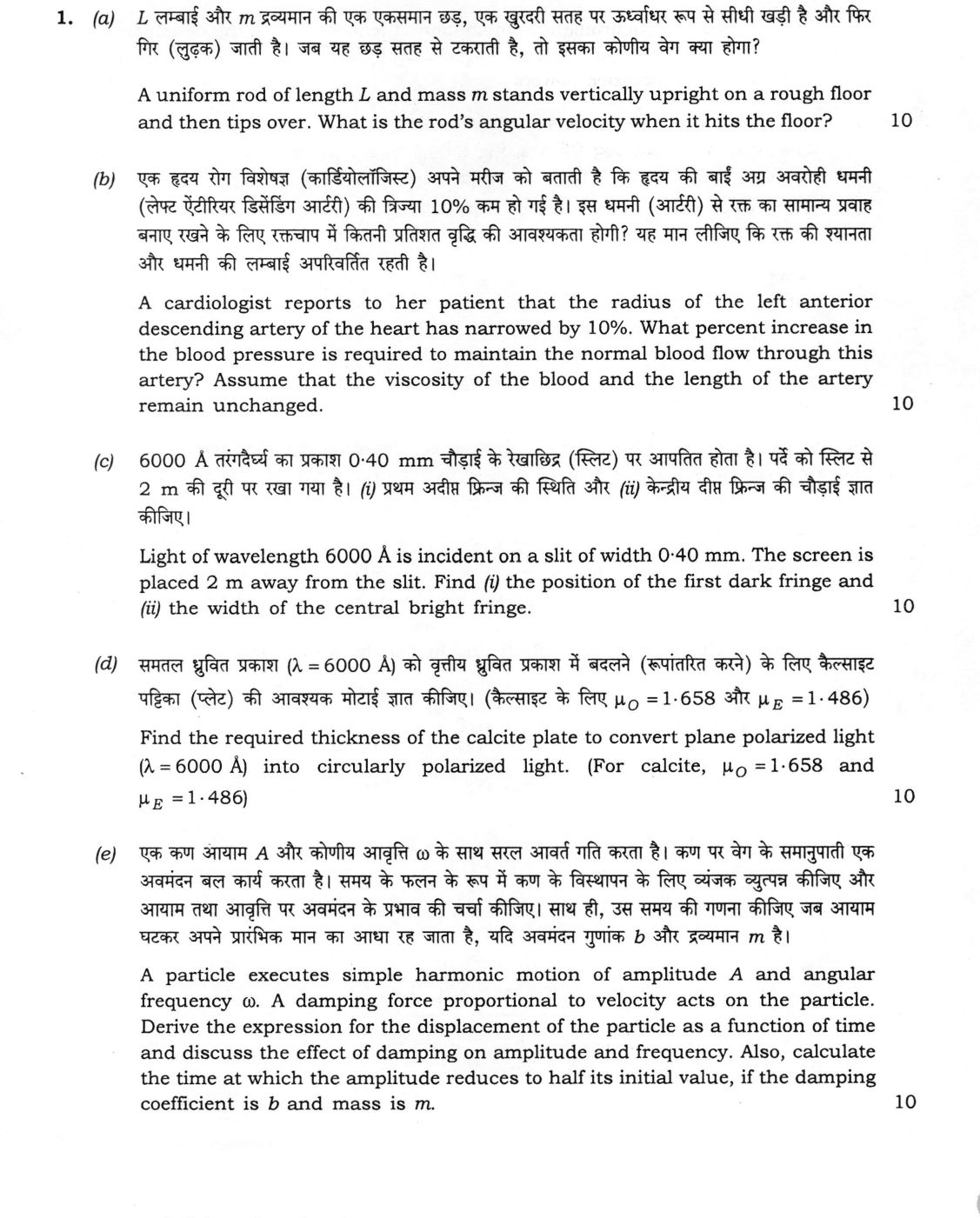
A uniform rod of length L and mass m stands vertically upright on a rough floor and then tips over. What is the rod's angular velocity when it hits the floor? 10 marks
A cardiologist reports to her patient that the radius of the left anterior descending artery of the heart has narrowed by 10%. What percent increase in the blood pressure is required to maintain the normal blood flow through this artery? Assume that the viscosity of the blood and the length of the artery remain unchanged. 10 marks
Light of wavelength 6000 Å is incident on a slit of width 0·40 mm. The screen is placed 2 m away from the slit. Find (i) the position of the first dark fringe and (ii) the width of the central bright fringe. 10 marks
Find the required thickness of the calcite plate to convert plane polarized light (λ = 6000 Å) into circularly polarized light. (For calcite, μ_O = 1·658 and μ_E = 1·486) 10 marks
A particle executes simple harmonic motion of amplitude A and angular frequency ω. A damping force proportional to velocity acts on the particle. Derive the expression for the displacement of the particle as a function of time and discuss the effect of damping on amplitude and frequency. Also, calculate the time at which the amplitude reduces to half its initial value, if the damping coefficient is b and mass is m. 10 marks
हिंदी में प्रश्न पढ़ें
L लम्बाई और m द्रव्यमान की एक एकसमान छड़, एक खुरदरी सतह पर ऊर्ध्वाधर रूप से सीधी खड़ी है और फिर गिर (लुढ़क) जाती है। जब यह छड़ सतह से टकराती है, तो इसका कोणीय वेग क्या होगा? (10 अंक)
एक हृदय रोग विशेषज्ञ (कार्डियोलॉजिस्ट) अपने मरीज को बताती है कि हृदय की बाईं अग्र अवरोही धमनी (लेफ्ट ऐंटीरियर डिसेंडिंग आर्टरी) की त्रिज्या 10% कम हो गई है। इस धमनी (आर्टरी) से रक्त का सामान्य प्रवाह बनाए रखने के लिए रक्तचाप में कितनी प्रतिशत वृद्धि की आवश्यकता होगी? यह मान लीजिए कि रक्त की श्यानता और धमनी की लम्बाई अपरिवर्तित रहती है। (10 अंक)
6000 Å तरंगदैर्ध्य का प्रकाश 0·40 mm चौड़ाई के रेखाछिद्र (स्लिट) पर आपतित होता है। पर्दे को स्लिट से 2 m की दूरी पर रखा गया है। (i) प्रथम अदीप्त फ्रिन्ज की स्थिति और (ii) केन्द्रीय दीप्त फ्रिन्ज की चौड़ाई ज्ञात कीजिए। (10 अंक)
समतल ध्रुवित प्रकाश (λ = 6000 Å) को वृत्तीय ध्रुवित प्रकाश में बदलने (रूपांतरित करने) के लिए कैल्साइट पट्टिका (प्लेट) की आवश्यक मोटाई ज्ञात कीजिए। (कैल्साइट के लिए μ_O = 1·658 और μ_E = 1·486) (10 अंक)
एक कण आयाम A और कोणीय आवृत्ति ω के साथ सरल आवर्त गति करता है। कण पर वेग के समानुपाती एक अवमंदन बल कार्य करता है। समय के फलन के रूप में कण के विस्थापन के लिए व्यंजक व्युत्पन्न कीजिए और आयाम तथा आवृत्ति पर अवमंदन के प्रभाव की चर्चा कीजिए। साथ ही, उस समय की गणना कीजिए जब आयाम घटकर अपने प्रारंभिक मान का आधा रह जाता है, यदि अवमंदन गुणांक b और द्रव्यमान m है। (10 अंक)
Model answer
Drafted with AI by UPSC Answer Check against this question's marking rubric, to the expected length. UPSC does not publish answers for Mains — this is one way to score well, not an official key. How we build rubrics and answers.
(a) Angular velocity of the toppling rod The floor is rough, so the lower end does not slip and the rod rotates about this fixed end. Moment of inertia about the end: I = mL²/3. The centre of mass falls from height L/2 to 0, i.e. through h = L/2. Energy conservation (rod starts from rest): mg(L/2) = ½Iω² = ½(mL²/3)ω² ω² = 3g/L ⇒ ω = √(3g/L) The result is independent of m; the tip strikes the floor with speed v = ωL = √(3gL).
(b) Pressure rise needed in a narrowed artery Poiseuille's law for steady laminar flow of a viscous fluid: Q = πΔP r⁴/(8ηl), where ΔP is the pressure difference across the artery of length l. With Q, η and l unchanged, ΔP ∝ r⁻⁴. r′ = 0.9r ⇒ ΔP′/ΔP = (1/0.9)⁴ = 1/0.6561 = 1.524 Required increase = (1.524 − 1) × 100% ≈ 52.4%.
(c) Single-slit diffraction Minima: a sin θ = nλ (n = 1, 2, …). For small θ, the nth minimum lies at yₙ = nDλ/a from the centre. λ = 6000 Å = 6.0 × 10⁻⁷ m, a = 0.40 mm = 4.0 × 10⁻⁴ m, D = 2 m. (i) y₁ = Dλ/a = (2 × 6.0 × 10⁻⁷)/(4.0 × 10⁻⁴) = 3.0 × 10⁻³ m = 3.0 mm on either side of the centre (θ₁ = λ/a = 1.5 × 10⁻³ rad). (ii) The central bright fringe extends between the first minima on both sides: width = 2Dλ/a = 6.0 mm.
(d) Thickness of a calcite quarter-wave plate Circularly polarised light needs equal O- and E-components (plane of vibration at 45° to the optic axis) with a phase difference of π/2, i.e. a path difference of λ/4: (μ_O − μ_E)t = λ/4 ⇒ t = λ/[4(μ_O − μ_E)] μ_O − μ_E = 1.658 − 1.486 = 0.172 t = 6.0 × 10⁻⁷/(4 × 0.172) = 8.72 × 10⁻⁷ m ≈ 0.872 μm This is the minimum thickness; plates giving odd multiples of λ/4, i.e. (2n + 1) × 8.72 × 10⁻⁷ m, also work.
(e) Damped harmonic oscillator With a damping force −bẋ, the equation of motion is mẍ + bẋ + mω²x = 0, i.e. ẍ + 2γẋ + ω²x = 0 with γ = b/2m. The trial solution x = e^αt gives α = −γ ± √(γ² − ω²). For weak damping (b < 2mω) the roots are complex and x(t) = A e^−bt/2m cos(ω′t + φ), ω′ = √(ω² − b²/4m²) Effect on amplitude: the amplitude decays exponentially, A(t) = A e^−bt/2m; the energy decays as e^−bt/m. Effect on frequency: ω′ < ω, so the oscillation is slightly slower (longer period). For b = 2mω (critical) or b > 2mω (overdamped) the motion is non-oscillatory. Half-amplitude time: e^−bt/2m = ½ ⇒ −bt/2m = −ln 2 ⇒ t₁/₂ = (2m/b) ln 2 ≈ 1.386 m/b
How this answer will be evaluated
Evaluation rubric
Each sub-part is marked on its own, against the marks and word limit printed on the paper.
- (a) Find the angular velocity of a uniform rod (length L, mass m) standing vertically on a rough floor at the instant it strikes the floor after tipping over. The rough floor means the lower end does not slip, so the rod rotates about that fixed contact point and mechanical energy is conserved. 10 marks
Must cover
- Rough floor ⇒ no slipping; rotation about the fixed lower end
- I about the end = mL²/3
- Energy conservation mg(L/2) = ½Iω² (centre of mass falls L/2)
- Result ω = √(3g/L), independent of m
Loses marks
- Using I = mL²/12 (about the centre) ⇒ ω = √(12g/L)
- Taking the centre-of-mass drop as L ⇒ ω = √(6g/L)
- Treating the floor as frictionless although it is stated to be rough
Earns more
- Tip speed at impact v = ωL = √(3gL)
- Labelled sketch showing the pivot and the centre of mass
- (b) Using Poiseuille's law for viscous laminar flow, compute the percentage increase in blood pressure (pressure difference across the artery) needed to keep the volume flow rate unchanged when the artery radius falls by 10%, with viscosity and length held fixed. 10 marks
Must cover
- Poiseuille's law Q = πΔP r⁴/(8ηl)
- At constant Q, η, l: ΔP ∝ r⁻⁴
- r′ = 0.9r ⇒ ΔP′/ΔP = 1/0.6561 = 1.524
- Required increase ≈ 52.4%
Loses marks
- Using an r² (area) dependence ⇒ 23.5%
- Taking r′ = 1.1r instead of 0.9r
- Reporting the ratio 1.52 as a '152% increase'
Earns more
- States the assumptions: steady laminar flow of a Newtonian fluid in a rigid cylindrical tube
- (c) For Fraunhofer single-slit diffraction with lambda = 6000 A, slit width a = 0.40 mm and screen distance D = 2 m, compute (i) the position of the first dark fringe (distance from the centre of the pattern) and (ii) the width of the central bright fringe. 10 marks
Must cover
- Minima condition a sin θ = nλ, n = 1, 2, …
- Small-angle position y₁ = Dλ/a
- (i) y₁ = 3.0 mm from the centre
- (ii) central fringe width = 2Dλ/a = 6.0 mm
Loses marks
- Giving the central width as Dλ/a = 3 mm (factor 2 missing)
- Using the secondary-maxima condition a sin θ = (2n + 1)λ/2 for a dark fringe
- Unit slips in converting Å or mm
Earns more
- Angular position θ₁ = λ/a = 1.5 × 10⁻³ rad
- SI conversions shown correctly
- (d) Compute the minimum thickness of a calcite plate (a quarter-wave plate) that converts plane polarized light of lambda = 6000 A into circularly polarized light, given mu_O = 1.658 and mu_E = 1.486. 10 marks
Must cover
- Quarter-wave plate: path difference λ/4 (phase difference π/2)
- Plane of vibration at 45° to the optic axis for equal amplitudes
- t = λ/[4(μ_O − μ_E)] with μ_O − μ_E = 0.172
- t = 8.72 × 10⁻⁷ m ≈ 0.872 μm
Loses marks
- Using the half-wave condition λ/2 ⇒ 1.74 μm
- Omitting the 45° condition (light would be elliptically polarised)
- Unit errors such as 0.872 mm
Earns more
- Notes that odd multiples of λ/4 also work, so 8.72 × 10⁻⁷ m is the minimum thickness
- (e) Set up and solve the damped-oscillator equation for a particle of mass m with a velocity-proportional damping force (coefficient b) to obtain x(t); discuss the effect of damping on amplitude and on frequency; and compute the time at which the amplitude falls to half its initial value. 10 marks
Must cover
- Equation mẍ + bẋ + kx = 0 with k = mω²
- Underdamped solution x = A e^{−bt/2m} cos(ω′t + φ), ω′ = √(ω² − b²/4m²), valid for b < 2mω
- Effects: amplitude decays exponentially; frequency is lowered (ω′ < ω)
- t₁/₂ = (2m/b) ln 2 ≈ 1.386 m/b
Loses marks
- Using e^{−bt/m} for the amplitude ⇒ t = (m/b) ln 2
- Stating that damping leaves the frequency unchanged
- Using log₁₀ 2 instead of ln 2
Earns more
- Mentions the critical (b = 2mω) and overdamped (b > 2mω) cases
- Energy decays as e^{−bt/m}; relaxation time 2m/b
What "Explain" is asking you to do
Make the working of something clear — what sets it off, what follows from what, and what it produces. Explain is the Commission's mechanism word: it dominates the technical papers and the “explain why” stems, where the marks sit in the causal chain and not in the label.
Structure that answers it
State what it is → the initiating condition → the chain of cause, step by step → an instance where it plays out → what the chain produces
Where marks are lost
Describing what something looks like instead of why it works that way. Naming the stages without linking them reads as description too.
Practice this exact question
Write your answer and it is marked point by point against the model answer above — what you covered, what you missed, what you got wrong.
Evaluate my answer →More from Physics 2026 Paper I
- Q1 (a) A uniform rod of length L and mass m stands vertically upright on a rough floor and t…
- Q2 (a) What is meant by achromatic combination of lenses? Derive the condition for achromati…
- Q3 (a) The energy of a photon is expressed as E = hν, where h is the Planck's constant and ν…
- Q4 (a) (i) In Newton's ring experiment, the space between planoconvex lens and glass plate i…