Paper I — Q4
(a) (i) In Newton's ring experiment, the space between planoconvex lens and glass plate is filled with a liquid of refractive…
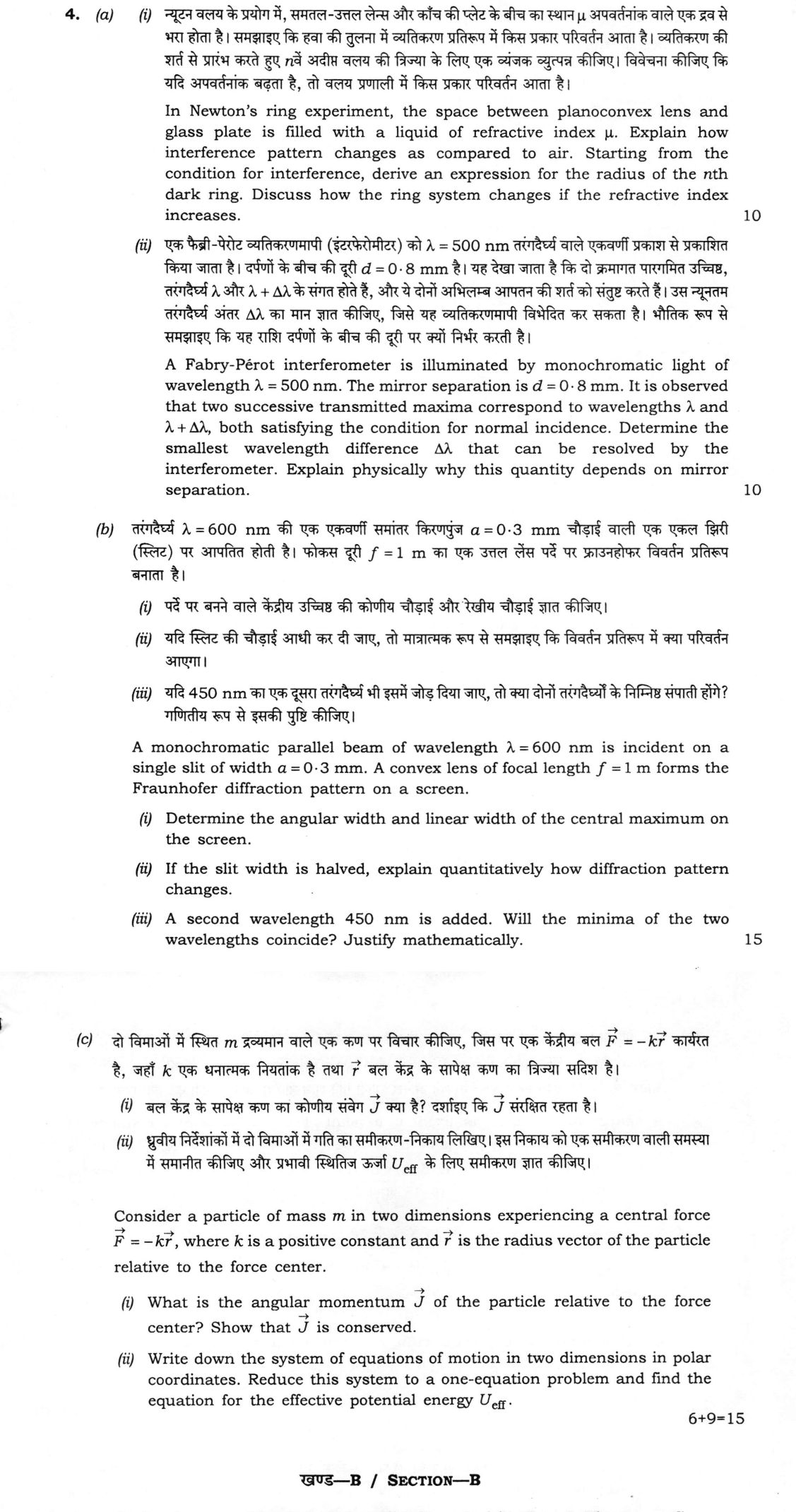
In Newton's ring experiment, the space between planoconvex lens and glass plate is filled with a liquid of refractive index μ. Explain how interference pattern changes as compared to air. Starting from the condition for interference, derive an expression for the radius of the nth dark ring. Discuss how the ring system changes if the refractive index increases. 10 marks
A Fabry-Pérot interferometer is illuminated by monochromatic light of wavelength λ = 500 nm. The mirror separation is d = 0·8 mm. It is observed that two successive transmitted maxima correspond to wavelengths λ and λ + Δλ, both satisfying the condition for normal incidence. Determine the smallest wavelength difference Δλ that can be resolved by the interferometer. Explain physically why this quantity depends on mirror separation. 10 marks
A monochromatic parallel beam of wavelength λ = 600 nm is incident on a single slit of width a = 0·3 mm. A convex lens of focal length f = 1 m forms the Fraunhofer diffraction pattern on a screen. Determine the angular width and linear width of the central maximum on the screen. If the slit width is halved, explain quantitatively how diffraction pattern changes. A second wavelength 450 nm is added. Will the minima of the two wavelengths coincide? Justify mathematically. 15 marks
Consider a particle of mass m in two dimensions experiencing a central force F⃗ = −k r⃗, where k is a positive constant and r⃗ is the radius vector of the particle relative to the force center.
What is the angular momentum J⃗ of the particle relative to the force center? Show that J⃗ is conserved.
Write down the system of equations of motion in two dimensions in polar coordinates. Reduce this system to a one-equation problem and find the equation for the effective potential energy U_eff. 15 marks
हिंदी में प्रश्न पढ़ें
न्यूटन वलय के प्रयोग में, समतल-उत्तल लेंस और काँच की प्लेट के बीच का स्थान μ अपवर्तनांक वाले एक द्रव से भरा होता है। समझाइए कि हवा की तुलना में व्यतिकरण प्रतिरूप में किस प्रकार परिवर्तन आता है। व्यतिकरण की शर्त से प्रारंभ करते हुए nवें अदीप्त वलय की त्रिज्या के लिए एक व्यंजक व्युत्पन्न कीजिए। विवेचना कीजिए कि यदि अपवर्तनांक बढ़ता है, तो वलय प्रणाली में किस प्रकार परिवर्तन आता है। (10 अंक)
एक फैब्रि-पेरोट व्यतिकरणमापी (इंटरफेरोमीटर) को λ = 500 nm तरंगदैर्ध्य वाले एकवर्णी प्रकाश से प्रकाशित किया जाता है। दर्पणों के बीच की दूरी d = 0·8 mm है। यह देखा जाता है कि दो क्रमागत पारगमित उच्चिष्ठ, तरंगदैर्ध्य λ और λ + Δλ के संगत होते हैं, और ये दोनों अभिलंब आपतन की शर्त को संतुष्ट करते हैं। उस न्यूनतम तरंगदैर्ध्य अंतर Δλ का मान ज्ञात कीजिए, जिसे यह व्यतिकरणमापी विभेदित कर सकता है। भौतिक रूप से समझाइए कि यह राशि दर्पणों के बीच की दूरी पर क्यों निर्भर करती है। (10 अंक)
तरंगदैर्ध्य λ = 600 nm की एक एकवर्णी समांतर किरणपुंज a = 0·3 mm चौड़ाई वाली एक एकल झिरी (स्लिट) पर आपतित होती है। फोकस दूरी f = 1 m का एक उत्तल लेंस पर्दे पर फ्राउनहोफर विवर्तन प्रतिरूप बनाता है। पर्दे पर बनने वाले केंद्रीय उच्चिष्ठ की कोणीय चौड़ाई और रेखीय चौड़ाई ज्ञात कीजिए। यदि स्लिट की चौड़ाई आधी कर दी जाए, तो मात्रात्मक रूप से समझाइए कि विवर्तन प्रतिरूप में क्या परिवर्तन आएगा। यदि 450 nm का एक दूसरा तरंगदैर्ध्य भी इसमें जोड़ दिया जाए, तो क्या दोनों तरंगदैर्ध्यों के निम्निष्ठ संपाती होंगे? गणितीय रूप से इसकी पुष्टि कीजिए। (15 अंक)
दो विमाओं में स्थित m द्रव्यमान वाले एक कण पर विचार कीजिए, जिस पर एक केंद्रीय बल F⃗ = −k r⃗ कार्यरत है, जहाँ k एक धनात्मक नियतांक है तथा r⃗ बल केंद्र के सापेक्ष कण का त्रिज्या सदिश है।
बल केंद्र के सापेक्ष कण का कोणीय संवेग J⃗ क्या है? दर्शाइए कि J⃗ संरक्षित रहता है।
ध्रुवीय निर्देशांकों में दो विमाओं में गति का समीकरण-निकाय लिखिए। इस निकाय को एक समीकरण वाली समस्या में समानीत कीजिए और प्रभावी स्थितिज ऊर्जा U_eff के लिए समीकरण ज्ञात कीजिए। (15 अंक)
Model answer
Drafted with AI by UPSC Answer Check against this question's marking rubric, to the expected length. UPSC does not publish answers for Mains — this is one way to score well, not an official key. How we build rubrics and answers.
(a) (i) Newton's rings with a liquid film With a liquid of refractive index μ in the gap, the optical path of the film becomes μ times its geometric path, so the pattern changes compared with air. At thickness t, the reflected rays have path difference 2μt + λ/2 (normal incidence; the λ/2 comes from the phase change of π at one of the two reflections, as long as μ lies below or above both glass indices consistently). Dark ring (destructive interference): 2μt + λ/2 = (2n + 1)λ/2 ⇒ 2μt = nλ, n = 0, 1, 2, … Geometry: for a lens of radius of curvature R, r² = 2Rt − t² ≈ 2Rt, so t = rₙ²/2R. 2μ(rₙ²/2R) = nλ ⇒ rₙ = √(nλR/μ), i.e. Dₙ² = 4nλR/μ.
Change compared with air (rₙ = √(nλR)): every ring shrinks by the factor 1/√μ, the rings come closer together and more rings are seen in the same field; the central spot stays dark (n = 0). If μ increases: the rings contract further (rₙ ∝ 1/√μ) and get more crowded. As μ approaches the refractive index of the glass, the reflections at the film surfaces weaken and the fringe contrast falls; at μ = μ_glass the rings disappear. The relation D²ₙ₊ₚ − D²ₙ = 4pλR/μ is used to measure μ.
(a) (ii) Fabry–Pérot: wavelength separation of successive maxima Transmitted maxima at normal incidence (air gap): 2d = mλ. Order: m = 2d/λ = (2 × 0.8 × 10⁻³)/(500 × 10⁻⁹) = 3200. Successive maxima satisfy 2d = mλ = (m − 1)(λ + Δλ) ⇒ Δλ = λ/(m − 1) ≈ λ/m = λ²/2d Δλ = (500 × 10⁻⁹)²/(2 × 0.8 × 10⁻³) = 1.56 × 10⁻¹⁰ m = 0.156 nm (1.56 Å) This is the wavelength interval between neighbouring transmitted orders (the free spectral range) set by the given data.
Why it depends on d: the phase difference between successive beams is δ = 4πd/λ, so dδ/dλ = −4πd/λ². A larger d makes the phase change faster with wavelength, so a smaller change of λ is needed to move from one maximum to the next (Δλ = λ²/2d) and the interference order m = 2d/λ is higher. The resolving power λ/δλ = mF (F = finesse, fixed by the mirror reflectivity) therefore rises with d, while the free spectral range shrinks.
(b) Single-slit Fraunhofer diffraction Minima: a sin θ = mλ, m = ±1, ±2, … (m = 0 is the central maximum).
(i) λ = 600 nm = 6.0 × 10⁻⁷ m, a = 0.3 mm = 3.0 × 10⁻⁴ m, f = 1 m. First minimum: θ₁ = λ/a = 2.0 × 10⁻³ rad Angular width of central maximum = 2λ/a = 4.0 × 10⁻³ rad Linear width on the screen in the focal plane = 2fλ/a = 2 × 1 × 2.0 × 10⁻³ = 4.0 × 10⁻³ m = 4.0 mm
(ii) Slit halved (a′ = 0.15 mm): angular width = 2λ/a′ = 8.0 × 10⁻³ rad and linear width = 8.0 mm, both doubled. All minima move out twice as far. The light through the slit is halved and the central peak intensity (I₀ ∝ a²) falls to one quarter.
(iii) Minima coincide if m₁λ₁ = m₂λ₂, i.e. m₁/m₂ = λ₂/λ₁ = 450/600 = 3/4. So the 3rd minimum of 600 nm coincides with the 4th minimum of 450 nm (3 × 600 = 4 × 450 = 1800 nm): sin θ = 1800 × 10⁻⁹/3.0 × 10⁻⁴ = 6.0 × 10⁻³, y = fθ = 6.0 mm from the centre (and again at 12 mm, 18 mm, …). The first minima (2.0 mm and 1.5 mm) do not coincide. So yes, some minima coincide: every (3k)th minimum of 600 nm with the (4k)th of 450 nm.
(c) Particle under the central force F = −kr (i) Angular momentum about the force centre: J = r × p = m(r × ṙ), of magnitude J = mr²θ̇, perpendicular to the plane of motion. dJ/dt = ṙ × mṙ + r × F = 0 + r × (−kr) = 0 Since the force is along r, its torque about the centre vanishes and J is conserved.
(ii) In polar coordinates, a = (r̈ − rθ̇²) r̂ + (rθ̈ + 2ṙθ̇) θ̂ and F = −kr r̂: Radial: m(r̈ − rθ̇²) = −kr Transverse: m(rθ̈ + 2ṙθ̇) = (m/r) d(r²θ̇)/dt = 0 ⇒ mr²θ̇ = J = constant Eliminate θ̇ = J/(mr²): mr̈ = −kr + J²/(mr³), a one-dimensional equation for r. Writing mr̈ = −dU_eff/dr with U(r) = ½kr²: U_eff(r) = ½kr² + J²/(2mr²) Energy: E = ½mṙ² + U_eff(r) is conserved. The J²/(2mr²) term is the centrifugal barrier; U_eff has a minimum (circular orbit) at r₀ = (J²/mk)¹/4.
How this answer will be evaluated
Evaluation rubric
Each sub-part is marked on its own, against the marks and word limit printed on the paper.
- (a)(i) Explain how the Newton's rings pattern changes when the air film between the plano-convex lens and the glass plate is replaced by a liquid of refractive index mu; derive, starting from the interference condition, the radius of the nth dark ring; and discuss the effect of increasing mu. 10 marks
Must cover
- Path difference 2μt + λ/2 ⇒ dark rings 2μt = nλ
- t = rₙ²/2R from the lens geometry
- rₙ = √(nλR/μ): rings shrink by 1/√μ compared with air, centre stays dark
- Higher μ: rings contract further and crowd; contrast falls as μ approaches the glass index
Loses marks
- rₙ = √(nλRμ) (rings predicted to expand)
- Radii scaling as 1/μ instead of 1/√μ
- Omitting the λ/2 phase change so that the centre is called bright
Earns more
- D²ₙ₊ₚ − D²ₙ = 4pλR/μ used to measure μ
- (a)(ii) For a Fabry-Perot interferometer with mirror separation d = 0.8 mm illuminated at lambda = 500 nm at normal incidence, determine the smallest resolvable wavelength difference Delta lambda (the separation of successive transmitted maxima, i.e. the free spectral range), and explain physically why this quantity depends on the mirror separation. 10 marks
Must cover
- Maxima at normal incidence: 2d = mλ; m = 2d/λ = 3200
- Successive orders: Δλ ≈ λ/m = λ²/2d
- Δλ = 1.56 × 10⁻¹⁰ m = 0.156 nm
- Dependence on d explained: phase 4πd/λ varies faster with λ for larger d; higher order, resolving power mF grows
Loses marks
- Using λ²/d or λ²/4d (wrong factor of 2)
- Order taken as d/λ = 1600
- Claiming resolution worsens as d increases
Earns more
- Identifies the result as the free spectral range and notes the finesse F (mirror reflectivity) sets the actual resolution limit λ/mF
- (b) For single-slit Fraunhofer diffraction with lambda = 600 nm, a = 0.3 mm and a lens of f = 1 m: (i) find the angular and linear widths of the central maximum; (ii) state quantitatively how the pattern changes if the slit width is halved; (iii) decide, with mathematical justification, whether the minima of 600 nm and 450 nm coincide. 15 marks
Must cover
- (i) Angular width 2λ/a = 4.0 × 10⁻³ rad; linear width 2fλ/a = 4.0 mm
- (ii) Halving a doubles the widths (8.0 × 10⁻³ rad, 8.0 mm); peak intensity falls to 1/4
- (iii) Condition m₁λ₁ = m₂λ₂ ⇒ m₁/m₂ = 3/4
- 3rd minimum of 600 nm coincides with the 4th of 450 nm at 6.0 mm (first minima do not)
Loses marks
- Central width taken as λ/a (half the correct value)
- Saying the pattern narrows when the slit is halved
- Answering (iii) 'no' without testing the ratio 3/4
Earns more
- Notes that coincidences repeat at 12 mm, 18 mm, …
- Notes total transmitted power is halved when a is halved
- (c) For a particle of mass m moving in two dimensions under the central force F = -k r (isotropic harmonic oscillator): (i) write the angular momentum J about the force centre and prove it is conserved; (ii) write the polar-coordinate equations of motion, reduce them to a single radial equation, and obtain the effective potential energy U_eff. 15 marks
Must cover
- J = r × p = mr²θ̇; torque r × F = 0 ⇒ J conserved
- Polar equations m(r̈ − rθ̇²) = −kr and d(mr²θ̇)/dt = 0
- Reduced equation mr̈ = −kr + J²/(mr³)
- U_eff(r) = ½kr² + J²/(2mr²)
Loses marks
- Writing J = mrθ̇
- Omitting the −mrθ̇² term in the radial equation
- Sign error giving U_eff = ½kr² − J²/(2mr²)
Earns more
- Energy E = ½mṙ² + U_eff conserved; circular-orbit minimum at r₀ = (J²/mk)^{1/4}
What "Discuss" is asking you to do
Lay the issue out from more than one side — how it arose, what is claimed for it, what is held against it, and where it now stands. UPSC attaches discuss to broad topics with several live dimensions, so coverage of the dimensions earns more than the strength of your opinion.
Structure that answers it
Set the issue up → the case as it is made → the case against → the dimension both sides leave out → where the balance now lies
Where marks are lost
Listing facts with no thread between them, or arguing one side throughout and calling it a discussion.
Practice this exact question
Write your answer and it is marked point by point against the model answer above — what you covered, what you missed, what you got wrong.
Evaluate my answer →More from Physics 2026 Paper I
- Q1 (a) A uniform rod of length L and mass m stands vertically upright on a rough floor and t…
- Q2 (a) What is meant by achromatic combination of lenses? Derive the condition for achromati…
- Q3 (a) The energy of a photon is expressed as E = hν, where h is the Planck's constant and ν…
- Q4 (a) (i) In Newton's ring experiment, the space between planoconvex lens and glass plate i…
- Q5 (a) Calculate the effective resistance of the following combination of resistances as sho…
- Q6 (a) Discuss the origin of hysteresis in ferromagnetic materials on the basis of domain th…
- Q7 (a) A gas has only two particles a and b. Show with the help of diagrams how these two pa…