Paper I — Q7
(a) A gas has only two particles a and b. Show with the help of diagrams how these two particles can be arranged in three energy…
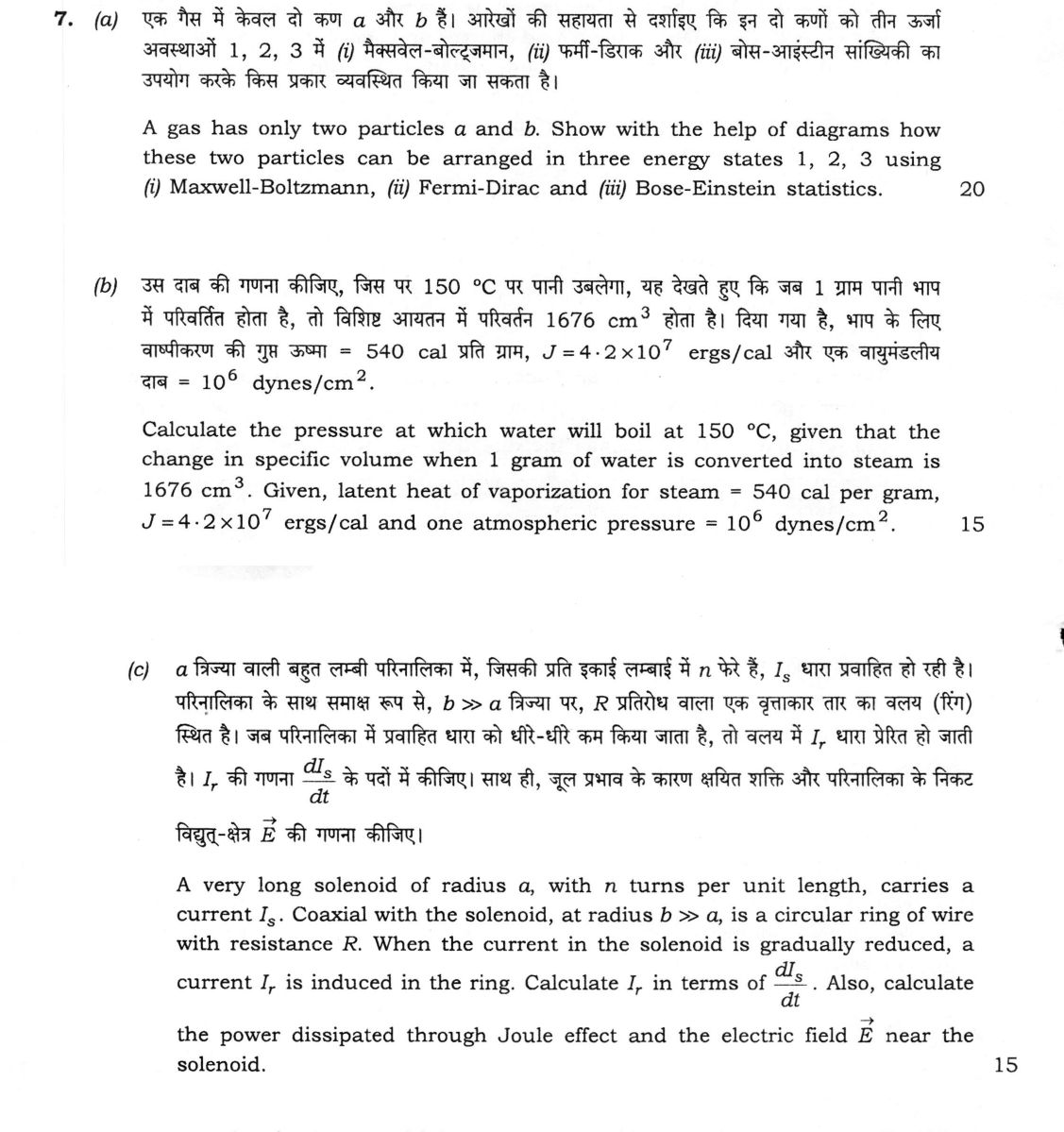
A gas has only two particles a and b. Show with the help of diagrams how these two particles can be arranged in three energy states 1, 2, 3 using (i) Maxwell-Boltzmann, (ii) Fermi-Dirac and (iii) Bose-Einstein statistics. 20 marks
Calculate the pressure at which water will boil at 150 °C, given that the change in specific volume when 1 gram of water is converted into steam is 1676 cm³. Given, latent heat of vaporization for steam = 540 cal per gram, J = 4·2×10⁷ ergs/cal and one atmospheric pressure = 10⁶ dynes/cm². 15 marks
A very long solenoid of radius a, with n turns per unit length, carries a current I_s. Coaxial with the solenoid, at radius b >> a, is a circular ring of wire with resistance R. When the current in the solenoid is gradually reduced, a current I_r is induced in the ring. Calculate I_r in terms of dI_s/dt. Also, calculate the power dissipated through Joule effect and the electric field E⃗ near the solenoid. 15 marks
हिंदी में प्रश्न पढ़ें
एक गैस में केवल दो कण a और b हैं। आरेखों की सहायता से दर्शाइए कि इन दो कणों को तीन ऊर्जा अवस्थाओं 1, 2, 3 में (i) मैक्सवेल-बोल्ट्ज़मान, (ii) फर्मी-डिराक और (iii) बोस-आइंस्टीन सांख्यिकी का उपयोग करके किस प्रकार व्यवस्थित किया जा सकता है। (20 अंक)
उस दाब की गणना कीजिए, जिस पर 150 °C पर पानी उबलेगा, यह देखते हुए कि जब 1 ग्राम पानी भाप में परिवर्तित होता है, तो विशिष्ट आयतन में परिवर्तन 1676 cm³ होता है। दिया गया है, भाप के लिए वाष्पीकरण की गुप्त ऊष्मा = 540 cal प्रति ग्राम, J = 4·2×10⁷ ergs/cal और एक वायुमंडलीय दाब = 10⁶ dynes/cm². (15 अंक)
a त्रिज्या वाली बहुत लम्बी परिनालिका में, जिसकी प्रति इकाई लम्बाई में n फेरे हैं, I_s धारा प्रवाहित हो रही है। परिनालिका के साथ समाक्ष रूप से, b >> a त्रिज्या पर, R प्रतिरोध वाला एक वृत्ताकार तार का वलय (रिंग) स्थित है। जब परिनालिका में प्रवाहित धारा को धीरे-धीरे कम किया जाता है, तो वलय में I_r धारा प्रेरित हो जाती है। I_r की गणना dI_s/dt के पदों में कीजिए। साथ ही, जूल प्रभाव के कारण क्षयित शक्ति और परिनालिका के निकट विद्युत्-क्षेत्र E⃗ की गणना कीजिए। (15 अंक)
Model answer
Drafted with AI by UPSC Answer Check against this question's marking rubric, to the expected length. UPSC does not publish answers for Mains — this is one way to score well, not an official key. How we build rubrics and answers.
(a) Arrangements of two particles in three states Two particles are placed in three single-particle states 1, 2, 3. The count depends on whether the particles are distinguishable and whether a state may hold more than one particle.
(i) Maxwell–Boltzmann: particles are distinguishable (labelled a, b) and any number may occupy a state. Number of arrangements = gⁿ = 3² = 9.
| No. | State 1 | State 2 | State 3 |
|---|---|---|---|
| 1 | ab | – | – |
| 2 | – | ab | – |
| 3 | – | – | ab |
| 4 | a | b | – |
| 5 | b | a | – |
| 6 | a | – | b |
| 7 | b | – | a |
| 8 | – | a | b |
| 9 | – | b | a |
(ii) Fermi–Dirac: particles are identical fermions (half-integral spin), indistinguishable, and obey the Pauli exclusion principle, so at most one particle per state. Number of arrangements = ᵍCₙ = ³C₂ = 3.
| No. | State 1 | State 2 | State 3 |
|---|---|---|---|
| 1 | • | • | – |
| 2 | • | – | • |
| 3 | – | • | • |
(iii) Bose–Einstein: particles are identical bosons (integral spin), indistinguishable, with no restriction on occupancy. Number of arrangements = ⁽ᵍ⁺ⁿ⁻¹⁾Cₙ = ⁴C₂ = 6.
| No. | State 1 | State 2 | State 3 |
|---|---|---|---|
| 1 | •• | – | – |
| 2 | – | •• | – |
| 3 | – | – | •• |
| 4 | • | • | – |
| 5 | • | – | • |
| 6 | – | • | • |

Result: MB 9, FD 3, BE 6. Relative to MB, the doubly occupied states carry more weight in BE (3 of 6 against 3 of 9: bunching) and are forbidden in FD (exclusion). When the number of states g is much larger than the number of particles, multiple occupancy becomes rare and both quantum counts approach gⁿ/n!, the corrected MB result.
(b) Boiling pressure of water at 150 °C Clausius–Clapeyron equation: dP/dT = L/[T(v₂ − v₁)] Data (CGS): L = 540 cal g⁻¹ = 540 × 4.2 × 10⁷ = 2.268 × 10¹⁰ erg g⁻¹; v₂ − v₁ = 1676 cm³ g⁻¹; known point: water boils at T = 373 K under P₀ = 1 atm = 10⁶ dyne cm⁻². dP/dT = 2.268 × 10¹⁰/(373 × 1676) = 2.268 × 10¹⁰/6.251 × 10⁵ = 3.63 × 10⁴ dyne cm⁻² K⁻¹ Treating dP/dT as constant for ΔT = 150 − 100 = 50 K: ΔP = 3.63 × 10⁴ × 50 = 1.81 × 10⁶ dyne cm⁻² = 1.81 atm P = P₀ + ΔP = 1.00 × 10⁶ + 1.81 × 10⁶ = 2.81 × 10⁶ dyne cm⁻² ≈ 2.81 atm (This linear estimate assumes L and Δv stay constant over 100–150 °C; the given Δv refers to 100 °C.)
(c) Ring around a solenoid with decreasing current Inside a long solenoid B = μ₀nIₛ (along the axis); outside, B ≈ 0. So the flux through the ring (radius b > a) is only that through the solenoid cross-section: Φ = μ₀nIₛ · πa²
(i) Induced current (Faraday's law, ring self-inductance neglected): ε = −dΦ/dt = −μ₀nπa² dIₛ/dt Iᵣ = ε/R = −(μ₀nπa²/R) dIₛ/dt As Iₛ is reduced (dIₛ/dt < 0), Iᵣ is positive, i.e. it flows in the same sense as Iₛ, opposing the fall in flux (Lenz's law).
(ii) Joule power in the ring: P = Iᵣ²R = (μ₀nπa²)²(dIₛ/dt)²/R = μ₀²n²π²a⁴(dIₛ/dt)²/R
(iii) Induced electric field: by symmetry E is azimuthal and depends only on the distance s from the axis. Using ∮E·dl = −dΦ/dt on a circle of radius s: Outside (s > a): E(2πs) = −μ₀nπa² dIₛ/dt ⇒ E = −(μ₀na²/2s)(dIₛ/dt) φ̂ Inside (s < a): E(2πs) = −μ₀nπs² dIₛ/dt ⇒ E = −(μ₀ns/2)(dIₛ/dt) φ̂ Just outside the surface (s = a), E = −(μ₀na/2)(dIₛ/dt). The field is non-zero outside even though B = 0 there, and at the ring E(b)·2πb = ε, as required.
How this answer will be evaluated
Evaluation rubric
Each sub-part is marked on its own, against the marks and word limit printed on the paper.
- (a) For a gas of exactly two particles a and b distributed over three energy states 1, 2, 3, enumerate and DRAW all distinct microstates under (i) Maxwell–Boltzmann, (ii) Fermi–Dirac and (iii) Bose–Einstein statistics, obtaining 9, 3 and 6 arrangements respectively, and explain the assumptions (distinguishability, spin, exclusion principle) that produce the different counts. 20 marks
Must cover
- MB: distinguishable, multiple occupancy allowed ⇒ gⁿ = 9 arrangements, all shown
- FD: indistinguishable, Pauli exclusion ⇒ ³C₂ = 3 arrangements, all shown
- BE: indistinguishable, no exclusion ⇒ ⁴C₂ = 6 arrangements, all shown
Loses marks
- Giving only the counts without diagrams
- Using unlabelled particles in MB (collapses 9 to 6)
- Labelling particles in FD/BE (double counting)
Earns more
- Spin link: fermions half-integral, bosons integral
- Comment on bunching (BE), exclusion (FD) and the g ≫ n classical limit
- (b) Using the Clausius–Clapeyron equation for the liquid–vapour transition, compute the pressure at which water boils at 150 °C, given L = 540 cal g⁻¹, Δv = 1676 cm³ g⁻¹, J = 4.2 × 10⁷ erg cal⁻¹ and 1 atm = 10⁶ dyne cm⁻². 15 marks
Must cover
- Clausius–Clapeyron dP/dT = L/[T(v₂ − v₁)] with T = 373 K
- L = 2.268 × 10¹⁰ erg g⁻¹ ⇒ dP/dT = 3.63 × 10⁴ dyne cm⁻² K⁻¹
- ΔP = 1.81 × 10⁶ dyne cm⁻² for ΔT = 50 K
- P ≈ 2.81 × 10⁶ dyne cm⁻² ≈ 2.81 atm
Loses marks
- Not converting L to ergs with J
- Forgetting to add the initial 1 atm (answer 1.81 atm)
- Using temperatures in °C
Earns more
- States the assumption that dP/dT (L, Δv) is constant over 50 K
- (c) For a long solenoid (radius a, n turns per unit length, current I_s) coaxial with a resistive ring of radius b ≫ a and resistance R, derive (i) the induced ring current I_r in terms of dI_s/dt, (ii) the Joule power dissipated in the ring, and (iii) the induced electric field E⃗ in the region near (outside) the solenoid. 15 marks
Must cover
- B = μ₀nIₛ inside, ≈ 0 outside ⇒ flux through ring Φ = μ₀nIₛπa² (not πb²)
- Iᵣ = −(μ₀nπa²/R) dIₛ/dt, sense given by Lenz's law
- P = Iᵣ²R = μ₀²n²π²a⁴(dIₛ/dt)²/R
- E = −(μ₀na²/2s)(dIₛ/dt) φ̂ for s > a (azimuthal)
Loses marks
- Using the ring area πb² for the flux
- Writing P = ε²/R² or Iᵣε with wrong algebra
- Claiming E = 0 outside because B = 0 there
Earns more
- Inside field −(μ₀ns/2)(dIₛ/dt) φ̂ or value at s = a
- Remark that E ≠ 0 where B = 0 and E(b)·2πb = ε
What "Prove" is asking you to do
Establish that the statement holds for every case it claims, not for one representative case. The argument must be closed: each line follows from a definition, a hypothesis, or a named theorem you are entitled to use.
Structure that answers it
Given and to prove, restated → theorem or construction to be used, named → the argument line by line → conclusion stated as proved
Where marks are lost
Testing one example, which illustrates but proves nothing. On an if and only if claim, proving one direction and stopping forfeits that half outright, and degenerate cases — zero, the empty set, the equality case — have to be disposed of rather than assumed away.
Practice this exact question
Write your answer and it is marked point by point against the model answer above — what you covered, what you missed, what you got wrong.
Evaluate my answer →More from Physics 2026 Paper I
- Q4 (a) (i) In Newton's ring experiment, the space between planoconvex lens and glass plate i…
- Q5 (a) Calculate the effective resistance of the following combination of resistances as sho…
- Q6 (a) Discuss the origin of hysteresis in ferromagnetic materials on the basis of domain th…
- Q7 (a) A gas has only two particles a and b. Show with the help of diagrams how these two pa…
- Q8 (a) The space between the plates of a parallel-plate capacitor is filled with a dielectri…