Paper I — Q8
(a) The space between the plates of a parallel-plate capacitor is filled with a dielectric material whose susceptibility varies…
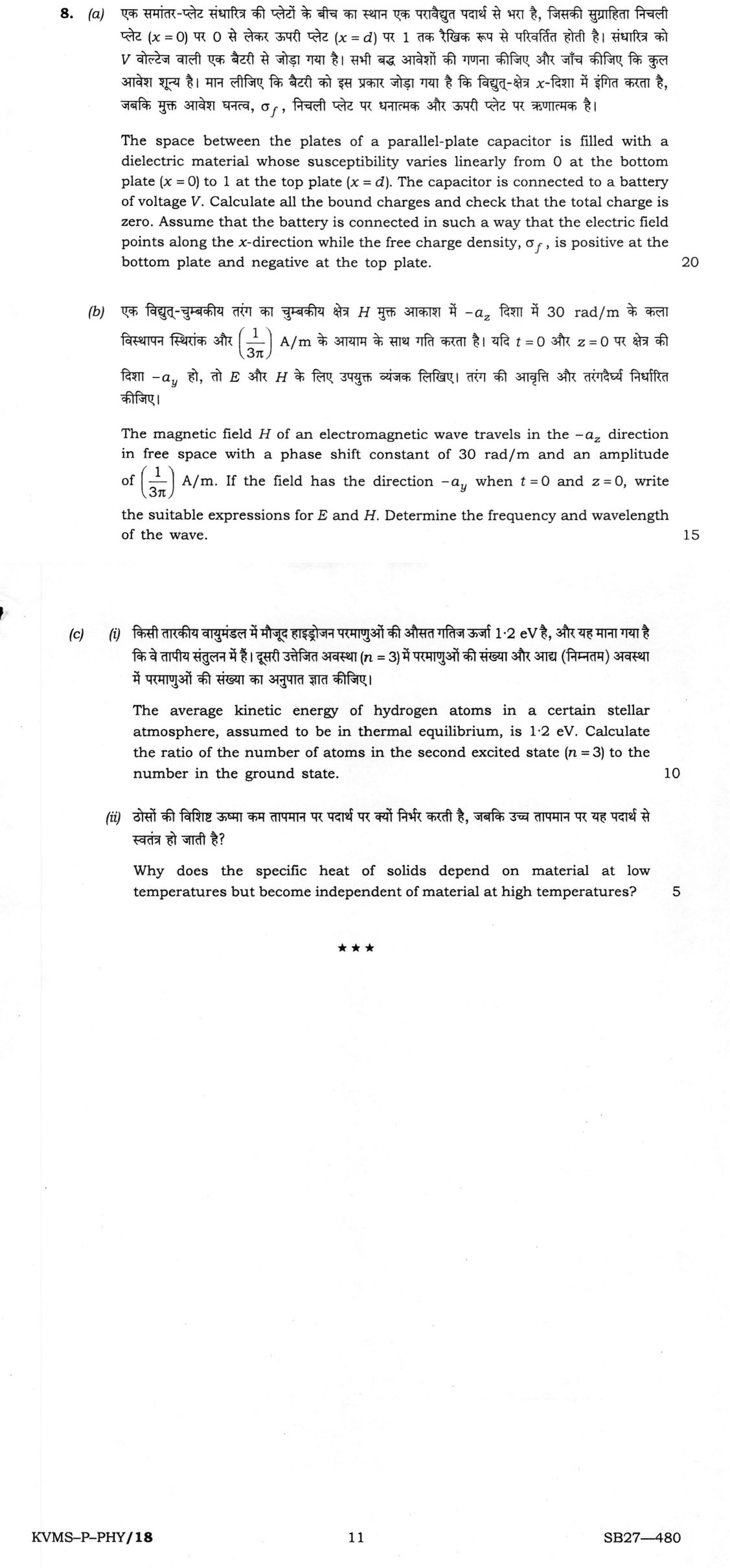
The space between the plates of a parallel-plate capacitor is filled with a dielectric material whose susceptibility varies linearly from 0 at the bottom plate (x = 0) to 1 at the top plate (x = d). The capacitor is connected to a battery of voltage V. Calculate all the bound charges and check that the total charge is zero. Assume that the battery is connected in such a way that the electric field points along the x-direction while the free charge density, σ_f, is positive at the bottom plate and negative at the top plate. 20 marks
The magnetic field H of an electromagnetic wave travels in the −a_z direction in free space with a phase shift constant of 30 rad/m and an amplitude of (1/3π) A/m. If the field has the direction −a_y when t = 0 and z = 0, write the suitable expressions for E and H. Determine the frequency and wavelength of the wave. 15 marks
The average kinetic energy of hydrogen atoms in a certain stellar atmosphere, assumed to be in thermal equilibrium, is 1·2 eV. Calculate the ratio of the number of atoms in the second excited state (n = 3) to the number in the ground state. 10 marks
Why does the specific heat of solids depend on material at low temperatures but become independent of material at high temperatures? 5 marks
हिंदी में प्रश्न पढ़ें
एक समांतर-प्लेट संधारित्र की प्लेटों के बीच का स्थान एक परावैद्युत पदार्थ से भरा है, जिसकी सुग्राहिता निचली प्लेट (x = 0) पर 0 से लेकर ऊपरी प्लेट (x = d) पर 1 तक रैखिक रूप से परिवर्तित होती है। संधारित्र को V वोल्टेज वाली एक बैटरी से जोड़ा गया है। सभी बद्ध आवेशों की गणना कीजिए और जाँच कीजिए कि कुल आवेश शून्य है। मान लीजिए कि बैटरी को इस प्रकार जोड़ा गया है कि विद्युत्-क्षेत्र x-दिशा में इंगित करता है, जबकि मुक्त आवेश घनत्व, σ_f, निचली प्लेट पर धनात्मक और ऊपरी प्लेट पर ऋणात्मक है। (20 अंक)
एक विद्युत्-चुम्बकीय तरंग का चुम्बकीय क्षेत्र H मुक्त आकाश में −a_z दिशा में 30 rad/m के कला विस्थापन स्थिरांक और (1/3π) A/m के आयाम के साथ गति करता है। यदि t = 0 और z = 0 पर क्षेत्र की दिशा −a_y हो, तो E और H के लिए उपयुक्त व्यंजक लिखिए। तरंग की आवृत्ति और तरंगदैर्ध्य निर्धारित कीजिए। (15 अंक)
किसी तारकीय वायुमंडल में मौजूद हाइड्रोजन परमाणुओं की औसत गतिज ऊर्जा 1·2 eV है, और यह माना गया है कि वे तापीय संतुलन में हैं। दूसरी उत्तेजित अवस्था (n = 3) में परमाणुओं की संख्या और आद्य (निम्नतम) अवस्था में परमाणुओं की संख्या का अनुपात ज्ञात कीजिए। (10 अंक)
ठोसों की विशिष्ट ऊष्मा कम तापमान पर पदार्थ पर क्यों निर्भर करती है, जबकि उच्च तापमान पर यह पदार्थ से स्वतंत्र हो जाती है? (5 अंक)
Model answer
Drafted with AI by UPSC Answer Check against this question's marking rubric, to the expected length. UPSC does not publish answers for Mains — this is one way to score well, not an official key. How we build rubrics and answers.
(a) Bound charges in a graded dielectric Susceptibility χₑ(x) = x/d, so εᵣ(x) = 1 + x/d. Free charge: by Gauss's law for D, with +σ_f on the bottom plate and −σ_f on the top, D = σ_f x̂ everywhere between the plates (it depends only on free charge). E(x) = D/(ε₀εᵣ) = σ_f/[ε₀(1 + x/d)] V = ∫₀ᵈ E dx = (σ_f/ε₀)∫₀ᵈ dx/(1 + x/d) = (σ_f d/ε₀) ln 2 ⇒ σ_f = ε₀V/(d ln 2)
Polarisation: P = ε₀χₑE = σ_f (x/d)/(1 + x/d) = σ_f x/(d + x) (along x̂)
Bound volume charge: ρ_b = −dP/dx = −σ_f d/(d + x)² ⇒ ρ_b(x) = −ε₀V/[ln 2 (d + x)²]
Bound surface charges (σ_b = P·n̂, n̂ pointing out of the dielectric):
- Bottom surface x = 0, n̂ = −x̂: P(0) = 0 ⇒ σ_b(0) = 0
- Top surface x = d, n̂ = +x̂: P(d) = σ_f/2 ⇒ σ_b(d) = +σ_f/2 = ε₀V/(2d ln 2)
Check of total bound charge (per unit plate area): ∫₀ᵈ ρ_b dx = −σ_f d[1/d − 1/(2d)] = −σ_f/2 Total = −σ_f/2 + 0 + σ_f/2 = 0, as it must be for a neutral dielectric. The negative volume charge is balanced by the positive surface charge next to the negative top plate.
(b) Fields of the plane wave travelling along −a_z Free space: β = 30 rad/m ⇒ ω = βc = 30 × 3 × 10⁸ = 9 × 10⁹ rad/s f = ω/2π = 1.43 × 10⁹ Hz (1.43 GHz), λ = 2π/β = 0.209 m (= c/f) Amplitudes: H₀ = 1/3π A/m, E₀ = η₀H₀ = 120π × 1/3π = 40 V/m Propagation along −a_z ⇒ phase (ωt + βz). H is along −a_y at t = 0, z = 0, so H = −(1/3π) cos(9 × 10⁹ t + 30z) a_y A/m Direction of E from a_E × a_H = aₖ: a_E × (−a_y) = −a_z ⇒ a_E × a_y = a_z ⇒ a_E = aₓ E = 40 cos(9 × 10⁹ t + 30z) aₓ V/m Check: E × H ∝ aₓ × (−a_y) = −a_z, the direction of travel.
(c) (i) Population of n = 3 relative to n = 1 in a stellar atmosphere Mean kinetic energy (3/2)k_BT = 1.2 eV ⇒ k_BT = 0.80 eV (T = 0.80/8.617 × 10⁻⁵ ≈ 9.28 × 10³ K). Hydrogen levels Eₙ = −13.6/n² eV: E₁ = −13.6 eV, E₃ = −1.51 eV; ΔE = 12.09 eV. Statistical weights gₙ = 2n²: g₁ = 2, g₃ = 18. Boltzmann distribution: N₃/N₁ = (g₃/g₁) e^−ΔE/k_BT = 9 × e^−12.09/0.80 = 9 × e^−15.11 = 9 × 2.74 × 10⁻⁷ N₃/N₁ ≈ 2.46 × 10⁻⁶ So almost all atoms are in the ground state.
(c) (ii) Why specific heat depends on the material only at low temperature A solid of N atoms has 3N lattice vibration modes. A mode of frequency ω contributes to the heat capacity only if ħω ≲ k_BT.
- Low T: only low-frequency acoustic phonons are excited, and how many depends on the phonon spectrum, i.e. on the Debye temperature θ_D (set by the sound speed, atomic mass and bond stiffness). Debye's law C_V = (12π⁴/5)R(T/θ_D)³ therefore differs from one solid to another.
- High T (T ≳ θ_D): all 3N modes are fully excited; by equipartition each contributes k_B, so C_V = 3Nk_B = 3R ≈ 24.9 J mol⁻¹ K⁻¹ (Dulong–Petit law) for every solid. The material constant θ_D drops out.
How this answer will be evaluated
Evaluation rubric
Each sub-part is marked on its own, against the marks and word limit printed on the paper.
- (a) For a parallel-plate capacitor filled with a dielectric of linearly graded susceptibility χ_e(x) = x/d (0 at x = 0, 1 at x = d) and held at voltage V, find the free surface charge density σ_f in terms of V, then compute ALL bound charges — the bound volume charge density ρ_b(x) and the bound surface charge densities at x = 0 and x = d — and verify that the total bound charge is zero. 20 marks
Must cover
- D = σ_f uniform; E(x) = σ_f/[ε₀(1 + x/d)]; V = (σ_f d/ε₀) ln 2 ⇒ σ_f = ε₀V/(d ln 2)
- P = σ_f x/(d + x); ρ_b = −dP/dx = −σ_f d/(d + x)²
- σ_b(0) = 0, σ_b(d) = +σ_f/2
- Total bound charge −σ_f/2 + 0 + σ_f/2 = 0
Loses marks
- Assuming E = V/d uniform
- Missing ln 2 in σ_f
- Sign error in ρ_b = −∇·P or in the outward normal
Earns more
- Bound charges expressed in terms of V: ρ_b = −ε₀V/[ln 2 (d + x)²], σ_b(d) = ε₀V/(2d ln 2)
- (b) For a plane EM wave in free space travelling along −a_z with β = 30 rad/m, |H| = 1/3π A/m and H along −a_y at t = 0, z = 0: write the complete time-domain expressions for H⃗ and E⃗ (amplitude, direction and phase), and determine the frequency and wavelength. 15 marks
Must cover
- ω = βc = 9 × 10⁹ rad/s, f = 1.43 GHz, λ = 0.209 m
- E₀ = η₀H₀ = 40 V/m; phase (ωt + 30z) for −a_z travel
- H = −(1/3π) cos(9 × 10⁹ t + 30z) a_y A/m
- E = 40 cos(9 × 10⁹ t + 30z) a_x V/m (from a_E × a_H = a_k)
Loses marks
- Phase (ωt − 30z)
- a_E = −a_x from a wrong triad order
- Quoting f = 9 × 10⁹ Hz
Earns more
- Check that E × H points along −a_z
- (c)(i) From the given mean kinetic energy of 1.2 eV, obtain the temperature of the stellar hydrogen using the equipartition result (3/2)kT, then apply the Boltzmann distribution with the correct statistical weights g_n = 2n² to find the population ratio N₃/N₁ between the second excited state (n = 3) and the ground state. 10 marks
Must cover
- (3/2)k_BT = 1.2 eV ⇒ k_BT = 0.80 eV (T ≈ 9.28 × 10³ K)
- ΔE = E₃ − E₁ = 12.09 eV; g₃/g₁ = 18/2 = 9
- N₃/N₁ = 9 e^{−15.11} ≈ 2.46 × 10⁻⁶
Loses marks
- Taking k_BT = 1.2 eV (ratio ≈ 3.8 × 10⁻⁴)
- Omitting g₃/g₁ (2.74 × 10⁻⁷)
- Treating n = 3 as the third excited state or using ΔE = 13.6 eV
Earns more
- Comment that practically all atoms are in the ground state
- (c)(ii) Explain why the lattice specific heat of solids is material-dependent at low temperature (Debye T³ regime, where C ∝ (T/θ_D)³ and θ_D encodes the material's elastic constants, atomic mass and bonding) but becomes material-independent at high temperature (Dulong–Petit limit, C = 3R per mole). 5 marks
Must cover
- Only modes with ħω ≲ k_BT contribute
- Low T: Debye T³ law with material-dependent θ_D
- High T: all 3N modes excited, equipartition ⇒ C_V = 3R ≈ 25 J mol⁻¹ K⁻¹ for all solids
Loses marks
- Reversing the two regimes
- Quoting the high-T limit as (3/2)R
Earns more
- θ_D linked to sound speed, atomic mass and bond stiffness
What "Calculate" is asking you to do
Apply the standard formula or schedule to data the question has already supplied — a table of readings, cost records, a balance sheet — and produce the number. The method is rarely in doubt; the marks sit in the named intermediate quantities, each of which has to appear as a labelled line.
Structure that answers it
Data as given → formula or standard treatment, named → substitution → each intermediate, labelled → result with units
Where marks are lost
Omitting an intermediate the marking scheme pays for separately, or rounding at an intermediate line so the final figure drifts. In commerce and accountancy, any figure in a statement that no numbered working note supports is treated as unearned.
Practice this exact question
Write your answer and it is marked point by point against the model answer above — what you covered, what you missed, what you got wrong.
Evaluate my answer →More from Physics 2026 Paper I
- Q5 (a) Calculate the effective resistance of the following combination of resistances as sho…
- Q6 (a) Discuss the origin of hysteresis in ferromagnetic materials on the basis of domain th…
- Q7 (a) A gas has only two particles a and b. Show with the help of diagrams how these two pa…
- Q8 (a) The space between the plates of a parallel-plate capacitor is filled with a dielectri…