Paper I — Q5
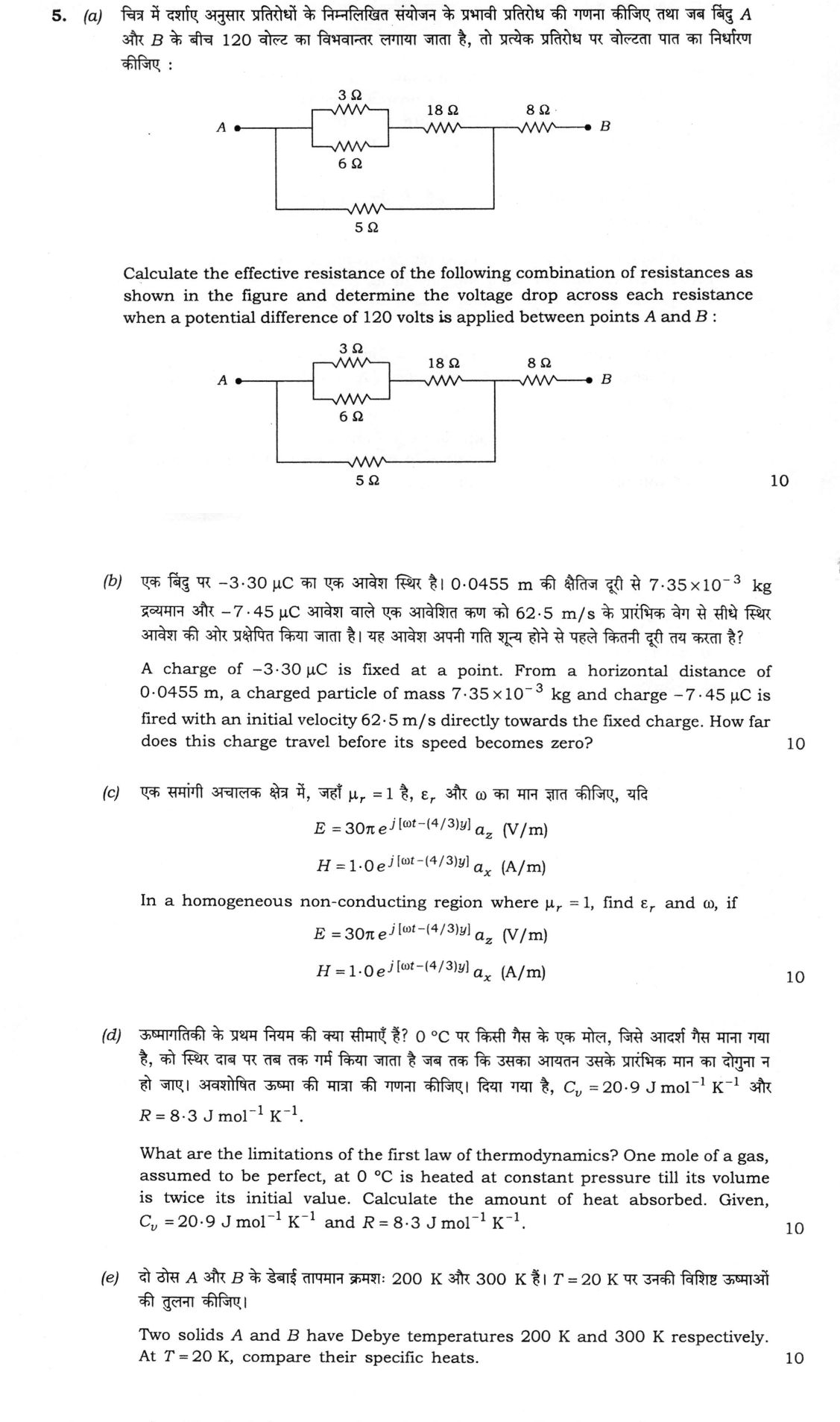
(a) Calculate the effective resistance of the following combination of resistances as shown in the figure and determine the…
Calculate the effective resistance of the following combination of resistances as shown in the figure and determine the voltage drop across each resistance when a potential difference of 120 volts is applied between points A and B : 10 marks
A charge of –3·30 μC is fixed at a point. From a horizontal distance of 0·0455 m, a charged particle of mass 7·35 × 10⁻³ kg and charge –7·45 μC is fired with an initial velocity 62·5 m/s directly towards the fixed charge. How far does this charge travel before its speed becomes zero? 10 marks
In a homogeneous non-conducting region where μᵣ = 1, find εᵣ and ω, if E = 30π e^j[ωt – (4/3)y] a_z (V/m) H = 1·0 e^j[ωt – (4/3)y] aₓ (A/m) 10 marks
What are the limitations of the first law of thermodynamics? One mole of a gas, assumed to be perfect, at 0 °C is heated at constant pressure till its volume is twice its initial value. Calculate the amount of heat absorbed. Given, Cᵥ = 20·9 J mol⁻¹ K⁻¹ and R = 8·3 J mol⁻¹ K⁻¹. 10 marks
Two solids A and B have Debye temperatures 200 K and 300 K respectively. At T = 20 K, compare their specific heats. 10 marks
हिंदी में प्रश्न पढ़ें
चित्र में दर्शाए अनुसार प्रतिरोधों के निम्नलिखित संयोजन के प्रभावी प्रतिरोध की गणना कीजिए तथा जब बिंदु A और B के बीच 120 वोल्ट का विभवांतर लगाया जाता है, तो प्रत्येक प्रतिरोध पर वोल्टता पात का निर्धारण कीजिए : (10 अंक)
एक बिंदु पर –3·30 μC का एक आवेश स्थिर है। 0·0455 m की क्षैतिज दूरी से 7·35 × 10⁻³ kg द्रव्यमान और –7·45 μC आवेश वाले एक आवेशित कण को 62·5 m/s के प्रारंभिक वेग से सीधे स्थिर आवेश की ओर प्रक्षेपित किया जाता है। यह आवेश अपनी गति शून्य होने से पहले कितनी दूरी तय करता है? (10 अंक)
एक समांगी अचालक क्षेत्र में, जहाँ μᵣ = 1 है, εᵣ और ω का मान ज्ञात कीजिए, यदि E = 30π e^j[ωt – (4/3)y] a_z (V/m) H = 1·0 e^j[ωt – (4/3)y] aₓ (A/m) (10 अंक)
उष्मागतिकी के प्रथम नियम की क्या सीमाएँ हैं? 0 °C पर किसी गैस के एक मोल, जिसे आदर्श गैस माना गया है, को स्थिर दाब पर तब तक गर्म किया जाता है जब तक कि उसका आयतन उसके प्रारंभिक मान का दोगुना न हो जाए। अवशोषित उष्मा की मात्रा की गणना कीजिए। दिया गया है, Cᵥ = 20·9 J mol⁻¹ K⁻¹ और R = 8·3 J mol⁻¹ K⁻¹. (10 अंक)
दो ठोस A और B के डेबाई तापमान क्रमशः 200 K और 300 K हैं। T = 20 K पर उनकी विशिष्ट ऊष्माओं की तुलना कीजिए। (10 अंक)
Model answer
Drafted with AI by UPSC Answer Check against this question's marking rubric, to the expected length. UPSC does not publish answers for Mains — this is one way to score well, not an official key. How we build rubrics and answers.
(a) Effective resistance and voltage drops Network (from the figure): between A and a node X there are two parallel branches, an upper branch of 3 Ω ∥ 6 Ω in series with 18 Ω and a lower branch of 5 Ω; an 8 Ω resistor joins X to B. 3 Ω ∥ 6 Ω = (3 × 6)/(3 + 6) = 2 Ω Upper branch = 2 + 18 = 20 Ω 20 Ω ∥ 5 Ω = (20 × 5)/(20 + 5) = 4 Ω R_eff = 4 + 8 = 12 Ω Total current I = 120/12 = 10 A.
- 8 Ω: V = 10 × 8 = 80 V
- Parallel block A–X: 120 − 80 = 40 V, so the 5 Ω has 40 V (current 8 A)
- Upper branch current = 40/20 = 2 A: 18 Ω has 36 V; the 3 Ω and 6 Ω (in parallel) each have 4 V (currents 4/3 A and 2/3 A) Check: 4 + 36 + 80 = 120 V and 40 + 80 = 120 V; 2 A + 8 A = 10 A.
(b) Distance travelled by the repelled charge Both charges are negative, so the force is repulsive and the moving charge slows down. The Coulomb force is conservative, so mechanical energy is conserved. kQq = (8.99 × 10⁹)(3.30 × 10⁻⁶)(7.45 × 10⁻⁶) = 0.221 J m Initial kinetic energy: ½mv² = ½(7.35 × 10⁻³)(62.5)² = 14.36 J Initial potential energy: U_i = kQq/r_i = 0.221/0.0455 = 4.86 J Total energy: E = 14.36 + 4.86 = 19.21 J At the turning point v = 0, so kQq/r_min = E: r_min = 0.221/19.21 = 1.15 × 10⁻² m Distance travelled = r_i − r_min = 0.0455 − 0.0115 = 3.40 × 10⁻² m (3.40 cm)
(c) εᵣ and ω of the medium The wave travels along +y (phase ωt − βy with β = 4/3 rad/m); a_z × a_x = a_y confirms E × H along +y. Intrinsic impedance: η = E₀/H₀ = 30π/1.0 = 30π Ω For μᵣ = 1: η = η₀/√εᵣ = 120π/√εᵣ ⇒ √εᵣ = 120π/30π = 4 ⇒ εᵣ = 16 Phase constant: β = ω√(μ₀ε₀εᵣ) = (ω/c)√εᵣ ω = βc/√εᵣ = (4/3)(3 × 10⁸)/4 = 1.0 × 10⁸ rad/s (Phase velocity c/4 = 7.5 × 10⁷ m/s, f ≈ 15.9 MHz.)
(d) Limitations of the first law; heat absorbed at constant pressure Limitations of the first law:
- It does not tell the direction of a process, e.g. why heat flows only from hot to cold by itself.
- It does not say whether a process is possible; it only balances energy.
- It treats heat and work as equivalent, yet heat cannot be converted fully into work in a cycle; it sets no limit on engine efficiency.
- It does not distinguish reversible from irreversible processes and has no concept of entropy. The second law removes these gaps.
Heat absorbed: at constant pressure V ∝ T, so doubling V gives T₂ = 2T₁ = 546 K, ΔT = 273 K. C_P = C_V + R = 20.9 + 8.3 = 29.2 J mol⁻¹ K⁻¹ Q = nC_PΔT = 1 × 29.2 × 273 = 7.97 × 10³ J ≈ 7.97 kJ Check: ΔU = C_VΔT = 5.71 kJ, W = RΔT = 2.27 kJ, ΔU + W = 7.97 kJ.
(e) Debye specific heats at 20 K At T = 20 K, T ≪ θ_D for both solids (20 K is θ_D/10 for A and θ_D/15 for B), so the Debye T³ law applies: C_V = (12π⁴/5)R(T/θ_D)³ ≈ 1944 (T/θ_D)³ J mol⁻¹ K⁻¹ At the same T, C_V ∝ 1/θ_D³: C_A/C_B = (θ_B/θ_A)³ = (300/200)³ = 3.375 Numerically, C_A ≈ 1944 × (0.1)³ = 1.94 J mol⁻¹ K⁻¹ and C_B ≈ 1944 × (1/15)³ = 0.58 J mol⁻¹ K⁻¹. Solid A (lower θ_D, softer lattice with lower phonon frequencies) has about 3.4 times the specific heat of B, because more of its vibrational modes are excited at 20 K.
How this answer will be evaluated
Evaluation rubric
Each sub-part is marked on its own, against the marks and word limit printed on the paper.
- (a) From the printed figure the candidate must (i) reduce the network between A and B to a single effective resistance R_eff and (ii) with 120 V applied across A-B, compute the main and branch currents and hence the voltage drop across EVERY individual resistor. The network is: from A the upper branch is 3 Ω in parallel with 6 Ω, that pair in series with 18 Ω; the lower branch is a single 5 Ω; the two branches are in parallel between A and node X; and 8 Ω runs from X to B. Both parts carry marks; a bare R_eff is a half answer. 10 marks
Must cover
- Correct series–parallel reduction: 3 ∥ 6 = 2 Ω, upper branch 20 Ω, 20 ∥ 5 = 4 Ω
- R_eff = 12 Ω and I = 10 A
- Drops: 8 Ω 80 V, 5 Ω 40 V, 18 Ω 36 V, 3 Ω and 6 Ω 4 V each
Loses marks
- Adding parallel resistances directly
- Putting 10 A through the upper-branch resistors
- Giving only R_eff without the voltage drop across each resistor
Earns more
- KVL/current check: 4 + 36 + 80 = 120 V, 40 + 80 = 120 V, 2 A + 8 A = 10 A
- (b) Using conservation of mechanical energy for two like (both negative, hence mutually repelling) point charges, find the distance of closest approach of the moving charge and hence how far it travels from its starting point before its speed falls to zero. 10 marks
Must cover
- Like charges repel; energy conservation ½mv² + kQq/r_i = kQq/r_min
- ½mv² = 14.36 J, U_i = 4.86 J, E = 19.21 J
- r_min = 1.15 × 10⁻² m; distance travelled = 3.40 × 10⁻² m
Loses marks
- Omitting the initial potential energy (gives r = 1.54 cm, travel 3.01 cm)
- Giving r_min (1.15 cm) instead of the distance travelled
- Treating the force as attractive
Earns more
- kQq = 0.221 J m computed with k = 8.99 × 10⁹ N m² C⁻²
- (c) For the given uniform plane wave in a lossless non-conducting medium with μ_r = 1, determine (i) the relative permittivity ε_r from the intrinsic impedance ratio E₀/H₀ and (ii) the angular frequency ω from the given phase constant β = 4/3 rad/m. 10 marks
Must cover
- η = E₀/H₀ = 30π Ω and η = 120π/√εᵣ ⇒ εᵣ = 16
- β = (ω/c)√εᵣ with β = 4/3 rad/m
- ω = 1.0 × 10⁸ rad/s
Loses marks
- εᵣ = 4 (forgetting to square η₀/η)
- Using β = ω/c ⇒ ω = 4 × 10⁸ rad/s
- Quoting 10⁸ Hz instead of rad/s
Earns more
- Propagation along +y confirmed by a_z × a_x = a_y
- Phase velocity 7.5 × 10⁷ m/s or f ≈ 15.9 MHz
- (d) Two parts: (i) state the limitations of the first law of thermodynamics (it says nothing about direction/feasibility, no concept of entropy or unavailable energy, cannot distinguish reversible from irreversible, gives no efficiency limit), and (ii) numerically compute the heat absorbed when one mole of an ideal gas at 0 °C is heated isobarically until its volume doubles, given C_V = 20.9 and R = 8.3 J mol⁻¹ K⁻¹. 10 marks
Must cover
- At least three limitations: no direction of processes, no feasibility criterion, no limit on heat-to-work conversion/efficiency, no entropy concept
- V ∝ T at constant P ⇒ ΔT = 273 K; C_P = C_V + R = 29.2 J mol⁻¹ K⁻¹
- Q = C_PΔT = 7.97 × 10³ J
Loses marks
- Using C_V (gives ΔU = 5.71 kJ, not Q)
- Taking ΔT = 546 K
- Saying the first law forbids a perpetual motion machine of the second kind
Earns more
- Check ΔU = 5.71 kJ and W = 2.27 kJ with Q = ΔU + W
- Notes that the second law supplies what the first law lacks
- (e) Using the Debye T³ law, compare the lattice specific heats of solids A (θ_D = 200 K) and B (θ_D = 300 K) at T = 20 K, first justifying that 20 K lies in the low-temperature regime for both, and obtaining the ratio C_A/C_B. 10 marks
Must cover
- T = 20 K ≪ θ_D for both ⇒ Debye T³ law C_V = (12π⁴/5)R(T/θ_D)³
- At fixed T, C_V ∝ 1/θ_D³
- C_A/C_B = (300/200)³ = 3.375; A has the larger specific heat
Loses marks
- Inverting the ratio (0.296)
- Forgetting to cube (ratio 1.5)
- Using Dulong–Petit (ratio 1) at 20 K
Earns more
- Numerical values C_A ≈ 1.94 and C_B ≈ 0.58 J mol⁻¹ K⁻¹
- Physical reason: lower θ_D, softer lattice, more modes excited
What "Calculate" is asking you to do
Apply the standard formula or schedule to data the question has already supplied — a table of readings, cost records, a balance sheet — and produce the number. The method is rarely in doubt; the marks sit in the named intermediate quantities, each of which has to appear as a labelled line.
Structure that answers it
Data as given → formula or standard treatment, named → substitution → each intermediate, labelled → result with units
Where marks are lost
Omitting an intermediate the marking scheme pays for separately, or rounding at an intermediate line so the final figure drifts. In commerce and accountancy, any figure in a statement that no numbered working note supports is treated as unearned.
Practice this exact question
Write your answer and it is marked point by point against the model answer above — what you covered, what you missed, what you got wrong.
Evaluate my answer →More from Physics 2026 Paper I
- Q2 (a) What is meant by achromatic combination of lenses? Derive the condition for achromati…
- Q3 (a) The energy of a photon is expressed as E = hν, where h is the Planck's constant and ν…
- Q4 (a) (i) In Newton's ring experiment, the space between planoconvex lens and glass plate i…
- Q5 (a) Calculate the effective resistance of the following combination of resistances as sho…
- Q6 (a) Discuss the origin of hysteresis in ferromagnetic materials on the basis of domain th…
- Q7 (a) A gas has only two particles a and b. Show with the help of diagrams how these two pa…
- Q8 (a) The space between the plates of a parallel-plate capacitor is filled with a dielectri…