Paper I — Q3
(a) The energy of a photon is expressed as E = hν, where h is the Planck's constant and ν is the frequency of the photon. The…
The energy of a photon is expressed as E = hν, where h is the Planck's constant and ν is the frequency of the photon. The momentum of the photon is hν/c, where c is the speed of light. Show that if a photon scatters from a free electron (of mass mₑ), the scattered photon has energy
E' = E [1 + (E/(mₑ c²))(1 − cos θ)]⁻¹
where θ is the angle through which the photon scatters. Also, show that the electron acquires a kinetic energy
T = (E²/(mₑ c²)) [ (1 − cos θ) / (1 + (E/(mₑ c²))(1 − cos θ)) ] 20 marks
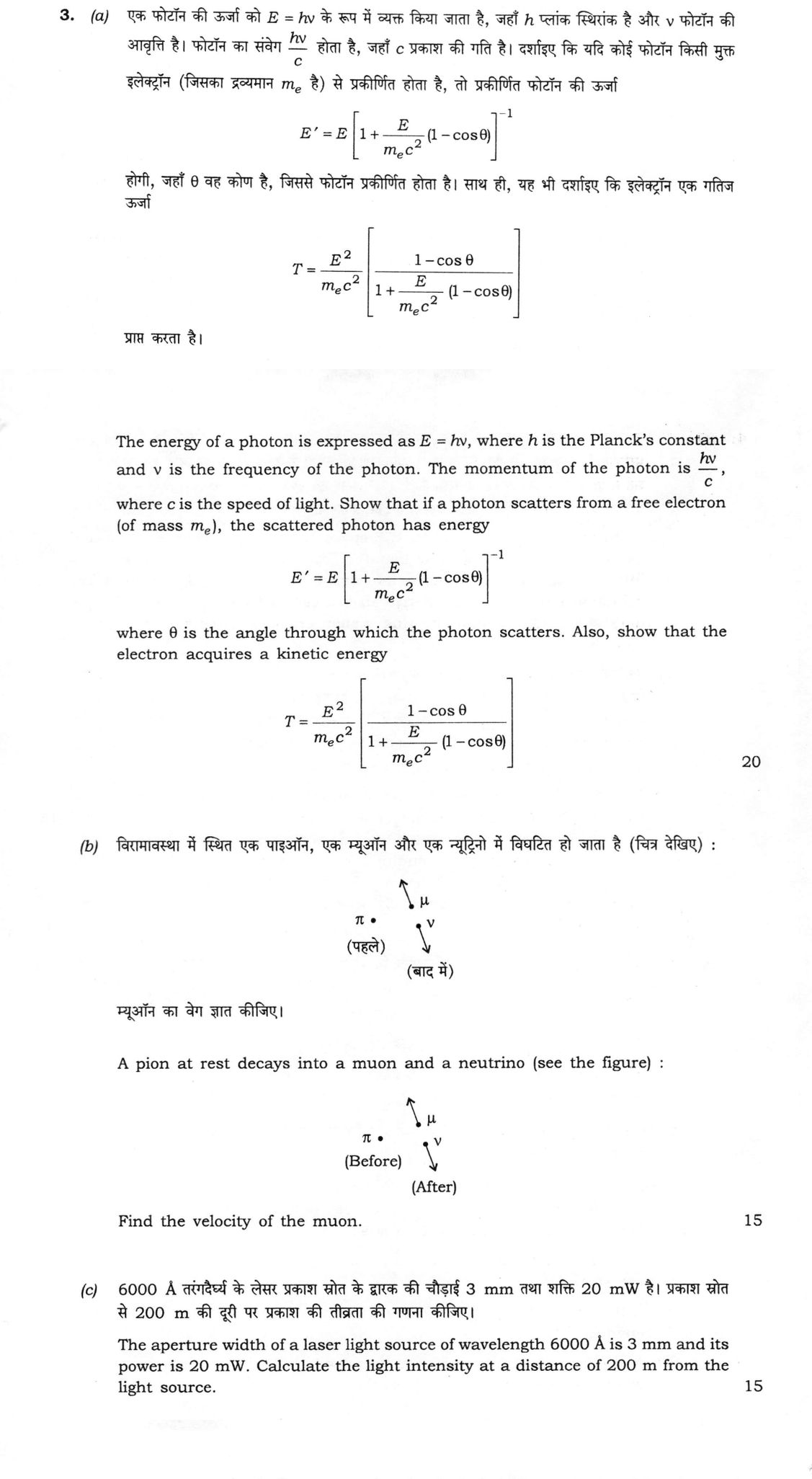
A pion at rest decays into a muon and a neutrino (see the figure) :
π • (Before)
↑ μ ↓ ν (After)
Find the velocity of the muon. 15 marks
The aperture width of a laser light source of wavelength 6000 Å is 3 mm and its power is 20 mW. Calculate the light intensity at a distance of 200 m from the light source. 15 marks
हिंदी में प्रश्न पढ़ें
एक फोटॉन की ऊर्जा E = hν के रूप में व्यक्त की जाती है, जहाँ h प्लांक नियतांक है तथा ν फोटॉन की आवृत्ति है। फोटॉन का संवेग hν/c है, जहाँ c प्रकाश का वेग है। दर्शाइए कि यदि कोई फोटॉन किसी मुक्त इलेक्ट्रॉन (द्रव्यमान mₑ) से प्रकीर्णित होता है, तो प्रकीर्णित फोटॉन की ऊर्जा
E' = E [1 + (E/(mₑ c²))(1 − cos θ)]⁻¹
होती है, जहाँ θ वह कोण है जिससे फोटॉन प्रकीर्णित होता है। यह भी दर्शाइए कि इलेक्ट्रॉन गतिज ऊर्जा
T = (E²/(mₑ c²)) [ (1 − cos θ) / (1 + (E/(mₑ c²))(1 − cos θ)) ]
प्राप्त करता है। (20 अंक)
विरामावस्था में स्थित एक पाइऑन, एक म्यूऑन और एक न्यूट्रिनो में विघटित हो जाता है (चित्र देखिए) :
π • (पहले)
↑ μ ↓ ν (बाद में)
म्यूऑन का वेग ज्ञात कीजिए। (15 अंक)
6000 Å तरंगदैर्ध्य के लेसर प्रकाश स्रोत के द्वारक की चौड़ाई 3 mm तथा शक्ति 20 mW है। प्रकाश स्रोत से 200 m की दूरी पर प्रकाश की तीव्रता की गणना कीजिए। (15 अंक)
Model answer
Drafted with AI by UPSC Answer Check against this question's marking rubric, to the expected length. UPSC does not publish answers for Mains — this is one way to score well, not an official key. How we build rubrics and answers.
(a) Compton scattering: E′ and the electron's kinetic energy A photon of energy E (momentum E/c along x) strikes a free electron at rest (energy mₑc²). After scattering, the photon has energy E′ at angle θ, and the electron has momentum pₑ at angle φ and total energy Eₑ, with Eₑ² = pₑ²c² + mₑ²c⁴.
Energy conservation: E + mₑc² = E′ + Eₑ ⇒ Eₑ = E − E′ + mₑc² Momentum conservation: x: E/c = (E′/c) cos θ + pₑ cos φ y: 0 = (E′/c) sin θ − pₑ sin φ Squaring and adding eliminates φ: pₑ²c² = E² + E′² − 2EE′ cos θ
Substituting in Eₑ² = pₑ²c² + mₑ²c⁴: (E − E′)² + 2(E − E′)mₑc² + mₑ²c⁴ = E² + E′² − 2EE′ cos θ + mₑ²c⁴ −2EE′ + 2(E − E′)mₑc² = −2EE′ cos θ (E − E′)mₑc² = EE′(1 − cos θ) 1/E′ − 1/E = (1 − cos θ)/(mₑc²) Hence E′ = E[1 + (E/mₑc²)(1 − cos θ)]⁻¹ (Equivalently Δλ = (h/mₑc)(1 − cos θ), with h/mₑc = 2.43 × 10⁻¹² m.)
Kinetic energy of the electron: T = Eₑ − mₑc² = E − E′. Writing k = (E/mₑc²)(1 − cos θ): T = E − E/(1 + k) = Ek/(1 + k) T = (E²/mₑc²)(1 − cos θ)/[1 + (E/mₑc²)(1 − cos θ)] Checks: θ = 0 gives T = 0; T is maximum for θ = π (back-scattering).
(b) Velocity of the muon from π → μ + ν The pion is at rest, so the total momentum is zero: the muon and neutrino move in opposite directions (as in the figure) with equal momentum p. Take the neutrino as massless, E_ν = pc. Energy: m_πc² = E_μ + pc, with E_μ² = p²c² + m_μ²c⁴ (m_πc² − pc)² = p²c² + m_μ²c⁴ ⇒ pc = (m_π² − m_μ²)c²/(2m_π) E_μ = m_πc² − pc = (m_π² + m_μ²)c²/(2m_π) v_μ/c = pc/E_μ = (m_π² − m_μ²)/(m_π² + m_μ²)
With m_πc² = 139.6 MeV and m_μc² = 105.7 MeV: pc = 29.8 MeV, E_μ = 109.8 MeV v_μ/c = (19488 − 11172)/(19488 + 11172) = 8316/30661 = 0.271 v_μ ≈ 0.271c ≈ 8.14 × 10⁷ m/s (γ = 1.039, kinetic energy T_μ = E_μ − m_μc² ≈ 4.1 MeV).
(c) Intensity of the laser beam at 200 m The beam spreads by diffraction at the aperture. Angular spread (half-angle to the first minimum): θ = λ/a = (6.0 × 10⁻⁷ m)/(3.0 × 10⁻³ m) = 2.0 × 10⁻⁴ rad Radius of the spot at L = 200 m: r = Lθ = 200 × 2.0 × 10⁻⁴ = 4.0 × 10⁻² m Area of the spot: A = πr² = π(0.040)² = 5.03 × 10⁻³ m² Intensity: I = P/A = (20 × 10⁻³ W)/(5.03 × 10⁻³ m²) ≈ 4.0 W/m² This is an estimate assuming the power stays within the central diffraction disc. Many textbooks take the "areal spread" as (Lθ)² = 1.6 × 10⁻³ m², giving I ≈ 12.5 W/m²; either estimate shows the beam is still intense at 200 m, unlike an isotropic 20 mW source (P/4πL² ≈ 4 × 10⁻⁸ W/m²).
How this answer will be evaluated
Evaluation rubric
Each sub-part is marked on its own, against the marks and word limit printed on the paper.
- (a) Starting from relativistic energy and momentum conservation for Compton scattering of a photon of energy E off a free electron of mass m_e at rest, prove E' = E[1 + (E/m_e c^2)(1 - cos theta)]^-1 for the scattered photon, and then prove that the electron's kinetic energy is T = (E^2/m_e c^2)(1 - cos theta)/[1 + (E/m_e c^2)(1 - cos theta)]. 20 marks
Must cover
- Energy conservation E + mₑc² = E′ + Eₑ with Eₑ² = pₑ²c² + mₑ²c⁴
- Momentum components squared and added: pₑ²c² = E² + E′² − 2EE′ cos θ
- 1/E′ − 1/E = (1 − cos θ)/(mₑc²) ⇒ E′ = E[1 + (E/mₑc²)(1 − cos θ)]⁻¹
- T = E − E′ = (E²/mₑc²)(1 − cos θ)/[1 + (E/mₑc²)(1 − cos θ)]
Loses marks
- Using non-relativistic p²/2m for the electron
- Writing T = Eₑ instead of Eₑ − mₑc²
- Sign error giving (1 + cos θ)
Earns more
- Equivalent wavelength shift Δλ = (h/mₑc)(1 − cos θ), h/mₑc = 2.43 × 10⁻¹² m
- Limiting checks: T = 0 at θ = 0, maximum at θ = π
- (b) A charged pion at rest decays to a muon plus a (massless) neutrino emitted back-to-back, as in the figure; find the velocity of the muon using relativistic energy-momentum conservation. 15 marks
Must cover
- Zero initial momentum ⇒ muon and neutrino back-to-back with equal p; E_ν = pc (massless neutrino)
- pc = (m_π² − m_μ²)c²/(2m_π) = 29.8 MeV, E_μ = (m_π² + m_μ²)c²/(2m_π) = 109.8 MeV
- v_μ/c = pc/E_μ = (m_π² − m_μ²)/(m_π² + m_μ²)
- v_μ ≈ 0.271c ≈ 8.14 × 10⁷ m/s
Loses marks
- Non-relativistic momentum conservation
- Giving the muon all of (m_π − m_μ)c² = 33.9 MeV as kinetic energy
- Using v = p/m_μ (non-relativistic), which gives 0.28c
Earns more
- γ = 1.039 and T_μ ≈ 4.1 MeV stated
- (c) For a laser of wavelength 6000 A, aperture width 3 mm and output power 20 mW, use diffraction-limited beam divergence to find the beam spot size at 200 m and hence compute the light intensity there. 15 marks
Must cover
- Diffraction angular spread θ = λ/a = 2.0 × 10⁻⁴ rad
- Spot size at 200 m: r = Lθ = 4.0 cm
- Intensity I = P/(spot area) with P = 0.020 W
- I ≈ 4.0 W/m² (with πr²) or ≈ 12.5 W/m² (textbook areal spread (Lθ)²)
Loses marks
- Dividing the power by the aperture area, ignoring the 200 m distance
- Treating the laser as an isotropic point source, I = P/4πL²
- Unit slips such as 20 mW taken as 20 W
Earns more
- Contrast with an isotropic source P/4πL² ≈ 4 × 10⁻⁸ W/m² to show the directionality of laser light
- Correct unit conversions (6000 Å = 6.0 × 10⁻⁷ m, 3 mm = 3.0 × 10⁻³ m)
What "Prove" is asking you to do
Establish that the statement holds for every case it claims, not for one representative case. The argument must be closed: each line follows from a definition, a hypothesis, or a named theorem you are entitled to use.
Structure that answers it
Given and to prove, restated → theorem or construction to be used, named → the argument line by line → conclusion stated as proved
Where marks are lost
Testing one example, which illustrates but proves nothing. On an if and only if claim, proving one direction and stopping forfeits that half outright, and degenerate cases — zero, the empty set, the equality case — have to be disposed of rather than assumed away.
Practice this exact question
Write your answer and it is marked point by point against the model answer above — what you covered, what you missed, what you got wrong.
Evaluate my answer →More from Physics 2026 Paper I
- Q1 (a) A uniform rod of length L and mass m stands vertically upright on a rough floor and t…
- Q2 (a) What is meant by achromatic combination of lenses? Derive the condition for achromati…
- Q3 (a) The energy of a photon is expressed as E = hν, where h is the Planck's constant and ν…
- Q4 (a) (i) In Newton's ring experiment, the space between planoconvex lens and glass plate i…
- Q5 (a) Calculate the effective resistance of the following combination of resistances as sho…
- Q6 (a) Discuss the origin of hysteresis in ferromagnetic materials on the basis of domain th…