Paper I — Q2
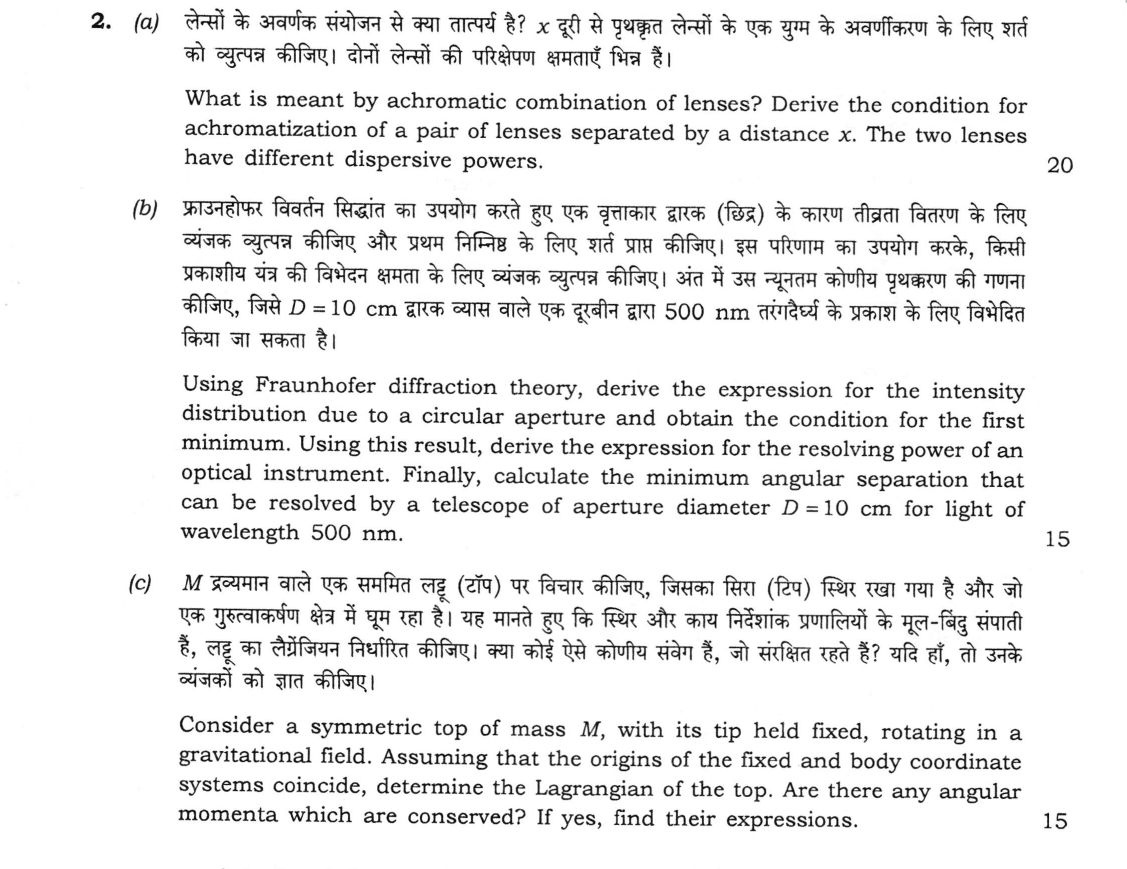
(a) What is meant by achromatic combination of lenses? Derive the condition for achromatization of a pair of lenses separated by…
What is meant by achromatic combination of lenses? Derive the condition for achromatization of a pair of lenses separated by a distance x. The two lenses have different dispersive powers. 20 marks
Using Fraunhofer diffraction theory, derive the expression for the intensity distribution due to a circular aperture and obtain the condition for the first minimum. Using this result, derive the expression for the resolving power of an optical instrument. Finally, calculate the minimum angular separation that can be resolved by a telescope of aperture diameter D = 10 cm for light of wavelength 500 nm. 15 marks
Consider a symmetric top of mass M, with its tip held fixed, rotating in a gravitational field. Assuming that the origins of the fixed and body coordinate systems coincide, determine the Lagrangian of the top. Are there any angular momenta which are conserved? If yes, find their expressions. 15 marks
हिंदी में प्रश्न पढ़ें
लेन्सों के अवर्णक संयोजन से क्या तात्पर्य है? x दूरी से पृथक्कृत लेन्सों के एक युग्म के अवर्णकरण के लिए शर्त को व्युत्पन्न कीजिए। दोनों लेन्सों की परिक्षेपण क्षमताएँ भिन्न हैं। (20 अंक)
फ्राउनहोफर विवर्तन सिद्धांत का उपयोग करते हुए एक वृत्ताकार द्वारक (छिद्र) के कारण तीव्रता वितरण के लिए व्यंजक व्युत्पन्न कीजिए और प्रथम निम्निष्ठ के लिए शर्त प्राप्त कीजिए। इस परिणाम का उपयोग करके, किसी प्रकाशीय यंत्र की विभेदन क्षमता के लिए व्यंजक व्युत्पन्न कीजिए। अंत में उस न्यूनतम कोणीय पृथक्करण की गणना कीजिए, जिसे D = 10 cm द्वारक वाले एक दूरबीन द्वारा 500 nm तरंगदैर्ध्य के प्रकाश के लिए विभेदित किया जा सकता है। (15 अंक)
M द्रव्यमान वाले एक सममित लट्टू (टॉप) पर विचार कीजिए, जिसका सिरा (टिप) स्थिर रखा गया है और जो एक गुरुत्वाकर्षण क्षेत्र में घूम रहा है। यह मानते हुए कि स्थिर और काय निर्देशांक प्रणालियों के मूल-बिंदु संपाती हैं, लट्टू का लैग्रेंजियन निर्धारित कीजिए। क्या कोई ऐसे कोणीय संवेग हैं, जो संरक्षित रहते हैं? यदि हाँ, तो उनके व्यंजकों को ज्ञात कीजिए। (15 अंक)
Model answer
Drafted with AI by UPSC Answer Check against this question's marking rubric, to the expected length. UPSC does not publish answers for Mains — this is one way to score well, not an official key. How we build rubrics and answers.
(a) Achromatic combination of two separated lenses An achromatic combination is a lens system whose focal length (power) is the same for two chosen wavelengths, usually red (C) and blue (F), so that chromatic aberration is removed to first order.
For a thin lens, P = 1/f = (μ − 1)K, where K = 1/R₁ − 1/R₂ depends only on the surfaces. Hence dP = K dμ = [dμ/(μ − 1)]P = ωP, where ω = (μ_B − μ_R)/(μ_Y − 1) is the dispersive power (μ_Y for the mean, yellow, wavelength).
Two thin lenses of powers P₁ = 1/f₁, P₂ = 1/f₂ and dispersive powers ω₁, ω₂, separated by x, have equivalent power P = P₁ + P₂ − xP₁P₂ Condition for achromatism, dP = 0: dP₁ + dP₂ − x(P₂dP₁ + P₁dP₂) = 0 ω₁P₁ + ω₂P₂ − xP₁P₂(ω₁ + ω₂) = 0 Dividing by P₁P₂: ω₁f₂ + ω₂f₁ = x(ω₁ + ω₂) x = (ω₁f₂ + ω₂f₁)/(ω₁ + ω₂)
Special cases:
- Same glass (ω₁ = ω₂): x = (f₁ + f₂)/2, as in Huygens' eyepiece.
- Lenses in contact (x = 0): ω₁/f₁ + ω₂/f₂ = 0, so f₁ and f₂ must have opposite signs (a converging crown lens with a diverging flint lens). Achromatism holds exactly only for the two chosen wavelengths; a small residual secondary spectrum remains.
(b) Circular aperture: Airy pattern and resolving power Intensity distribution: take a circular aperture of radius a (diameter D = 2a) illuminated normally by a plane wave, and a point in direction θ in the focal plane. An element ρ dρ dφ at (ρ, φ) contributes with path difference ρ sin θ cos φ, so the amplitude is E(θ) ∝ ∫₀ᵃ ∫₀²π e^−ikρ sin θ cos φ ρ dρ dφ = 2π ∫₀ᵃ J₀(kρ sin θ) ρ dρ Using ∫₀ᵘ uJ₀(u) du = uJ₁(u), with v = ka sin θ = (πD/λ) sin θ: E(θ) ∝ πa²[2J₁(v)/v] I(θ) = I₀[2J₁(v)/v]² This is the Airy pattern: a bright central disc surrounded by faint rings (the first ring has about 1.75% of I₀).
First minimum: J₁(v) = 0 first at v = 3.832, so (πD/λ) sin θ₁ = 3.832 ⇒ sin θ₁ = 1.22λ/D
Resolving power: by Rayleigh's criterion two point objects are just resolved when the central maximum of one image falls on the first minimum of the other. The minimum resolvable angle is therefore θ_min = 1.22λ/D, and the resolving power is 1/θ_min = D/(1.22λ). A larger aperture or a shorter wavelength improves resolution.
Numerical: D = 10 cm = 0.10 m, λ = 500 nm = 5.0 × 10⁻⁷ m θ_min = 1.22 × 5.0 × 10⁻⁷/0.10 = 6.1 × 10⁻⁶ rad ≈ 1.26″ (1 rad = 206265″) Resolving power = 1/θ_min ≈ 1.64 × 10⁵.
(c) Lagrangian of the heavy symmetric top Use Euler angles: θ (nutation, tilt of the symmetry axis from the vertical), φ (precession about the vertical) and ψ (spin about the symmetry axis). With the fixed tip as the common origin, let I₁ = I₂ be the principal moments about transverse axes through the tip (I₁ = I_cm + Ml²) and I₃ that about the symmetry axis; l is the distance from the tip to the centre of mass.
Body-frame angular velocity components: ω₁ = φ̇ sin θ sin ψ + θ̇ cos ψ, ω₂ = φ̇ sin θ cos ψ − θ̇ sin ψ, ω₃ = ψ̇ + φ̇ cos θ T = ½I₁(ω₁² + ω₂²) + ½I₃ω₃² = ½I₁(θ̇² + φ̇² sin²θ) + ½I₃(ψ̇ + φ̇ cos θ)² V = Mgl cos θ L = ½I₁(θ̇² + φ̇² sin²θ) + ½I₃(ψ̇ + φ̇ cos θ)² − Mgl cos θ
Conserved angular momenta: φ and ψ do not appear in L (cyclic), so their conjugate momenta are constants of motion.
- Angular momentum about the body symmetry axis: p_ψ = ∂L/∂ψ̇ = I₃(ψ̇ + φ̇ cos θ) = I₃ω₃ = constant
- Angular momentum about the fixed vertical axis: p_φ = ∂L/∂φ̇ = I₁φ̇ sin²θ + I₃(ψ̇ + φ̇ cos θ) cos θ = constant Physically, the gravitational torque about the tip, l × Mg, lies along the line of nodes, which is perpendicular to both the vertical and the symmetry axis, so the components of angular momentum along these two axes do not change. Since L has no explicit time dependence, the energy E = T + V is also conserved.
How this answer will be evaluated
Evaluation rubric
Each sub-part is marked on its own, against the marks and word limit printed on the paper.
- (a) Define an achromatic combination of lenses, and derive the condition for achromatism of two thin lenses of different dispersive powers (omega_1, omega_2) separated by a distance x, obtaining x = (omega_1 f_2 + omega_2 f_1)/(omega_1 + omega_2). 20 marks
Must cover
- Definition: focal length/power the same for two wavelengths
- dP = ωP from P = (μ − 1)K, with ω = (μ_B − μ_R)/(μ_Y − 1)
- P = P₁ + P₂ − xP₁P₂ and dP = 0
- x = (ω₁f₂ + ω₂f₁)/(ω₁ + ω₂)
Loses marks
- Using the contact formula 1/F = 1/f₁ + 1/f₂ and dropping the separation term
- Assuming ω₁ = ω₂ from the start although the dispersive powers differ
- Sign error giving x = (ω₁f₂ − ω₂f₁)/(ω₁ − ω₂)
Earns more
- Special cases: ω₁ = ω₂ gives x = (f₁ + f₂)/2; x = 0 gives ω₁/f₁ + ω₂/f₂ = 0 (crown + flint of opposite sign)
- Notes the residual secondary spectrum
- (b) Derive the Fraunhofer intensity distribution for a circular aperture (Airy pattern) and the first-minimum condition, use it to obtain the resolving power/Rayleigh criterion for an optical instrument, and compute the minimum resolvable angular separation of a telescope with D = 10 cm at lambda = 500 nm. 15 marks
Must cover
- Amplitude integral over the aperture giving I = I₀[2J₁(v)/v]², v = (πD/λ) sin θ
- First zero of J₁ at v = 3.832 ⇒ sin θ₁ = 1.22λ/D
- Rayleigh criterion ⇒ θ_min = 1.22λ/D, resolving power D/(1.22λ)
- θ_min = 6.1 × 10⁻⁶ rad ≈ 1.26″
Loses marks
- Using the slit result λ/D (no 1.22 factor) ⇒ 5.0 × 10⁻⁶ rad
- Using the radius instead of the diameter in 1.22λ/D
- Using the first zero of J₀ (2.405) instead of J₁ (3.832)
Earns more
- Resolving power ≈ 1.64 × 10⁵ for this telescope
- Sketch of the Airy pattern or of two just-resolved images
- (c) For a heavy symmetric top of mass M with its tip fixed and rotating in a uniform gravitational field, write the Lagrangian in terms of the Euler angles (theta, phi, psi), and identify which angular momenta are conserved, giving their expressions. 15 marks
Must cover
- Euler angles θ, φ, ψ defined; I₁ = I₂ ≠ I₃ about the fixed tip
- L = ½I₁(θ̇² + φ̇² sin²θ) + ½I₃(ψ̇ + φ̇ cos θ)² − Mgl cos θ
- φ and ψ cyclic ⇒ conjugate momenta conserved
- p_ψ = I₃(ψ̇ + φ̇ cos θ) and p_φ = I₁φ̇ sin²θ + I₃(ψ̇ + φ̇ cos θ) cos θ
Loses marks
- Using I₁ about the centre of mass instead of about the tip
- Writing ω₃ = ψ̇ (dropping φ̇ cos θ)
- Giving p_φ = I₁φ̇ sin²θ only, without the I₃ω₃ cos θ term
Earns more
- Body-frame components ω₁, ω₂, ω₃ in Euler angles shown
- Physical reason: gravitational torque lies along the line of nodes, perpendicular to both axes; energy also conserved
What "Derive" is asking you to do
Reach the stated expression from a starting relation, justifying every step. The destination is printed in the question, so only the route earns marks, and the assumptions you work under are part of that route.
Structure that answers it
Assumptions and notation defined → starting relation or governing equation → each step with its justification → the required expression → limiting case or boundary check
Where marks are lost
Writing the standard result first and fitting three lines to it, which an examiner reads at a glance. Marks also go on assumptions left unstated — lossless medium, small amplitude, errors independent with zero mean — and on symbols used before they are defined, even when the question says usual notations.
Practice this exact question
Write your answer and it is marked point by point against the model answer above — what you covered, what you missed, what you got wrong.
Evaluate my answer →More from Physics 2026 Paper I
- Q1 (a) A uniform rod of length L and mass m stands vertically upright on a rough floor and t…
- Q2 (a) What is meant by achromatic combination of lenses? Derive the condition for achromati…
- Q3 (a) The energy of a photon is expressed as E = hν, where h is the Planck's constant and ν…
- Q4 (a) (i) In Newton's ring experiment, the space between planoconvex lens and glass plate i…
- Q5 (a) Calculate the effective resistance of the following combination of resistances as sho…