Paper I — Q6
(a) Discuss the origin of hysteresis in ferromagnetic materials on the basis of domain theory. Explain how domain wall motion and…
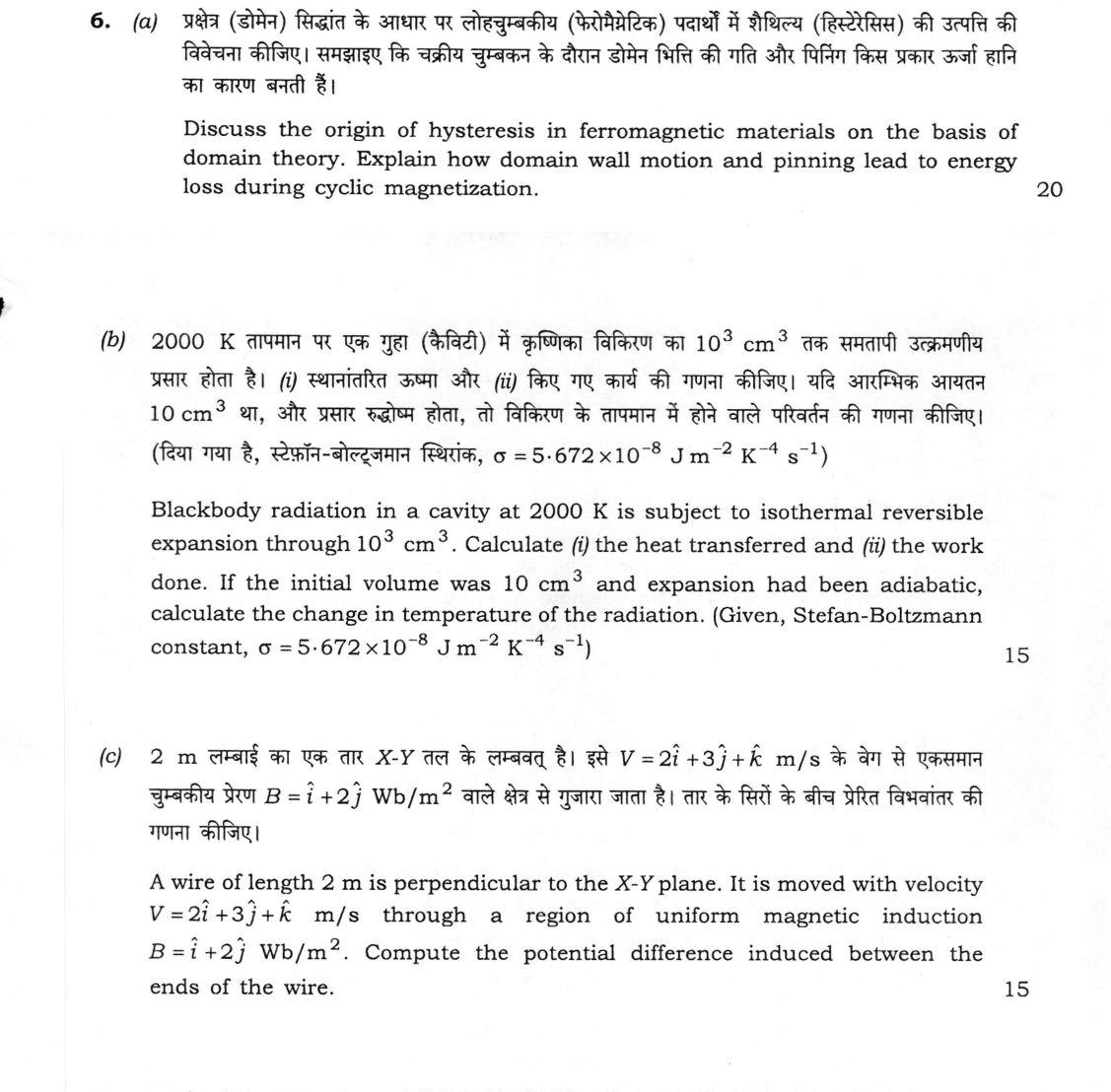
Discuss the origin of hysteresis in ferromagnetic materials on the basis of domain theory. Explain how domain wall motion and pinning lead to energy loss during cyclic magnetization. 20 marks
Blackbody radiation in a cavity at 2000 K is subject to isothermal reversible expansion through 10³ cm³. Calculate (i) the heat transferred and (ii) the work done. If the initial volume was 10 cm³ and expansion had been adiabatic, calculate the change in temperature of the radiation. (Given, Stefan-Boltzmann constant, σ = 5·672×10⁻⁸ J m⁻² K⁻⁴ s⁻¹) 15 marks
A wire of length 2 m is perpendicular to the X-Y plane. It is moved with velocity V = 2î + 3ĵ + k̂ m/s through a region of uniform magnetic induction B = î + 2ĵ Wb/m². Compute the potential difference induced between the ends of the wire. 15 marks
हिंदी में प्रश्न पढ़ें
प्रक्षेत्र (डोमेन) सिद्धांत के आधार पर लोहचुम्बकीय (फेरोमैग्नेटिक) पदार्थों में शैथिल्य (हिस्टेरेसिस) की उत्पत्ति की विवेचना कीजिए। समझाइए कि चक्रीय चुम्बकन के दौरान डोमेन भित्ति की गति और पिनिंग किस प्रकार ऊर्जा हानि का कारण बनती हैं। (20 अंक)
2000 K तापमान पर एक गुहा (कैविटी) में कृष्णिका विकिरण का 10³ cm³ तक समतापी उत्क्रमणीय प्रसार होता है। (i) स्थानांतरित ऊष्मा और (ii) किए गए कार्य की गणना कीजिए। यदि आरंभिक आयतन 10 cm³ था, और प्रसार रुद्धोष्म होता, तो विकिरण के तापमान में होने वाले परिवर्तन की गणना कीजिए। (दिया गया है, स्टेफ़ॉन-बोल्ट्ज़मान स्थिरांक, σ = 5·672×10⁻⁸ J m⁻² K⁻⁴ s⁻¹) (15 अंक)
2 m लम्बाई का एक तार X-Y तल के लम्बवत् है। इसे V = 2î + 3ĵ + k̂ m/s के वेग से एकसमान चुम्बकीय प्रेरण B = î + 2ĵ Wb/m² वाले क्षेत्र से गुजारा जाता है। तार के सिरों के बीच प्रेरित विभवांतर की गणना कीजिए। (15 अंक)
Model answer
Drafted with AI by UPSC Answer Check against this question's marking rubric, to the expected length. UPSC does not publish answers for Mains — this is one way to score well, not an official key. How we build rubrics and answers.
(a) Domain theory of hysteresis and energy loss Domains: in a ferromagnet the quantum-mechanical exchange interaction aligns neighbouring atomic moments, so the material splits into Weiss domains, each spontaneously magnetised to saturation. In an unmagnetised sample the domain moments point in different easy directions and the net magnetisation is zero; this arrangement lowers the magnetostatic (stray-field) energy. Neighbouring domains are separated by Bloch walls in which the spin direction turns gradually; the wall width is a balance between exchange energy (favours a wide wall) and magnetocrystalline anisotropy energy (favours a narrow wall).
Magnetisation process: when a field H is applied,
- at low fields, walls bow and shift reversibly, so domains aligned with H grow;
- at intermediate fields, walls make large irreversible jumps;
- at high fields, domain moments rotate towards H until saturation.
Pinning and irreversibility: real crystals contain inclusions, voids, dislocations, grain boundaries and strain fields. A wall passing through such a defect has lower energy, so it sticks there (pinning). The field must rise until the wall breaks free; it then jumps suddenly to the next pinning site. These jumps are the Barkhausen effect. Because walls do not return along the same path when H is reduced, M lags behind H: at H = 0 some magnetisation remains (remanence Bᵣ), and a reverse field (coercivity H_c) is needed to remove it. This path-dependence traced over a full cycle is the hysteresis loop.
Energy loss: in each sudden jump the energy released is not recovered but is dissipated as heat through local eddy currents and spin-wave (lattice) damping. The work done by the source per cycle per unit volume is W = ∮ H dB = area of the B–H loop, and this appears as heat in the material (hysteresis loss, P = Wf per unit volume for frequency f).
- Soft materials (Si-steel, ferrites): few pinning sites, small H_c, narrow loop, low loss (transformer cores).
- Hard materials (alnico, NdFeB): strong pinning, large H_c, wide loop (permanent magnets). Above the Curie temperature the exchange ordering is destroyed, domains disappear and there is no hysteresis.
(b) Isothermal and adiabatic expansion of blackbody radiation Photon gas: u = aT⁴ with a = 4σ/c = 4 × 5.672 × 10⁻⁸/3.0 × 10⁸ = 7.57 × 10⁻¹⁶ J m⁻³ K⁻⁴ Pressure P = u/3 = aT⁴/3; internal energy U = aT⁴V; entropy S = (4/3)aT³V. At T = 2000 K: aT⁴ = 7.57 × 10⁻¹⁶ × 1.6 × 10¹³ = 1.21 × 10⁻² J m⁻³; ΔV = 10³ cm³ = 10⁻³ m³.
(i) Heat transferred (isothermal, reversible): Q = TΔS = (4/3)aT⁴ΔV = (4/3)(1.21 × 10⁻²)(10⁻³) = 1.61 × 10⁻⁵ J (absorbed)
(ii) Work done: at constant T the pressure is constant, so W = PΔV = (1/3)aT⁴ΔV = 4.04 × 10⁻⁶ J Check: ΔU = aT⁴ΔV = 1.21 × 10⁻⁵ J = Q − W; so Q = 4W.
(iii) Reversible adiabatic expansion: S = constant ⇒ VT³ = constant (PV⁴/3 = constant). V₁ = 10 cm³, V₂ = 10 + 10³ = 1010 cm³: T₂ = T₁(V₁/V₂)¹/3 = 2000 × (10/1010)¹/3 = 2000 × 0.2148 ≈ 429 K ΔT = 429 − 2000 ≈ −1.57 × 10³ K (the radiation cools by about 1571 K). If the expansion is taken to a final volume of 10³ cm³, T₂ ≈ 431 K and ΔT ≈ −1.57 × 10³ K as well.
(c) Motional emf in the moving wire Wire perpendicular to the X–Y plane ⇒ along z: L = 2k̂ m. Motional emf: ε = ∫(V × B)·dL = (V × B)·L for uniform V and B. V × B = | î ĵ k̂ ; 2 3 1 ; 1 2 0 | = î(3·0 − 1·2) − ĵ(2·0 − 1·1) + k̂(2·2 − 3·1) = −2î + ĵ + k̂ (V/m) ε = (−2î + ĵ + k̂)·(2k̂) = 2 V Only the component of V × B along the wire contributes; the magnitude of the potential difference is 2 V, with the end towards +z at the higher potential for the given directions.
How this answer will be evaluated
Evaluation rubric
Each sub-part is marked on its own, against the marks and word limit printed on the paper.
- (a) Explain the microscopic origin of the hysteresis loop in ferromagnets using Weiss domain theory, and then explain in detail how reversible and irreversible domain-wall motion, domain-wall pinning at defects, and Barkhausen jumps convert magnetic work into heat, making the loop area the energy loss per cycle per unit volume. 20 marks
Must cover
- Weiss domains from exchange interaction; Bloch walls (exchange vs anisotropy)
- Magnetisation by reversible wall motion, irreversible wall jumps, then domain rotation
- Pinning of walls at defects ⇒ Barkhausen jumps ⇒ irreversibility, remanence and coercivity
- Loss per cycle per unit volume W = ∮H dB = loop area, dissipated as heat
Loses marks
- Describing the loop only phenomenologically without the domain-wall mechanism
- Treating hysteresis loss as eddy-current loss
- Writing the loss as ∮B dH
Earns more
- Soft vs hard materials linked to weak vs strong pinning, with applications
- Hysteresis vanishes above the Curie temperature
- Labelled B–H loop sketch showing B_r, H_c and saturation
- (b) For blackbody (photon-gas) radiation: (i) compute the heat transferred and (ii) the work done in a reversible isothermal expansion at 2000 K through ΔV = 10³ cm³, and then (iii) compute the temperature change if instead the same expansion from an initial volume of 10 cm³ were carried out reversibly and adiabatically. 15 marks
Must cover
- u = aT⁴, a = 4σ/c = 7.57 × 10⁻¹⁶ J m⁻³ K⁻⁴; P = aT⁴/3; S = (4/3)aT³V
- (i) Q = (4/3)aT⁴ΔV = 1.61 × 10⁻⁵ J
- (ii) W = (1/3)aT⁴ΔV = 4.04 × 10⁻⁶ J
- (iii) VT³ = constant ⇒ T₂ ≈ 429 K, ΔT ≈ −1.57 × 10³ K
Loses marks
- Using ideal-gas W = nRT ln(V₂/V₁) or TV^{γ−1} = constant
- Using P = aT⁴ or u = σT⁴
- Setting Q = W by assuming ΔU = 0 at constant T
Earns more
- First-law check ΔU = aT⁴ΔV = Q − W, Q = 4W
- (c) A 2 m wire lying along the z-axis (perpendicular to the X-Y plane) moves with velocity V = 2î + 3ĵ + k̂ m/s through a uniform field B = î + 2ĵ Wb/m². Compute the motional emf induced between its ends using ε = ∫(V × B)·dL. 15 marks
Must cover
- Wire along z: L = 2k̂ m
- ε = (V × B)·L
- V × B = −2î + ĵ + k̂ V/m
- ε = 2 V
Loses marks
- Using ε = BLv with magnitudes
- Taking |V × B| × L = 2√6 ≈ 4.9 V
- Taking the wire along x or y
Earns more
- Notes that only the component of V × B along the wire contributes and states polarity
What "Discuss" is asking you to do
Lay the issue out from more than one side — how it arose, what is claimed for it, what is held against it, and where it now stands. UPSC attaches discuss to broad topics with several live dimensions, so coverage of the dimensions earns more than the strength of your opinion.
Structure that answers it
Set the issue up → the case as it is made → the case against → the dimension both sides leave out → where the balance now lies
Where marks are lost
Listing facts with no thread between them, or arguing one side throughout and calling it a discussion.
Practice this exact question
Write your answer and it is marked point by point against the model answer above — what you covered, what you missed, what you got wrong.
Evaluate my answer →More from Physics 2026 Paper I
- Q3 (a) The energy of a photon is expressed as E = hν, where h is the Planck's constant and ν…
- Q4 (a) (i) In Newton's ring experiment, the space between planoconvex lens and glass plate i…
- Q5 (a) Calculate the effective resistance of the following combination of resistances as sho…
- Q6 (a) Discuss the origin of hysteresis in ferromagnetic materials on the basis of domain th…
- Q7 (a) A gas has only two particles a and b. Show with the help of diagrams how these two pa…
- Q8 (a) The space between the plates of a parallel-plate capacitor is filled with a dielectri…