Paper II — Q1
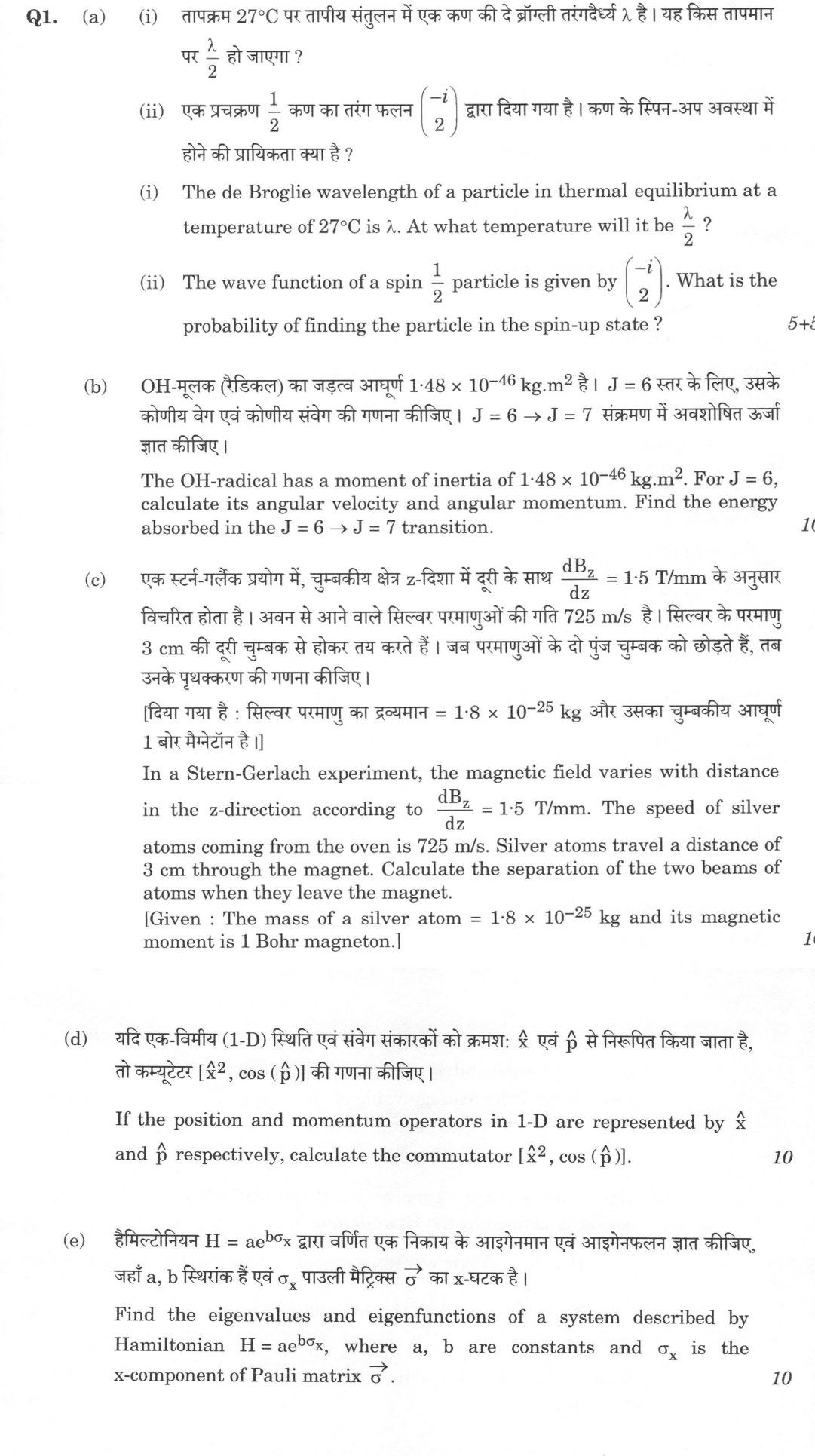
(a) (i) The de Broglie wavelength of a particle in thermal equilibrium at a temperature of 27°C is λ. At what temperature will it…
The de Broglie wavelength of a particle in thermal equilibrium at a temperature of 27°C is λ. At what temperature will it be λ/2 ?
The wave function of a spin 1/2 particle is given by (−i, 2). What is the probability of finding the particle in the spin-up state ? 10 marks
The OH-radical has a moment of inertia of 1·48 × 10⁻⁴⁶ kg.m². For J = 6, calculate its angular velocity and angular momentum. Find the energy absorbed in the J = 6 → J = 7 transition. 10 marks
In a Stern-Gerlach experiment, the magnetic field varies with distance in the z-direction according to dB_z/dz = 1·5 T/mm. The speed of silver atoms coming from the oven is 725 m/s. Silver atoms travel a distance of 3 cm through the magnet. Calculate the separation of the two beams of atoms when they leave the magnet. [Given : The mass of a silver atom = 1·8 × 10⁻²⁵ kg and its magnetic moment is 1 Bohr magneton.] 10 marks
If the position and momentum operators in 1-D are represented by x̂ and p̂ respectively, calculate the commutator [x̂², cos (p̂)]. 10 marks
Find the eigenvalues and eigenfunctions of a system described by Hamiltonian H = ae^(bσ_x), where a, b are constants and σ_x is the x-component of Pauli matrix σ⃗. 10 marks
हिंदी में प्रश्न पढ़ें
तापक्रम 27°C पर तापीय संतुलन में एक कण की दे ब्रॉग्ली तरंगदैर्ध्य λ है। यह किस तापमान पर λ/2 हो जाएगा ?
एक प्रचक्रण 1/2 कण का तरंग फलन (−i, 2) द्वारा दिया गया है। कण के स्पिन-अप अवस्था में होने की प्रायिकता क्या है ? (10 अंक)
OH-मूलक (रैडिकल) का जड़त्व आघूर्ण 1·48 × 10⁻⁴⁶ kg.m² है। J = 6 स्तर के लिए, उसके कोणीय वेग एवं कोणीय संवेग की गणना कीजिए। J = 6 → J = 7 संक्रमण में अवशोषित ऊर्जा ज्ञात कीजिए। (10 अंक)
एक स्टर्न-गर्लैक प्रयोग में, चुम्बकीय क्षेत्र z-दिशा में दूरी के साथ dB_z/dz = 1·5 T/mm के अनुसार विचरित होता है। अवन से आने वाले सिल्वर परमाणुओं की गति 725 m/s है। सिल्वर के परमाणु 3 cm की दूरी चुम्बक से होकर तय करते हैं। जब परमाणुओं के दो पुंज चुम्बक को छोड़ते हैं, तब उनके पृथक्करण की गणना कीजिए। [दिया गया है : सिल्वर परमाणु का द्रव्यमान = 1·8 × 10⁻²⁵ kg और उसका चुम्बकीय आघूर्ण 1 बोर मैग्नेटॉन है।] (10 अंक)
यदि एक-विमीय (1-D) स्थिति एवं संवेग संकारकों को क्रमशः x̂ एवं p̂ से निरूपित किया जाता है, तो कम्यूटेटर [x̂², cos (p̂)] की गणना कीजिए। (10 अंक)
हैमिल्टोनियन H = ae^(bσ_x) द्वारा वर्णित एक निकाय के आइगेनमान एवं आइगेनफलन ज्ञात कीजिए, जहाँ a, b स्थिरांक हैं एवं σ_x पाउली मैट्रिक्स σ⃗ का x-घटक है। (10 अंक)
Model answer
Drafted with AI by UPSC Answer Check against this question's marking rubric, to the expected length. UPSC does not publish answers for Mains — this is one way to score well, not an official key. How we build rubrics and answers.
(a) (i) Temperature for half the de Broglie wavelength For a particle in thermal equilibrium, p = √(3mk_BT) (from ½mv²_rms = (3/2)k_BT), so λ = h/p = h/√(3mk_BT) ⇒ λ ∝ 1/√T λ₁/λ₂ = √(T₂/T₁) ⇒ 2 = √(T₂/300 K) ⇒ T₂ = 4 × 300 = 1200 K (927 °C)
(a) (ii) Probability of spin-up χ = (−i, 2)ᵀ in the (↑, ↓) basis is not normalised: ⟨χ|χ⟩ = |−i|² + |2|² = 1 + 4 = 5. Normalised χ = (1/√5)(−i, 2)ᵀ, so by the Born rule P(↑) = |−i|²/5 = 1/5 = 0.2 (and P(↓) = 4/5).
(b) Rotation of the OH radical Rigid rotor: E_J = J(J + 1)ħ²/2I, |L| = √(J(J + 1)) ħ, L = Iω. For J = 6: L = √42 ħ = 6.481 × 1.055 × 10⁻³⁴ = 6.83 × 10⁻³⁴ J s ω = L/I = 6.83 × 10⁻³⁴/1.48 × 10⁻⁴⁶ = 4.62 × 10¹² rad s⁻¹ Energy absorbed, J = 6 → 7 (ΔJ = +1): ΔE = (ħ²/2I)(7 × 8 − 6 × 7) = 14ħ²/2I = 7ħ²/I ΔE = 7 × (1.055 × 10⁻³⁴)²/1.48 × 10⁻⁴⁶ = 5.26 × 10⁻²² J ≈ 3.28 × 10⁻³ eV (a far-infrared photon, ν ≈ 7.9 × 10¹¹ Hz).
(c) Beam separation in the Stern–Gerlach experiment Force on an atom: F_z = ±μ_B dB_z/dz = 9.274 × 10⁻²⁴ × 1.5 × 10³ = 1.39 × 10⁻²⁰ N Acceleration: a = F/m = 1.39 × 10⁻²⁰/1.8 × 10⁻²⁵ = 7.73 × 10⁴ m s⁻² Time in the magnet: t = L/v = 0.03/725 = 4.14 × 10⁻⁵ s Deflection of each beam: z = ½at² = ½ × 7.73 × 10⁴ × (4.14 × 10⁻⁵)² = 6.6 × 10⁻⁵ m The two beams deflect in opposite directions, so the separation is Δz = 2z = aL²/v² = 1.32 × 10⁻⁴ m ≈ 0.13 mm
(d) Commutator [x̂², cos p̂] Use [x̂, p̂] = iħ, the identity [x̂, f(p̂)] = iħ f′(p̂), and [ÂB̂, Ĉ] = Â[B̂, Ĉ] + [Â, Ĉ]B̂. [x̂, cos p̂] = −iħ sin p̂, [x̂, sin p̂] = iħ cos p̂ [x̂², cos p̂] = x̂[x̂, cos p̂] + [x̂, cos p̂]x̂ = −iħ(x̂ sin p̂ + sin p̂ x̂) Since sin p̂ x̂ = x̂ sin p̂ − iħ cos p̂: [x̂², cos p̂] = −iħ(x̂ sin p̂ + sin p̂ x̂) = −2iħ x̂ sin p̂ − ħ² cos p̂ (Check in momentum space, x̂ = iħ d/dp: acting on g(p) both sides give ħ²(cos p) g + 2ħ²(sin p) g′.)
(e) Eigenvalues and eigenfunctions of H = a e^bσₓ σₓ = [[0, 1], [1, 0]], σₓ² = I, so the exponential series separates into even and odd terms: e^bσₓ = I cosh b + σₓ sinh b ⇒ H = a [[cosh b, sinh b], [sinh b, cosh b]] H is a function of σₓ, so it has the eigenvectors of σₓ (eigenvalues ±1): χ₊ = (1/√2)(1, 1)ᵀ: Hχ₊ = a(cosh b + sinh b)χ₊ ⇒ E₊ = a e^b χ₋ = (1/√2)(1, −1)ᵀ: Hχ₋ = a(cosh b − sinh b)χ₋ ⇒ E₋ = a e^−b
How this answer will be evaluated
Evaluation rubric
Each sub-part is marked on its own, against the marks and word limit printed on the paper.
- (a) Two independent 5-mark numericals: (i) use the thermal de Broglie wavelength λ = h/√(3mkT) to find the temperature at which λ halves, starting from 27 °C; (ii) normalise the unnormalised spinor (−i, 2) and compute the probability of a spin-up measurement. 10 marks
Must cover
- λ = h/√(3mk_BT) ⇒ λ ∝ 1/√T
- T₂ = 4 × 300 K = 1200 K (927 °C)
- Norm ⟨χ|χ⟩ = 5 ⇒ P(↑) = 1/5 = 0.2
Loses marks
- Scaling T in °C (108 °C)
- Using λ ∝ 1/T (600 K)
- Treating (−i, 2) as normalised or taking |−i|² = −1
Earns more
- Writes the normalised spinor (1/√5)(−i, 2)ᵀ and P(↓) = 4/5
- (b) A three-part rigid-rotor numerical on the OH radical with I = 1.48 × 10⁻⁴⁶ kg m²: compute (a) the angular momentum for J = 6, (b) the corresponding angular velocity, and (c) the energy absorbed in the J = 6 → J = 7 rotational transition. 10 marks
Must cover
- |L| = √(J(J + 1)) ħ = √42 ħ = 6.83 × 10⁻³⁴ J s
- ω = L/I = 4.62 × 10¹² rad s⁻¹
- ΔE = (ħ²/2I)[7·8 − 6·7] = 7ħ²/I = 5.26 × 10⁻²² J (3.28 × 10⁻³ eV)
Loses marks
- L = Jħ = 6ħ
- ΔE with factor J = 6 instead of J + 1 = 7
- Using h instead of ħ
Earns more
- E_J = J(J + 1)ħ²/2I and selection rule ΔJ = ±1 stated
- (c) Compute the beam separation in a Stern–Gerlach apparatus: silver atoms (m = 1.8 × 10⁻²⁵ kg, μ = 1 Bohr magneton) at v = 725 m s⁻¹ traverse 3 cm of a field gradient dB_z/dz = 1.5 T mm⁻¹. The answer required is the separation of the TWO beams at the exit of the magnet (not the deflection of one beam). 10 marks
Must cover
- F = μ_B dB_z/dz with 1.5 T/mm = 1500 T/m ⇒ 1.39 × 10⁻²⁰ N
- a = 7.73 × 10⁴ m s⁻², t = L/v = 4.14 × 10⁻⁵ s, z = ½at² = 6.6 × 10⁻⁵ m
- Separation 2z = 1.32 × 10⁻⁴ m
Loses marks
- Giving one beam's deflection as the separation
- No T/mm to T/m conversion
- Using z = at² or vt
Earns more
- Compact form Δz = (μ_B dB/dz)L²/(mv²)
- (d) Evaluate the operator commutator [x̂², cos p̂] in one dimension. The candidate must use the canonical relation [x̂, p̂] = iħ, the identity [x̂, f(p̂)] = iħ ∂f/∂p̂, and the product rule for commutators, and present the ordered (non-commuting) result. 10 marks
Must cover
- [x̂, f(p̂)] = iħ f′(p̂) ⇒ [x̂, cos p̂] = −iħ sin p̂
- Product rule [x̂², C] = x̂[x̂, C] + [x̂, C]x̂
- [x̂², cos p̂] = −iħ(x̂ sin p̂ + sin p̂ x̂) = −2iħ x̂ sin p̂ − ħ² cos p̂
Loses marks
- Sign error: [x̂, cos p̂] = +iħ sin p̂
- Answer −2iħ x̂ sin p̂ without the −ħ² cos p̂ term (unless written in the symmetric form)
- Concluding the commutator is zero
Earns more
- Proof of [x̂, f(p̂)] = iħ f′(p̂) via series or momentum representation
- Verification by acting on a test function
- (e) Find BOTH the eigenvalues and the eigenfunctions (eigenspinors) of H = a e^(b σ_x). The key idea is that any function of σ_x is diagonal in the eigenbasis of σ_x, so the eigenvectors are those of σ_x and the eigenvalues are a e^(±b). 10 marks
Must cover
- σ_x² = I ⇒ e^{bσ_x} = I cosh b + σ_x sinh b
- Eigenvalues E± = a e^{±b}
- Eigenvectors (1/√2)(1, ±1)ᵀ, the eigenvectors of σ_x
Loses marks
- Eigenvalues ±a e^{b}
- Using σ_z eigenvectors (1, 0), (0, 1)
- Giving eigenvalues without eigenfunctions
Earns more
- Explicit matrix H = a[[cosh b, sinh b], [sinh b, cosh b]] and direct verification
What "State" is asking you to do
Give the formulation itself — the theorem, rule, statutory provision or position — worded accurately. Precision of wording is the whole of the mark; no background or justification is being asked for.
Structure that answers it
The statement in full, complete in itself → the conditions under which it holds → an illustration only where the stem asks for one
Where marks are lost
Approximating the wording. A theorem or a provision stated loosely forfeits the mark that exact statement would have carried.
Practice this exact question
Write your answer and it is marked point by point against the model answer above — what you covered, what you missed, what you got wrong.
Evaluate my answer →More from Physics 2026 Paper II
- Q1 (a) (i) The de Broglie wavelength of a particle in thermal equilibrium at a temperature o…
- Q2 (a) A particle is in the ground state of a 1-D simple harmonic oscillator potential, V(x)…
- Q3 (a) (i) Calculate the number of permitted electrons in a sub-shell and a shell in an atom…
- Q4 (a) (i) What are hot bands in vibrational spectroscopy ? Why are they called so ? (8 mark…