Paper II — Q2
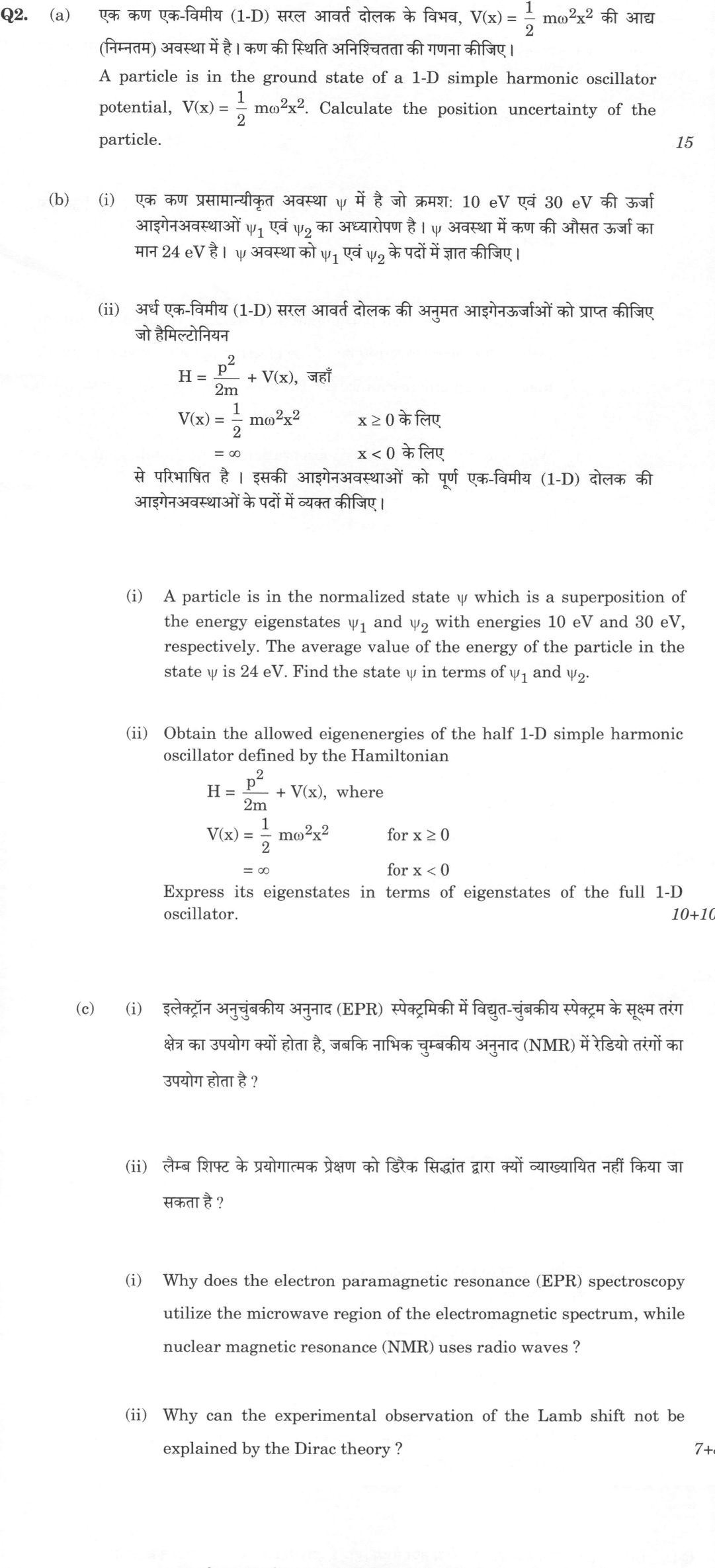
(a) A particle is in the ground state of a 1-D simple harmonic oscillator potential, V(x) = 1/2 mω²x². Calculate the position…
A particle is in the ground state of a 1-D simple harmonic oscillator potential, V(x) = 1/2 mω²x². Calculate the position uncertainty of the particle. 15 marks
A particle is in a normalized state ψ which is a superposition of the energy eigenstates ψ₁ and ψ₂ of energies 10 eV and 30 eV respectively. The average energy of the particle in the state ψ is 24 eV. Find the state ψ in terms of ψ₁ and ψ₂. 10 marks
Obtain the allowed energy eigenvalues of a half 1-D simple harmonic oscillator defined by the Hamiltonian H = p²/2m + V(x), where V(x) = 1/2 mω²x² for x ≥ 0 = ∞ for x < 0 Express its eigenstates in terms of the eigenstates of a complete 1-D oscillator. 10 marks
Why does the electron paramagnetic resonance (EPR) spectroscopy utilize the microwave region of the electromagnetic spectrum, while nuclear magnetic resonance (NMR) uses radio waves ? 7 marks
Why can the experimental observation of the Lamb shift not be explained by the Dirac theory ? 8 marks
हिंदी में प्रश्न पढ़ें
एक कण एक-विमीय (1-D) सरल आवर्त दोलक के विभव, V(x) = 1/2 mω²x² की आद्य (निम्नतम) अवस्था में है। कण की स्थिति अनिश्चितता की गणना कीजिए। (15 अंक)
एक कण प्रसामान्यीकृत अवस्था ψ में है जो क्रमशः 10 eV एवं 30 eV की ऊर्जा आइगेनअवस्थाओं ψ₁ एवं ψ₂ का अध्यारोपण है। ψ अवस्था में कण की औसत ऊर्जा का मान 24 eV है। ψ अवस्था को ψ₁ एवं ψ₂ के पदों में ज्ञात कीजिए। (10 अंक)
अर्ध एक-विमीय (1-D) सरल आवर्त दोलक की अनुमत आइगेनऊर्जाओं को प्राप्त कीजिए जो हैमिल्टोनियन H = p²/2m + V(x), जहाँ V(x) = 1/2 mω²x² x ≥ 0 के लिए = ∞ x < 0 के लिए से परिभाषित है। इसकी आइगेनअवस्थाओं को पूर्ण एक-विमीय (1-D) दोलक की आइगेनअवस्थाओं के पदों में व्यक्त कीजिए। (10 अंक)
इलेक्ट्रॉन अनुचुंबकीय अनुनाद (EPR) स्पेक्ट्रमिकी में विद्युत-चुंबकीय स्पेक्ट्रम के सूक्ष्म तरंग क्षेत्र का उपयोग क्यों होता है, जबकि नाभिक चुंबकीय अनुनाद (NMR) में रेडियो तरंगों का उपयोग होता है ? (7 अंक)
लैम्ब शिफ्ट के प्रयोगात्मक प्रेक्षण को डिरैक सिद्धांत द्वारा क्यों व्याख्यायित नहीं किया जा सकता है ? (8 अंक)
Model answer
Drafted with AI by UPSC Answer Check against this question's marking rubric, to the expected length. UPSC does not publish answers for Mains — this is one way to score well, not an official key. How we build rubrics and answers.
(a) Position uncertainty in the oscillator ground state Normalised ground state: ψ₀(x) = (mω/πħ)¹/4 e^−mωx²/2ħ, E₀ = ½ħω. Let α = mω/ħ, so |ψ₀|² = √(α/π) e^−αx². ⟨x⟩ = √(α/π) ∫ x e^−αx² dx = 0 (odd integrand over −∞ to ∞). ⟨x²⟩ = √(α/π) ∫ x² e^−αx² dx = √(α/π) · √π/(2α³/2) = 1/(2α) = ħ/(2mω) Δx = √(⟨x²⟩ − ⟨x⟩²) = √(ħ/2mω) Check: similarly Δp = √(mħω/2), so Δx·Δp = ħ/2, the minimum allowed by the uncertainty principle; and ⟨V⟩ = ½mω²⟨x²⟩ = ¼ħω = ½E₀, as the virial theorem requires. (Ladder-operator route: x = √(ħ/2mω)(a + a†) gives ⟨0|x²|0⟩ = ħ/2mω directly.)
(b) (i) Superposition with mean energy 24 eV Let ψ = c₁ψ₁ + c₂ψ₂ with ψ₁, ψ₂ orthonormal. Normalisation: |c₁|² + |c₂|² = 1 Mean energy: ⟨E⟩ = |c₁|²E₁ + |c₂|²E₂ ⇒ 10|c₁|² + 30|c₂|² = 24 ⇒ 10|c₁|² + 30(1 − |c₁|²) = 24 ⇒ |c₁|² = 0.3, |c₂|² = 0.7 ψ = √0.3 ψ₁ + √0.7 ψ₂ = √(3/10) ψ₁ + √(7/10) ψ₂ (up to an undetermined relative phase, ψ = √0.3 ψ₁ + eⁱφ√0.7 ψ₂). A measurement of energy gives 30 eV with probability 0.7, which is why the mean lies nearer 30 eV.
(b) (ii) Half oscillator For x < 0 the potential is infinite, so ψ(x) = 0 there and continuity requires ψ(0) = 0. For x ≥ 0 the Schrödinger equation is the same as for the full oscillator, so the solutions are full-oscillator eigenfunctions ψₙ(x) that vanish at x = 0. ψₙ has parity (−1)ⁿ: even-n states have ψₙ(0) ≠ 0, odd-n states have ψₙ(0) = 0. Only odd n = 2k + 1 are allowed: Eₖ = (2k + 1 + ½)ħω = (2k + 3/2)ħω, k = 0, 1, 2, … (i.e. 3ħω/2, 7ħω/2, 11ħω/2, …; spacing 2ħω) Eigenstates: φₖ(x) = √2 ψ₂ₖ₊₁(x) for x ≥ 0; φₖ(x) = 0 for x < 0 The factor √2 normalises the function on the half-line, since |ψ₂ₖ₊₁|² is even and only half of its area lies in x ≥ 0.
(c) (i) Why EPR uses microwaves and NMR uses radio waves Resonance condition: hν = gμB, where μ is the relevant magneton. Electron: μ_B = eħ/2mₑ = 9.27 × 10⁻²⁴ J T⁻¹, g ≈ 2.0023 ⇒ ν/B ≈ 28 GHz T⁻¹. Nucleus: μ_N = eħ/2mₚ = 5.05 × 10⁻²⁷ J T⁻¹, about 1836 (mₚ/mₑ) times smaller; for the proton (gₚ = 5.586) ν/B = 42.58 MHz T⁻¹. With laboratory fields of a few tesla, the electron spin splitting (e.g. 9.5 GHz at 0.34 T, X-band) lies in the microwave region, while the nuclear splitting (e.g. 42.6 MHz at 1 T, 400 MHz at 9.4 T) lies in the radio-frequency region. The difference comes from the nuclear magnetic moment being about three orders of magnitude smaller, because it varies inversely as the mass.
(c) (ii) Why Dirac theory cannot explain the Lamb shift Dirac theory: for hydrogen the energy depends only on n and j, so 2S₁/₂ and 2P₁/₂ (both n = 2, j = ½) are exactly degenerate. Observation: Lamb and Retherford (1947), using microwave transitions in an atomic beam, found 2S₁/₂ lying about 1057 MHz (≈ 4.4 × 10⁻⁶ eV) above 2P₁/₂. Reason: Dirac's equation treats the electron in a classical, unquantised Coulomb field. It leaves out the interaction of the electron with the quantised electromagnetic field. Quantum electrodynamics supplies this:
- Electron self-energy: zero-point fluctuations of the radiation field make the electron jitter, smearing its charge. The averaged Coulomb potential is weakened most for s states, which have |ψ(0)|² ≠ 0, so 2S₁/₂ is raised (Bethe's 1947 estimate ≈ 1040 MHz).
- Vacuum polarisation (virtual e⁺e⁻ pairs) and the anomalous magnetic moment give smaller corrections (vacuum polarisation ≈ −27 MHz). Because these effects arise only when the field itself is quantised, the Lamb shift lies outside the single-particle Dirac theory and is a test of QED.
How this answer will be evaluated
Evaluation rubric
Each sub-part is marked on its own, against the marks and word limit printed on the paper.
- (a) For the ground state of the 1-D harmonic oscillator V = ½mω²x², calculate the position uncertainty Δx = √(⟨x²⟩ − ⟨x⟩²). This requires writing the normalised ground-state Gaussian (or using ladder operators), evaluating ⟨x⟩ and ⟨x²⟩ explicitly, and giving the closed-form result. 15 marks
Must cover
- Normalised ψ₀ = (mω/πħ)^{1/4} e^{−mωx²/2ħ}
- ⟨x⟩ = 0 by parity; ⟨x²⟩ = ħ/(2mω) from the Gaussian integral (or ladder operators)
- Δx = √(ħ/2mω)
Loses marks
- Missing square root or factor 2 in Δx
- Wrong Gaussian exponent e^{−mωx²/ħ}
- Quoting the classical amplitude √(ħ/mω) as Δx
Earns more
- Δp = √(mħω/2) and Δx·Δp = ħ/2 (minimum-uncertainty state)
- Virial check ⟨V⟩ = ¼ħω
- (b)(i) A normalised state ψ is a superposition of two energy eigenstates (10 eV and 30 eV) with mean energy 24 eV. Determine the expansion coefficients and write ψ explicitly in terms of ψ₁ and ψ₂. 10 marks
Must cover
- ⟨E⟩ = |c₁|²E₁ + |c₂|²E₂ with |c₁|² + |c₂|² = 1
- |c₁|² = 0.3, |c₂|² = 0.7
- ψ = √0.3 ψ₁ + √0.7 ψ₂ (up to a relative phase)
Loses marks
- Using c₁E₁ + c₂E₂ = 24 (linear in c)
- Writing ψ = 0.3ψ₁ + 0.7ψ₂
- Interchanging the weights
Earns more
- Mentions the undetermined relative phase
- (b)(ii) Obtain the allowed energy eigenvalues of the half-oscillator (V = ½mω²x² for x ≥ 0, V = ∞ for x < 0) AND express its eigenstates in terms of the eigenstates of the full 1-D oscillator. Both parts must be answered; the key argument is the boundary condition ψ(0) = 0. 10 marks
Must cover
- ψ(0) = 0 from the infinite wall
- Only odd-n full-oscillator states allowed ⇒ E_k = (2k + 3/2)ħω, k = 0, 1, 2, …
- φ_k = √2 ψ_{2k+1} for x ≥ 0, 0 for x < 0
Loses marks
- Keeping all n (full spectrum)
- Keeping even instead of odd states
- Omitting the √2 factor or the eigenstate part
Earns more
- Ground energy 3ħω/2 and spacing 2ħω stated
- Reason for the √2 normalisation
- (c)(i) Explain, with the resonance condition and the relevant magnitudes, WHY EPR resonances fall in the microwave region while NMR resonances fall in the radiofrequency region at laboratory magnetic fields. The answer hinges on the ratio of the electron magnetic moment to the nuclear magnetic moment. 7 marks
Must cover
- Resonance hν = gμB for both
- μ_B/μ_N = m_p/m_e ≈ 1836 (nuclear moment far smaller)
- At lab fields: electron ≈ 28 GHz T⁻¹ (microwave, e.g. 9.5 GHz at 0.34 T); proton 42.58 MHz T⁻¹ (radio frequency)
Loses marks
- 'Electron is lighter' with no link to μ ∝ 1/m and ΔE
- No numbers at all
- Saying EPR needs higher fields than NMR
Earns more
- Magneton values μ_B = 9.27 × 10⁻²⁴ and μ_N = 5.05 × 10⁻²⁷ J T⁻¹
- (c)(ii) Explain why the observed Lamb shift lies outside the Dirac theory: state what Dirac theory predicts for 2S₁/₂ and 2P₁/₂, what is actually measured, and identify the missing physics (quantisation of the radiation field, i.e. QED). 8 marks
Must cover
- Dirac: energy depends on n and j only ⇒ 2S₁/₂ and 2P₁/₂ degenerate
- Lamb–Retherford (1947): 2S₁/₂ above 2P₁/₂ by ≈ 1057 MHz
- Missing physics is field quantisation (QED): self-energy from vacuum fluctuations raising s states, plus vacuum polarisation
Loses marks
- Saying Dirac theory ignores spin or relativity
- Attributing the shift to hyperfine structure or nuclear size
- Naming QED without any mechanism
Earns more
- Bethe's 1947 non-relativistic estimate ≈ 1040 MHz
- Why s states: |ψ(0)|² ≠ 0
What "Calculate" is asking you to do
Apply the standard formula or schedule to data the question has already supplied — a table of readings, cost records, a balance sheet — and produce the number. The method is rarely in doubt; the marks sit in the named intermediate quantities, each of which has to appear as a labelled line.
Structure that answers it
Data as given → formula or standard treatment, named → substitution → each intermediate, labelled → result with units
Where marks are lost
Omitting an intermediate the marking scheme pays for separately, or rounding at an intermediate line so the final figure drifts. In commerce and accountancy, any figure in a statement that no numbered working note supports is treated as unearned.
Practice this exact question
Write your answer and it is marked point by point against the model answer above — what you covered, what you missed, what you got wrong.
Evaluate my answer →More from Physics 2026 Paper II
- Q1 (a) (i) The de Broglie wavelength of a particle in thermal equilibrium at a temperature o…
- Q2 (a) A particle is in the ground state of a 1-D simple harmonic oscillator potential, V(x)…
- Q3 (a) (i) Calculate the number of permitted electrons in a sub-shell and a shell in an atom…
- Q4 (a) (i) What are hot bands in vibrational spectroscopy ? Why are they called so ? (8 mark…
- Q5 (a) Are the nucleons inside the nucleus governed by the laws of quantum physics ? Justify…