Paper II — Q3
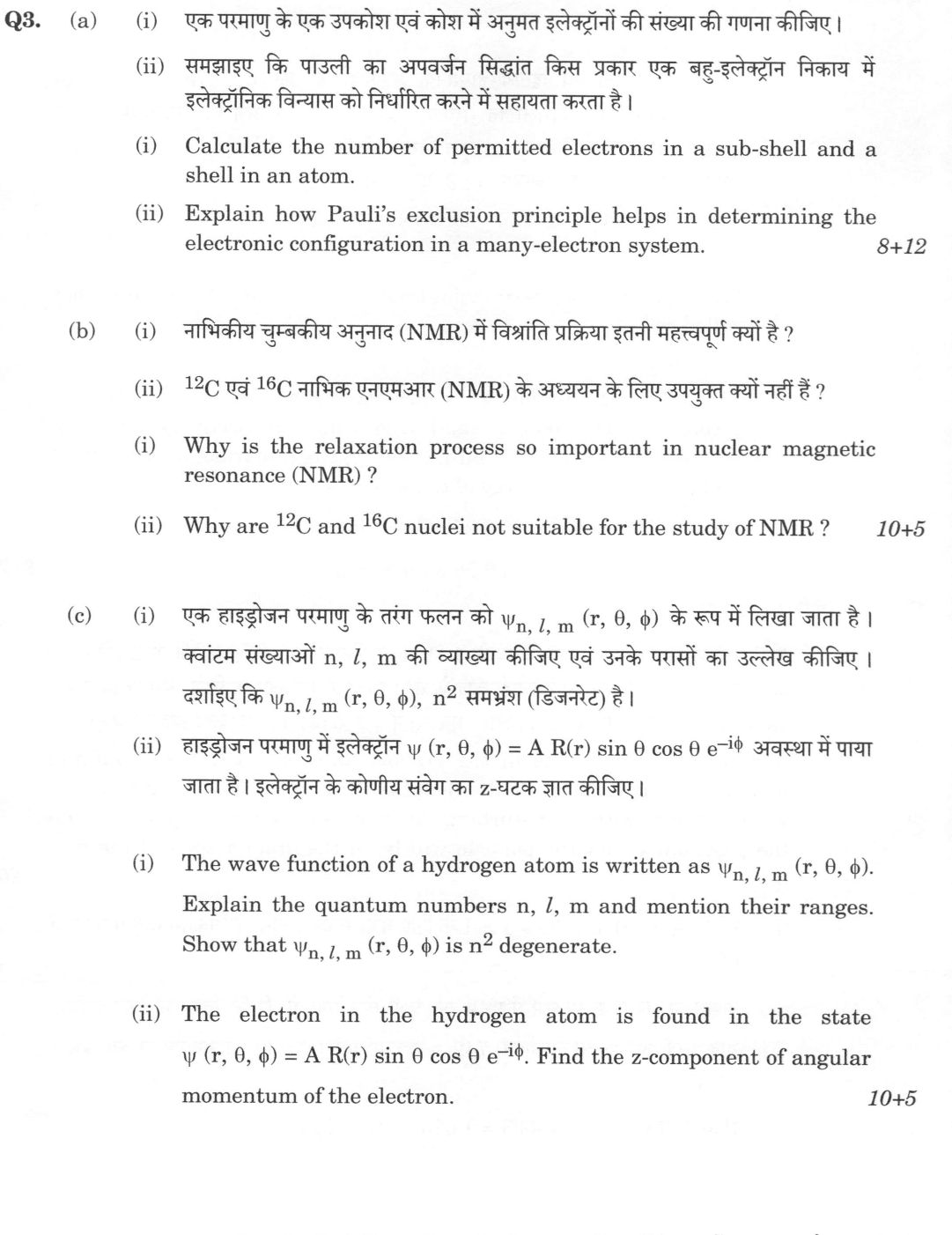
(a) (i) Calculate the number of permitted electrons in a sub-shell and a shell in an atom. (ii) Explain how Pauli's exclusion…
Calculate the number of permitted electrons in a sub-shell and a shell in an atom. (ii) Explain how Pauli's exclusion principle helps in determining the electronic configuration in a many-electron system. (8+12 marks)
Why is the relaxation process so important in nuclear magnetic resonance (NMR)? (ii) Why are 12C and 16C nuclei not suitable for the study of NMR? (10+5 marks)
The wave function of a hydrogen atom is written as ψn, l, m (r, θ, φ). Explain the quantum numbers n, l, m and mention their ranges. Show that ψn, l, m (r, θ, φ) is n² degenerate. (ii) The electron in the hydrogen atom is found in the state ψ (r, θ, φ) = A R(r) sin θ cos θ e⁻ⁱφ. Find the z-component of angular momentum of the electron. (10+5 marks)
हिंदी में प्रश्न पढ़ें
एक परमाणु के एक उपकोश एवं कोश में अनुमत इलेक्ट्रॉनों की संख्या की गणना कीजिए। (ii) समझाइए कि पाउली का अपवर्जन सिद्धांत किस प्रकार एक बहु-इलेक्ट्रॉन निकाय में इलेक्ट्रॉनिक विन्यास को निर्धारित करने में सहायता करता है। (8+12 अंक)
नाभिकीय चुम्बकीय अनुनाद (NMR) में विश्रांति प्रक्रिया इतनी महत्वपूर्ण क्यों है? (ii) 12C एवं 16C नाभिक एनएमआर (NMR) के अध्ययन के लिए उपयुक्त क्यों नहीं हैं? (10+5 अंक)
एक हाइड्रोजन परमाणु के तरंग फलन को ψn, l, m (r, θ, φ) के रूप में लिखा जाता है। क्वांटम संख्याओं n, l, m की व्याख्या कीजिए एवं उनके परासों का उल्लेख कीजिए। दर्शाइए कि ψn, l, m (r, θ, φ), n² समप्रभ (डिजनरेट) है। (ii) हाइड्रोजन परमाणु में इलेक्ट्रॉन ψ (r, θ, φ) = A R(r) sin θ cos θ e⁻ⁱφ अवस्था में पाया जाता है। इलेक्ट्रॉन के कोणीय संवेग का z-घटक ज्ञात कीजिए। (10+5 अंक)
Model answer
Drafted with AI by UPSC Answer Check against this question's marking rubric, to the expected length. UPSC does not publish answers for Mains — this is one way to score well, not an official key. How we build rubrics and answers.
(a) (i) Maximum number of electrons in a sub-shell and a shell By Pauli's exclusion principle no two electrons in an atom have the same set (n, l, mₗ, mₛ). Sub-shell (fixed n, l): mₗ = −l, …, 0, …, +l gives 2l + 1 orbitals; each takes mₛ = +½ and −½. N_sub-shell = 2(2l + 1): s 2, p 6, d 10, f 14. Shell (fixed n): l = 0, 1, …, n − 1, so N_shell = Σₗ₌₀ⁿ⁻¹ 2(2l + 1) = 2[2 · n(n − 1)/2 + n] = 2n²: K 2, L 8, M 18, N 32.
(a) (ii) Role of Pauli's exclusion principle in electronic configuration Statement: no two electrons in an atom can have all four quantum numbers (n, l, mₗ, mₛ) the same; equivalently, the total wavefunction of electrons (fermions) must be antisymmetric under exchange of any two electrons (a Slater determinant vanishes if two electrons share a state). How it fixes the configuration:
- It limits each orbital to two electrons of opposite spin, each sub-shell to 2(2l + 1) and each shell to 2n² electrons. Without it, all electrons would fall into 1s and every atom would behave alike.
- Electrons therefore fill successive orbitals in order of increasing energy (Aufbau, n + l rule): 1s, 2s, 2p, 3s, 3p, 4s, 3d, …
- Within a partly filled sub-shell, Hund's rule applies: electrons occupy different mₗ orbitals with parallel spins before pairing, because the antisymmetry that Pauli's principle imposes keeps parallel-spin electrons apart and lowers their Coulomb repulsion (exchange energy). For example, N (1s² 2s² 2p³) has three unpaired 2p electrons; O (2p⁴) has the fourth electron paired.
- Examples: Na (Z = 11) = 1s² 2s² 2p⁶ 3s¹, one electron outside a closed neon core, hence an alkali metal. Closed shells and sub-shells (He, Ne, Ar) are chemically inert. Thus Pauli's principle produces the shell structure, the periods of lengths 2, 8, 8, 18, …, and the periodicity of chemical properties.
(b) (i) Importance of relaxation in NMR In a field B₀ the nuclear spin levels are populated according to the Boltzmann law, giving a very small population excess in the lower level; the net absorption signal depends on this excess. Relaxation is the return of the spin system to this equilibrium.
- Spin–lattice (longitudinal) relaxation, time T₁: the spins give energy to the surroundings (lattice) and the equilibrium population difference, i.e. M_z, is restored. Without it, continuous absorption would equalise the populations (saturation) and the signal would vanish. T₁ also sets how often pulses can be repeated for signal averaging.
- Spin–spin (transverse) relaxation, time T₂: spins lose phase coherence and M_xy decays. It determines the lifetime of the free induction decay and the natural line width, Δν ≈ 1/(πT₂). Very short T₂ (as in solids) gives broad lines; long T₂ gives the sharp lines needed to resolve chemical shifts and spin–spin coupling.
- T₁ and T₂ depend on molecular motion and environment, so they give information on structure and dynamics, and they provide contrast in MRI. So relaxation makes a steady, sharp and repeatable NMR signal possible and is itself a source of information.
(b) (ii) Why ¹²C and ¹⁶C are unsuitable for NMR NMR needs a nucleus with non-zero spin I, since the magnetic moment μ = γħI and the Zeeman splitting into 2I + 1 levels both vanish for I = 0. Both ¹²C (6 protons, 6 neutrons) and ¹⁶C (6 protons, 10 neutrons) are even–even nuclei. Their protons and neutrons pair off to total angular momentum zero, so I = 0 and μ = 0. There is no Zeeman splitting and no resonance. (¹⁶C is also radioactive, with half-life about 0.75 s.) Carbon NMR therefore uses ¹³C (I = ½, natural abundance about 1.1%).
(c) (i) Quantum numbers of hydrogen and n² degeneracy
- Principal quantum number n = 1, 2, 3, …: fixes the energy Eₙ = −13.6/n² eV and the size of the orbital (number of radial nodes n − l − 1).
- Orbital quantum number l = 0, 1, …, n − 1: fixes the magnitude of orbital angular momentum, L² = l(l + 1)ħ², and the shape (s, p, d, …).
- Magnetic quantum number m = −l, −l + 1, …, +l: fixes L_z = mħ, the orientation of L. Energy of hydrogen depends only on n (Coulomb 1/r potential). For a given n the number of states is Σₗ₌₀ⁿ⁻¹ (2l + 1) = 1 + 3 + 5 + … + (2n − 1) = n² So each level Eₙ is n²-fold degenerate (2n² including spin). Example: n = 2 has 2s (1) + 2p (3) = 4 states.
(c) (ii) z-component of angular momentum L̂_z = −iħ ∂/∂φ L̂_zψ = −iħ ∂/∂φ [A R(r) sin θ cos θ e^−iφ] = −iħ(−i)ψ = −ħψ So ψ is an eigenfunction of L̂_z with L_z = −ħ (m = −1). Since sin θ cos θ e^−iφ ∝ Y₂⁻¹(θ, φ), the state also has l = 2 and L² = 6ħ².
How this answer will be evaluated
Framework: Principle > Setup and diagram > Derivation > Result and limiting case
What earns full marks: Rigorous derivations, correct quantum number logic, clear NMR physics, and accurate calculation of Lz.
Evaluation rubric
Each sub-part is marked on its own, against the marks and word limit printed on the paper.
- (a)(i) Derive formulas for maximum electrons in a sub-shell and a shell. 8 marks
calculate— given → formula → substitution → result with units → interpretation
Must cover
- 2l + 1 values of m_l, two spins each ⇒ 2(2l + 1) per sub-shell
- Σ_{l=0}^{n−1} 2(2l + 1) = 2n² per shell
- Basis: Pauli exclusion principle
Loses marks
- Stating formula without derivation
- Confusing sub-shell and shell limits
Earns more
- Numerical examples: s 2, p 6, d 10; K 2, L 8, M 18
Extra mark
- Notes the sum of the first n odd numbers is n²
- (a)(ii) Explain how Pauli's principle determines electronic configuration. 12 marks
explain— definition/context → points in order → small example → short close
Must cover
- Statement with all four quantum numbers (or antisymmetry of the wavefunction)
- Limits: 2 per orbital, 2(2l + 1) per sub-shell, 2n² per shell ⇒ electrons fill successive levels (Aufbau)
- Hund's rule for partly filled sub-shells, with an example configuration
Loses marks
- Vague description without quantum numbers
- Ignoring spin quantum number
Earns more
- Explains shell structure and periodicity (closed shells inert, alkali single s electron)
- Links Hund's rule to exchange/antisymmetry
Extra mark
- Slater determinant form of the antisymmetric wavefunction
- (b)(i) Explain the importance of relaxation in NMR. 10 marks
explain— definition/context → points in order → small example → short close
Must cover
- Relaxation restores the Boltzmann population difference after excitation
- T₁ (spin–lattice) prevents saturation and sets the repetition rate
- T₂ (spin–spin) governs FID decay and line width Δν ≈ 1/πT₂
Loses marks
- Confusing relaxation with the resonance frequency
- No mention of saturation or equilibrium restoration
- Claiming the FID would not decay without relaxation and that this makes the signal indistinguishable from noise
Earns more
- T₁, T₂ carry information on molecular motion/environment; MRI contrast
- Sharp lines needed to resolve chemical shifts
Extra mark
- Typical values (T₁ seconds for liquids, T₂ microseconds in solids)
- (b)(ii) Explain why 12C and 16C are not suitable for NMR. 5 marks
explain— definition/context → points in order → small example → short close
Must cover
- NMR needs nuclear spin I ≠ 0 (magnetic moment)
- ¹²C and ¹⁶C are even–even nuclei with I = 0, so no Zeeman splitting
Loses marks
- Saying they are 'too light' or 'unstable'
- Failing to mention nuclear spin
Earns more
- Even Z, even N pairing rule stated
- Contrast with ¹³C (I = ½)
Extra mark
- Notes ¹⁶C is short-lived or ¹³C natural abundance ≈ 1.1%
- (c)(i) Explain quantum numbers and show n² degeneracy. 10 marks
explain— definition/context → points in order → small example → short close
Must cover
- n = 1, 2, …; l = 0 … n − 1; m = −l … +l, with physical meaning of each
- Energy depends only on n for hydrogen
- Σ_{l=0}^{n−1}(2l + 1) = n² ⇒ n²-fold degeneracy
Loses marks
- Incorrect ranges for l or m
- Stating n² without proof
Earns more
- L² = l(l + 1)ħ², L_z = mħ stated
- Example n = 2 gives 4 states
Extra mark
- Spin gives 2n²; accidental l-degeneracy due to the 1/r potential
- (c)(ii) Find z-component of angular momentum from wave function. 5 marks
calculate— given → formula → substitution → result with units → interpretation
Must cover
- L̂_z = −iħ ∂/∂φ applied to e^{−iφ}
- L_z = −ħ (m = −1)
Loses marks
- Confusing m with l
- Forgetting the negative sign
Earns more
- Shows the operator step explicitly
- Identifies Y₂^{−1}, l = 2, L² = 6ħ²
Extra mark
- Mention units of angular momentum
What "Calculate" is asking you to do
Apply the standard formula or schedule to data the question has already supplied — a table of readings, cost records, a balance sheet — and produce the number. The method is rarely in doubt; the marks sit in the named intermediate quantities, each of which has to appear as a labelled line.
Structure that answers it
Data as given → formula or standard treatment, named → substitution → each intermediate, labelled → result with units
Where marks are lost
Omitting an intermediate the marking scheme pays for separately, or rounding at an intermediate line so the final figure drifts. In commerce and accountancy, any figure in a statement that no numbered working note supports is treated as unearned.
Practice this exact question
Write your answer and it is marked point by point against the model answer above — what you covered, what you missed, what you got wrong.
Evaluate my answer →More from Physics 2026 Paper II
- Q1 (a) (i) The de Broglie wavelength of a particle in thermal equilibrium at a temperature o…
- Q2 (a) A particle is in the ground state of a 1-D simple harmonic oscillator potential, V(x)…
- Q3 (a) (i) Calculate the number of permitted electrons in a sub-shell and a shell in an atom…
- Q4 (a) (i) What are hot bands in vibrational spectroscopy ? Why are they called so ? (8 mark…
- Q5 (a) Are the nucleons inside the nucleus governed by the laws of quantum physics ? Justify…
- Q6 (a) By considering the three-dimensional harmonic oscillator potential, explain the energ…