Paper II — Q4
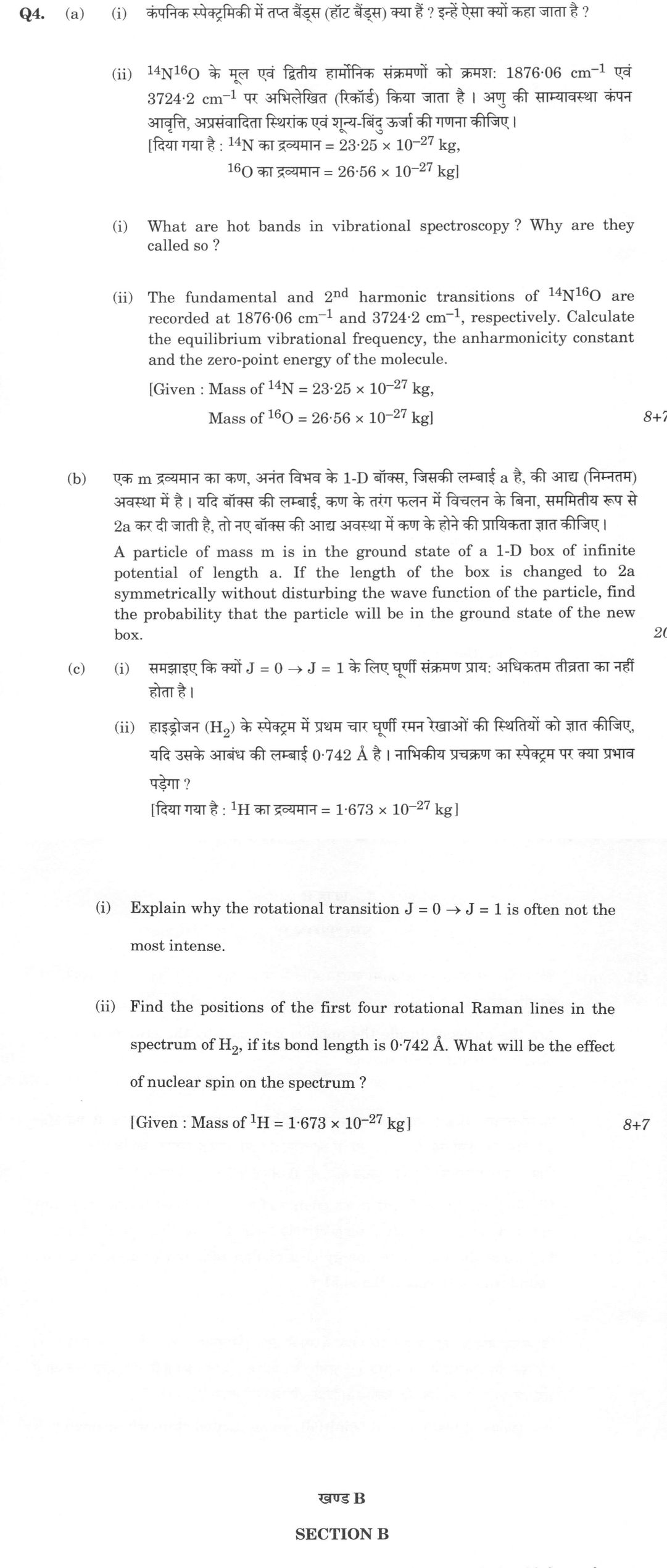
(a) (i) What are hot bands in vibrational spectroscopy ? Why are they called so ? (8 marks) (ii) The fundamental and 2nd…
What are hot bands in vibrational spectroscopy ? Why are they called so ? 8 marks
The fundamental and 2nd harmonic transitions of ¹⁴N¹⁶O are recorded at 1876·06 cm⁻¹ and 3724·2 cm⁻¹, respectively. Calculate the equilibrium vibrational frequency, the anharmonicity constant and the zero-point energy of the molecule. [Given : Mass of ¹⁴N = 23·25 × 10⁻²⁷ kg, Mass of ¹⁶O = 26·56 × 10⁻²⁷ kg] 7 marks
A particle of mass m is in the ground state of a 1-D box of infinite potential of length a. If the length of the box is changed to 2a symmetrically without disturbing the wave function of the particle, find the probability that the particle will be in the ground state of the new box. 20 marks
Explain why the rotational transition for J = 0 → J = 1 is usually not of maximum intensity. 8 marks
Determine the positions of the first four rotational Raman lines in the spectrum of hydrogen (H₂), given that its bond length is 0·742 Å. What effect will the nuclear spin have on the spectrum ? [Given : Mass of ¹H = 1·673 × 10⁻²⁷ kg] 7 marks
हिंदी में प्रश्न पढ़ें
कंपनिक स्पेक्ट्रमिकी में तप्त बैंड्स (हॉट बैंड्स) क्या हैं ? इन्हें ऐसा क्यों कहा जाता है ? (8 अंक)
¹⁴N¹⁶O के मूल एवं द्वितीय हार्मोनिक संक्रमणों को क्रमश: 1876·06 cm⁻¹ एवं 3724·2 cm⁻¹ पर अभिलेखित (रिकॉर्डिंग) किया जाता है । अणु की साम्यावस्था कंपन आवृत्ति, अप्रसंवादिता स्थिरांक एवं शून्य-बिंदु ऊर्जा की गणना कीजिए । [दिया गया है : ¹⁴N का द्रव्यमान = 23·25 × 10⁻²⁷ kg, ¹⁶O का द्रव्यमान = 26·56 × 10⁻²⁷ kg] (7 अंक)
एक m द्रव्यमान का कण, अनंत विभव के 1-D बॉक्स, जिसकी लम्बाई a है, की आद्य (निम्नतम) अवस्था में है । यदि बॉक्स की लम्बाई, कण के तरंग फलन में विचलन के बिना, सममितीय रूप से 2a कर दी जाती है, तो नए बॉक्स की आद्य अवस्था में कण के होने की प्रायिकता ज्ञात कीजिए । (20 अंक)
समझाइए कि क्यों J = 0 → J = 1 के लिए घूर्णी संक्रमण प्राय: अधिकतम तीव्रता का नहीं होता है । (8 अंक)
हाइड्रोजन (H₂) के स्पेक्ट्रम में प्रथम चार घूर्णी रमन रेखाओं की स्थितियों को ज्ञात कीजिए, यदि उसके आबंध की लम्बाई 0·742 Å है । नाभिकीय प्रचक्रण का स्पेक्ट्रम पर क्या प्रभाव पड़ेगा ? [दिया गया है : ¹H का द्रव्यमान = 1·673 × 10⁻²⁷ kg] (7 अंक)
Model answer
Drafted with AI by UPSC Answer Check against this question's marking rubric, to the expected length. UPSC does not publish answers for Mains — this is one way to score well, not an official key. How we build rubrics and answers.
(a) (i) Hot bands A hot band is a vibrational transition that starts from a thermally excited level, e.g. v = 1 → 2, instead of from the ground level v = 0. Why "hot": the band's intensity depends on the population of v = 1, N₁/N₀ = e^−hcω̃/k_BT, which is appreciable only at higher temperature. The band grows in strength when the sample is heated and fades on cooling. Position: with anharmonicity, G(v) = ω̃ₑ(v + ½) − ω̃ₑ xₑ(v + ½)², so ν̃(0 → 1) = ω̃ₑ − 2ω̃ₑ xₑ and ν̃(1 → 2) = ω̃ₑ − 4ω̃ₑ xₑ. The hot band therefore lies about 2ω̃ₑ xₑ below the fundamental, as a weak satellite on its low-wavenumber side (for a harmonic oscillator it would coincide with the fundamental). Hot bands are prominent for low-frequency modes (hcω̃ ~ k_BT) and in flames and planetary atmospheres, and their intensity ratio to the fundamental can be used to estimate temperature.
(a) (ii) ¹⁴N¹⁶O: ω̃ₑ, anharmonicity and zero-point energy G(v) = ω̃ₑ(v + ½) − ω̃ₑ xₑ(v + ½)² Fundamental (0 → 1): ω̃ₑ − 2ω̃ₑ xₑ = 1876.06 cm⁻¹ Second harmonic (first overtone, 0 → 2): 2ω̃ₑ − 6ω̃ₑ xₑ = 3724.2 cm⁻¹ Subtracting twice the first from the second: −2ω̃ₑ xₑ = 3724.2 − 3752.12 = −27.92 ω̃ₑ xₑ = 13.96 cm⁻¹ ω̃ₑ = 1876.06 + 2(13.96) = 1903.98 cm⁻¹ (νₑ = cω̃ₑ = 5.71 × 10¹³ Hz) Anharmonicity constant xₑ = 13.96/1903.98 = 7.33 × 10⁻³ Zero-point energy: G(0) = ½ω̃ₑ − ¼ω̃ₑ xₑ = 951.99 − 3.49 = 948.5 cm⁻¹ = 1.88 × 10⁻²⁰ J (0.118 eV)
(b) Probability of the new ground state after symmetric widening The box widens suddenly, so the wavefunction is unchanged just after the change and P = |⟨φ₁|ψ⟩|² (sudden approximation). Take the centre of the box as origin. Old ground state (width a): ψ(x) = √(2/a) cos(πx/a) for |x| ≤ a/2, zero elsewhere. New ground state (width 2a): φ₁(x) = √(2/2a) cos(πx/2a) = √(1/a) cos(πx/2a) for |x| ≤ a. Overlap (only |x| ≤ a/2 contributes): c = (√2/a) ∫_−a/2^a/2 cos(πx/a) cos(πx/2a) dx = (√2/2a) ∫_−a/2^a/2 [cos(3πx/2a) + cos(πx/2a)] dx = (√2/2a) [ (2a/3π) · 2 sin(3π/4) + (2a/π) · 2 sin(π/4) ] = (√2/2a) [ 2√2a/3π + 2√2a/π ] = (√2/2a)(8√2a/3π) = 8/(3π) = 0.849 P = c² = 64/(9π²) ≈ 0.72 So there is a 72% chance of finding the particle in the new ground state. (If instead the box were extended on one side only, from [0, a] to [0, 2a], the result would be 32/(9π²) ≈ 0.36; the symmetric widening keeps the larger overlap.)
(c) (i) Why J = 0 → 1 is not the most intense rotational line The intensity of a line J → J + 1 is proportional (mainly) to the population of the lower level J: N_J/N₀ = (2J + 1) e^−hcBJ(J + 1)/k_BT The degeneracy factor (2J + 1) (the 2J + 1 values of M_J) increases with J, while the Boltzmann factor decreases. For typical molecules at room temperature hcB ≪ k_BT, so the degeneracy wins at first and the population rises through several J values before the exponential takes over. J = 0 has degeneracy 1 and is therefore not the most populated level. The maximum is at dN_J/dJ = 0 ⇒ J_max = √(k_BT/2hcB) − ½ Example: CO (B ≈ 1.93 cm⁻¹) at 300 K gives J_max ≈ 7. Only for very light molecules or very low temperatures (hcB comparable to k_BT) is the J = 0 → 1 line the strongest.
(c) (ii) Rotational Raman lines of H₂ and effect of nuclear spin Reduced mass: μ = m_H/2 = 8.365 × 10⁻²⁸ kg Moment of inertia: I = μr² = 8.365 × 10⁻²⁸ × (0.742 × 10⁻¹⁰)² = 4.61 × 10⁻⁴⁸ kg m² Rotational constant: B = h/(8π²cI) = 6.626 × 10⁻³⁴/(8π² × 3.0 × 10¹⁰ × 4.61 × 10⁻⁴⁸) = 60.8 cm⁻¹ Rotational Raman selection rule ΔJ = ±2; the lines J → J + 2 are displaced from the exciting line by Δν̃ = B[(J + 2)(J + 3) − J(J + 1)] = B(4J + 6)
- J = 0 → 2: 6B = 364.7 cm⁻¹
- J = 1 → 3: 10B = 607.8 cm⁻¹
- J = 2 → 4: 14B = 850.9 cm⁻¹
- J = 3 → 5: 18B = 1094.1 cm⁻¹ These appear as Stokes lines on the low-frequency side of the exciting line, with anti-Stokes lines at the same shifts on the high side; the first line is at 6B and the spacing is 4B = 243 cm⁻¹. Nuclear-spin effect: the protons are fermions (I = ½), so the total wavefunction must be antisymmetric under their exchange. The symmetric nuclear-spin triplet (ortho-H₂, weight 3) goes with odd J, and the antisymmetric singlet (para-H₂, weight 1) with even J. Lines from odd J (607.8, 1094.1 cm⁻¹) are therefore about three times as strong as those from even J (364.7, 850.9 cm⁻¹): an intensity alternation of 1 : 3. No lines are missing.
How this answer will be evaluated
Evaluation rubric
Each sub-part is marked on its own, against the marks and word limit printed on the paper.
- (a)(i) Define hot bands in vibrational (IR/Raman) spectroscopy and explain the origin of the name — both halves must be answered, the second requiring the Boltzmann population argument. 8 marks
Must cover
- Transition from a thermally populated excited level (v = 1 → 2), not from v = 0
- Named 'hot' because intensity ∝ Boltzmann population of v = 1, rising with temperature
- Anharmonicity puts it ≈ 2ω̃_e x_e below the fundamental
Loses marks
- Confusing hot bands with overtones or combination bands
- Saying the hot band lies at higher wavenumber
- Definition without the Boltzmann reason for the name
Earns more
- ν̃(1→2) = ω̃_e − 4ω̃_e x_e vs ν̃(0→1) = ω̃_e − 2ω̃_e x_e written
- Use as a thermometer or importance for low-frequency modes
- (a)(ii) From the fundamental (1876.06 cm⁻¹) and the '2nd harmonic' (first overtone, 3724.2 cm⁻¹) of ¹⁴N¹⁶O, calculate THREE quantities: the equilibrium vibrational frequency ω̃_e, the anharmonicity constant, and the zero-point energy of the molecule. 7 marks
Must cover
- ω̃_e − 2ω̃_e x_e = 1876.06 and 2ω̃_e − 6ω̃_e x_e = 3724.2 (0 → 2 overtone)
- ω̃_e x_e = 13.96 cm⁻¹, x_e = 7.33 × 10⁻³
- ω̃_e = 1903.98 cm⁻¹
- ZPE = ½ω̃_e − ¼ω̃_e x_e = 948.5 cm⁻¹
Loses marks
- Treating 3724.2 cm⁻¹ as a 1 → 2 transition
- Harmonic ZPE ½ω̃_e = 952 cm⁻¹ without the anharmonic term
- Using 2ω̃_e − 4ω̃_e x_e for the overtone
Earns more
- ZPE also in joules (1.88 × 10⁻²⁰ J) or eV
- (b) A particle sits in the ground state of an infinite well of width a; the well is suddenly widened SYMMETRICALLY to width 2a with the wave function unchanged. Compute the probability of finding the particle in the ground state of the new well — i.e. apply the sudden approximation and evaluate the overlap integral. 20 marks
Must cover
- Sudden approximation: P = |⟨φ₁|ψ⟩|²
- ψ = √(2/a) cos(πx/a) on |x| ≤ a/2; φ₁ = √(1/a) cos(πx/2a) on |x| ≤ a
- Overlap integral over |x| ≤ a/2 only: c = 8/(3π) = 0.849
- P = 64/(9π²) ≈ 0.72
Loses marks
- Integrating over |x| ≤ a
- Wrong normalisation √(2/a) for the new state
- Giving c = 0.849 as the probability
Earns more
- Product-to-sum evaluation shown step by step
- Remark that one-sided widening would give 32/(9π²) ≈ 0.36
- (c)(i) Explain why the J = 0 → J = 1 line is usually NOT the most intense line in a rotational (microwave) spectrum: the intensity follows the thermal population of the lower level, which is the product of the degeneracy (2J+1) and the Boltzmann factor, and peaks at an intermediate J. 8 marks
Must cover
- Line intensity follows the population of the lower level J
- N_J ∝ (2J + 1) e^{−hcBJ(J + 1)/k_BT}: degeneracy rises, Boltzmann factor falls
- Maximum at J_max = √(k_BT/2hcB) − ½, not at J = 0
Loses marks
- Explaining through selection rules or dipole moment instead of populations
- Omitting the (2J + 1) degeneracy
- J_max without the −½
Earns more
- Numerical example (e.g. CO at 300 K, J_max ≈ 7)
- Notes J = 0 → 1 can be strongest only for very light molecules or very low T
- (c)(ii) Two demands: (a) compute the positions (Raman shifts) of the first four rotational Raman lines of H₂ given r = 0.742 Å and m(¹H) = 1.673 × 10⁻²⁷ kg; (b) state the effect of nuclear spin (ortho/para hydrogen) on the spectrum. 7 marks
Must cover
- μ = m_H/2, I = 4.61 × 10⁻⁴⁸ kg m², B = 60.8 cm⁻¹
- ΔJ = ±2, Δν̃ = B(4J + 6): 364.7, 607.8, 850.9, 1094.1 cm⁻¹
- Nuclear spin: ortho (odd J, weight 3) and para (even J, weight 1) ⇒ 1 : 3 intensity alternation, starting weak
Loses marks
- μ = m_H
- Using ΔJ = ±1 or first line at 4B
- Saying alternate lines are missing, or giving weight 3 to even J
Earns more
- Mentions Stokes and anti-Stokes lines at equal shifts
- Explains the weights from antisymmetry for fermions
What "Explain" is asking you to do
Make the working of something clear — what sets it off, what follows from what, and what it produces. Explain is the Commission's mechanism word: it dominates the technical papers and the “explain why” stems, where the marks sit in the causal chain and not in the label.
Structure that answers it
State what it is → the initiating condition → the chain of cause, step by step → an instance where it plays out → what the chain produces
Where marks are lost
Describing what something looks like instead of why it works that way. Naming the stages without linking them reads as description too.
Practice this exact question
Write your answer and it is marked point by point against the model answer above — what you covered, what you missed, what you got wrong.
Evaluate my answer →More from Physics 2026 Paper II
- Q1 (a) (i) The de Broglie wavelength of a particle in thermal equilibrium at a temperature o…
- Q2 (a) A particle is in the ground state of a 1-D simple harmonic oscillator potential, V(x)…
- Q3 (a) (i) Calculate the number of permitted electrons in a sub-shell and a shell in an atom…
- Q4 (a) (i) What are hot bands in vibrational spectroscopy ? Why are they called so ? (8 mark…
- Q5 (a) Are the nucleons inside the nucleus governed by the laws of quantum physics ? Justify…
- Q6 (a) By considering the three-dimensional harmonic oscillator potential, explain the energ…
- Q7 (a) (i) What is diamagnetism ? Why do diamagnetic materials have negative magnetic suscep…