Paper II — Q7
(a) (i) What is diamagnetism ? Why do diamagnetic materials have negative magnetic susceptibility ? (ii) Discuss the limitations…
What is diamagnetism ? Why do diamagnetic materials have negative magnetic susceptibility ?
Discuss the limitations of the quantum theory of diamagnetism.
Draw a diagram of magnetic susceptibility as a function of temperature. Pay attention to the relative scales in your diagram so that the relative strengths of the magnetic phenomena are presented. 20 marks
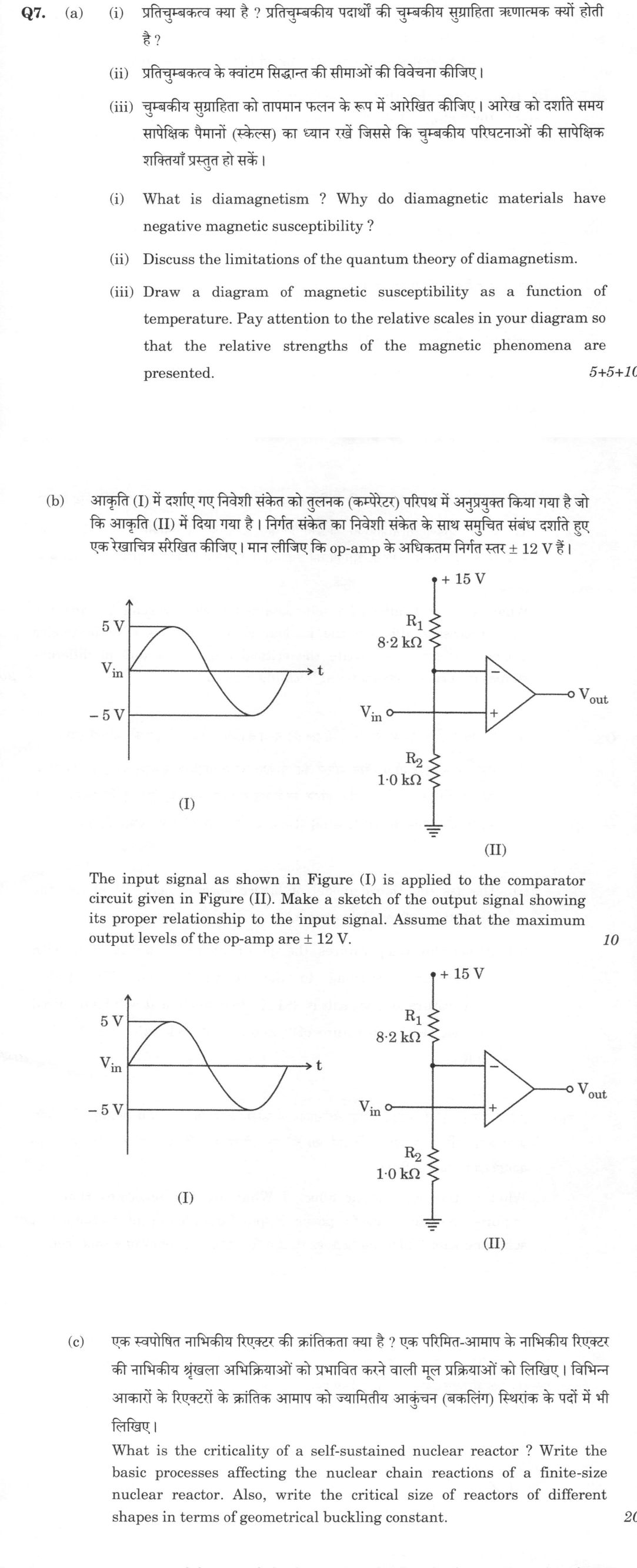
The input signal as shown in Figure (I) is applied to the comparator circuit given in Figure (II). Make a sketch of the output signal showing its proper relationship to the input signal. Assume that the maximum output levels of the op-amp are ± 12 V. 10 marks
What is the criticality of a self-sustained nuclear reactor ? Write the basic processes affecting the nuclear chain reactions of a finite-size nuclear reactor. Also, write the critical size of reactors of different shapes in terms of geometrical buckling constant. 20 marks
हिंदी में प्रश्न पढ़ें
प्रतिचुम्बकत्व क्या है ? प्रतिचुम्बकीय पदार्थों की चुम्बकीय सुग्राहिता ऋणात्मक क्यों होती है ?
प्रतिचुम्बकत्व के क्वांटम सिद्धान्त की सीमाओं की विवेचना कीजिए ।
चुम्बकीय सुग्राहिता को तापमान फलन के रूप में आरेखित कीजिए । आरेख को दर्शिते समय सापेक्षिक पैमानों (स्केल्स) का ध्यान रखें जिससे कि चुम्बकीय परिघटनाओं की सापेक्षिक शक्तियाँ प्रस्तुत हो सकें । (20 अंक)
आकृति (I) में दर्शाए गए निवेशी संकेत को तुलनक (कम्पेरेटर) परिपथ में अनुप्रयुक्त किया गया है जो कि आकृति (II) में दिया गया है। निर्गत संकेत का निवेशी संकेत के साथ समुचित संबंध दर्शाते हुए एक रेखाचित्र संरचित कीजिए। मान लीजिए कि op-amp के अधिकतम निर्गत स्तर ± 12 V हैं। (10 अंक)
एक स्वपोषित नाभिकीय रिएक्टर की क्रांतिकता क्या है ? एक परिमित-आमाप के नाभिकीय रिएक्टर की नाभिकीय श्रृंखला अभिक्रियाओं को प्रभावित करने वाली मूल प्रक्रियाओं को लिखिए। विभिन्न आकारों के रिएक्टरों के क्रांतिक आमाप को ज्यामितीय आकुंचन (बकलिंग) स्थिरांक के पदों में भी लिखिए। (20 अंक)
Model answer
Drafted with AI by UPSC Answer Check against this question's marking rubric, to the expected length. UPSC does not publish answers for Mains — this is one way to score well, not an official key. How we build rubrics and answers.
(a) Diamagnetism (20 marks)
(i) Diamagnetism is the weak magnetisation that a material acquires in a direction opposite to the applied field, so that it is slightly repelled. It is present in all matter and dominates when all electrons are paired. When a field B is applied, the orbits of the electrons precess about B at the Larmor frequency ω_L = eB/2mₑ; by Lenz's law the induced circulation produces a moment opposing B. For Z electrons per atom, with ⟨r²⟩ the mean square radius of the orbits, each atom acquires a moment -Ze²B⟨r²⟩/6mₑ, so for N atoms per unit volume the Langevin-Larmor susceptibility is χ = -μ₀NZe²⟨r²⟩/6mₑ. Every factor is positive, so χ is negative and very small, about -10⁻⁵ to -10⁻⁶, independent of temperature.
(ii) Classically there would be no diamagnetism at all (Bohr-van Leeuwen theorem), so it is a quantum effect, but the simple quantum theory has limits. It treats each atom or ion independently and applies to closed-shell systems such as noble gases and ionic solids; where atoms carry a permanent moment the paramagnetic term overwhelms it. The value of ⟨r²⟩ needs accurate wave functions, so for many-electron atoms only estimates are possible. Second-order perturbation theory adds a positive, temperature-independent Van Vleck term from mixing with excited states, which can be comparable to the diamagnetic term. It also ignores the conduction electrons of metals, which give Landau diamagnetism, χ_L = -⅓χ_Pauli, and it cannot explain the large anisotropic diamagnetism of bismuth and graphite, which depends on band structure and the Fermi surface. Finally, it assumes weak fields; in strong fields at low temperature oscillatory effects (de Haas-van Alphen) appear.
(iii) The diagram plots χ against T on a signed logarithmic scale, so that phenomena differing by up to ten orders of magnitude can be compared. The diamagnet is a flat line at about -10⁻⁵. The paramagnet follows Curie's law χ = C/T, with values of 10⁻⁵ to 10⁻³, rising as T falls. The ferromagnet follows the Curie-Weiss law χ = C/(T - T_C) above the Curie temperature T_C and, below it, has very large values of about 10³ to 10⁵. The antiferromagnet shows a cusp (maximum) at the Néel temperature T_N, with Curie-Weiss behaviour above it. A superconductor below T_c is a perfect diamagnet with χ = -1, by far the strongest response.

(b) Comparator (10 marks)
In the circuit the junction of R₁ and R₂ goes to the inverting input and the signal V_in to the non-inverting input, so the op-amp is an open-loop comparator with no feedback and no hysteresis. The reference is the divider voltage:
V_ref = 15 V × R₂/(R₁ + R₂) = 15 × 1.0/(8.2 + 1.0) ≈ 1.63 V.
The output saturates at +12 V when V_in > 1.63 V and at -12 V when V_in < 1.63 V. The input is V_in = 5 sin ωt (peak 5 V). The output switches where 5 sin θ = 1.63, that is sin θ = 0.326, so θ ≈ 19° and 180° - 19° = 161°. The output is therefore a square wave that is at +12 V for 19° < ωt < 161° (142° per cycle, a duty cycle of about 39%) and at -12 V for the remaining 218° (about 61%), switching exactly at the instants the sine wave crosses the dashed V_ref level.

(c) Criticality of a nuclear reactor (20 marks)
A self-sustained reactor is critical when the effective multiplication factor k_eff, the ratio of neutrons in one generation to those in the previous one, equals 1: each fission leads on average to exactly one further fission, so the chain reaction is steady. Reactivity ρ = (k_eff - 1)/k_eff is zero at criticality, positive when supercritical and negative when subcritical.
In an infinite medium the chain is governed by four processes, in the four-factor formula k∞ = ηεpf: reproduction factor η, the number of fission neutrons produced per thermal neutron absorbed in the fuel; fast fission factor ε, the enhancement of fission by fast neutrons; resonance escape probability p, the fraction of neutrons that slow down to thermal energy without being captured in resonances (chiefly of ²³⁸U); and thermal utilisation f, the fraction of thermal neutrons absorbed in the fuel rather than in moderator, coolant and structure. In a finite reactor neutrons also leak out, and k_eff = k∞ P_FNL P_TNL, the six-factor formula, where P_FNL and P_TNL are the non-leakage probabilities during slowing down (fast) and diffusion (thermal). A small fraction of neutrons, about 0.0065 for ²³⁵U, is delayed and makes control possible.
Criticality requires the material buckling B_m² = (k∞ - 1)/M², fixed by composition (M² is the migration area), to equal the geometrical buckling B_g², fixed by the shape and size. For a bare sphere B_g² = (π/R)², so R_c = π/B_m. For a finite cylinder of radius R and height H, B_g² = (2.405/R)² + (π/H)², where 2.405 is the first zero of the Bessel function J₀. For a rectangular box, B_g² = (π/a)² + (π/b)² + (π/c)²; an infinite slab has (π/a)². The dimensions used are extrapolated dimensions, slightly larger than the physical ones, to allow for the flux extending beyond the boundary. For a given B_m² the critical size, and hence the critical mass, is smallest for the sphere, which has the least leakage per unit volume.
How this answer will be evaluated
Evaluation rubric
Each sub-part is marked on its own, against the marks and word limit printed on the paper.
- (a) Three sub-parts (5 + 5 + 10): (i) define diamagnetism and explain why the susceptibility is negative; (ii) discuss the limitations of the quantum theory of diamagnetism; (iii) draw χ against T with the relative scales of the magnetic phenomena shown. 20 marks
Must cover
- Larmor precession ω_L = eB/2mₑ, Lenz's law, and χ = -μ₀NZe²⟨r²⟩/6mₑ < 0 (Langevin-Larmor), of order -10⁻⁵ and temperature-independent
- Limitations: independent closed-shell atoms only, need for ⟨r²⟩, Van Vleck paramagnetism, Landau diamagnetism of conduction electrons (χ_L = -⅓χ_Pauli), band-structure effects; Bohr-van Leeuwen theorem
- Diagram: diamagnet flat and about -10⁻⁵; paramagnet C/T; ferromagnet Curie-Weiss above T_C and 10³-10⁵ below; antiferromagnet cusp at T_N; superconductor χ = -1
- Relative scales stated or drawn (signed logarithmic axis), superconductor and ferromagnet far larger in magnitude than diamagnet and paramagnet
Loses marks
- Stating that diamagnetism is a purely classical effect.
- Omitting the Van Vleck term or the conduction-electron contribution when discussing limitations.
- Drawing the diagram on a linear scale with no indication of relative magnitudes, or giving the ferromagnet a negative χ.
Earns more
- Derivation of the moment -Ze²B⟨r²⟩/6mₑ per atom from the Larmor frequency and ⟨r²⟩ = (3/2)⟨ρ²⟩.
- Correct sign and order of magnitude of each curve in the diagram, with labelled T_C, T_N and T_c.
Extra mark
- de Haas-van Alphen oscillations as a strong-field effect not covered by the simple theory
- (b) Draw the output of the comparator of Figure (II) for the sinusoidal input of Figure (I), showing its correct relation to the input; the op-amp saturates at ±12 V. 10 marks
Must cover
- Open-loop comparator: R₁/R₂ junction to the inverting input, V_in to the non-inverting input; no feedback
- V_ref = 15 × 1.0/(8.2 + 1.0) ≈ 1.63 V; output +12 V when V_in > V_ref and -12 V when V_in < V_ref
- Switching at 5 sin θ = 1.63, θ ≈ 19° and 161°; output high for 142° per cycle (about 39%)
- Output sketched as a square wave aligned with the input, switching at the V_ref crossings
Loses marks
- Taking V_ref as 0 V or as the full 15 V, or connecting the divider to the non-inverting input.
- Giving a sine-like or clipped output instead of a ±12 V square wave.
- Duty cycle of 50% (ignoring the offset threshold).
Earns more
- Correct divider calculation with the node identified as the reference input.
- Aligned sketch with the +12 V and -12 V levels and the crossing angles marked.
Extra mark
- Remark that adding positive feedback (Schmitt trigger) would remove multiple crossings from noise
- (c) Three tasks: (i) what is criticality of a self-sustained reactor; (ii) write the basic processes affecting the chain reaction in a finite reactor; (iii) write the critical size of reactors of different shapes in terms of the geometrical buckling. 20 marks
Must cover
- Critical means k_eff = 1 (steady chain); reactivity ρ = (k_eff - 1)/k_eff
- Four-factor formula k∞ = ηεpf, each factor defined; finite reactor k_eff = k∞P_FNLP_TNL (six-factor); delayed neutrons, β ≈ 0.0065
- Criticality condition B_m² = B_g² with B_m² = (k∞ - 1)/M²
- Sphere B_g² = (π/R)², R_c = π/B; cylinder (2.405/R)² + (π/H)²; box (π/a)² + (π/b)² + (π/c)²; extrapolated dimensions
Loses marks
- Defining criticality as k = 0 or as any k > 1.
- Confusing k∞ with k_eff, or omitting leakage.
- Giving the cylinder or box expression without the correct geometric terms or with H and R interchanged.
Earns more
- Definition of each of η, ε, p, f and the two non-leakage probabilities in words.
- Explaining why the shape matters: for a given B_m² the sphere has the smallest critical size because leakage per unit volume is least.
Extra mark
- Infinite slab (π/a)² and the extrapolation length of about 0.71 λ_tr
What "Discuss" is asking you to do
Lay the issue out from more than one side — how it arose, what is claimed for it, what is held against it, and where it now stands. UPSC attaches discuss to broad topics with several live dimensions, so coverage of the dimensions earns more than the strength of your opinion.
Structure that answers it
Set the issue up → the case as it is made → the case against → the dimension both sides leave out → where the balance now lies
Where marks are lost
Listing facts with no thread between them, or arguing one side throughout and calling it a discussion.
Practice this exact question
Write your answer and it is marked point by point against the model answer above — what you covered, what you missed, what you got wrong.
Evaluate my answer →More from Physics 2026 Paper II
- Q4 (a) (i) What are hot bands in vibrational spectroscopy ? Why are they called so ? (8 mark…
- Q5 (a) Are the nucleons inside the nucleus governed by the laws of quantum physics ? Justify…
- Q6 (a) By considering the three-dimensional harmonic oscillator potential, explain the energ…
- Q7 (a) (i) What is diamagnetism ? Why do diamagnetic materials have negative magnetic suscep…
- Q8 (a) (i) Discuss the Debye model of lattice specific heat. What are the limitations of the…