Paper II — Q8
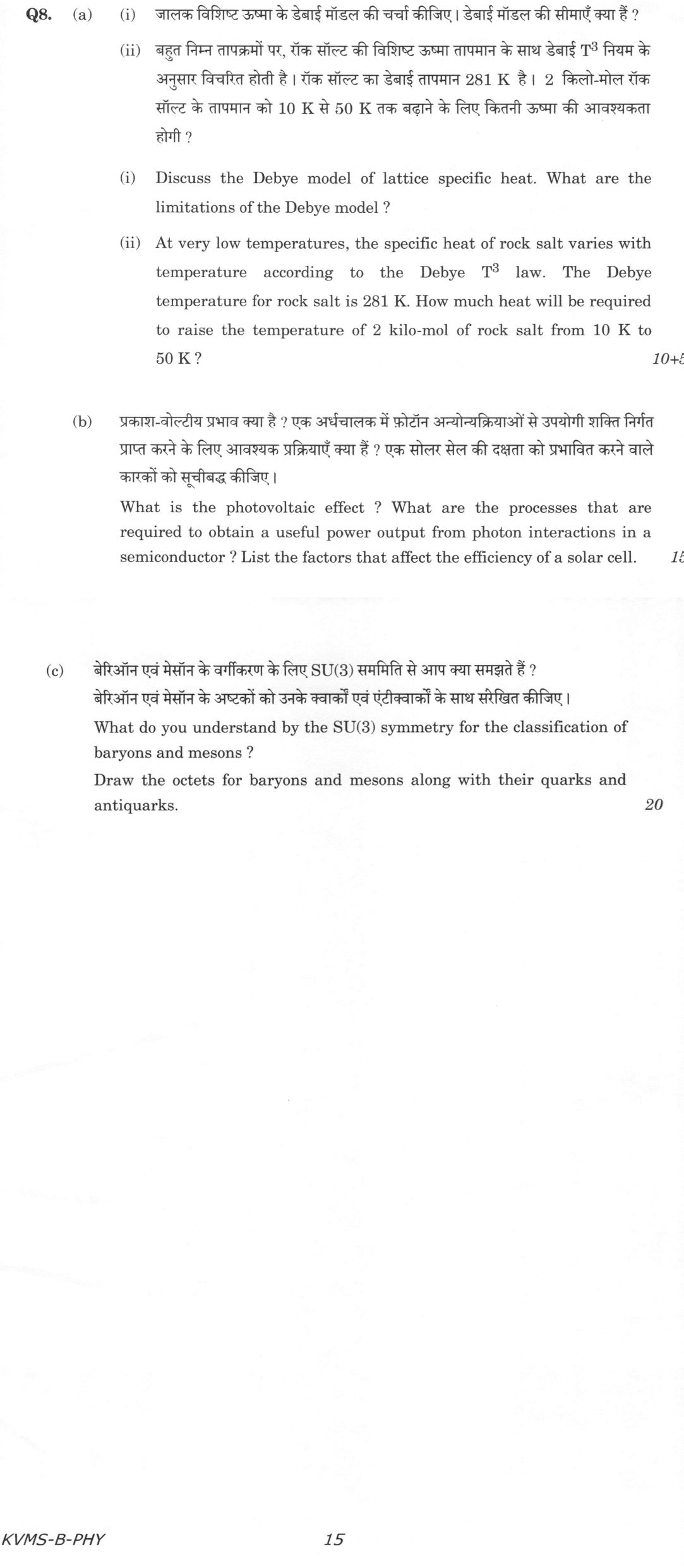
(a) (i) Discuss the Debye model of lattice specific heat. What are the limitations of the Debye model ? (10 marks) (ii) At very…
Discuss the Debye model of lattice specific heat. What are the limitations of the Debye model ? 10 marks
At very low temperatures, the specific heat of rock salt varies with temperature according to the Debye T³ law. The Debye temperature for rock salt is 281 K. How much heat will be required to raise the temperature of 2 kilo-mol of rock salt from 10 K to 50 K ? 5 marks
What is the photovoltaic effect ? What are the processes that are required to obtain a useful power output from photon interactions in a semiconductor ? List the factors that affect the efficiency of a solar cell. 15 marks
What do you understand by the SU(3) symmetry for the classification of baryons and mesons ? Draw the octets for baryons and mesons along with their quarks and antiquarks. 20 marks
हिंदी में प्रश्न पढ़ें
जालक विशिष्ट ऊष्मा के डेबाई मॉडल की चर्चा कीजिए। डेबाई मॉडल की सीमाएँ क्या हैं ? (10 अंक)
बहुत निम्न तापक्रमों पर, रॉक सॉल्ट की विशिष्ट ऊष्मा तापमान के साथ डेबाई T³ नियम के अनुसार विचरित होती है। रॉक सॉल्ट का डेबाई तापमान 281 K है। 2 किलो-मोल रॉक सॉल्ट के तापमान को 10 K से 50 K तक बढ़ाने के लिए कितनी ऊष्मा की आवश्यकता होगी ? (5 अंक)
प्रकाश-वोल्टीय प्रभाव क्या है ? एक अर्धचालक में फोटॉन अन्योन्यक्रियाओं से उपयोगी शक्ति निर्गत प्राप्त करने के लिए आवश्यक प्रक्रियाएँ क्या हैं ? एक सोलर सेल की दक्षता को प्रभावित करने वाले कारकों को सूचीबद्ध कीजिए। (15 अंक)
बेरिऑन एवं मेसॉन के वर्गीकरण के लिए SU(3) सममिति से आप क्या समझते हैं ? बेरिऑन एवं मेसॉन के अष्टकों को उनके क्वार्कों एवं एंटीक्वार्कों के साथ संरिखित कीजिए । (20 अंक)
Model answer
Drafted with AI by UPSC Answer Check against this question's marking rubric, to the expected length. UPSC does not publish answers for Mains — this is one way to score well, not an official key. How we build rubrics and answers.
(a) Debye model and heat required (10 + 5 = 15 marks)
(i) Debye treated a crystal of N atoms as an elastic continuum whose 3N vibrational modes are phonons with a linear dispersion ω = vk and a common sound speed v, cut off at a maximum frequency ω_D so that exactly 3N modes exist: ω_D = v(6π²N/V)^(1/3). The Debye temperature is θ_D = ħω_D/k_B. The mode density is g(ω) = 9Nω²/ω_D³, and the lattice energy is U = 9Nk_BT (T/θ_D)³ ∫₀^(θ_D/T) x³/(eˣ − 1) dx, with x = ħω/k_BT. Hence, per kilomole,
C_V = 9R (T/θ_D)³ ∫₀^(θ_D/T) x⁴eˣ/(eˣ − 1)² dx.
For T ≫ θ_D, C_V → 3R ≈ 24.9 kJ kmol⁻¹ K⁻¹ (Dulong-Petit law). For T ≪ θ_D the integral tends to 4π⁴/15, giving C_V = (12π⁴/5) R (T/θ_D)³ ≈ 1944 (T/θ_D)³ kJ kmol⁻¹ K⁻¹, the T³ law. The model thus explains the fall of specific heat at low temperature, which Einstein's single-frequency model (exponential fall) could not.
Limitations: the solid is treated as an isotropic continuum with a single sound speed and a linear dispersion to the cut-off, whereas real dispersion flattens near the zone boundary and has different longitudinal and transverse speeds; optical branches (crystals with several atoms per cell) are ignored; the phonon spectrum is taken as harmonic, so thermal expansion and the C_P - C_V difference are not explained; the electronic contribution of metals (γT) is excluded; and θ_D is not constant but varies with T when fitted to experiment, the T³ form being accurate only below about θ_D/50.
(ii) At low temperature the heat capacity per kilomole is C = (12π⁴R/5)(T/θ_D)³, and the heat required is
Q = n ∫ C dT = n (12π⁴R/5θ_D³) (T₂⁴ − T₁⁴)/4 = n (3π⁴R/5θ_D³)(T₂⁴ − T₁⁴).
With n = 2 kmol, R = 8314 J kmol⁻¹ K⁻¹, θ_D = 281 K, T₁ = 10 K, T₂ = 50 K: T₂⁴ − T₁⁴ = 6.25×10⁶ − 1×10⁴ = 6.24×10⁶ K⁴ and θ_D³ = 2.219×10⁷ K³. Then 3π⁴/5 = 58.45, so
Q = 2 × 58.45 × 8314 × (6.24×10⁶/2.219×10⁷) = 2 × 1.367×10⁵ ≈ 2.73×10⁵ J.
(The T³ law is taken as given in the question; strictly it is safe only below about 6 K for rock salt, so the true heat would differ somewhat.)
(b) Photovoltaic effect and solar cell (15 marks)
The photovoltaic effect is the generation of a voltage and current in a junction device when it absorbs light, without an external bias. In a p-n junction solar cell, three processes are required for useful output.
First, absorption: a photon of energy hν ≥ E_g excites an electron across the gap, creating an electron-hole pair; photons with hν < E_g are not absorbed and the excess of hν over E_g is lost as heat. Second, separation: pairs generated within about a diffusion length of the depletion region reach it, and the built-in electric field sweeps electrons to the n side and holes to the p side, building up the photovoltage V_oc and a photocurrent I_L. Third, collection: the separated carriers must reach the front and back contacts and flow through the external load before they recombine, delivering power P = IV.
The efficiency is η = V_oc I_sc FF / P_in, where FF is the fill factor. The factors affecting it are:
- Band gap: a small gap wastes photon energy as heat (thermalisation) and a large gap fails to absorb the low-energy photons; the ideal single-junction limit (Shockley-Queisser) is about 33% near 1.3-1.4 eV, with silicon (1.1 eV) at about 29%.
- Reflection and shading: front-surface reflection, cured by anti-reflection coating and textured surfaces, and shadowing by the metal grid.
- Recombination: bulk and surface recombination, governed by minority-carrier lifetime and diffusion length, and by material purity and defects.
- Series and shunt resistance, which lower the fill factor.
- Temperature: V_oc falls by roughly 2 mV per kelvin per cell, so efficiency drops as the cell heats.
- Illumination: intensity (concentration raises V_oc) and spectrum (air mass), and cell design such as multi-junction stacks.
(c) SU(3) symmetry of baryons and mesons (20 marks)
The strong interaction is nearly independent of the flavour of the light quarks u, d and s, because their masses are small compared with the strong scale. This approximate flavour symmetry is the group SU(3), the unitary transformations of the triplet (u, d, s) with unit determinant, with eight generators (the Gell-Mann matrices). Two generators commute, giving the quantum numbers I₃ (third component of isospin) and hypercharge Y = B + S, related to charge by Q = I₃ + Y/2. The quarks form the fundamental triplet 3: u (I₃ = +½, Y = +⅓), d (-½, +⅓), s (0, -⅔); the antiquarks form the conjugate 3̄. Hadrons fall into irreducible representations, plotted on the (I₃, Y) plane.
Mesons are quark-antiquark pairs, 3 ⊗ 3̄ = 8 ⊕ 1: an octet plus a singlet. Baryons are three-quark states, 3 ⊗ 3 ⊗ 3 = 10 ⊕ 8 ⊕ 8 ⊕ 1: the spin-½ baryons form an octet and the spin-3/2 baryons a decuplet (predicting the Ω⁻ before its discovery). The octets are hexagons with two particles at the centre.

The baryon octet (J^P = ½⁺) contains p (uud), n (udd), Σ⁺ (uus), Σ⁰ (uds), Σ⁻ (dds), Λ (uds), Ξ⁰ (uss) and Ξ⁻ (dss).

The pseudoscalar meson octet (J^P = 0⁻) contains π⁺ (ud̄), π⁻ (dū), π⁰ and η (mixtures of uū, dd̄, ss̄), K⁺ (us̄), K⁰ (ds̄), K⁻ (sū) and K̄⁰ (sd̄); the singlet η′ completes the nonet. The antiparticles of the octet members lie at the reflected positions, so the meson octet is self-conjugate. The symmetry is broken because m_s exceeds m_u and m_d, which splits the masses within a multiplet according to the Gell-Mann-Okubo formula, M = M₀ + aY + b[I(I + 1) − Y²/4].
How this answer will be evaluated
Evaluation rubric
Each sub-part is marked on its own, against the marks and word limit printed on the paper.
- (a)(i) (i) Discuss the Debye model of lattice specific heat and its limitations (10). 10 marks
Must cover
- Model: continuum, 3N modes, linear dispersion, cut-off ω_D, θ_D = ħω_D/k_B, g(ω) = 9Nω²/ω_D³, C_V integral form
- Limits: 3R at high T and (12π⁴/5)R(T/θ_D)³ at low T
- At least three limitations: isotropic single sound speed, no optical branches, harmonic (no thermal expansion), electrons ignored, θ_D varies with T
Loses marks
- Using C = 3R at these temperatures.
- Integrating C dT with wrong power (T³ instead of T⁴) or using moles/kmol inconsistently.
Earns more
- Comparison with Einstein's model (exponential fall).
Extra mark
- Remark that the T³ law is safe only below about θ_D/50
- (a)(ii) (ii) Heat needed to raise 2 kmol of rock salt (θ_D = 281 K) from 10 K to 50 K using the Debye T³ law (5). 5 marks
Must cover
- Q = n(3π⁴R/5θ_D³)(T₂⁴ − T₁⁴) ≈ 2.73×10⁵ J for n = 2 kmol
Loses marks
- Answer off by a factor of 1000 from unit slip.
Earns more
- Correct substitution with T₂⁴ − T₁⁴ = 6.24×10⁶ K⁴ and R = 8314 J/kmol K.
- (b) What is the photovoltaic effect; the processes needed to obtain useful power from photon interactions in a semiconductor; list the factors affecting solar-cell efficiency (15). 15 marks
Must cover
- Definition: generation of voltage/current at a junction under illumination without bias
- Three processes: absorption (hν ≥ E_g, pair creation), carrier separation by junction field, collection by contacts through the load
- η = V_oc I_sc FF/P_in
- At least five factors: band gap, reflection/shading, recombination, series/shunt resistance, temperature, illumination/spectrum
Loses marks
- Describing the photoelectric effect (emission) instead of the junction effect.
- Listing factors without any explanation of why they matter.
- Missing the separation step, so that absorption alone is claimed to give power.
Earns more
- Band-gap trade-off and Shockley-Queisser limit (about 33%).
- Explaining the role of diffusion length and depletion region.
Extra mark
- Multi-junction, concentrator or passivation strategies
- (c) Explain SU(3) symmetry for classifying baryons and mesons; draw the octets with quarks and antiquarks (20). 20 marks
Must cover
- SU(3) flavour of u, d, s; generators, quantum numbers I₃ and Y = B + S, Q = I₃ + Y/2
- Mesons 3 ⊗ 3̄ = 8 ⊕ 1; baryons 3⊗3⊗3 = 10 ⊕ 8 ⊕ 8 ⊕ 1
- Baryon octet in the (I₃, Y) hexagon with correct quark content (p uud, n udd, Σ, Λ, Ξ)
- Meson octet with π, K, K̄, η and quark-antiquark content (ud̄, us̄, and so on)
Loses marks
- Putting u, d, s at wrong (I₃, Y) or Q ≠ I₃ + Y/2.
- Giving the baryon octet as a decuplet, or missing Λ or Σ⁰ at the centre.
- Only a list of particles without any diagram.
Earns more
- Correct positions of every particle (Y = ±1 at the corners, Σ⁰ and Λ at the centre).
- Mention of symmetry breaking by m_s and the Gell-Mann-Okubo formula.
Extra mark
- Decuplet and prediction of Ω⁻; singlet η′
What "Discuss" is asking you to do
Lay the issue out from more than one side — how it arose, what is claimed for it, what is held against it, and where it now stands. UPSC attaches discuss to broad topics with several live dimensions, so coverage of the dimensions earns more than the strength of your opinion.
Structure that answers it
Set the issue up → the case as it is made → the case against → the dimension both sides leave out → where the balance now lies
Where marks are lost
Listing facts with no thread between them, or arguing one side throughout and calling it a discussion.
Practice this exact question
Write your answer and it is marked point by point against the model answer above — what you covered, what you missed, what you got wrong.
Evaluate my answer →More from Physics 2026 Paper II
- Q5 (a) Are the nucleons inside the nucleus governed by the laws of quantum physics ? Justify…
- Q6 (a) By considering the three-dimensional harmonic oscillator potential, explain the energ…
- Q7 (a) (i) What is diamagnetism ? Why do diamagnetic materials have negative magnetic suscep…
- Q8 (a) (i) Discuss the Debye model of lattice specific heat. What are the limitations of the…