Paper II — Q6
(a) By considering the three-dimensional harmonic oscillator potential, explain the energy levels of nucleons inside the nucleus…
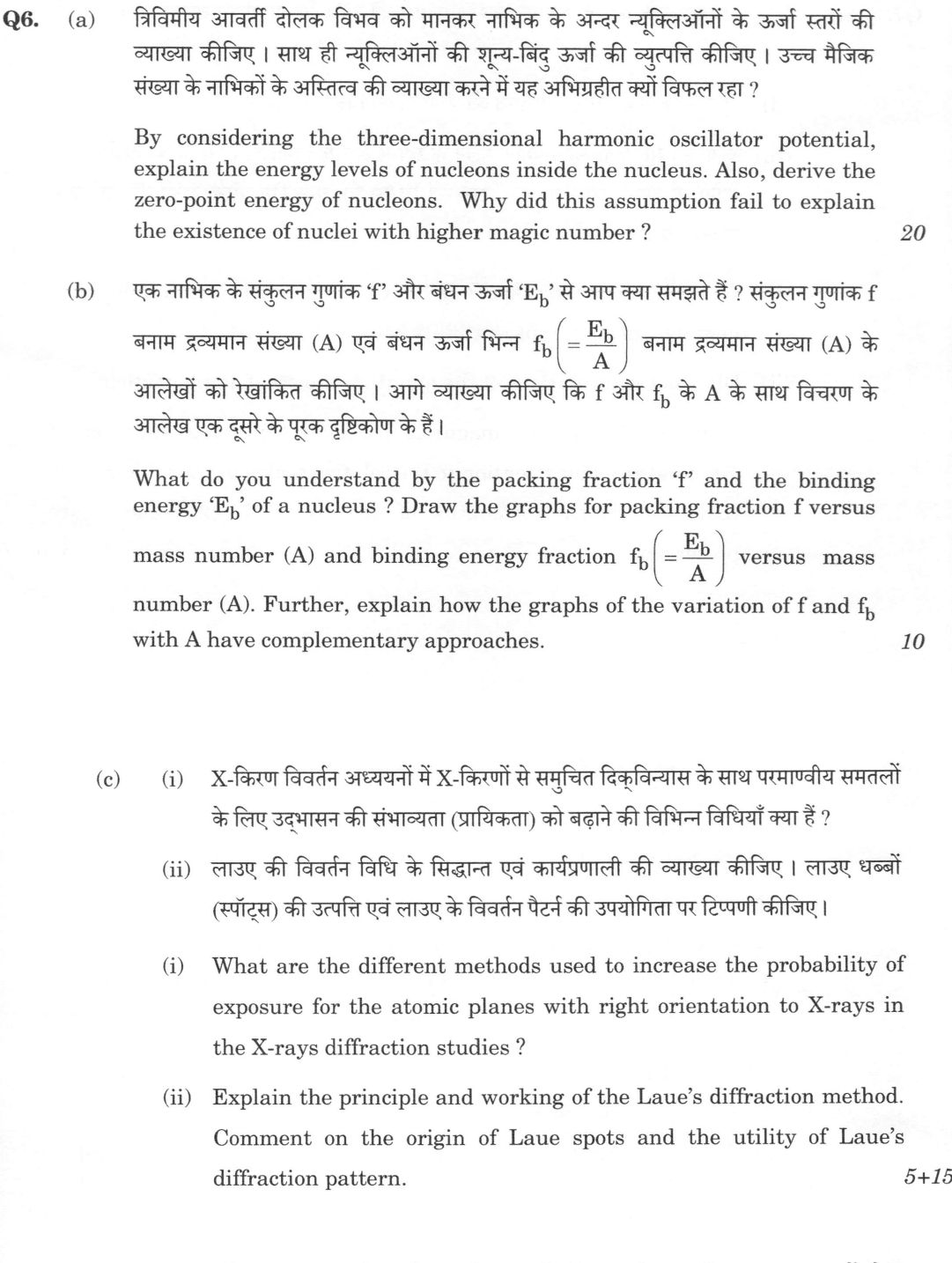
By considering the three-dimensional harmonic oscillator potential, explain the energy levels of nucleons inside the nucleus. Also, derive the zero-point energy of nucleons. Why did this assumption fail to explain the existence of nuclei with higher magic number ? 20 marks
What do you understand by the packing fraction ‘f’ and the binding energy ‘Eb’ of a nucleus ? Draw the graphs for packing fraction f versus mass number (A) and binding energy fraction f_b (= E_b / A) versus mass number (A). Further, explain how the graphs of the variation of f and f_b with A have complementary approaches. 10 marks
What are the different methods used to increase the probability of exposure for the atomic planes with right orientation to X-rays in the X-rays diffraction studies ?
Explain the principle and working of the Laue's diffraction method. Comment on the origin of Laue spots and the utility of Laue's diffraction pattern. 20 marks
हिंदी में प्रश्न पढ़ें
त्रिविमीय आवर्ती दोलक विभव को मानकर नाभिक के अन्दर न्यूक्लिऑनों के ऊर्जा स्तरों की व्याख्या कीजिए । साथ ही न्यूक्लिऑनों की शून्य-बिंदु ऊर्जा की व्युत्पत्ति कीजिए । उच्च मैजिक संख्या के नाभिकों के अस्तित्व की व्याख्या करने में यह अभिगृहीत क्यों विफल रहा ? (20 अंक)
एक नाभिक के संकुलन गुणांक ‘f’ और बंधन ऊर्जा ‘E_b’ से आप क्या समझते हैं ? संकुलन गुणांक f बनाम द्रव्यमान संख्या (A) एवं बंधन ऊर्जा भिन्न f_b (= E_b / A) बनाम द्रव्यमान संख्या (A) के आलेखों को रेखांकित कीजिए । आगे व्याख्या कीजिए कि f और f_b के A के साथ विचरण के आलेख एक दूसरे के पूरक दृष्टिकोण के हैं । (10 अंक)
X-किरण विवर्तन अध्ययनों में X-किरणों से समुचित दिक्विन्यास के साथ परमाण्वीय समतलों के लिए उद्भासन की संभाव्यता (प्रायिकता) को बढ़ाने की विभिन्न विधियाँ क्या हैं ?
लाउए की विवर्तन विधि के सिद्धान्त एवं कार्यप्रणाली की व्याख्या कीजिए । लाउए धब्बों (स्पॉट्स) की उत्पत्ति एवं लाउए के विवर्तन पैटर्न की उपयोगिता पर टिप्पणी कीजिए । (20 अंक)
Model answer
Drafted with AI by UPSC Answer Check against this question's marking rubric, to the expected length. UPSC does not publish answers for Mains — this is one way to score well, not an official key. How we build rubrics and answers.
(a) Harmonic oscillator shell model (20 marks)
Take the nucleons to move independently in the central potential V(r) = ½mω²r². Separating the Schrödinger equation in Cartesian coordinates gives three one-dimensional oscillators, so E = (nₓ + n_y + n_z + 3/2)ħω = (N + 3/2)ħω, where N = 2(n - 1) + l, n = 1, 2, … is the radial quantum number and l the orbital angular momentum. The zero-point energy is the ground state N = 0: each of the three degrees of freedom contributes ½ħω, so E₀ = (3/2)ħω, with ħω ≈ 41 A^(-1/3) MeV. Levels of given N are degenerate, with g_N = (N + 1)(N + 2) including spin, and shells close at cumulative occupancies 2, 8, 20, 40, 70 and 112.
The model reproduces only the first three observed magic numbers, 2, 8 and 20. It fails for 28, 50, 82 and 126 because a purely central potential gives the wrong gaps between levels; the harmonic well has no mechanism that separates the states of a shell by total angular momentum. Mayer and Jensen (1949) added a strong spin-orbit term -a l·s, which lowers the j = l + 1/2 level (the opposite ordering to atoms). It pulls the high-j intruder levels 1f₇/₂, 1g₉/₂, 1h₁₁/₂ and 1i₁₃/₂ down from the shell above into the shell below, opening the large gaps at 28, 50, 82 and 126.
(b) Packing fraction and binding energy (10 marks)
The packing fraction is f = (M - A)/A × 10⁴, where M is the atomic mass in u and A the mass number, that is the mass excess per nucleon. The binding energy is the energy needed to disassemble a nucleus into its free protons and neutrons, E_b = [Zm_H + (A - Z)mₙ - M]c², with 1 u = 931.5 MeV; f_b = E_b/A is the binding energy per nucleon.
The f-A curve starts at large positive values for light nuclei (about +70 for ²H), passes through zero at ¹²C, reaches a broad minimum of about -11.6 near ⁵⁶Fe (A ≈ 50-60), and rises again to small positive values for the heaviest nuclei (about +2 for ²³⁸U). The f_b-A curve rises steeply from 1.11 MeV for ²H, shows a peak at ⁴He (7.07 MeV), reaches a broad maximum of about 8.8 MeV near ⁵⁶Fe, and falls slowly to about 7.6 MeV for ²³⁸U.

The two graphs are complementary because f measures the mass excess and f_b the mass defect, which differ essentially in sign: the minimum of f coincides with the maximum of f_b. Nuclei near A ≈ 56 are the most tightly bound, so fusion of light nuclei and fission of heavy nuclei both move towards this region and release energy.
(c) X-ray diffraction and the Laue method (20 marks)
(i) A single fixed crystal in a monochromatic beam reflects only when some plane happens to satisfy Bragg's law 2d sinθ = nλ. Three methods raise the probability that planes of the right orientation are exposed. The Laue method keeps the crystal fixed but uses a continuous ("white") spectrum, so that some wavelength fits every plane. The rotating-crystal method uses monochromatic X-rays and rotates the crystal, so that different planes in turn satisfy the law. The Debye-Scherrer powder method uses monochromatic X-rays on a powder of randomly oriented crystallites, so that some always satisfy it.
(ii) In the Laue method a narrow beam of continuous X-rays, of wavelengths from λ_min = 12.4/V(kV) Å upwards, from a high-voltage tube passes through a pin-hole collimator onto a stationary single crystal, and the diffracted beams are recorded on a flat film placed beyond the crystal (transmission) or between the source and the crystal (back reflection). Each set of planes selects from the spectrum the wavelength that satisfies Bragg's law for its spacing and angle, equivalently the three Laue conditions a·(s - s₀) = hλ, b·(s - s₀) = kλ, c·(s - s₀) = lλ.
Origin of the spots: in the Ewald construction, a reflection occurs whenever a reciprocal lattice point lies on the Ewald sphere; because the radiation is continuous, every reciprocal lattice point between the limiting spheres of radii 1/λ_min and 1/λ_max is on some sphere, giving a spot. Spots from planes of one zone lie on an ellipse in transmission and a hyperbola in back reflection. A spot may combine higher orders (λ, λ/2, λ/3).
Utility: the pattern shows the symmetry of the crystal, with only the 11 Laue groups distinguishable because of Friedel's law, and it fixes the orientation of the crystal, which is used to cut and mount crystals. Streaked spots (asterism) reveal strain and imperfection. Because the wavelength of each spot is unknown, the method does not give lattice parameters or the full structure.
How this answer will be evaluated
Evaluation rubric
Each sub-part is marked on its own, against the marks and word limit printed on the paper.
- (a) Using the three-dimensional harmonic oscillator potential, explain the energy levels of nucleons, derive the zero-point energy, and say why the model fails to explain the higher magic numbers. 20 marks
Must cover
- E_N = (N + 3/2)ħω with N = 2(n - 1) + l; zero-point energy (3/2)ħω, i.e. ħω/2 for each of three degrees of freedom
- Level degeneracy (N + 1)(N + 2) including spin; oscillator magic numbers 2, 8, 20, 40, 70, 112
- Agreement only for 2, 8, 20; observed magic numbers 28, 50, 82, 126 not reproduced
- Spin-orbit term -a l·s (Mayer and Jensen, 1949) lowers j = l + 1/2 and pulls down the intruder levels 1f7/2, 1g9/2, 1h11/2, 1i13/2
Loses marks
- Stating E_N without the zero-point term or with the wrong degeneracy.
- Claiming the oscillator reproduces all magic numbers.
- Omitting the spin-orbit coupling, or giving atomic-physics ordering of j = l ± 1/2.
Earns more
- Derivation of the zero-point energy from the three one-dimensional oscillators and of the level count.
- Explaining that the pure oscillator potential (and any purely central potential) gives the wrong gaps, and that the spin-orbit splitting, with the sign opposite to that in atoms, creates them.
Extra mark
- ħω ≈ 41 A^(-1/3) MeV; flattening of the potential (l² term) as a first correction
- (b) Define the packing fraction f and the binding energy E_b of a nucleus, draw f versus A and f_b = E_b/A versus A, and explain how the two graphs are complementary. 10 marks
Must cover
- f = (M - A)/A × 10⁴ (M in atomic mass units); E_b = [Zm_H + (A - Z)m_n - M]c², with 1 u = 931.5 MeV
- f falls from large positive values for light nuclei to a minimum near A ≈ 50-60 and rises to small positive values for the heaviest nuclei
- E_b/A rises steeply for light nuclei (⁴He 7.07 MeV), peaks near ⁵⁶Fe (about 8.8 MeV) and falls slowly to about 7.6 MeV for ²³⁸U
- f is essentially minus E_b/A: the minimum of f coincides with the maximum of E_b/A
Loses marks
- Defining f without dividing by A, or forgetting the 10⁴ factor.
- Drawing f with its minimum at heavy A.
- Giving the graphs without explaining why they are complementary.
Earns more
- Two labelled sketches with the extremum near A ≈ 56 and the light-nucleus rise.
- Consequence stated: fusion of light nuclei and fission of heavy nuclei both release energy.
Extra mark
- Values: f(⁵⁶Fe) ≈ -11.6, E_b/A(²H) = 1.11 MeV
- (c) Two sub-parts (5 + 15): (i) name the methods used to increase the probability that atomic planes with the right orientation reflect X-rays; (ii) explain the principle and working of the Laue method, the origin of Laue spots and the utility of the pattern. 20 marks
Must cover
- Bragg's law 2d sinθ = nλ; three methods - Laue (white radiation, fixed crystal), rotating-crystal (monochromatic, rotated crystal), Debye-Scherrer powder
- Laue principle: continuous X-ray spectrum (λ_min = 12.4/V(kV) Å) supplies the wavelength satisfying Bragg's law for each plane of a fixed single crystal; transmission and back-reflection arrangements
- Origin of spots: Ewald sphere construction with reciprocal lattice points between limiting spheres; spots lie on ellipses (transmission) or hyperbolas (back reflection) for planes of a zone
- Utility: crystal orientation and Laue symmetry (11 Laue groups from Friedel's law), detection of imperfections through asterism; limitation that wavelength of each spot is unknown
Loses marks
- Describing the rotating-crystal or powder method instead of Laue in (ii).
- Saying Laue uses monochromatic radiation.
- Omitting the Ewald sphere or the uses of the pattern.
Earns more
- Laue conditions a·(s - s₀) = hλ, b·(s - s₀) = kλ, c·(s - s₀) = lλ, or the equivalent reciprocal-lattice statement.
- Noting that a spot may be the overlap of higher orders (λ, λ/2, λ/3), so lattice parameters cannot be found directly.
Extra mark
- Mention of the pin-hole collimator, flat film and the use of the pattern to orient crystals for cutting
What "Explain" is asking you to do
Make the working of something clear — what sets it off, what follows from what, and what it produces. Explain is the Commission's mechanism word: it dominates the technical papers and the “explain why” stems, where the marks sit in the causal chain and not in the label.
Structure that answers it
State what it is → the initiating condition → the chain of cause, step by step → an instance where it plays out → what the chain produces
Where marks are lost
Describing what something looks like instead of why it works that way. Naming the stages without linking them reads as description too.
Practice this exact question
Write your answer and it is marked point by point against the model answer above — what you covered, what you missed, what you got wrong.
Evaluate my answer →More from Physics 2026 Paper II
- Q3 (a) (i) Calculate the number of permitted electrons in a sub-shell and a shell in an atom…
- Q4 (a) (i) What are hot bands in vibrational spectroscopy ? Why are they called so ? (8 mark…
- Q5 (a) Are the nucleons inside the nucleus governed by the laws of quantum physics ? Justify…
- Q6 (a) By considering the three-dimensional harmonic oscillator potential, explain the energ…
- Q7 (a) (i) What is diamagnetism ? Why do diamagnetic materials have negative magnetic suscep…
- Q8 (a) (i) Discuss the Debye model of lattice specific heat. What are the limitations of the…