Paper II — Q5
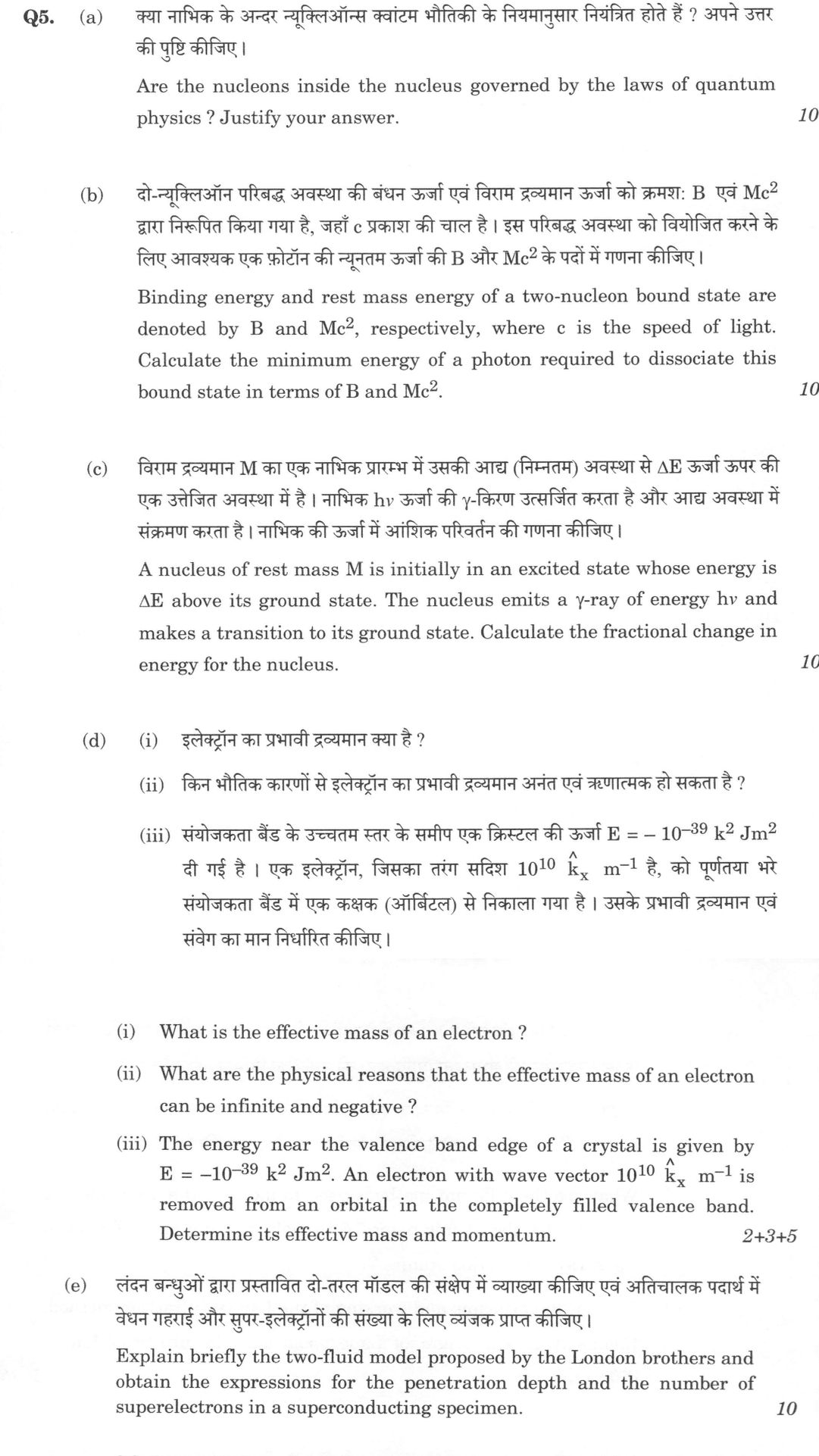
(a) Are the nucleons inside the nucleus governed by the laws of quantum physics ? Justify your answer. (10 marks) (b) Binding…
Are the nucleons inside the nucleus governed by the laws of quantum physics ? Justify your answer. 10 marks
Binding energy and rest mass energy of a two-nucleon bound state are denoted by B and Mc², respectively, where c is the speed of light. Calculate the minimum energy of a photon required to dissociate this bound state in terms of B and Mc². 10 marks
A nucleus of rest mass M is initially in an excited state whose energy is ΔE above its ground state. The nucleus emits a γ-ray of energy hν and makes a transition to its ground state. Calculate the fractional change in energy for the nucleus. 10 marks
What is the effective mass of an electron ?
For what physical reasons can the effective mass of an electron be infinite and negative ?
Near the top of the valence band, the energy of a crystal is given by E = – 10⁻³⁹ k² Jm². An electron with wave vector 10¹⁰ k̂ₓ m⁻¹ is removed from an orbital in a completely filled valence band. Determine its effective mass and momentum. 10 marks
Explain briefly the two-fluid model proposed by the London brothers and obtain the expressions for the penetration depth and the number of superelectrons in a superconducting specimen. 10 marks
हिंदी में प्रश्न पढ़ें
क्या नाभिक के अन्दर न्यूक्लिऑन्स क्वांटम भौतिकी के नियमानुसार नियंत्रित होते हैं ? अपने उत्तर की पुष्टि कीजिए । (10 अंक)
दो-न्यूक्लिऑन परिबद्ध अवस्था की बंधन ऊर्जा एवं विराम द्रव्यमान ऊर्जा को क्रमश: B एवं Mc² द्वारा निरूपित किया गया है, जहाँ c प्रकाश की चाल है । इस परिबद्ध अवस्था को वियोजित करने के लिए आवश्यक एक फोटॉन की न्यूनतम ऊर्जा की B और Mc² के पदों में गणना कीजिए । (10 अंक)
विराम द्रव्यमान M का एक नाभिक प्रारम्भ में उसकी आद्य (निम्नतम) अवस्था से ΔE ऊर्जा ऊपर की एक उत्तेजित अवस्था में है । नाभिक hν ऊर्जा की γ-किरण उत्सर्जित करता है और आद्य अवस्था में संक्रमण करता है । नाभिक की ऊर्जा में आंशिक परिवर्तन की गणना कीजिए । (10 अंक)
इलेक्ट्रॉन का प्रभावी द्रव्यमान क्या है ?
किन भौतिक कारणों से इलेक्ट्रॉन का प्रभावी द्रव्यमान अनंत एवं ऋणात्मक हो सकता है ?
संयोजकता बैंड के उच्चतम स्तर के समीप एक क्रिस्टल की ऊर्जा E = – 10⁻³⁹ k² Jm² दी गई है । एक इलेक्ट्रॉन, जिसका तरंग सदिश 10¹⁰ k̂ₓ m⁻¹ है, को पूर्णतया भरे संयोजकता बैंड में एक कक्षक (ऑर्बिटल) से निकाला गया है । उसके प्रभावी द्रव्यमान एवं संवेग का मान निर्धारित कीजिए । (10 अंक)
लंदन बन्धुओं द्वारा प्रस्तावित दो-तरल मॉडल की संक्षेप में व्याख्या कीजिए एवं अतिचालक पदार्थ में वेधन गहराई और सुपर-इलेक्ट्रॉनों की संख्या के लिए व्यंजक प्राप्त कीजिए । (10 अंक)
Model answer
Drafted with AI by UPSC Answer Check against this question's marking rubric, to the expected length. UPSC does not publish answers for Mains — this is one way to score well, not an official key. How we build rubrics and answers.
(a) Are nucleons quantum objects? (10 marks)
Yes. First, the uncertainty principle: nucleons are confined within R = 1.2 A^(1/3) fm, a few femtometres, so Δp ≳ ħ/R ≈ 100 MeV/c; the resulting kinetic energy is several MeV (the Fermi energy of nuclear matter is about 30 MeV), the scale of the observed binding energy of about 8 MeV per nucleon. A classical particle has no such zero-point energy. Second, nuclei show discrete energy levels and unusual stability at the magic numbers 2, 8, 20, 28, 50, 82 and 126, which the shell model explains with spin-orbit coupling. Third, nucleons are spin-½ fermions obeying the Pauli exclusion principle, forming a degenerate Fermi gas. Fourth, α-decay is possible only by quantum tunnelling through the Coulomb barrier (Gamow theory), which explains the Geiger-Nuttall relation between half-life and α energy; classically the α-particle lacks the energy to escape.
(b) Photodisintegration threshold (10 marks)
For γ + (bound state of rest energy Mc²) → n + p, the photon has momentum Eγ/c, so the products must recoil and Eγ must exceed B. At threshold the products are at rest in the centre-of-mass frame, so the invariant mass equals the sum of the free nucleon masses, √s = Mc² + B. For a photon striking a state at rest, s = (Mc²)² + 2Mc²Eγ. Equating, (Mc² + B)² = (Mc²)² + 2Mc²Eγ, so 2Mc²B + B² = 2Mc²Eγ and
Eγ(min) = B + B²/(2Mc²) = B(1 + B/2Mc²).
For the deuteron (B = 2.22 MeV, Mc² ≈ 1876 MeV) the recoil correction is about 1.3 keV.
(c) Recoil of a de-exciting nucleus (10 marks)
The nucleus emits a γ-ray of energy hν and, to conserve momentum, recoils with p = hν/c. Its recoil energy is E_R = p²/(2M) = (hν)²/(2Mc²). Energy conservation gives ΔE = hν + E_R, so the γ-ray energy falls short of ΔE by E_R. The fractional change is E_R/ΔE = (hν)²/(2Mc²ΔE) ≈ ΔE/(2Mc²), since hν ≈ ΔE. For Fe-57 (ΔE = 14.4 keV) this gives E_R ≈ 2 meV and a fractional shift of about 10⁻⁷, far larger than the natural linewidth. The emitted line therefore misses resonant absorption by free nuclei, which is why recoil-free emission in a solid (the Mössbauer effect) is needed.
(d) Effective mass of an electron (10 marks)
(i) The effective mass describes how an electron responds to an external force inside the periodic crystal potential: m* = ħ²/(d²E/dk²), so that the acceleration under a force F is F/m*, with group velocity v_g = (1/ħ)dE/dk.
(ii) m* is infinite where d²E/dk² = 0, at the inflection point of E(k), where the band curvature changes sign and the electron is not accelerated by the force. It is negative near the top of a band, where d²E/dk² < 0: the lattice then takes up more momentum (Bragg reflection) than the force supplies, so the electron accelerates opposite to the force. This is why the missing electron in a nearly full band behaves as a hole, a positive charge with positive effective mass.
(iii) For E = -10⁻³⁹ k² J m², d²E/dk² = -2 × 10⁻³⁹ J m², so m* = ħ²/(d²E/dk²) = (1.055 × 10⁻³⁴)²/(-2 × 10⁻³⁹) ≈ -5.56 × 10⁻³⁰ kg, about -6.1 mₑ. The crystal momentum is p = ħk = 1.055 × 10⁻³⁴ × 10¹⁰ ≈ 1.05 × 10⁻²⁴ kg m s⁻¹ along +x. The hole left behind has wave vector -k, and effective mass +5.56 × 10⁻³⁰ kg.
(e) Two-fluid model and London equations (10 marks)
In the two-fluid model (Gorter-Casimir, adopted by the London brothers), a superconductor below T_c has a normal fluid of density nₙ and a superfluid of density nₛ, with n = nₛ + nₙ and nₛ/n = 1 - (T/T_c)⁴; the superfluid carries current without resistance. For the superelectrons, m dvₛ/dt = eE, so with Jₛ = nₛevₛ the first London equation is dJₛ/dt = (nₛe²/m)E (perfect conductivity). The second London equation, ∇ × Jₛ = -(nₛe²/m)B, expresses flux expulsion. Combining it with Maxwell's ∇ × B = μ₀Jₛ gives ∇ × ∇ × B = -∇²B = -(μ₀nₛe²/m)B, that is ∇²B = B/λ_L². For a semi-infinite superconductor this gives B(x) = B₀e^(-x/λ_L): the field decays inside (Meissner effect) over the London penetration depth
λ_L = √(m/(μ₀nₛe²)),
and inverting, the superelectron density is nₛ = m/(μ₀e²λ_L²).
How this answer will be evaluated
Evaluation rubric
Each sub-part is marked on its own, against the marks and word limit printed on the paper.
- (a) Answer yes or no and justify: are nucleons inside the nucleus governed by quantum physics? The justification must be evidential - uncertainty-principle estimate, discrete levels and shell structure, Pauli statistics, tunnelling. 10 marks
Must cover
- Yes; Δx Δp ≥ ħ/2 with Δx of a few fm (R = 1.2 A^(1/3) fm) gives Δp of order 100 MeV/c and kinetic energy of several MeV
- Discrete levels and magic numbers 2, 8, 20, 28, 50, 82, 126 (shell model)
- Nucleons are spin-½ fermions obeying the Pauli exclusion principle (Fermi gas)
- α-decay by tunnelling (Gamow theory) and the Geiger-Nuttall law
Loses marks
- Saying yes with no evidence.
- Confusing nuclear magic numbers with atomic shell capacities (2, 8, 18, 32).
- Omitting the Pauli/Fermi-statistics aspect, or treating the liquid-drop model as evidence against quantum behaviour.
Earns more
- An energy estimate, not only a qualitative statement of the uncertainty principle.
- Contrast with the classical picture, which predicts no zero-point energy and no α-emission through the Coulomb barrier.
Extra mark
- Spin-orbit coupling in the shell model as the origin of the magic numbers
- (b) Find the minimum photon energy that can dissociate a two-nucleon bound state of binding energy B and rest-mass energy Mc²; express it in terms of B and Mc² only. It must exceed B because the system must recoil. 10 marks
Must cover
- Photodisintegration γ + d → n + p; photon momentum p = Eγ/c
- At threshold the products are at rest in the centre-of-mass frame; invariant s = (Mc²)² + 2Mc²Eγ = (Mc² + B)²
- Eγ(min) = B + B²/(2Mc²) = B(1 + B/2Mc²)
Loses marks
- Answering Eγ = B, ignoring recoil.
- Subtracting the recoil term instead of adding it, or writing B²/(Mc²) instead of B²/(2Mc²).
- Introducing individual nucleon masses when the answer is asked in B and Mc².
Earns more
- Recognising that the free nucleon masses sum to M + B/c², so the threshold total energy is Mc² + B.
- Stating that the recoil term B²/(2Mc²) is a small correction added to B.
Extra mark
- Numerical check for the deuteron (B = 2.22 MeV, Mc² ≈ 1876 MeV): recoil correction about 1.3 keV
- (c) A nucleus of rest mass M de-excites from a level ΔE above the ground state by emitting a γ-ray of energy hν. Calculate the fractional change in the nucleus's energy, i.e. the recoil energy and the shift relative to the transition energy. 10 marks
Must cover
- Recoil momentum p = hν/c and recoil energy E_R = (hν)²/(2Mc²)
- Energy balance ΔE = hν + E_R
- Fractional change E_R/ΔE ≈ ΔE/(2Mc²)
- Consequence: the emitted line is shifted, which prevents resonant absorption by free nuclei (Mössbauer effect)
Loses marks
- Ignoring recoil, i.e. hν = ΔE.
- Writing E_R = hν/(2Mc²) or (hν)²/(Mc²).
- Confusing recoil shift with Doppler or thermal broadening.
Earns more
- Correct use of p = hν/c (units) and the factor 2 in the denominator.
- Giving a fractional (dimensionless) answer, not only an energy in eV.
Extra mark
- Fe-57 example: ΔE = 14.4 keV gives E_R ≈ 2 meV and a fractional shift of about 10⁻⁷
- (d) Three sub-parts (2 + 3 + 5): (i) define the effective mass of an electron in a crystal; (ii) give the physical reasons why it can be infinite and negative; (iii) for E = -10⁻³⁹ k² J m² near the valence band top, find the effective mass and momentum of an electron with k = 10¹⁰ x̂ m⁻¹ removed from a filled band. 10 marks
Must cover
- m* = ħ²/(d²E/dk²), with group velocity v_g = (1/ħ)dE/dk
- Infinite at the inflection point of E(k), where d²E/dk² = 0; negative near the band top where the curvature is negative (the lattice takes more momentum than the applied force gives)
- m* = -5.56 × 10⁻³⁰ kg (about -6.1 mₑ)
- Crystal momentum p = ħk = 1.05 × 10⁻²⁴ kg m s⁻¹
Loses marks
- Writing m* = ħ²(d²E/dk²) instead of dividing by the curvature.
- Giving a positive m* for the electron, or computing momentum as m*v instead of ħk.
- Saying m* is infinite at the band edges rather than at the inflection point.
Earns more
- Explaining the negative mass through the hole picture: the missing electron behaves as a positive charge with positive mass +5.56 × 10⁻³⁰ kg and wave vector -k.
- Correct arithmetic: d²E/dk² = -2 × 10⁻³⁹ J m².
Extra mark
- Noting that near the band bottom m* is positive and generally differs from the free-electron mass
- (e) Explain briefly the London brothers' two-fluid model of superconductivity and derive expressions for the London penetration depth and the number density of superelectrons. Both expressions must appear. 10 marks
Must cover
- Two-fluid model: n = nₛ + nₙ, nₛ/n = 1 - (T/T_c)⁴ (Gorter-Casimir), nₛ → 0 at T_c
- London equations: dJₛ/dt = (nₛe²/m)E and ∇ × Jₛ = -(nₛe²/m)B
- ∇²B = B/λ_L² with B(x) = B₀e^(-x/λ_L); Meissner effect
- λ_L = √(m/(μ₀nₛe²)) and nₛ = m/(μ₀e²λ_L²)
Loses marks
- Inverting the formula, λ_L = √(μ₀nₛe²/m).
- Giving only the first London equation, which alone predicts dB/dt = 0, not the Meissner effect.
- Using nₛ ∝ (1 - T/T_c) instead of 1 - (T/T_c)⁴, or confusing λ_L with the coherence length.
Earns more
- Deriving ∇²B = B/λ_L² by combining the second London equation with Maxwell's ∇ × B = μ₀J.
- Physical statement that the first equation gives perfect conductivity and the second gives flux expulsion.
Extra mark
- Remark that the combination nₛe²/m is unchanged if Cooper pairs (charge 2e, mass 2m) are used
What "Justify" is asking you to do
Defend a position with reasons that carry evidence, and show why the contrary view does not hold. Where the stem runs as a question and asks you to justify your answer, the position is yours to choose and the marks lie wholly in the defence.
Structure that answers it
Position stated plainly → reason 1 with evidence → reason 2 with evidence → strongest objection, met → position restated as qualified
Where marks are lost
Reasons stated and none of them evidenced. The other standard loss is fence-sitting — an answer that finds merit on both sides and commits to neither has justified nothing.
Practice this exact question
Write your answer and it is marked point by point against the model answer above — what you covered, what you missed, what you got wrong.
Evaluate my answer →More from Physics 2026 Paper II
- Q2 (a) A particle is in the ground state of a 1-D simple harmonic oscillator potential, V(x)…
- Q3 (a) (i) Calculate the number of permitted electrons in a sub-shell and a shell in an atom…
- Q4 (a) (i) What are hot bands in vibrational spectroscopy ? Why are they called so ? (8 mark…
- Q5 (a) Are the nucleons inside the nucleus governed by the laws of quantum physics ? Justify…
- Q6 (a) By considering the three-dimensional harmonic oscillator potential, explain the energ…
- Q7 (a) (i) What is diamagnetism ? Why do diamagnetic materials have negative magnetic suscep…
- Q8 (a) (i) Discuss the Debye model of lattice specific heat. What are the limitations of the…