Paper I — Q1
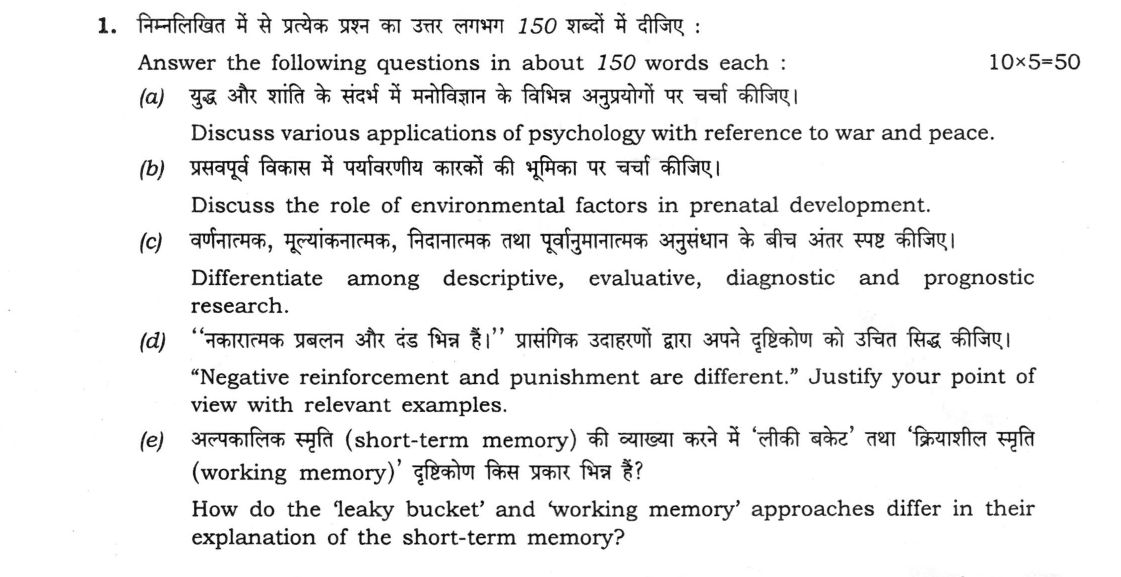
(a) Discuss various applications of psychology with reference to war and peace. (10 marks) (b) Discuss the role of environmental…
Answer the following questions in about 150 words each :
Discuss various applications of psychology with reference to war and peace. 10 marks
Discuss the role of environmental factors in prenatal development. 10 marks
Differentiate among descriptive, evaluative, diagnostic and prognostic research. 10 marks
“Negative reinforcement and punishment are different.” Justify your point of view with relevant examples. 10 marks
How do the ‘leaky bucket’ and ‘working memory’ approaches differ in their explanation of the short-term memory? 10 marks
हिंदी में प्रश्न पढ़ें
निम्नलिखित में से प्रत्येक प्रश्न का उत्तर लगभग 150 शब्दों में दीजिए :
युद्ध और शांति के संबंध में मनोविज्ञान के विभिन्न अनुप्रयोगों पर चर्चा कीजिए। (10 अंक)
प्रसवपूर्व विकास में पर्यावरणीय कारकों की भूमिका पर चर्चा कीजिए। (10 अंक)
वर्णनात्मक, मूल्यांकनात्मक, निदानात्मक तथा पूर्वानुमानात्मक अनुसंधान के बीच अंतर स्पष्ट कीजिए। (10 अंक)
“नकारात्मक प्रबलन और दंड भिन्न हैं।” प्रासंगिक उदाहरणों द्वारा अपने दृष्टिकोण को उचित सिद्ध कीजिए। (10 अंक)
अल्पकालिक स्मृति (short-term memory) की व्याख्या करने में ‘लीकी बकेट’ तथा ‘क्रियाशील स्मृति (working memory)’ दृष्टिकोण किस प्रकार भिन्न हैं? (10 अंक)
Model answer
Drafted with AI by UPSC Answer Check against this question's marking rubric, to the 150-word length. UPSC does not publish answers for Mains — this is one way to score well, not an official key. How we build rubrics and answers.
(a) Discuss various applications of psychology with reference to war and peace.
Psychology is applied in war primarily through military selection, combat support, and human factors. In 1917, Robert Yerkes developed the Army Alpha and Beta tests to assess the cognitive aptitude of recruits. Modern applications include the Services Selection Board (SSB) and Defence Institute of Psychological Research (DIPR), which evaluate leadership and personality for defence roles. Psychology also addresses combat stress, treating conditions like shell shock and Post-Traumatic Stress Disorder (PTSD) to maintain morale.
In the context of peace, psychology focuses on conflict reduction and reconciliation. Sherif’s 1954 Robbers Cave experiment demonstrated that "superordinate goals" can reduce intergroup hostility. Gordon Allport’s contact hypothesis (1954) suggests that equal-status contact reduces prejudice. Charles Osgood’s GRIT (1962) and Morton Deutsch’s work on cooperation provide frameworks for negotiation. Bronfenbrenner’s mirror-image perceptions (1961) further explain how psychological barriers to peace can be dismantled through mutual understanding.
(b) Discuss the role of environmental factors in prenatal development.
Prenatal development passes through the germinal (weeks 1–2), embryonic (weeks 3–8) and fetal (week 9 to birth) stages. Environmental factors, especially teratogens, act most severely in the embryonic stage, when organogenesis occurs. The impact of these factors is governed by the "critical period" principle, dose-response relationships, and individual susceptibility. For instance, exposure to thalidomide during limb development causes phocomelia. Maternal consumption of alcohol leads to Fetal Alcohol Syndrome (Jones and Smith, 1973), characterized by facial dysmorphology and intellectual disability.
Infections like rubella (Gregg, 1941) can cause congenital defects. Maternal nutrition is also vital; a lack of folic acid is linked to neural tube defects, while iodine deficiency causes cretinism. Physical factors such as radiation, lead, and mercury, as well as maternal stress and cortisol levels, also play a role. Unlike genetic disorders (e.g., Down syndrome), which are chromosomal, these environmental influences are external to the fetus's DNA.
(c) Differentiate among descriptive, evaluative, diagnostic and prognostic research.
These four research types are distinguished by their purpose, guiding question, and design:
- Descriptive Research: Answers "what is?" It portrays existing phenomena without manipulation. Typical designs include surveys and ex post facto studies. Example: A study describing the prevalence of anxiety in a specific population.
- Diagnostic Research: Seeks to identify the causes, correlates, and frequency of a problem. It is non-manipulative but focuses on associations. Example: Investigating the specific environmental triggers for a student's learning disability.
- Evaluative Research: Judges the effectiveness of a program against its objectives. It is divided into formative (during implementation) and summative (after completion) evaluation (Scriven, 1967). Example: Assessing the success of a new school-based anti-bullying program.
- Prognostic Research: Predicts future outcomes or the course of a condition. It uses longitudinal/follow-up designs and predictive validity. Example: Using current behavioral markers to forecast the likelihood of a child developing conduct disorder.
(d) “Negative reinforcement and punishment are different.” Justify your point of view with relevant examples.
In B.F. Skinner’s operant conditioning, negative reinforcement and punishment are distinct because they have opposite effects on the probability of a behavior. Negative reinforcement involves the removal of an aversive stimulus, which increases the likelihood of a response. For example, taking an aspirin to remove a headache (escape) or fastening a seatbelt to stop a car buzzer (avoidance) reinforces the behavior.
Punishment, conversely, aims to decrease a response. Positive punishment involves adding an aversive stimulus, such as a traffic fine for speeding. Negative punishment (response cost or time-out) involves removing an appetitive stimulus, such as withdrawing play privileges through a "time-out" for a child. A common error is equating "negative" with "unpleasant"; however, negative reinforcement strengthens and maintains behavior (like avoidance in phobias), whereas punishment only suppresses it.
(e) How do the ‘leaky bucket’ and ‘working memory’ approaches differ in their explanation of the short-term memory?
The "leaky bucket" model, associated with Atkinson and Shiffrin’s (1968) modal model, views short-term memory (STM) as a passive unitary store with limited capacity (7±2 chunks; Miller, 1956) and brief duration (about 18–30 seconds without rehearsal; Peterson and Peterson, 1959). Forgetting occurs through decay or displacement, and information is retained only through rehearsal.
In contrast, Baddeley and Hitch’s (1974) Working Memory (WM) model describes an active system for manipulating information. It consists of the Central Executive, the Phonological Loop, the Visuo-spatial Sketchpad, and the Episodic Buffer (added by Baddeley in 2000). Unlike the passive "bucket," WM explains how we process and use information simultaneously. Evidence from dual-task studies and the "word-length effect", along with patient K.F. (Shallice and Warrington, 1970), whose verbal STM was impaired while long-term learning was intact, supports the WM model's multi-component architecture, showing that STM is not just a storage vessel but a workspace for cognitive tasks.
How this answer will be evaluated
Evaluation rubric
Each sub-part is marked on its own, against the marks and word limit printed on the paper.
- (a) 'Discuss' requires the candidate to lay out, with examples, how psychological knowledge is actually applied in BOTH contexts named: war (military/defence settings) and peace (conflict reduction, reconciliation, rehabilitation). An answer covering only military psychology, or only peace psychology, is half-answered. 10 marks · 150 words
Must cover
- Army Alpha and Army Beta tests, Robert Yerkes, 1917
- Services Selection Board (SSB) / DIPR (DRDO)
- Sherif, Robbers Cave experiment, 1954, superordinate goals
- Gordon Allport, contact hypothesis, The Nature of Prejudice, 1954
- Charles Osgood, GRIT, 1962
- PTSD / shell shock / combat fatigue
- Bronfenbrenner's mirror-image perceptions (1961) or Morton Deutsch's cooperation-competition work
Loses marks
- Writing only about military psychology and ignoring the 'peace' half of the question (or vice versa) - caps the answer at about half marks
- Listing general branches of applied psychology (clinical, industrial, educational) with no link to war or peace
- Naming no experiment, test or theorist - pure generalities such as 'psychology helps soldiers cope'
- Attributing Robbers Cave to Allport or the contact hypothesis to Sherif; confusing GRIT with 'grit' as a personality trait (Duckworth)
- Exceeding 150 words by narrating the Robbers Cave study at length instead of using it as a one-line citation
Earns more
- Morale, propaganda/psychological warfare, leadership and human-factors (engineering psychology) applications in defence
- Combat stress: shell shock / combat fatigue / PTSD (DSM-III, 1980) and its psychological treatment
- Tension-reduction and negotiation tools: Osgood's GRIT (1962), Bronfenbrenner's mirror-image perceptions (1961), Deutsch on cooperation/competition
- (b) 'Discuss the role of environmental factors in prenatal development' asks for the teratogenic and maternal-environmental influences acting between conception and birth, the principles governing their effect (critical period, dose-response, individual susceptibility), and named outcomes. Genetic/chromosomal causes are NOT environmental and should be mentioned only as a contrast. 10 marks · 150 words
Must cover
- Teratogen
- Critical period / organogenesis, weeks 3-8 (embryonic stage)
- Thalidomide and phocomelia
- Fetal Alcohol Syndrome (Jones and Smith, 1973)
- Rubella / German measles (Gregg, 1941)
- Germinal (weeks 1-2), embryonic (weeks 3-8), fetal (week 9 to birth) stages
Loses marks
- Writing about the postnatal environment (parenting, schooling, nutrition of the infant) instead of the prenatal period
- Listing genetic disorders - chromosomal ones such as Down syndrome and Turner syndrome, or single-gene ones such as PKU - as environmental factors; they are genetic and only belong as a contrast (maternal PKU, where the mother's untreated phenylalanine load damages the fetus, is the one genuinely intrauterine-environmental case).
- Naming teratogens without linking each to a specific outcome ('alcohol is harmful' rather than 'alcohol causes FAS - microcephaly, facial dysmorphology, intellectual disability')
- Omitting the critical-period principle, which is the conceptual core the examiner rewards
- Claiming teratogens act uniformly, ignoring dose-response and genotype-dependent susceptibility
Earns more
- Maternal infection, especially rubella (Gregg, 1941) and the TORCH group
- Maternal nutrition (folic acid and neural tube defects, iodine and cretinism; Dutch Hunger Winter 1944-45 cohort) and maternal stress/cortisol
- Physical and social environment: radiation, lead and mercury, maternal age, Rh incompatibility, and access to antenatal care
- (c) 'Differentiate among' requires all FOUR research types - descriptive, evaluative, diagnostic and prognostic - to be distinguished on a common set of criteria (purpose, question answered, typical design, output) with an illustrative psychological example of each. A four-way comparison is mandatory; describing only some of them cannot pass. 10 marks · 150 words
Must cover
- Descriptive - 'what is'; survey / normative / ex post facto
- Diagnostic - causes, correlates and frequency of a problem
- Evaluative - effectiveness against objectives; formative versus summative (Scriven, 1967)
- Prognostic - prediction of future outcome; predictive validity; longitudinal / follow-up design
- At least one concrete psychological example per type
Loses marks
- Answering with the unrelated qualitative-versus-quantitative or basic-versus-applied distinction instead of the four types actually asked
- Covering only two or three of the four - the commonest and costliest error here
- Confusing diagnostic with descriptive (both are non-manipulative, but diagnostic seeks causes and associations, descriptive only portrays)
- Confusing evaluative with prognostic - evaluation judges a programme already delivered, prognosis forecasts a future outcome
- Writing four disconnected definitions with no comparative axis, which forfeits the 'differentiate' credit
Earns more
- Prognostic research correctly distinguished: predicts future course or success; longitudinal/follow-up and predictive-validity designs, regression, with an example
- An explicit comparison on shared criteria - purpose, guiding question, design, time orientation and typical statistic - rather than four unconnected paragraphs
- (d) The statement must be JUSTIFIED (not merely explained): show that negative reinforcement and punishment are conceptually distinct by contrasting their effect on response probability and the operation performed, and prove it with at least two concrete examples of each. The four-cell operant contingency table (positive/negative x reinforcement/punishment) is the expected scaffolding. 10 marks · 150 words
Must cover
- B. F. Skinner / operant conditioning
- Negative reinforcement = removal of aversive stimulus, behaviour increases
- Punishment = behaviour decreases; positive punishment versus negative punishment (response cost / time-out)
- Escape and avoidance learning
- At least two examples on each side
Loses marks
- Equating 'negative' with 'unpleasant' and therefore treating negative reinforcement as a mild punishment - the very error the question targets
- Giving examples that do not actually specify the change in behaviour frequency, so it is impossible to tell which contingency is illustrated
- Omitting negative punishment (response cost/time-out), which leaves the four-cell logic incomplete
- Illustrating with classical-conditioning examples (Pavlov's dogs, Little Albert) that involve no operant response
- Merely defining both terms without justifying the claim, which the directive 'justify your point of view' explicitly demands
Earns more
- At least two apt concrete examples of each (e.g. painkiller for headache / seat-belt buzzer versus traffic fine / time-out)
- Functional consequence of the distinction: negative reinforcement maintains avoidance, phobia and compulsion, while punishment only suppresses - Skinner's and Azrin and Holz's (1966) caveats on punishment
- (e) A two-model contrast: explain how the 'leaky bucket' conception (the passive short-term store of Atkinson and Shiffrin's modal model) accounts for short-term memory, how Baddeley and Hitch's working-memory model accounts for it, and state precisely how they DIFFER - in architecture, in the cause of forgetting, and in the evidence each explains. 10 marks · 150 words
Must cover
- Atkinson and Shiffrin (1968) multi-store / modal model, short-term store
- Miller (1956), 7 plus or minus 2 chunks
- Peterson and Peterson (1959), about 18-30 seconds
- Baddeley and Hitch (1974) working memory
- Central executive, phonological loop, visuospatial sketchpad, episodic buffer (2000)
- Rehearsal / decay and displacement versus active manipulation
Loses marks
- Treating 'leaky bucket' as a separate named theory by an unidentified author instead of recognising it as the metaphor for the passive short-term store of the multi-store model
- Describing working memory's components but never stating a single point of difference, which forfeits the comparative credit
- Giving Miller's capacity as 7 items rather than 7 plus or minus 2 chunks, or the duration as 30 minutes rather than 18-30 seconds
- Attributing working memory to Atkinson and Shiffrin, or the episodic buffer to the original 1974 model rather than to Baddeley (2000)
- Drifting into an account of long-term memory types, which the question does not ask for
Earns more
- Empirical evidence favouring working memory: dual-task/selective-interference findings, word-length effect (Baddeley, Thomson and Buchanan, 1975), phonological similarity effect (Conrad, 1964), articulatory suppression, patient K.F. (Shallice and Warrington, 1970)
- Evaluative note - capacity re-estimated at about 4 chunks (Cowan, 2001); the central executive remains vaguely specified; the models are complementary in explaining the serial position curve
What "Discuss" is asking you to do
Lay the issue out from more than one side — how it arose, what is claimed for it, what is held against it, and where it now stands. UPSC attaches discuss to broad topics with several live dimensions, so coverage of the dimensions earns more than the strength of your opinion.
Structure that answers it
Set the issue up → the case as it is made → the case against → the dimension both sides leave out → where the balance now lies
Where marks are lost
Listing facts with no thread between them, or arguing one side throughout and calling it a discussion.
Practice this exact question
Write your answer and it is marked point by point against the model answer above — what you covered, what you missed, what you got wrong.
Evaluate my answer →More from Psychology 2026 Paper I
- Q1 Answer the following questions in about 150 words each : (a) Discuss various applications…
- Q2 (a) Critically examine the top-down and bottom-up processing in perception. How can we ma…
- Q3 (a) Discuss various types of long-term memory. Explain how primacy and recency effect ill…
- Q4 (a) Explain how learning takes place through classical conditioning. Discuss the role of…