Paper I — Q2
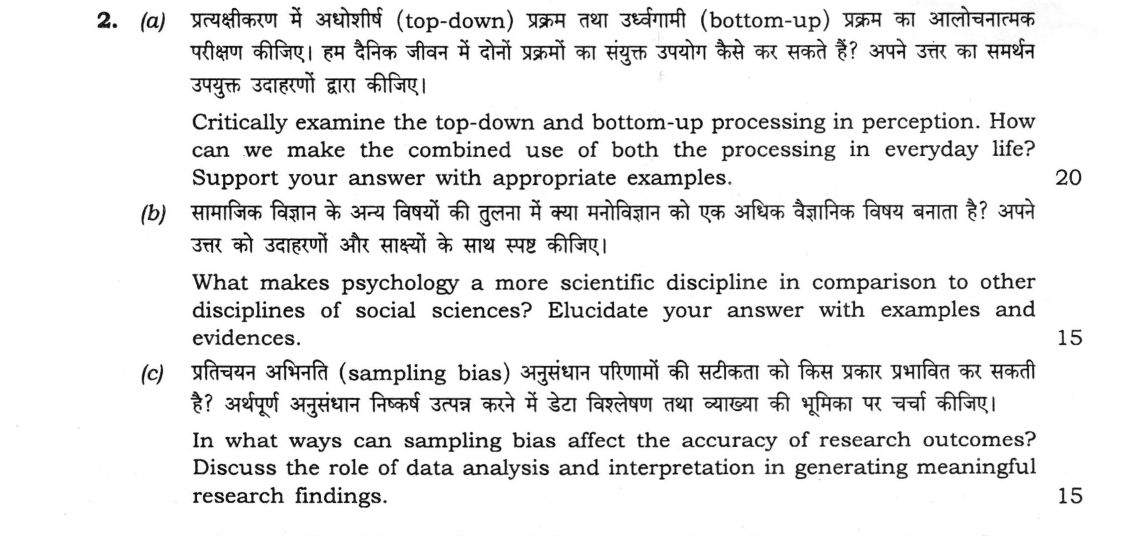
(a) Critically examine the top-down and bottom-up processing in perception. How can we make the combined use of both the…
Critically examine the top-down and bottom-up processing in perception. How can we make the combined use of both the processing in everyday life? Support your answer with appropriate examples. 20 marks
What makes psychology a more scientific discipline in comparison to other disciplines of social sciences? Elucidate your answer with examples and evidences. 15 marks
In what ways can sampling bias affect the accuracy of research outcomes? Discuss the role of data analysis and interpretation in generating meaningful research findings. 15 marks
हिंदी में प्रश्न पढ़ें
प्रत्यक्षीकरण में अधोशीर्ष (top-down) प्रक्रम तथा उर्ध्वगामी (bottom-up) प्रक्रम का आलोचनात्मक परीक्षण कीजिए। हम दैनिक जीवन में दोनों प्रक्रमों का संयुक्त उपयोग कैसे कर सकते हैं? अपने उत्तर का समर्थन उपयुक्त उदाहरणों द्वारा कीजिए। (20 अंक)
सामाजिक विज्ञान के अन्य विषयों की तुलना में क्या मनोविज्ञान को एक अधिक वैज्ञानिक विषय बनाता है? अपने उत्तर को उदाहरणों और साक्ष्यों के साथ स्पष्ट कीजिए। (15 अंक)
प्रतिचयन अभिनति (sampling bias) अनुसंधान परिणामों की सटीकता को किस प्रकार प्रभावित कर सकती है? अर्थपूर्ण अनुसंधान निष्कर्ष उत्पन्न करने में डेटा विश्लेषण तथा व्याख्या की भूमिका पर चर्चा कीजिए। (15 अंक)
Model answer
Drafted with AI by UPSC Answer Check against this question's marking rubric, to the expected length. UPSC does not publish answers for Mains — this is one way to score well, not an official key. How we build rubrics and answers.
(a) Top-down and bottom-up processing in perception Perception involves two interacting mechanisms: bottom-up (data-driven) and top-down (conceptually driven) processing. Bottom-up processing begins with sensory stimulation, where raw data is analyzed hierarchically. Hubel and Wiesel’s work on feature detectors (simple, complex, and hypercomplex cells) illustrates how the visual system builds complex images from basic features. J. J. Gibson’s ecological approach (1966, 1979) supports this by arguing that perception is "direct," relying on invariant information in the environment (affordances) rather than internal inference.
Top-down processing, conversely, is driven by prior knowledge, expectations, and context. Richard Gregory (1970), extending Helmholtz’s idea of unconscious inference, described perception as hypothesis testing that makes sense of ambiguous stimuli. This is demonstrated by perceptual set, such as in Bruner and Minturn’s (1955) study where the same symbol was perceived as a "B" in a letter context but a "13" in a number context.
Critically, neither process is sufficient alone. Bottom-up processing cannot explain how degraded or ambiguous input, as in low visibility, is still recognised, while top-down processing can be "fooled" by illusions or strong expectations, leading to perceptual errors.
In everyday life, we utilize a combined approach. For instance, when reading a handwritten note, bottom-up processing identifies the ink strokes, while top-down processing uses linguistic context to identify the words. Similarly, in driving, we use bottom-up data to detect a red light, but top-down knowledge of traffic rules dictates the action of stopping. Treisman’s Feature Integration Theory (1980), in which attention binds bottom-up features, and McClelland and Rumelhart’s Interactive Activation Model (1981), in which word-level knowledge feeds back to letter detectors, formalize this synergy. The relative weighting of these processes shifts based on stimulus quality and expertise; for example, a radiologist relies more on top-down pattern recognition than a novice, who must rely on bottom-up feature analysis.
(b) Why psychology is more scientific than other social sciences Psychology is often regarded as more scientific than other social sciences such as sociology or political science because it relies on experimental control, precise measurement and biological anchoring. Where other social sciences depend largely on correlational, historical or observational data, psychology has prioritised the experiment to establish causality.
This status is rooted in its early adoption of quantitative methods. Fechner’s psychophysics (1860), building on Weber’s law, expressed the relation between physical stimulus and sensation mathematically. Wilhelm Wundt’s Leipzig laboratory (1879) marked the shift from philosophy to empirical science, and Ebbinghaus (1885) derived the forgetting curve through controlled self-experimentation.
Modern psychology manipulates an independent variable (IV) to observe its effect on a dependent variable (DV) while controlling extraneous variables through control groups and randomisation. Pavlov’s conditioning studies, Asch’s conformity experiments and Bandura’s Bobo doll study exemplify this. Psychometrics adds rigour: tests are standardised, normed and checked for reliability (consistency) and validity (accuracy). Neuroscience methods such as EEG and fMRI further anchor behaviour in measurable biology.
This status is not absolute. The Open Science Collaboration (2015) replicated only about one-third of 100 published studies; demand characteristics (Orne, 1962) and WEIRD samples (Henrich et al., 2010) limit validity and generalisability. Yet falsifiability (Popper), replication, meta-analysis and pre-registration keep psychology self-correcting, distinguishing it from more interpretive social disciplines.
(c) Sampling bias, data analysis and interpretation Sampling bias occurs when the sample used in a study is not representative of the target population, systematically distorting the accuracy of research outcomes. It is distinct from random sampling error, which decreases as sample size increases; bias, however, persists regardless of sample size. Common types include volunteer bias (participants self-selecting), undercoverage (missing segments of the population), and non-response bias. A classic example is the 1936 Literary Digest poll, which predicted the wrong presidential outcome because its sample was drawn from telephone and car owner lists, over-representing affluent voters. This bias primarily threatens external validity (generalizability). Remedies include using probability sampling designs—simple random, stratified, cluster, or systematic sampling—and ensuring an adequate sampling frame.
Data analysis and interpretation are the final steps in generating meaningful findings. Analysis involves statistical procedures to determine if results are significant, focusing on Type I (false positive) and Type II (false negative) errors, statistical power, and effect size. However, analysis alone is insufficient; interpretation must be rigorous to avoid fallacies.
Researchers must avoid the "correlation does not imply causation" error. They must also avoid the ecological fallacy (inferring individual traits from group data) and the confusion between statistical significance (a small *p*-value) and practical significance (a meaningful real-world effect). Meaningful findings are generated only when statistical data is interpreted within the context of the theoretical model and the specific limitations of the study.
How this answer will be evaluated
Evaluation rubric
Each sub-part is marked on its own, against the marks and word limit printed on the paper.
- (a) Three linked demands: (i) explain top-down (conceptually driven) and bottom-up (data-driven) processing in perception; (ii) CRITICALLY examine them - i.e. give the evidence for and the limitations of each, not just definitions; and (iii) show how the two combine in everyday life, with appropriate examples. All three must be present. 20 marks
Must cover
- Bottom-up = data-driven; top-down = conceptually driven
- Hubel and Wiesel, feature detectors (simple, complex, hypercomplex cells)
- J. J. Gibson, direct/ecological perception (1966, 1979)
- Richard Gregory (1970), perception as hypothesis testing / unconscious inference
- Perceptual set - Bruner and Minturn (1955) B/13, or Bruner and Goodman (1947)
- Treisman's feature integration theory (1980)
- McClelland and Rumelhart's interactive activation model (1981) or an equivalent interactive account
- At least two everyday combined-use examples
Loses marks
- Defining the two processes correctly but never criticising either, which loses the whole 'critically examine' block of marks
- Confusing the direction of the labels - calling context-driven perception 'bottom-up' or feature analysis 'top-down'
- Naming no researcher or study, so the answer reads as a dictionary entry
- Ignoring the second question entirely - the combined use in everyday life with examples - which is separately marked
- Using only classroom illusions as examples of everyday combined use, rather than genuine tasks such as reading, driving, medical image reading or hearing speech in noise
- Attributing direct perception to Gregory and constructivism to Gibson, which reverses the two positions
Earns more
- Evaluative conclusion that the relative weighting varies with stimulus quality, prior knowledge and expertise, so the two are complementary rather than competing
- (b) 'Elucidate with examples and evidences' - argue what specifically makes psychology more scientific than the other social sciences (experimentation, measurement, replication, biological anchoring), substantiating each claim with a named study, instrument or method; a balanced answer should also concede the limits of that claim. 15 marks
Must cover
- Wilhelm Wundt, Leipzig laboratory, 1879
- Fechner's psychophysics (1860) / Weber's law
- Ebbinghaus (1885) forgetting curve
- Experimental method: IV, DV, control group, randomisation
- Reliability and validity / standardisation / norms
- At least one named experiment (Asch, Milgram, Bandura, Pavlov)
- A named limitation such as the replication crisis or demand characteristics
Loses marks
- Asserting that psychology is scientific without a single example or piece of evidence, despite the directive 'with examples and evidences'
- Simply listing the characteristics of science with no comparison to other social sciences, which the phrase 'in comparison to' requires
- Dating Wundt's laboratory or Fechner's Psychophysics wrongly, or crediting the first psychology laboratory to James or Titchener
- Overclaiming - presenting psychology as an exact science and ignoring the replication crisis and measurement limits, which costs the balance marks
- Confusing reliability with validity when describing psychometric rigour
Earns more
- Falsifiability, replication, cumulative theory-building and self-correction as scientific criteria (Popper; meta-analysis; pre-registration)
- Balanced acknowledgement of limits: the replication crisis (Open Science Collaboration, 2015 - about one-third of 100 studies replicated), demand characteristics (Orne, 1962), experimenter expectancy (Rosenthal), WEIRD samples (Henrich et al., 2010), ethical constraints
- (c) Two distinct parts, both marked: (i) how sampling bias distorts the accuracy of research outcomes - name its types, the validity it threatens and the remedies; and (ii) the role of data analysis and interpretation in producing meaningful findings, including the errors of interpretation to be avoided. 15 marks
Must cover
- Sampling bias versus random sampling error
- At least three named types of sampling bias
- External validity / generalisability
- Probability sampling: simple random, stratified, cluster, systematic
- Type I and Type II error / statistical power / effect size
- Correlation does not imply causation
- A concrete case of bias such as the 1936 Literary Digest poll or WEIRD samples (Henrich et al., 2010)
Loses marks
- Answering only the first half and leaving data analysis and interpretation undiscussed - each half carries roughly half the marks
- Confusing sampling bias with sampling error, and therefore claiming a larger sample cures it
- Listing sampling techniques as the whole answer without linking any of them to the accuracy of outcomes
- Treating 'data analysis' as a list of statistical test names with no statement of what analysis contributes to meaning
- Omitting the interpretive fallacies (correlation-causation, ecological fallacy, statistical versus practical significance), which is where the 'meaningful findings' marks sit
Earns more
- Remedies: probability sampling designs (simple random, stratified, cluster, systematic), adequate sampling frame, power analysis, weighting, and replication in another population
What "Critically examine" is asking you to do
Test the proposition the question puts to you and return a finding on how far it holds. Examine stems carry a claim, or ask whether something has happened, and expect evidence weighed both ways before the extent is stated — often with remedial measures attached. “Critically” is not a section added at the end: name the yardstick you are judging by — the evidence, the stated objective, a constitutional principle, a rival explanation — and let a verdict close each part of the body. Where the question quotes a claim, that verdict must land on the claim itself, accepted, qualified or rejected, and not on the theme in general.
Structure that answers it
Restate the claim as the question frames it → evidence that supports it → evidence that undercuts it → the conditions under which it holds → verdict on how far it stands
Where marks are lost
Merits in one paragraph, demerits in the next, and a conclusion calling for a balanced and holistic approach. That is a survey with the judgement left out and it holds the answer in the middle band. The opposite error is reading “critically” as permission to attack — and with the odd pairings, critically describe or critically explain, the exposition still carries most of the marks, the judgement being a layer on it rather than a substitute for it.
Practice this exact question
Write your answer and it is marked point by point against the model answer above — what you covered, what you missed, what you got wrong.
Evaluate my answer →More from Psychology 2026 Paper I
- Q1 Answer the following questions in about 150 words each : (a) Discuss various applications…
- Q2 (a) Critically examine the top-down and bottom-up processing in perception. How can we ma…
- Q3 (a) Discuss various types of long-term memory. Explain how primacy and recency effect ill…
- Q4 (a) Explain how learning takes place through classical conditioning. Discuss the role of…
- Q5 Answer the following questions in about 150 words each : (a) How does knowledge influence…